You are here

climate change

The Sky’s Limit: Unpacking the Climate Math

By David Turnbull - Oil Change International, October 6, 2016

Four years ago, the concept of “unburnable carbon” hit the mainstream when Bill McKibben published “Global Warming’s Terrifying New Math” in Rolling Stone magazine, based off of work by the analysts at Carbon Tracker and before that Greenpeace. The research underlying that concept showed that the carbon embedded in proven fossil fuel reserves on the books of fossil fuel companies is many times greater than what climate scientists have determined the atmosphere can withstand in a safe climate scenario. This month, new analysis by Oil Change International updated that math, took it further, and is making waves.

In the new report, entitled “The Sky’s Limit: Why the Paris Climate Goals Require a Managed Decline of Fossil Fuel Production,” we’ve identified a stark reality when it comes to fossil fuel development and the climate: Existing fossil fuel production, if allowed to run its course, would take us beyond the globally agreed goals of limiting warming to well below 2?C and aiming towards 1.5?C.

For the first time ever, this study utilized data from industry databases (e.g. Rystad Energy UCube) to catalog the fossil fuels that exist in current mines and wells — those sites where investments have been made and development is already underway — and compared it to carbon budgets associated with a two-in-three chance of staying below 2?C, or even chances of limiting warming to 1.5?C, backed by data from the Intergovernmental Panel on Climate Change (IPCC).

Our research found that the carbon budgets will be exhausted with current development, and in fact some currently-operating fossil fuel projects will need to be retired early in order to have appropriately high chances of staying below even the 2?C limit. Further, to meet a 1.5?C goal, the existing oil and gas wells currently in production have enough fuels in them to fill the budget, even if coal were phased out tomorrow.

This analysis is already sending shockwaves through the climate movement and being echoed by influential thought leaders around the globe. More than a dozen organizations, ranging from smaller groups like the Health of Mother Earth Foundation in Nigeria to larger groups such as 350.org and Christian Aid, joined in to release the report. Climate scientists and energy analysts have expressed agreement with the findings since the release, and countless organizations and prominent individuals have joined the choir to spread the word about the report.

As George Monbiot writes in The Guardian, the report presents three scenarios for moving forward:

First: a gradual, managed decline of existing production and its replacement with renewable energy and low-carbon infrastructure, which offer great potential for employment. Second: allowing fossil fuel production to continue at current rates for a while longer, followed by a sudden and severe termination of the sector, with dire consequences for both jobs and economies. Third: continuing to produce fossil fuels as we do today, followed by climate breakdown.

The good news, as highlighted in our report, is that if the right investments of political will and financing are made, a just transition to renewable energy is definitely possible in the timeframe necessary. Renewable energy is expanding at ever-increasing rates, becoming cheaper by the day, and could be poised to follow the path to universality seen by recent technologies such as the personal computer and cell phone. The report lays out a number of studies that show renewable energy can absolutely fill in the energy gap as fossil fuels are phased out.

Many have already called the report “the math behind the Keep It In The Ground movement,” and, with any luck, just as unburnable carbon entered the public consciousness four years ago, the climate imperative of ending new fossil fuel development may do the same.

Capital Blight News #122

Compiled by x344543 - IWW Environmental Unionism Caucus, September 20, 2016

A supplement to Eco Unionist News:

Lead Stories:

The Man Behind the Curtain:

Green is the New Red:

How to Stop Capitalism’s Deadly War With Nature

By Paul Street - TruthDig, September 14, 2016

So far, 2016 is the hottest year on record. So was 2015. So was 2014. (John McColgan / U.S. Department of Agriculture)

Earth scientists now know that the history of our planet has been set for some time in our current geological age, the Anthropocene. According to leading experts Will Steffen, Paul Crutzen and John McNeill, in this era, “human activities have become so pervasive and profound that they rival the great forces of Nature and are pushing the earth into planetary terra incognita. The Earth is rapidly moving into a less biologically diverse, less forested, much warmer, and probably wetter and stormier era.” We are living in a “no-analogue state” in which “the Earth system has recently moved well outside the range of natural variability.”

The new earth epoch bearing its species’ mark and name is nothing for Homo sapiens to hold up with pride. The unprecedented changes introduced by humanity are ecologically unsustainable for decent life on the planet. Thanks to the Anthropocene, the world is now in the middle of “its sixth great extinction event, with rates of species loss growing rapidly for both terrestrial and marine ecosystems. The atmospheric concentrations of several important greenhouse gases have increased substantially, and the Earth is warming rapidly,” according to Steffen et al., bringing us ever closer to the precipice of ecosystem collapse and putting prospects for a decent future at grave risk. The signs are clear to those willing to look: the melting of polar ice and Arctic permafrost, the acid bleaching of global coral reefs, the pronounced warming of the oceans, the drying out of the Amazonian rain forests. All this and more are moving at an unexpectedly rapid pace. Marked by now-predictable epic forest fires and floods, 2016 is the hottest year on record. So was 2015. So was 2014.

The terrible trends and data have led the venerable progressive political scientist and social-justice advocate Susan George to introduce what she calls “a new phenomenon in the history of humankind.” In a recent lecture to the International Centre for the Promotion of Human Rights in Buenos Aires, she names it “geocide,” meaning “the collective action of a single species among millions of other species which is changing planet Earth to the point that it can become unrecognisable and unfit for life.” Humanity, George says, “is committing geocide against all components of nature, whether microscopic organisms, plants, animals or against itself, homo sapiens, humankind.” George is unstinting in her denunciation of the human species: “Homo sapiens has only existed for roughly 200,000 years. The time we’ve spent on this planet compared to its total age is infinitesimally short, just the tiniest sliver of geological time. It amounts to a mere 0.00004 percent of Earth’s existence. And although any given species of plant or animal—vertebrate or invertebrate—tends to last on average about 10 million years, our species seems determined to cause its own extinction, along with the rest of creation, long before its allotted time.”

It’s a hard to imagine a more terrible crime. Geocide is bigger than genocide.

Welcome to The Anthropocene, are Environmentalists Equipped to Respond?

By Roger Annis - CounterPunch, September 14, 2016

Capitalism has run so amok, producing so much waste and life-destroying pollution, that scientists now say that Earth has entered an entirely new epoch: The Anthropocene

On September 5 in Cape Town, South Africa, members of the ‘Working Group on the Anthropocene’ presented findings of their research to the annual International Geological Congress. A research paper by the group of 35 scientists, commissioned by the Congress, was published in January of this year, concluding that a new, “functionally and stratigraphically distinct” unit of geologic time has begun.

Scientists term the new epoch ‘The Anthropocene’, meaning that human activity has become the dominant influence on climate and the environment. Earth’s biosphere has been so thoroughly altered by human activity that changes are now permanently inscribed in the rock and fossil record, just as earlier events such as asteroid impacts and the evolution of multi-celled life forms left their records.

The Anthropocene succeeds The Holocene, an epoch of approximately 12,000 years which was marked by relative climate stability. During the Holocene, average global temperatures varied by no more than one degree Celsius. Here are two articles reporting on what the scientists have reported:

* The Anthropocene epoch: Scientists declare dawn of human-influenced age, by Damian Carrington, The Guardian, August 29, 2016

“… The current epoch, the Holocene, is the 12,000 years of stable climate since the last ice age during which all human civilisation developed. But the striking acceleration since the mid-20th century of carbon dioxide emissions and sea level rise, the global mass extinction of species, and the transformation of land by deforestation and development mark the end of that slice of geological time, the experts argue. The Earth is so profoundly changed that the Holocene must give way to the Anthropocene.”

* Expert panel: The Anthropocene epoch has definitely begun, by Ian Angus, in Climate and Capitalism, Aug 29, 2016

“… changes to the Earth System that characterize the potential Anthropocene Epoch include marked acceleration to rates of erosion and sedimentation, large-scale chemical perturbations to the cycles of carbon, nitrogen, phosphorus and other elements, the inception of significant change to global climate and sea level, and biotic changes such as unprecedented levels of species invasions across the Earth. Many of these changes are geologically long-lasting, and some are effectively irreversible.”

A 12-minute interview with author Ian Angus on the findings and recommendations of the Working Group on the Anthropocene was broadcast on The Real News Network on September 4; watch or read it here.

Capital Blight News #121

Compiled by x344543 - IWW Environmental Unionism Caucus, September 13, 2016

A supplement to Eco Unionist News:

Lead Stories:

The Man Behind the Curtain:

Capital Blight News #120

Compiled by x344543 - IWW Environmental Unionism Caucus, September 7, 2016

A supplement to Eco Unionist News:

Lead Stories:

The Man Behind the Curtain:

Green is the New Red:

Greenwashers:

Disaster Capitalism:

An Energy Revolution is possible: Tax havens and financing climate action

By Patrick Hearps and Sam Cossar-Gilbert - Friends of the Earth, September 2016

This report is the technical report that supports Friend of the Earth International’s summary report with recommendations and general analysis, also entitled ‘An energy revolution is possible’.

The aim of this analysis is purely to calculate an investment cost of providing several regions of the developing world with 100% renewable electricity, and to compare those amounts with government revenue lost through tax havens globally, in order to highlight the need for economic and climate justice.

Read the report (PDF).

A Global High Shift Scenario: Impacts and Potential for More Public Transport, Walking, and Cycling With Lower Car Use

By Michael A. Replogle, Institute for Transportation and Development Policy and Lewis M. Fulton, University of California, Davis - Publication, September 2016

This report is the first study to examine how major changes in urban transport investments worldwide would affect urban passenger transport emissions as well as mobility by different income groups. It starts with the most recent United Nations urban population forecasts and the most recent model framework and forecasts used by the International Energy Agency (IEA) for global mobility modeling. The study extends these with new research on the extent of various urban passenger transport systems in cities across the world, as well as new estimates of the extent of mobility by non-motorized transport and low power e-bikes.

The study considers two main future scenarios: a baseline urban scenario calibrated to the IEA 2012 Energy Technology Perspectives 4° Scenario and a newly developed alternative scenario called “High Shift” (HS), with far greater urban passenger travel by clean public transport and non-motorized modes than in the Baseline and a decrease in the rates of road construction, parking garages and other ways in which car ownership is encouraged.

The study concludes that this High Shift scenario could save over $100 trillion in public and private capital and operating costs of urban transportation between now and 2050 and eliminate about 1.7 gigatons of carbon dioxide (CO2) annually – a 40 percent reduction of urban passenger transport emissions -- by 2050. This suggests one of the more afford-able ways to cut global warming pollution is to design cities to give people clean options for using public transportation, walking and cycling. In recent years transportation, driven by rapid growth in car use, has been the fastest growing source of CO2 in the world.

Transportation in urban areas accounted for about 2.3 gigatons of CO2 in 2010, almost one quarter of carbon emissions from all parts of the transportation sector. Rapid urbanization—especially in fast developing countries like China and India—will cause these emissions to nearly double worldwide by 2050 without changes in policy and investments.

Read the report (PDF).

Breathing in the benefits: How an accelerated coal phase-out can reduce health impacts and costs for Albertans

By Benjamin Israël, Kim Perrotta, Joe Vipond, Leigh Allard, and Vanessa Foran - Pembina Institute, September 2016

With the phase-out of coal power announced by the provincein November 2015, Albertans stand to avoid significant health impacts caused by coal pollution. By extension, afurtheraccelerated phase out of coal power facilities would both hastenand amplify those avoided health impacts.The health benefits and costs savings in avoided health outcomes would be significant, and should be consideredin the government’s planning of the coal phase-out from now to 2030.
While the provincial government has announced a coal phase-out, they have not yet released a transition schedule. This analysis assesses the relative benefits of an accelerated stepwise transition away from coal, as proposed by the Pembina Institute,versus the back-loaded phase-out that otheranalyses haveposited.

In 2012, when the federal government finalized its coal regulations that —in effect —reduce electricity generation from coal plants, Environment Canada(as it was called at that time)estimated considerable health impacts would be avoided, usinghighly regarded modelling techniques. Logically, thesesignificantbenefits from reducing coal necessarily mean that the use of coal for power generation causesconsiderablehealth impacts in the first place.

By extrapolating the health benefit results from Environment Canada’s analysis, this report highlights the full impact of coal-fired generation in Albertaand indicates attainable benefits associated with the province’s coal phase- out.When the federal government weakened its proposed coal regulations back in 2012 in response to lobbying from some coal generators, allowing coal plants to continue unabated longer than first proposed,it left health savings on the table. Alberta can now grasp these savings byaccelerating our transition away from coal-fired electricity.

Read the report (PDF).

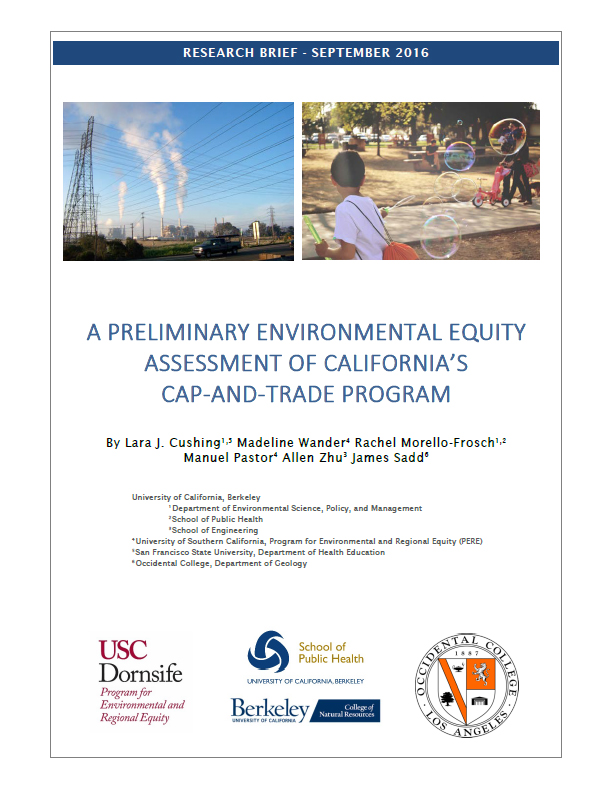
“A Preliminary Environmental Equity Assessment of California’s Cap-And-Trade Program

By Rachel Morello-Frosch, Manuel Pastor, James Sadd, Lara Cushing, Madeline Wander, and Allen Zhu - California Environmental Justice Alliance, September 2016

California’s cap-and-trade program is a key strategy for achieving reductions in greenhouse gas (GHG) emissions under AB32, the California Global Warming Solutions Act. For residents living near large industrial facilities, AB32 offered the possibility that along with reductions in GHGs, emissions of other harmful pollutants would also be decreased in their neighborhoods. Carbon dioxide (CO2), the primary GHG, indirectly impacts health by causing climate change but is not directly harmful to health in the communities where it is emitted. However, GHG emissions are usually accompanied by releases of other pollutants such as particulate matter (PM10) and air toxics that can directly harm the health of nearby residents.

In this brief, we assess inequalities in the location of GHG-emitting facilities and in the amount of GHGs and PM10 emitted by facilities regulated under cap-and-trade. We also provide a preliminary evaluation of changes in localized GHG emissions from large point sources since the advent of the program in 2013. To do this, we combined pollutant emissions data from California’s mandatory GHG and criteria pollutant reporting systems, data on neighborhood demographics from the American Community Survey, cumulative environmental health impacts from the California Environmental Protection Agency’s CalEnviroScreen tool, and information from the California Air Resources Board (CARB) about how regulated companies fulfilled their obligations under the first compliance period (2013-14) of the cap-and-trade program. Our methodology is described in greater detail in the appendix to this report.

In this analysis, we focus primarily on what are called “emitter covered emissions,” which correspond to localized, in-state emissions (derived mostly from fossil fuels) from industries that are subject to regulation under cap-and-trade. The cap-and-trade program also regulates out-of-state emissions associated with electricity imported into the state and, beginning in 2015, began regulating distributed emissions that result from the burning of fuels such as gasoline and natural gas in off-site locations (e.g., in the engines of vehicles and in homes).

We found that regulated GHG-emitting facilities are located in neighborhoods with higher proportions of residents of color and residents living in poverty. In addition, facilities that emit the highest levels of both GHGs and PM10 are also more likely to be located in communities with higher proportions of residents of color and residents living in poverty. This suggests that the public health and environmental equity co-benefits of California’s cap-and-trade program could be enhanced if there were more emissions reductions among the larger emitting facilities that are located in disadvantaged communities. In terms of GHG emission trends, in-state emissions have increased on average for several industry sectors since the advent of the cap-and-trade program, with many high emitting companies using offset projects located outside of California to meet their compliance obligations. Enhanced data collection and availability can strengthen efforts to track future changes in GHG and co-pollutant emissions and inform decision making in ways that incentivize deeper in-state reductions in GHGs and better maximize public health benefits and environmental equity goals.

Read the report (PDF).

Pages

The Fine Print I:

Disclaimer: The views expressed on this site are not the official position of the IWW (or even the IWW’s EUC) unless otherwise indicated and do not necessarily represent the views of anyone but the author’s, nor should it be assumed that any of these authors automatically support the IWW or endorse any of its positions.

Further: the inclusion of a link on our site (other than the link to the main IWW site) does not imply endorsement by or an alliance with the IWW. These sites have been chosen by our members due to their perceived relevance to the IWW EUC and are included here for informational purposes only. If you have any suggestions or comments on any of the links included (or not included) above, please contact us.

The Fine Print II:

Fair Use Notice: The material on this site is provided for educational and informational purposes. It may contain copyrighted material the use of which has not always been specifically authorized by the copyright owner. It is being made available in an effort to advance the understanding of scientific, environmental, economic, social justice and human rights issues etc.

It is believed that this constitutes a 'fair use' of any such copyrighted material as provided for in section 107 of the US Copyright Law. In accordance with Title 17 U.S.C. Section 107, the material on this site is distributed without profit to those who have an interest in using the included information for research and educational purposes. If you wish to use copyrighted material from this site for purposes of your own that go beyond 'fair use', you must obtain permission from the copyright owner. The information on this site does not constitute legal or technical advice.

