

You are here

climate change

Wrong way! A climatic baby step forward beats a giant leap back

By Pete Dolack - The Ecologist, June 7, 2017

The world surely is approaching a danger point when the abrogation of an inadequate agreement is cursed as a disaster.

The Paris Climate Summit goals can't be characterized as anything significantly better than feel-good window dressing, but the argument that the world has to start somewhere is difficult to challenge.

Better to take a baby step forward than a giant leap backward!

As always, we must ask: Who profits? The Trump administration's decision to withdraw from the Paris Accord is due to factors beyond Donald Trump's astounding ignorance and his contempt for science or reality. There is a long history of energy company denial of global warming, a well-funded campaign.

Never mind that a widely cited 2015 study by the Stockholm Resilience Center, prepared by 18 scientists, found that the Earth is crossing several "planetary boundaries" that together will render the planet much less hospitable.

Or that two scientific studies issued in 2015 suggest that so much carbon dioxide already has been thrown into the air that humanity may have already committed itself to a six-meter rise in sea level.

Or that the oceans can't continue to act as shock absorbers - heat accumulated in them is not permanently stored, but can be released back into the atmosphere, potentially providing significant feedback that would accelerate global warming.

Trump spurns Paris Climate Accord

By Michael Schrieber - Socialist Action, June 5, 2017

“We’re getting out!” President Trump declared before the press and a knot of governmental officials who had gathered in the White House Rose Garden on June 1. “In order to fulfill my solemn duty to protect America and its citizens, the United States will withdraw from the Paris Climate Accord.”

Trump characterized the Accord as being “less about the climate and more about other countries’ gaining a financial advantage over the United States.”

He continued his xenophobic message: “The rest of the world applauded when we signed the Paris agreement—they went wild; they were so happy—for the simple reason that it put our country, the United States of America, which we all love, at a very, very big economic disadvantage.”

Trump singled out in particular the “Green Climate Fund,” which he said has been siphoning billions of dollars out of the U.S. economy, “a massive re-distribution of United States wealth to other countries.” The fund was intended to help underdeveloped nations move to renewable energy and mitigate the effects of climate change. So far, the fund has raised a total of around $10 billion from wealthier capitalist countries, including $3 billion from the U.S. (about one-hundredth of one percent of the U.S. budget).

According to the precepts of the Paris Accord, it will take more than three years for the U.S. to formally withdraw from it. But Trump indicated in his speech that he believes his announcement can help dampen any legal challenge to the measures that his administration has already put into place that weaken environmental safeguards in order to ramp up oil, coal, and other extractive industries.

And what about the climate? That burning issue was scarcely apparent in Trump’s June 1 speech. Although his address was long, rambling, and repetitive, Trump never found a single moment to utter the words “climate change.”

Our Responsibility After Trump's Climate Withdrawal

By Kevin Zeese and Margaret Flowers - Popular Resistance, June 3, 2017

President Donald Trump’s decision to withdraw from the Paris climate agreement follows the path of previous presidents who have undermined international climate agreements. We disagree with Trump but it is important to understand his actions in the context of the history of the United States regarding previous climate agreements. Once again, the political problems in the US are bigger than Trump. His action brings greater clarity to the inability of the US government to confront the climate crisis and clarifies the tasks of people seeking smart climate policy.

The US Has Always Prevented Effective International Climate Agreements

The US has consistently blocked effective climate agreements because both parties in power have put the profits of big energy before the climate crisis when it comes to domestic and international policies. The Republicans proclaimed themselves the “drill baby drill” party while the Democrats are the “all of the above energy” party. Both slogans mean the parties seek to ensure US corporations profit from carbon energy. Both have supported massive oil and gas infrastructure and extreme energy excavation including the most dangerous forms, i.e. tar sands and fracking. Both parties have also supported wars for oil and gas. All of these positions will be viewed as extreme as the world confronts the great dangers of the climate crisis and the US will be deservedly blamed.

Climate Change and the Need for a New Paradigm

By Yavor Tarinski - Resilience, June 1, 2017

Despite many international meetings, dealing with every subject from biodiversity to climate change, the national political elites have found it impossible to come to meaningful agreements to deal with the environmental crisis. […] There is no avoiding imagining new and different scenarios than the status quo. Surely another world is possible.”
– Dimitrios Roussopoulos[1]

We live in times where there seems to be a crisis in just about everything – from the so called financial sector, through the contemporary mass migratory processes, to the severe corrosion of the social fabric. The ruling elites, devoted to the dominant doctrine of economism, advocate for the priority that should be given to the economy, many activists struggle for the humane treatment of migrants, while growing numbers of new age mysticists call for escapism and individual salvation.

One crisis in particular, however, is being unevenly neglected, in comparison with the above mentioned crises – the climate one. There is reason why this serious problem is being constantly postponed by those in seats of power. Unlike the financial crisis, which offers a wide playground for different economic “shamans” to put forward their theories that do not leave the imaginary of economism, the climate change and the ongoing environmental degradation questions the contemporary dogmas of constant growth and domination, demanding solutions beyond them. Surely there are international summits and agreements for tackling this problem, but their outcomes are nonbinding and often neglected in the expense of economic “prosperity”.

The climate crisis, as growing number of researches are revealing, will have us pay a dear cost for the wasteful and destructive lifestyle that capitalism promotes. It will even deepen the rest of the ongoing crises. It is not yet completely clear what exact effects and processes will be triggered by the climate change, but it is increasingly clear that the results will not be favorable to us, unless we decide to change the contemporary dominant paradigm with a new one that will allow us to develop our potential inside the planetary limits.

Paris is Burning

By James P. Hare - Rosa Luxemburg Stiftung, June 2017

With Trump’s decision to formally withdraw from the Paris Agreement, he has put an end to months of apparent indecision. This withdrawal does not dissolve the agreement, which still includes nearly every nation on the planet, but it is hard to imagine how an already weak agreement can be expected to slow—not to mention reverse—greenhouse gas emissions without the participation of the United States. Seeing this decision as anything other than a nail in the coffin of the global climate regime is nothing but wishful thinking.

For an administration that has promoted a seemingly unending series of bad policies—from healthcare to immigration to militarism to the unceasing transfer of wealth from working people to the wealthy—this may be its worst. When future generations look back at the harm done by this president, they may remember this as his greatest crime. This is not to minimize the damage of his other policies or of the racism, xenophobia, and misogyny that drove his campaign and brought him into the White House, but climate change is the ultimate issue. It will affect everyone while exacerbating existing inequalities, and we only have one chance to get it right.

This decision is no surprise. Throughout his campaign, Trump promised to pull out of the Paris Agreement as part of his “America First” agenda that pits the promise of domestic jobs against environmental protections and international cooperation. We must reject Trump’s noxious brand of nationalism and climate denialism. It is critical, however, not to sugarcoat the nature of much of what passes as international cooperation. So-called trade agreements have benefitted corporations and the wealthy at the expense of working people both in the United States and abroad.

It is not, as Trump’s nativist critique would have it, that the United States made a bad deal with Mexico when negotiating NAFTA. Rather, elites in the United States, Mexico, and Canada made a good deal for themselves at the expense of the citizens of each country. Still, working people understand what NAFTA did to their workplaces and their communities, and Trump’s attack on trade deals may have helped him to win enough working-class support in critical states to shift the electoral map in his favor, even if the extent of his working-class support has been greatly overstated by centrist commentators.

Beyond Democrat Dead-ends: What Real Climate Action Looks Like

By Carol Dansereau - CounterPunch, June 2, 2017

The global warming situation is absolutely crazy.  Millions of people are already experiencing drought, famine, floods, wildfires, superstorms and other climate disasters.  As a species, we are teetering on the edge of full-blown catastrophe, with extinction a distinct possibility.  Yet, we can’t seem to put in place obvious solutions that are sitting right there in front of us.
Even crazier, environmentalists repeatedly praise Democrats for phony climate action plans that don’t come close to what’s needed.

Take the “100 by ‘50” legislation recently introduced by Oregon Senator Merkley and other Democrats.  Environmental leaders lined up to celebrate this as the blueprint that will get us beyond global warming, even though it’s nothing of the sort.  Some environmentalists used their endorsements to denounce Republicans for being funded by the fossil fuel industry, deftly ignoring the funding received by Democrats from that same industry.  The message was clear: when we put Democrats back in power and pass a bill like “100 by ‘50”, we’ll be on our way to solving the climate crisis.

This is pure hogwash.  The Democrats have kept us running in circles as the climate crisis has deepened.   And although this new bill purports to get us to 100% clean and renewable energy by 2050—hence the catchy title—it almost certainly won’t do that.  Yes, it is “the most ambitious piece of climate legislation Congress has ever seen”.  But that’s only because prior offerings were so pathetic that “100 by ’50” seems ambitious in comparison.

It’s crucial that we understand this as Donald Trump and the Republicans move forward with their horrifying agenda.  More than ever, we need to be uniting behind a real climate action plan and the broader vision for society it engenders.  We need to be building a movement that has a clear understanding of where our power lies and how to use it.

GGJ Statement on Trump's Withdrawal from Paris Agreement

By staff - Grassroots Global Justice Alliance, June 2, 2017

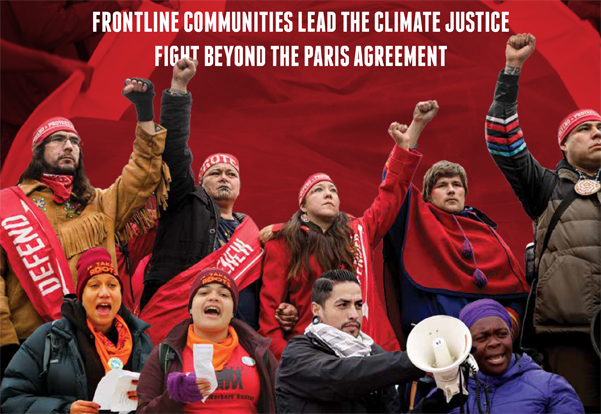
While the accord was far from what the planet needs, Trump's reckless decision underscores a key overarching issue with the Paris Agreement in the first place.  When the Paris Agreement was signed in 2015, we put out this report entitled "We Are Mother Earth’s Red Line: Frontline Communities Lead the Climate Justice Fight Beyond the Paris Agreement."  We laid out 5 key concerns in the report.  Our number one concern (see page 6) with the agreement was “The Agreement relies on voluntary versus mandatory emission cuts that do not meet targets scientists say are necessary to avoid climate catastrophe.”  Trump’s withdrawal is a clear example that voluntary pledges are not enough.

“Donald Trump is showing us the art of breaking a deal,” says Tom BK Goldtooth, Executive Director of Indigenous Environmental Network. “By abandoning the Paris Agreement, this administration will further perpetuate environmental racism and climate injustice against Indigenous peoples experiencing the worst effects of climate change across the globe. We’ve stated before that the Paris Agreement falls short of embracing the sort of climate solutions that lift up human rights and the rights of Indigenous peoples. Regardless of its shortcomings, it is critical that the United States be held accountable for its contributions to the climate chaos we are seeing across the globe and to take ambitious action to meet the Agreement’s goal to limit temperature increases to 1.5 degrees Celsius. Backing out of this agreement continues a long history of broken promises and threatens the vital and sacred life cycles of Mother Earth.”

Our number two concern (page 6) was “The Agreement advances pollution trading mechanisms that allow polluters to purchase “offsets” and continue extremely dangerous levels of emissions.”  If we truly aim to reach the stated goal of reducing carbon emissions to 1.5 degrees Celsius, we will never get there with a carbon market system.

Monique Verdin, Secretary of the United Houma Nation Tribal Council, Louisiana says “the Paris Accord is not a perfect solution, but to step out of it is to step back. Our coastal communities in the Mississippi River Delta are surrounded by a web of pipelines, oil and gas canals, while our sinking lands are pock marked by oil waste pits. We are being told that our traditional territories may have to be sacrificed to the sea and that our post-colonial sanctuary settlements may have to be abandoned in this unprecedented wake of sea-level rise. If we don’t change our relationships with extreme extraction the heartache of losing some of the most precious biodiversity in the world, will be disregarded for the delusions of “progress.”

While the agreement was far from what we need at the global scale, at minimum it was still a significant indication that world leaders were taking climate change seriously.  Across the globe, the Paris Agreement was being used as a baseline argument to continue promoting the real Just Transition that we need away from a fossil fuel economy.

Reclaiming Public Services: How cities and citizens are turning back privatisation

Edited by Satoko Kishimoto and Olivier Petitjean - Transnational Institute, June 2017

You would be forgiven, especially if you live in Europe, to think that public services are by nature expensive, inefficient, maybe even somewhat outdated, and that reforming them to adapt to new challenges is difficult. It would seem natural to assume – because this is what most politicians, media and so-called experts tell us continuously – that we, as citizens and users, should resign ourselves to paying ever higher tariffs for services of an ever lower standard, and that service workers have no choice but to accept ever more degraded conditions. It would seem that private companies will inevitably play an ever larger role in the provision of public services, because everything has a price, because politicians have lost sight of the common good and citizens are only interested in their own individual pursuits.

This book, however, tells a completely different story. Sometimes it may feel as though we are living in a time when profit and austerity are our only horizons. In reality, below the radar, thousands of politicians, public officials, workers and unions, and social movements are working to reclaim or create effective public services that address the basic needs of people and respond to our social, environmental and climate challenges. They do this most often at the local level. Our research shows there have been at least 835 examples of (re)municipalisation of public services worldwide in recent years, some of them involving several cities. In total there have been more than 1600 cities in 45 countries involved in (re)municipalisation. And these (re)municipalisations generally succeed-ed in bringing down costs and tariffs, improving conditions for workers and boosting service quality, while ensuring greater transparency and accountability.

Read the text (PDF).

Reversing Inequality, Combatting Climate Change: A Climate Jobs Program for New York State

By J. Muin Cha, Ph.D. and Lara Skinner, Ph.D.- The Worker Institute - June 2017

Economic inequality in New York is rising. Currently, the state has the second highest level of economic inequality in the country. Unequal job growth across the state and stagnant wages in several sectors are two of the main contributors to rising inequality. While the state overall has seen several years of employment growth, there are stronger employment gains in New York City than in other parts of the state still suffering from job losses and stagnant employment levels. Additionally, in many sectors, such as construction and manufacturing, wages are not increasing at the same pace as inflation, leaving many workers with paychecks that fail to cover basic household costs.

At the same time, New York is falling far short of its necessary greenhouse gas pollution reductions. To stop catastrophic climate change, global greenhouse gas emissions must be reduced at least 80 percent below 1990 levels by 2050, which would require four times the current annual emissions reduction rate. By 2050, New York State’s emissions must be only a fraction of what they are now to meet the United Nations’ Intergovernmental Panel on Climate Change’s targets set to prevent irreversible damage. We are far from that target. In the transportation sector, emissions are actually increasing and energy sector emissions may also be increasing given likely underestimation of methane emissions from natural gas.

New York State can take action now to protect New Yorkers from the worst effects of climate change, and do our part in reducing global emissions, while also fighting against growing economic inequality. Extreme weather, such as Hurricanes Irene and Sandy, is predicted to become more the norm, not the exception. These recent extreme weather events highlighted New York’s deep inequality: some could afford to leave the city or move into hotels when their residences flooded while others were left stranded.

Adopting a bold and aggressive plan to invest in climate-addressing infrastructure can be an important step towards simultaneously addressing the crises of inequality and climate change head on and position New York as a national leader in charting the path to a low-carbon, equitable economy. The recommendations presented below aim to create good, high-road jobs that provide familysustaining wages and benefits for communities across the state. These proposals could also result in meaningful emissions reductions and put New York on the path to building an equitable clean-energy economy that can work for all New Yorkers. The authors hope this report helps spark additional research and policy development on how to simultaneously reduce greenhouse gas emissions and reverse inequality by protecting workers and creating good, family-sustaining jobs in new lowcarbon sectors. Future research, in particular, could perform a detailed analysis of the cost of job creation strategies in low-carbon sectors, how to finance these strategies, and a cost-benefit analysis that includes the cost of potential job loss and reduced economic activity in high-carbon sectors.

Read the Report (Link).

An Eco-Revolutionary Tipping Point?

By Paul Burkett - Monthly Review, May 2017

In the summer of 2016, the acceleration of climate change was once again making headlines. In July, the World Meteorological Association announced that the first six months of 2016 had broken all previous global temperature records, with June being the fourteenth month in a row of record heat for both land and oceans and the 378th straight month of temperatures greater than the historical average. Heating has been especially rapid in Arctic regions, where thawing effects are releasing large amounts of methane and carbon dioxide. On July 21, 2016, temperatures at locations in Kuwait and Iraq reached 129oF, the hottest ever recorded in the Eastern Hemisphere. The disruptive effects of bi-polar warming were evident in the unprecedented crossing of the equator by the Northern Hemisphere jet stream, where it merged with the Southern Hemisphere jet stream, further threatening seasonal integrity with unforeseen impacts on weather extremes and the overall climate system.1 Meanwhile a report from the United Nations Environment Program (UNEP) described the December 2015 Paris Agreement on climate change as “outdated even before it takes effect,” with climatologists now expecting a global warming of at least 3.4oC (more than double the 1.5oC limit supposedly built into the agreement) even if the promised emissions goals of the nations involved are somehow achieved despite the lack of binding enforcement mechanisms. “The world will still be pumping out 54–56 gigatons of carbon dioxide equivalent a year by 2030 under current plans, well above the 42 gigatons needed to limit warming to 2 degrees,” according to the UNEP report.2

The historical irony in this situation is hard to miss. Just a couple decades ago, we were told that neoliberal capitalism marked the “end of history.” Now it appears that the system’s ideologues may have been right, but not in the way they envisioned. The system of fossil-fueled neoliberal capitalism is indeed moving toward an end of history, but only in the sense of the end of any historical advance of humanity as a productive, political, and cultural species due to the increasingly barbaric socio- economic and environmental conditions the system creates. There is now no alternative to the end of history as we know it. The sustainable development of human society co-evolving with nature including other species now depends on a definite historical break with capitalism (wage-labor, market competition, production for profit) as the dominant mode of production. That is the main lesson of three recent books: Ian Angus’s Facing the Anthropocene, Andreas Malm’s Fossil Capital, and Naomi Klein’s This Changes Everything. To solve the climate crisis—which is only part of the broader environmental crisis created by capitalism—competitive, profit-driven production under unequal class control must be replaced with a system in which working people and their communities collectively and democratically regulate production and other interactions with their material and social environment. Sustainable development of people cooperatively co-evolving in a healthy way with other species must replace the profit motive, exploitation, and competition as the motive force in production and in the entire system of material provisioning. To deny that the climate crisis is hardwired into capitalism, and that we need a new system to deal with it, is just as misleading and dangerous as to deny the existence of human-induced global warming. Both forms of climate denial must be overcome in theory and practice.

Pages

The Fine Print I:

Disclaimer: The views expressed on this site are not the official position of the IWW (or even the IWW’s EUC) unless otherwise indicated and do not necessarily represent the views of anyone but the author’s, nor should it be assumed that any of these authors automatically support the IWW or endorse any of its positions.

Further: the inclusion of a link on our site (other than the link to the main IWW site) does not imply endorsement by or an alliance with the IWW. These sites have been chosen by our members due to their perceived relevance to the IWW EUC and are included here for informational purposes only. If you have any suggestions or comments on any of the links included (or not included) above, please contact us.

The Fine Print II:

Fair Use Notice: The material on this site is provided for educational and informational purposes. It may contain copyrighted material the use of which has not always been specifically authorized by the copyright owner. It is being made available in an effort to advance the understanding of scientific, environmental, economic, social justice and human rights issues etc.

It is believed that this constitutes a 'fair use' of any such copyrighted material as provided for in section 107 of the US Copyright Law. In accordance with Title 17 U.S.C. Section 107, the material on this site is distributed without profit to those who have an interest in using the included information for research and educational purposes. If you wish to use copyrighted material from this site for purposes of your own that go beyond 'fair use', you must obtain permission from the copyright owner. The information on this site does not constitute legal or technical advice.
