You are here

climate change

The Teacher-Friendly Guide to Climate Change

Edited by Ingrid H. H. Zabel, Don Duggan-Haas, and Robert M. Ross - Paleontological Research Institution, 2017

The subject of climate change has become so socially and politically polarizing that it may be awkward to bring it up in polite conversation if one is not already sure of where others stand on the issue. But climate change is happening, and it’s essential for all to have an accurate understanding of the findings and implications of climate science: climate change is one of the most critical issues of the 21st century. Indeed, in the context of school curricula, it is difficult to imagine a subject that is not in some way affected by climate change or the processes of mitigating or adapting to it, so there are potentially myriad connections of this subject to just about everything that goes on in the classroom.

Despite this importance, even the basic science of climate change has until recently appeared much less in K-12 education than might be expected. Its presence is now accelerating, however, facilitated in part by its integration into the Next Generation Science Standards, and there are many existing books on climate change and some excellent online resources for teachers to help with integration of climate change into curricula. Yet there exist few user-friendly books on climate change, written for teachers, that include both the basics of climate change science and perspectives on teaching communities of learners across the polarized spectrum. That is a need we seek to help fill with this volume.

This book was written for teachers who could benefit from a “teacher-friendly” resource on climate change.

Read the text (PDF).

Climate Change and Eco-Socialism

By Jason O’ Neal, Founding Member Green Party, UC Berkeley - Facts for Working People, December 31, 2016

Climate change is a fact of life in the twenty-first century. Our society’s dependence on fossil fuels to encourage more economic growth is directly contributing to the global warming crisis. Climate models accounting for changes in surface air temperatures, ocean currents, land masses, and polar ice cover have forecast extreme weather events occurring on a more regular basis.  Organizations such as the Pentagon, the UN, NASA, and 90% of the world’s scientists forecast the end of life on Earth as we know it in the decades ahead unless things are changed.

For the past several decades, scientists and government policy makers have modeled possible solutions to the problem based on stabilizing the amount of carbon dioxide in the air at 350 ppm, (parts per million) a level that is probably no longer feasible. If CO2 concentrations within the atmosphere continue to increase, the ability of the planet to sustain the environment will diminish. Possibly crashing the entire ecosystem. How did we arrive at such a dangerous precipice? And, can we do anything about it? Current debates are between market-based approaches of taxes on emissions or trading programs against stricter government regulation. What is left out of this discussion on the economic front is how to rapidly reduce emissions and improve carbon sequestering capabilities, both natural and technological. With the easiest path to 350 ppm by the year 2030 becoming an unrealistic expectation, where do we set the next target? And, how did climate science and our political and economic goals become so disconnected?

The use of carbon-dense fossil fuels helped to industrialize America as productivity exploded and the economy expanded. Two hundred years had passed since the transition from feudal labor relations to industrial labor relations created the Second Industrial Revolution. Rural communities were realigned with workers migrating to urban areas where they were forced to sell their labor for income. The emerging economy became one based on social relations and interactions that were held in place by commodities. Like the arguments between early economists during the transition between mercantilism and capitalism, questions about who was best equipped to responsibly manage surpluses from the economic boom remained. Because ‘capital’ needs to be free and allowed to work in a global economy, neoclassical economics became the preferred economic system in the United States by the end of the nineteenth century. The downside of this heightened productivity was that it was based on energy from fossil fuels and the risks associated with climate change were an unknown threat at the time.

Trump, Putin and the Pipelines to Nowhere

By Alex Steffin - Medium, December 15, 2016

You can’t understand what Trump’s doing to America without understanding the “Carbon Bubble”

If you’re an American, you’re likely misinformed about the most dire crisis in our world.

American journalists, pundits and media executives have largely convinced themselves that climate change is not a serious political issue, because they think the polls tell them that. A majority of American voters regularly tell pollsters they don’t think climate change is a critically important election issue, so therefore the media decides it must not be an important political issue at all.

Unfortunately, that conventional wisdom blinds us to both to the actual bedrock reality of this era, and to — as I see it — the defining aim of the in-coming Trump administration: delaying climate action.

Trump has surrounded himself with more oil industry and oil industry connected people than any president in history (even George W. Bush). You can’t understand what’s going on with Trump unless you understand the oil industry… and you can’t understand the oil industry without understanding climate change.

Understanding Climate Change

In case you’re just joining us here on Earth, we’re making the planet hotter. The science is incontrovertible that by burning fossil fuels, we’re changing the planet’s climate. Because the consequences worsen dramatically as we emit more climate pollution and the planet gets hotter, every nation on Earth agreed last year in Paris to hold that temperature rise to two degrees Celsius (2ºC).

This means we must limit the total amount of CO2 and other greenhouse pollution we put into the sky: we have to meet a “carbon budget.” To meet that budget, we have to radically cut greenhouse gas emissions — burning way less oil, coal and gas — in the next two decades, and set the global economy on a steep path to zero emissions.

Again, the American media has failed to convey the magnitude of the costs of unchecked global warming. Those costs are profound already, today, as the Arctic heatwave, Syrian civil war, bleaching of the Great Barrier Reef, worsening storms, droughts, wildfires and freak weather events all show. Those costs will only grow, and they will grow more dire, more quickly as the planet heats.

At the same time, the innovations we need to create zero-carbon prosperity are already here. From plummeting costs for solar, wind, electric vehicles and green buildings to better approaches to urban planning, agriculture and forestry, we already have the tools we need to start building a much more prosperous world, producing hosts of new companies and millions of jobs. Indeed, a giant building boom is what successful climate action looks like.

Because we have no real choice but to act — and, in fact, climate action will make most people not only safer, but better off — big changes are coming, far sooner than most Americans understand.

But some people totally understand: the ones who stand to lose money from these changes.

Together We Can Cool the Planet

By Eugenia Izquierdo and IvanZigarán - La Via Campesina and GRAIN - December 2016

Based on the video Together we can cool the planet! co-produced by La Vía Campesina and GRAIN in 2015, we have created a comic book to support training activities of social movements and civil society organisations around climate change. This comic book looks at how the industrial food system impacts our climate and also explains what we can do to change course and start cooling the planet.

La Via Campesina and GRAIN have pointed out that the industrial food system is responsible for half of all greenhouse gas emissions. In the Americas, Asia, Europe and Africa, we have been denouncing the false solutions to climate change such as GMOs, the “green economy” and "climate-smart agriculture".

We say loud and clear: it is peasants and small farmers, along with consumers who choose agroecological products from local markets, who hold the solution to the climate crisis.

We must all rise to the challenge!

Read the report (PDF).

Watch the video, too:

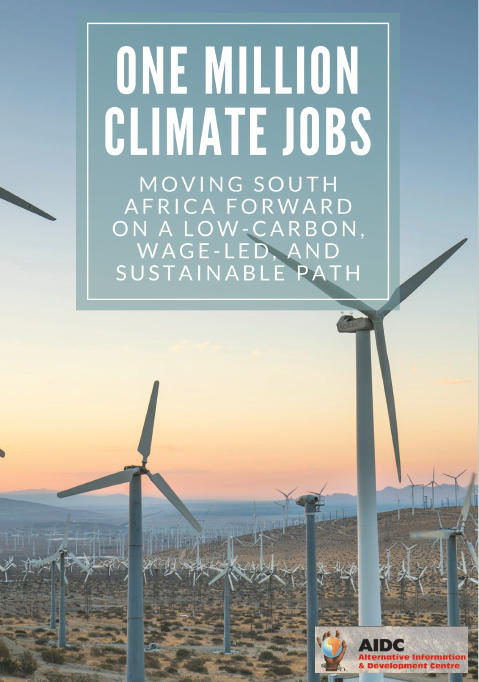
One Million Climate Jobs: Moving South Africa Forward on a Low-Carbon, Wage-Led, and Sustainable Path

By Brian Ashley, et. al. - One Million Climate Jobs - December 2016

The One Million Climate Jobs Campaign is an alliance of labour, social movements and popular organisations in South Africa that is campaigning for the creation of a million climate jobs as part of a collective approach to the crisis of unemployment and climate change. The Campaign was launched in 2011 and since then has been mobilising thousands of South Africans around real solutions to slowing down climate change, protecting the natural environment, improving the quality of life for all and moving towards a sustainable development path. Climate change will exacerbate inequality and poverty because it reduces access to food, water, energy and housing. Thus it is vital that social justice struggles around these issues incorporate struggles around climate change.

This booklet is a follow-up, six years later, to the first booklet that was produced in 2011. It is based on well- researched solutions for how South Africa can immediately begin a just transition, away from the Minerals-Energy Complex that continues to dominate the South African capitalist economy, to a low carbon economy in which the basic needs of communities are met in an equitable, sustainable and affordable way.

It recognizes that in these six years there have been many developments – for instance, renewable energy is now firmly established as part of the energy mix (although still a minor part); retrofitting buildings, and the development of environmentally friendly construction methods, is being developed, and the Rapid Bus Transit system is being slowly implemented in some municipalities.

But most of these solutions are being pursued within the logic of the market. It is not possible, we would argue, within these market parameters, to respond adequately to the enormous challenges facing us – what is needed is a publicly-driven solution for the shift to a sustainable, low-carbon future. The research that this booklet is based on begins to set out what such a transition could look like. We hope that it will be an important contribution to the ongoing work of building a political movement to struggle around these issues.

Download (PDF).

Committing Geocide: Climate Change and Corporate Capture

By Susan George - Climate and Capitalism, November 23, 2016

Susan George is president of the board of the Trans National Institute, an international research and advocacy institute committed to building a just, democratic and sustainable world. She spoke at the Seminar of the International Center for the promotion of Human Rights [CIPDH] and Unesco titled “Interreligious and inter cultural dialogue: consciences and climate change”  in September in Buenos Aires.  Find the video here.

Distinguished Guests, Ladies and Gentlemen,

The International Centre for the Promotion of Human Rights has given me the honour of closing this seminar and I’m extremely grateful to the CIPDH for including me in this important event. We could compare this seminar to one part of the long road on a kind of modern pilgrimage; one stage of a difficult but infinitely rewarding journey. We’ve shared part of this road towards what we all hope will be a stable, sustainable world, fit for human habitation.

We hope this pilgrimage will lead to the success of the COP22 in Marrakech and then continue well beyond, until we reach that far-off goal of halting, then reversing climate change.

We know that the earth and all the myriad forms of life living on its land and under its seas are unlikely to withstand an increase in temperatures beyond 2 degrees. We have already reached more than one degree above the historical average and have been dangerously slow to take this road. Now it is crucial that we continue.

It strikes me that all religions have their pilgrimages, whether to Mecca, Saint Jacques de Compostelle, the place in India of the Buddha’s Enlightenment, the holy Hindu cities of India or the sacred sites of Jerusalem. The people who set out on these pilgrimages of faith are usually seeking forgiveness or salvation, enlightenment, healing or perhaps the granting of a special wish.

Our common pilgrimage is of a different nature. We do not seek personal blessings but salvation and hope for all peoples and for our home, the earth. All are under tremendous threat. We have embarked on this journey because we recognise that humanity has never been in greater danger than at this moment.

I try not to speak of “saving the planet”. Whatever human beings may do, the planet will continue to rotate on its axis and to orbit the sun as it has done for some four and a half billion years. Planet earth, which we think of as “ours”, is not really “ours” at all. It could perfectly well continue, utterly changed, to move along its prescribed path without us. Indeed, one could easily argue, as the so-called “deep ecologists” do, that the planet would be far better off without us, since they stress that we humans are the most predatory, wasteful and destructive species ever to have lived on earth in those four and a half billion years.

I am not here to promote the deep ecology view. I am here rather to introduce and define what I see as a new phenomenon in the history of humankind. I call it Geocide. Geocide is the collective action of a single species among millions of other species which is changing planet Earth to the point that it can become unrecognisable and unfit for life. This species is committing geocide against all components of nature, whether microscopic organisms, plants, animals or against itself, homo sapiens, humankind.

Homo sapiens has only existed for roughly 200,000 years. The time we’ve spent one this planet compared to its total age is infinitesimally short, just the tiniest sliver of geological time. It amounts to a mere 0.00004 percent of earth’s existence. And although any given species of plant or animal–vertebrate or invertebrate– tends to last on average about ten million years, our species seems determined to cause its own extinction, along with the rest of creation, long before it allotted time.

The death of an entire species is, geologically speaking, a common occurrence. Some extinctions are spectacular—think of the dinosaurs—most are quiet disappearances that leave few traces. Several species will have disappeared forever between the time we arrived and the time we leave this seminar. Scientists tell us that the “background rate” of extinction is approximately a thousand times greater than average and some have begun to call our era the “sixth great extinction.” The previous one, the Permian extinction, occurred about 250 million years ago. Some 95 percent of all species then on earth were wiped out, probably because of volcanic activity and warming causing huge releases of methane from the oceans.

Species disappear massively because they cannot adapt fast enough to rapidly changing conditions. Some, humans included, can adapt to a broad set of environments and wide divergence of temperature, from Siberia or Greenland to Pakistan or the Sahel, but no species is infinitely adaptable and all have their limits.

Ours is the only species among millions that has been gifted with language, tool-making skills, and above all consciousness, the capacity for imagination, thought and spirituality. And yet, the end of our own existence seems beyond our collective comprehension: too terrible and too definitive to contemplate. Extinction can’t possibly happen to us—we humans are too technologically brilliant, we can find the solution to any problem, we are the lords of creation and we cannot fail, much less disappear.

No one except a few eccentrics now denies that humans are capable of committing genocide; we have witnessed horrible episodes of mass murder in our own lifetimes and, because we have recognised this horror, we are able to name it. All languages have been obliged to add this terrible word, genocide, to their vocabularies.

Are we even capable of imagining, much less recognising that we are also capable of committing geocide? In my mind, this term goes beyond “ecocide” which so far seems limited to specific environments or geographic locations such as the razing of a forest or the massive pollution of, say, the Gulf of Mexico. Geocide is alas more general: it is a massive assault against nature of which we are only a part, against all earthly life and against Creation as well as the complete denial of human rights; I submit that this ultimate act of destruction is underway and that we need a name for it. Without a name, we have no concept and without a concept we cannot combat it. This is why I searched for a new word.

The Role of Labour in the Fight Against Climate Change

By Asbjørn Wahl - International Transport Workers Federation (ITF), (hosted by Trade Unions for Energy Democracy) November 2016

The climate crisis is steadily coming closer. At the same time, we face a deepening economic crisis, as well as social and political crises. This creates an increasingly serious situation for the future of humanity.

However, given that the various crises have many of the same root causes, going to the core of our economic system, this can contribute to strengthening the mobilisation of social forces needed to break the current trend-–in favour of a democratic and planned development of society.

Action to combat dramatic climate change will require major societal transformation. In other words, we have an all-out battle on our hands over how to organise society. Solutions to the climate crisis do exist. We have most of what is required in terms of technology, knowledge, and competence to avert a climate disaster. It is the power to translate words into action that will pose the greatest challenge.

Since economic growth and ruthless exploitation of natural resources are embedded parts of a capitalist economy–indeed, any capitalism without growth is a capitalism in crisis-–a narrow focus on individual issues of environmental policy will not suffice. Nor will we be able to combat the climate crisis by making individual choices. A system critical approach is needed. We need democratic control of the economy. This means that we are not only faced with a threat, but also an opportunity-–an opportunity, not just to prevent a climate catastrophe, but also to fight the economic and social crises which are currently eroding and threatening the living conditions of millions upon millions of people. In particular, this also provides us with a foundation upon which to build extensive social alliances in search of a different kind of society.

Read the report (PDF).

The Chevron Way: Polluting California and Degrading California

By various - International Transport Federation, et. al., November 2016

In the recent election, Chevron-backed campaigns lost bigtime, despite the $61 million the company has spent to influence California elections since 2009. That’s far more than any other oil company spend in state elections. The report, by the International Transport Workers Federation, was released Nov. 17 at the Chevron gates by a coalition including the Richmond Progressive Alliance (RPA), Alliance of Californians for Community Empowerment (ACCE), Communities for a Better Environment (CBE), and more.

Members of the coalition said the report, The Chevron Way: Polluting California and Degrading Democracy, will educate the public about the corrupting influence of corporate money and alert politicians that they will be judged on whether they act in the public interest or in Chevron’s interest.

In this election, in State Assembly and State Senate races, candidates heavily backed by Chevron lost. In Monterey County, Chevron spent $1.5 to oppose a ballot measure to ban fracking and expanded oil drilling. Despite being outspent 33 to 1, the measure passed.

In Richmond, Chevron sat out this election, having spent $3 million in the last election, when its candidates lost anyway. This year, two additional progressive candidates won seats on the city council and a longstanding Chevron candidate was voted out.

Chevron makes billions in profits from its huge retail and refining business in California, but has aggressively cut tax payments to federal, state and local governments. In 2015, the company paid no net income tax in the US, but instead banked nearly $1.7 billion in tax credits.

In 2015, Chevron had over $45 billion stashed in offshore accounts, including the company’s 211 active Bermuda subsidiaries, and the company’s global effective tax rate fell to below 3%.

Read the report (PDF).

Sharing the challenges and opportunities of a clean energy economy: Policy discussion paper A Just Transition for coal-fired electricity sector workers and communities

By staff - Australian Council of Trade Unions - November 2016

The ACTU is primarily concerned with workers, their rights, their welfare and their future. A just and civil society is one where everyone shares in the wealth of the nation but it is also one where economic costs are equally shared.

Transitioning an industry is a massive economic and social disruption. History shows that this has often been done poorly in Australia, with workers and communities bearing the brunt of such transitions - suffering hardship, unemployment and generations of economic and social depression.

Research in the textiles, clothing and footwear (TCF) and car manufacturing industries shows, for example, that only one third of workers find equivalent full time work following their retrenchment, while one third move into lower quality jobs (lower wage, lower job status or into part-time and casual work) and one third are locked out of the labour force altogether.

International experience however shows that a transition can be done equitably, achieve positive outcomes for workers, save communities and forge new areas of industrial growth and prosperity.

Australia is currently facing one such transition in the coal-fired electricity sector. If Australia manages this transition well, the nation would have a structured and equitable approach that could apply to any industry undergoing similar change in the future.

At last year’s Paris climate conference, Australia alongside 194 countries, committed to limit global warming to less than 2°C above pre-industrial levels. As part of this historic agreement, unions successfully achieved recognition of the need for a ‘Just Transition’ that supports the most affected workers obtain new decent and secure jobs in a clean energy economy.

While Australia’s international obligations will require a range of complementary policies that focus on emission reduction across a number of sectors of the economy, as the largest contributor to Australia’s emissions, effective reform of the electricity sector has been identified as a key step in tackling climate change.

Download (PDF).

‘Get A Life’: Clinton Bashed Anti-Fracking Activists During Private Labor Meeting

By Kevin Gosztola - Shadow Proof, October 15, 2016

At a private meeting with the Building Trades Council, Hillary Clinton bashed environmentalists who oppose natural gas fracking and insist the United States must keep all fossil fuels in the ground. She said these environmentalists need to “get a life.”

A transcript of a part of the meeting, which took place on September 9, 2015, was published by WikiLeaks. It was attached to an email from Clinton campaign chairman John Podesta’s account, which he claims was hacked.

Clinton met with the Building Trades Council, which is part of North America’s Building Trades Unions (NABTU). She sought their endorsement, however, she wanted to be clear about what she was willing to support in the way of new pipeline construction. The labor organization is very pro-pipeline because its members work on pipelines.

“Bernie Sanders is getting lots of support from the most radical environmentalists because he’s out there every day bashing the Keystone pipeline,” Clinton stated. “And, you know, I’m not into it for that.”

“My view is I want to defend natural gas. I want to defend repairing and building the pipelines we need to fuel our economy. I want to defend fracking under the right circumstances,” Clinton added. She made it clear she was willing to defend new, modern energy sources.

Then, on environmentalists, Clinton shared, “I’m already at odds with the most organized and wildest. They come to my rallies and they yell at me and, you know, all the rest of it. They say, ‘Will you promise never to take any fossil fuels out of the earth ever again?’ No. I won’t promise that. Get a life, you know.”

Pages

The Fine Print I:

Disclaimer: The views expressed on this site are not the official position of the IWW (or even the IWW’s EUC) unless otherwise indicated and do not necessarily represent the views of anyone but the author’s, nor should it be assumed that any of these authors automatically support the IWW or endorse any of its positions.

Further: the inclusion of a link on our site (other than the link to the main IWW site) does not imply endorsement by or an alliance with the IWW. These sites have been chosen by our members due to their perceived relevance to the IWW EUC and are included here for informational purposes only. If you have any suggestions or comments on any of the links included (or not included) above, please contact us.

The Fine Print II:

Fair Use Notice: The material on this site is provided for educational and informational purposes. It may contain copyrighted material the use of which has not always been specifically authorized by the copyright owner. It is being made available in an effort to advance the understanding of scientific, environmental, economic, social justice and human rights issues etc.

It is believed that this constitutes a 'fair use' of any such copyrighted material as provided for in section 107 of the US Copyright Law. In accordance with Title 17 U.S.C. Section 107, the material on this site is distributed without profit to those who have an interest in using the included information for research and educational purposes. If you wish to use copyrighted material from this site for purposes of your own that go beyond 'fair use', you must obtain permission from the copyright owner. The information on this site does not constitute legal or technical advice.