You are here

climate justice

Paris is Burning

By James P. Hare - Rosa Luxemburg Stiftung, June 2017

With Trump’s decision to formally withdraw from the Paris Agreement, he has put an end to months of apparent indecision. This withdrawal does not dissolve the agreement, which still includes nearly every nation on the planet, but it is hard to imagine how an already weak agreement can be expected to slow—not to mention reverse—greenhouse gas emissions without the participation of the United States. Seeing this decision as anything other than a nail in the coffin of the global climate regime is nothing but wishful thinking.

For an administration that has promoted a seemingly unending series of bad policies—from healthcare to immigration to militarism to the unceasing transfer of wealth from working people to the wealthy—this may be its worst. When future generations look back at the harm done by this president, they may remember this as his greatest crime. This is not to minimize the damage of his other policies or of the racism, xenophobia, and misogyny that drove his campaign and brought him into the White House, but climate change is the ultimate issue. It will affect everyone while exacerbating existing inequalities, and we only have one chance to get it right.

This decision is no surprise. Throughout his campaign, Trump promised to pull out of the Paris Agreement as part of his “America First” agenda that pits the promise of domestic jobs against environmental protections and international cooperation. We must reject Trump’s noxious brand of nationalism and climate denialism. It is critical, however, not to sugarcoat the nature of much of what passes as international cooperation. So-called trade agreements have benefitted corporations and the wealthy at the expense of working people both in the United States and abroad.

It is not, as Trump’s nativist critique would have it, that the United States made a bad deal with Mexico when negotiating NAFTA. Rather, elites in the United States, Mexico, and Canada made a good deal for themselves at the expense of the citizens of each country. Still, working people understand what NAFTA did to their workplaces and their communities, and Trump’s attack on trade deals may have helped him to win enough working-class support in critical states to shift the electoral map in his favor, even if the extent of his working-class support has been greatly overstated by centrist commentators.

Beyond Democrat Dead-ends: What Real Climate Action Looks Like

By Carol Dansereau - CounterPunch, June 2, 2017

The global warming situation is absolutely crazy.  Millions of people are already experiencing drought, famine, floods, wildfires, superstorms and other climate disasters.  As a species, we are teetering on the edge of full-blown catastrophe, with extinction a distinct possibility.  Yet, we can’t seem to put in place obvious solutions that are sitting right there in front of us.

Even crazier, environmentalists repeatedly praise Democrats for phony climate action plans that don’t come close to what’s needed.

Take the “100 by ‘50” legislation recently introduced by Oregon Senator Merkley and other Democrats.  Environmental leaders lined up to celebrate this as the blueprint that will get us beyond global warming, even though it’s nothing of the sort.  Some environmentalists used their endorsements to denounce Republicans for being funded by the fossil fuel industry, deftly ignoring the funding received by Democrats from that same industry.  The message was clear: when we put Democrats back in power and pass a bill like “100 by ‘50”, we’ll be on our way to solving the climate crisis.

This is pure hogwash.  The Democrats have kept us running in circles as the climate crisis has deepened.   And although this new bill purports to get us to 100% clean and renewable energy by 2050—hence the catchy title—it almost certainly won’t do that.  Yes, it is “the most ambitious piece of climate legislation Congress has ever seen”.  But that’s only because prior offerings were so pathetic that “100 by ’50” seems ambitious in comparison.

It’s crucial that we understand this as Donald Trump and the Republicans move forward with their horrifying agenda.  More than ever, we need to be uniting behind a real climate action plan and the broader vision for society it engenders.  We need to be building a movement that has a clear understanding of where our power lies and how to use it.

GGJ Statement on Trump's Withdrawal from Paris Agreement

By staff - Grassroots Global Justice Alliance, June 2, 2017

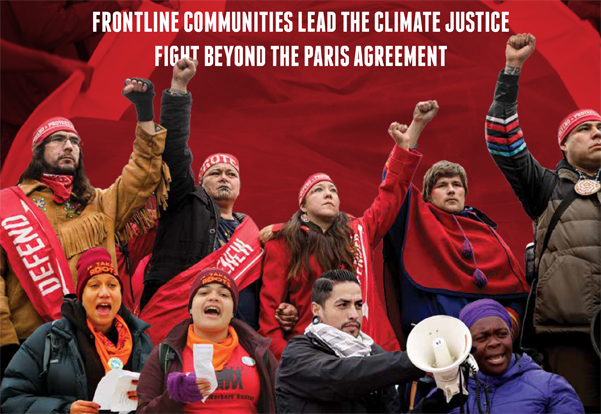
While the accord was far from what the planet needs, Trump's reckless decision underscores a key overarching issue with the Paris Agreement in the first place.  When the Paris Agreement was signed in 2015, we put out this report entitled "We Are Mother Earth’s Red Line: Frontline Communities Lead the Climate Justice Fight Beyond the Paris Agreement."  We laid out 5 key concerns in the report.  Our number one concern (see page 6) with the agreement was “The Agreement relies on voluntary versus mandatory emission cuts that do not meet targets scientists say are necessary to avoid climate catastrophe.”  Trump’s withdrawal is a clear example that voluntary pledges are not enough.

“Donald Trump is showing us the art of breaking a deal,” says Tom BK Goldtooth, Executive Director of Indigenous Environmental Network. “By abandoning the Paris Agreement, this administration will further perpetuate environmental racism and climate injustice against Indigenous peoples experiencing the worst effects of climate change across the globe. We’ve stated before that the Paris Agreement falls short of embracing the sort of climate solutions that lift up human rights and the rights of Indigenous peoples. Regardless of its shortcomings, it is critical that the United States be held accountable for its contributions to the climate chaos we are seeing across the globe and to take ambitious action to meet the Agreement’s goal to limit temperature increases to 1.5 degrees Celsius. Backing out of this agreement continues a long history of broken promises and threatens the vital and sacred life cycles of Mother Earth.”

Our number two concern (page 6) was “The Agreement advances pollution trading mechanisms that allow polluters to purchase “offsets” and continue extremely dangerous levels of emissions.”  If we truly aim to reach the stated goal of reducing carbon emissions to 1.5 degrees Celsius, we will never get there with a carbon market system.

Monique Verdin, Secretary of the United Houma Nation Tribal Council, Louisiana says “the Paris Accord is not a perfect solution, but to step out of it is to step back. Our coastal communities in the Mississippi River Delta are surrounded by a web of pipelines, oil and gas canals, while our sinking lands are pock marked by oil waste pits. We are being told that our traditional territories may have to be sacrificed to the sea and that our post-colonial sanctuary settlements may have to be abandoned in this unprecedented wake of sea-level rise. If we don’t change our relationships with extreme extraction the heartache of losing some of the most precious biodiversity in the world, will be disregarded for the delusions of “progress.”

While the agreement was far from what we need at the global scale, at minimum it was still a significant indication that world leaders were taking climate change seriously.  Across the globe, the Paris Agreement was being used as a baseline argument to continue promoting the real Just Transition that we need away from a fossil fuel economy.

Toward a climate insurgency

By Jay O'Hara - Waging Nonviolence, May 16, 2017

To the outward eye, the climate movement looks to be back on its heels, reeling from the ascendancy of a fossil fuel regime, the completion of the Dakota Access Pipeline, the zombie Keystone XL and the threatened departure of the United States from the Paris Climate Accord. And there’s not much I can offer, as a climate organizer, to dissuade one from that opinion. The one major effort thus far was a massive march on Washington, D.C. that was planned when most expected Hillary Clinton to be in the White House. So we’re left wondering: What the hell are we supposed to do now?

Into this breach steps Jeremy Brecher’s slim new volume “Against Doom: A Climate Insurgency Manual.” Neither glitzy, eloquent nor subtle, Brecher methodically lays out an interlocking vision of direct action within a constitutional legal framework to build the powerful nonviolent climate insurgency necessary to turn the ship around. “Against Doom” smartly connects disparate threads of the existing climate movement and pulls them together with strategic vision. I finished the book fired up with a clearer sense of where my own work with the Climate Disobedience Center, as well as my Quaker faith community, fits into an unfolding climate insurgency. And I’m ready to get back to the pipeline valves, coal piles, construction sites, boardrooms and courtrooms where we have the opportunity to stem the tide of climate cataclysm.

Brecher puts all this in perspective right up front: Before Trump, the Paris agreements represented merely “the illusion that world leaders were fixing climate change” — with ineffectual emissions reduction targets of only 2 degrees Celsius (non-binding) and 1.5 degrees (aspirational). As such, Trump is only a refreshingly honest manifestation of the movement’s failure to muster sufficient power to achieve its ultimate aims. The illusion of the efficacy of an inside politics game somehow survived the failure of cap-and-trade among the major environmental groups, and those groups refocused on the Obama administration’s potential for executive action. At the same time, the national fight against Keystone XL and grassroots resistance by frontline communities across the country and globe have laid the groundwork for a strategy of insurgency.

Which way for the climate movement?

By Michael Schreiber - Socialist Action, May 11, 2017

On April 29, more than 200,000 people marched in Washington, D.C., in a powerful show of determination to rescue the earth from the ravages of climate change. Over 370 sister marches took place simultaneously across the United States and in countries around the world from Britain to Brazil, and from Mexico to Kenya and the Philippines.

The size of the crowd in Washington far surpassed earlier expectations by the organizers and the National Park Service. At precisely 2 p.m., virtually the entire march, which at that point extended more than 20 blocks along Pennsylvania Avenue from the Capitol to the White House, grew quiet as people sat down as an ensemble. Drums kept the rhythm as the marchers thumped their chests to show that while coming from many backgrounds, their hearts beat as one.

In addition to the colorful puppets and banners carried by organized contingents, most of the marchers brought hand-lettered signs, with slogans reflecting a variety of related social concerns (such as “Black Lives Matter”) in addition to that of the environment.

Although the organized trade-union contingents were meager, spirited groups of Native Americans, LGBTQ people, and communities of color—including a number of Washington, D.C., youth—made their presence felt.

“In the face of a federal administration that would rather reap profits than protect people, our communities are rising up,” Jeremiah Lowery, climate justice organizer with the Chesapeake Climate Action Network, said in a press statement on the eve of the march. “In Washington, D.C. and around the world, it’s low-income communities, communities of color, and workers who are bearing the brunt of the climate crisis they did the least to contribute to.”

There is no doubt that the threats by the Trump administration to pull out of the Paris Climate Accords and to rescind environmental measures put in place by Obama—which themselves were far from adequate—were responsible for swelling the numbers of people who joined the demonstration.

Toward an Ecological Revolution

By David Johnson - CounterPunch, May 5, 2017

Climate change, as it has emerged as a defining political issue of our time, has a peculiar exceptionalism attached to it. While we know it is in some sense a political problem, or at least demands a political solution, we nevertheless tend to think of it as a problem in nature – one that transcends social issues and threatens social life itself. Every year, waves of liberal students enter environmental science programs at universities across the West, determined to study the changes human beings are causing in the earth’s ecosystems. We know that human activity in general, and the burning of fossil fuels in particular, is the primary agent of climate change, with very serious implications for the natural environment upon which humans depend, and for human life itself

The need to drastically reduce carbon emissions, then, is as clear as it is urgent.  Technologically speaking, there is a path forward: innovations in energy production abound, including in renewable sources like sun and wind. It would seem we have a problem and a solution. Why then do we see little meaningful reform, when the stakes are so high and the answers so clear?

Here the conversation often crumbles into a series of dead-ends. A significant portion of the public has resorted to denying the scientific consensus on climate change, and there is no shortage of funding for such a campaign. Others who accept the science nevertheless become cynical from the scale of the problem; the obstacle, many conclude, is “human nature” itself. Still others, determined to fight, seek to appease large corporations with innovations that are both environmentally friendly and profitable – so-called Green capitalism. Can the profit motive save us?

A new book edited by Vijay Prashad bursts through this rigid state of affairs. Focused around Naomi Klein’s Edward Said lecture, delivered in London on 4 May 2016, Will the Flower Slip Through the Asphalt is a short collection of narrative essays and analysis that responds to the global climate crisis in a refreshingly expansive way.

Climate Movement to May Day Strikers: "We've Got Your Back"

By Deirdre Fulton - Common Dreams, April 27, 2017

Just as labor leaders are standing firmly behind this Saturday's national climate mobilization, the environmental movement has declared its support for workers who plan to strike as part of Monday's May Day demonstrations.

May 1st, International Workers Day, will see rallies, marches, and strikes around the country and the world; in the United States, acts of civil disobedience, work stoppages, and boycotts will target the Trump administration and support immigrants who have experienced an increase in raids and racist rhetoric since the election of President Donald Trump.

"May 1st is the first step in a series of strikes and boycotts that will change the conversation on immigration in the United States," said Maria Fernanda Cabello, a spokesperson from Movimiento Cosecha, which is part of a coalition organizing the actions. "We believe that when the country recognizes it depends on immigrant labor to function, we will win permanent protection from deportation for the 11 million undocumented immigrants, the right to travel freely to visit our loved ones abroad, and the right to be treated with dignity and respect."

An open letter signed this week by more than 80 environmental and climate justice groups recognizes that these demands and those of green groups have many points of intersection. 

"Today, workers face unprecedented attacks on wages, benefits, workplace safety, and the right to organize free from fear and retaliation," reads the letter, whose signatories include 350.org, Greenpeace, Rising Tide North America, and the Sierra Club. "But we know that we are all stronger when workers in our communities have safe, fair, and dignified employment with which they can support their families without fear of deportation or violence."

What's more, the letter continues:

The effects of our fossil fuel economy fall first and worst on working class communities, communities of color, immigrants, and Indigenous peoples who have not only contributed the least to climate disruption, but have the least resources to shoulder the burden of a transition to a new, climate-friendly economy. It is these frontline communities who are also at the forefront of change and whose solutions and leadership we most need.

[...] As environmental and climate justice organizations, we support workers who choose to walk off their jobs on May 1st because we know that the fight to protect land, water, air and soil is inseparable from the fight to protect the life and dignity of workers, migrants, and communities of color.

This language dovetails with that of Mary Kay Henry, international president of Service Employees International Union (SEIU), who declared Wednesday, "Every day SEIU members and our communities experience the impact of toxic pollution in our air and water and the catastrophic impacts from climate change that are made worse from this pollution."

Of Saturday's Peoples Climate March, Henry said: "We march because we are on the frontlines. As working people, people of color, and immigrants, we march because our families are disproportionately hardest hit by pollution and climate change's impacts. We march because as service and care workers we are on the frontlines of caring for and responding to impacted families and communities."

The letter from eco- and climate-justice groups calls on employers not to retaliate against workers who choose to go on strike, and pledges to defend workers who face retaliation.

USFSA’s Participation in the #PeoplesClimateMarch

By staff - The US Food Sovereignty Alliance, April 28, 2017

The US Food Sovereignty Alliance, an alliance of food justice, anti-hunger, labor, environmental, faith-based, and food producer groups, is joining in solidarity with the It Takes Roots Coalition at the People’s Climate March in Washington D.C. on April 29, 2017 to stand for “the rights, actions, and leadership of communities who are at the frontlines of fighting for water, land, and home.”

As a US-based organization, the USFSA upholds the right to food as a fundamental human right and works to connect our local and national struggles to global movements led by farmers, fishers and indigenous people. Corporate-controlled industrial agriculture and fishing are significant contributors to climate change and smallholder farmers producing and harvesting food build the resiliency of ecosystems which contribute to both nourishing people and cooling the planet.

Humans have a right to the resources required to meet their basic needs and provide themselves with shelter, sustenance, and an adequate livelihood. The means of meeting these needs are often embedded in cultural practices that are vital for people’s sense of identity. Food feeds more than the body.

Climate change increases hunger.  A sustainable and nutritious food supply is essential for the entire human population, but it’s also essential for the economic well-being of food producers.  People who produce food – like farmers and fishers – are often hardest hit by climate change, which directly affects their family’s food supply and sources of income.  With 78 percent of the world’s poor relying on farming to support their families, it’s important to develop sustainable ways of farming that support both the environment and those who rely on crops for economic stability.

An Eco-Revolutionary Tipping Point?

By Paul Burkett - Monthly Review, May 2017

In the summer of 2016, the acceleration of climate change was once again making headlines. In July, the World Meteorological Association announced that the first six months of 2016 had broken all previous global temperature records, with June being the fourteenth month in a row of record heat for both land and oceans and the 378th straight month of temperatures greater than the historical average. Heating has been especially rapid in Arctic regions, where thawing effects are releasing large amounts of methane and carbon dioxide. On July 21, 2016, temperatures at locations in Kuwait and Iraq reached 129oF, the hottest ever recorded in the Eastern Hemisphere. The disruptive effects of bi-polar warming were evident in the unprecedented crossing of the equator by the Northern Hemisphere jet stream, where it merged with the Southern Hemisphere jet stream, further threatening seasonal integrity with unforeseen impacts on weather extremes and the overall climate system.1 Meanwhile a report from the United Nations Environment Program (UNEP) described the December 2015 Paris Agreement on climate change as “outdated even before it takes effect,” with climatologists now expecting a global warming of at least 3.4oC (more than double the 1.5oC limit supposedly built into the agreement) even if the promised emissions goals of the nations involved are somehow achieved despite the lack of binding enforcement mechanisms. “The world will still be pumping out 54–56 gigatons of carbon dioxide equivalent a year by 2030 under current plans, well above the 42 gigatons needed to limit warming to 2 degrees,” according to the UNEP report.2

The historical irony in this situation is hard to miss. Just a couple decades ago, we were told that neoliberal capitalism marked the “end of history.” Now it appears that the system’s ideologues may have been right, but not in the way they envisioned. The system of fossil-fueled neoliberal capitalism is indeed moving toward an end of history, but only in the sense of the end of any historical advance of humanity as a productive, political, and cultural species due to the increasingly barbaric socio- economic and environmental conditions the system creates. There is now no alternative to the end of history as we know it. The sustainable development of human society co-evolving with nature including other species now depends on a definite historical break with capitalism (wage-labor, market competition, production for profit) as the dominant mode of production. That is the main lesson of three recent books: Ian Angus’s Facing the Anthropocene, Andreas Malm’s Fossil Capital, and Naomi Klein’s This Changes Everything. To solve the climate crisis—which is only part of the broader environmental crisis created by capitalism—competitive, profit-driven production under unequal class control must be replaced with a system in which working people and their communities collectively and democratically regulate production and other interactions with their material and social environment. Sustainable development of people cooperatively co-evolving in a healthy way with other species must replace the profit motive, exploitation, and competition as the motive force in production and in the entire system of material provisioning. To deny that the climate crisis is hardwired into capitalism, and that we need a new system to deal with it, is just as misleading and dangerous as to deny the existence of human-induced global warming. Both forms of climate denial must be overcome in theory and practice.

Restoring the Heartland and Rustbelt through Clean Energy Democracy: an Organizing Proposal

By That Green Union Guy - IWW Environmental Unionism Caucus, April 29, 2017

The world faces a crises of enormous proportions. Global warming, caused by the continued burning of fossil fuels, threatens life on Earth as we know it, and yet, those most responsible for causing the crisis, the fossil fuel wing of the capitalist class, seems hell bent on doubling down on business as usual. In the United States of America, whose corporate overlords are among the worst offenders, they are led by the recently elected Donald Trump, whose cabinet is bursting at the seams with climate change denialists and fossil fuel capitalist industry representatives. Instead of transitioning to a clean energy economy and decarbonizing society as quickly as possible, as climate scientists overwhelmingly recommend, Trump and his inner circle would seemingly rather not just maintain the status quo; they’ve signaled that they intend to make the worst choices imaginable, putting all of the US’s energy eggs into the oil, natural gas, and coal basket.

Worse still, Trump claims to enjoy a good deal of support for such moves from the Voters who elected him, which includes a good portion of the "White working class" who have traditionally supported the Democratic Party, whose policies are just barely more favorable to addressing the problems of global warming (which is to say, still woefully inadequate). Meanwhile, the leadership of the AFL-CIO, pushed principally by the Building Trades unions, have doubled down on their efforts to continue to serve as capital’s junior partners, even as the latter continues to liquidate them in their ongoing campaign of systemic union busting.  Just recently, science teachers across the country began to find packets in their school mailboxes, containing a booklet entitled "Why Scientists Disagree About Global Warming", a DVD, and a cover letter urging them to "read this remarkable book and view the video, and then use them in your classroom," courtesy of the climate change denialist Heartland Institute.

One might think, given all of these situations, that…well, to put it mildly…we’re doomed. However, nothing could be further from the truth. In fact, in spite of the bleakness of these circumstances, a deeper look behind them reveals that fossil fuel capitalism is in terminal decline, that their hold over our lives hangs by a thread, so much that we the people, the workers and peasants of the world, have the ability to transform the human existence to one based not on plundering the Earth and exploiting the masses for the profit of a few, but one based on true grassroots democracy, free of suffering and want, and one that exists in harmony with the Earth. The key to making this transformation lies with clean energy, and the people who can make this transformation are the very people who helped elect Donald Trump themselves. One may justifiably ask, how is this even remotely possible?

This new organizing proposal, Restoring the Heartland and Rustbelt through Clean Energy Democracy, offers a potential solution and practical steps to achieve it which can not only break the reactionary tide, perhaps once and for all, but also can greatly accelerate the very necessary process of abolishing capitalism and building a new, ecological sustainable world in the shell of the ecocidal old by building an intersectional movement championing "Clean Energy Democracy". Such a movement has the potential to unite workers, rural and rustbelt communities, climate justice activists, environmentalists, indigenous peoples, and farmers of all backgrounds and revitalize a vibrant and grassroots democratic anti-capitalist left, and it offers goals that help address the intertwining crises of global warming, decadent capitalism, failing economies, and demoralized communities plagued by economic depression, racism, and reactionary nationalism.

While the burgeoning "resistance", loosely led by a coalition of groups and movements with a smorgasbord of goals and demands, many of which are reformist and defensive (though not undesirable if seen as steps along the way to more revolutionary and transformative demands) has so far successfully held back much of the worst intentions of Trump and the forces he represents, making the latter fight tooth and nail for every single inch (as well they should), such resistance still lacks the positive vision needed to truly meet the needs of most people, including especially the most oppressed and downtrodden. By contrast, Restoring the Heartland and Rustbelt through Clean Energy Democracy offers one piece of a revolutionary and transformative vision that can truly help build a new world within the shell of the old, thus putting an end to capitalist economic oppression as well as the ongoing systematic destruction of the Earth's ability to sustain life.

Download the Proposal (PDF File).

Pages

The Fine Print I:

Disclaimer: The views expressed on this site are not the official position of the IWW (or even the IWW’s EUC) unless otherwise indicated and do not necessarily represent the views of anyone but the author’s, nor should it be assumed that any of these authors automatically support the IWW or endorse any of its positions.

Further: the inclusion of a link on our site (other than the link to the main IWW site) does not imply endorsement by or an alliance with the IWW. These sites have been chosen by our members due to their perceived relevance to the IWW EUC and are included here for informational purposes only. If you have any suggestions or comments on any of the links included (or not included) above, please contact us.

The Fine Print II:

Fair Use Notice: The material on this site is provided for educational and informational purposes. It may contain copyrighted material the use of which has not always been specifically authorized by the copyright owner. It is being made available in an effort to advance the understanding of scientific, environmental, economic, social justice and human rights issues etc.

It is believed that this constitutes a 'fair use' of any such copyrighted material as provided for in section 107 of the US Copyright Law. In accordance with Title 17 U.S.C. Section 107, the material on this site is distributed without profit to those who have an interest in using the included information for research and educational purposes. If you wish to use copyrighted material from this site for purposes of your own that go beyond 'fair use', you must obtain permission from the copyright owner. The information on this site does not constitute legal or technical advice.