You are here

ecosocialism

Toward Climate-Catalyzed Social Transformation?

By Diana Stuart and Ryan Gunderson - ROARMag, May 3, 2019

In the past weeks, Extinction Rebellion has continued to make news headlines with acts of protest in London, Boston, New York and other cities across the globe. In London, thousands of activists blocked roads and bridges and over 1,000 were arrested. These actions are a part of Extinction Rebellion’s ongoing strategy to disrupt the economy and pressure governments to meet their demands to address climate change.

In addition, the youth movement Fridays for Future continues to hold school strikes with an estimated 1.6 million participants across the globe on March 15. In the United States, the Sunrise Movement has just launched a tour to promote the Green New Deal, a possibly transformative resolution that targets both inequality and greenhouse gas emissions.

These movements are unprecedented, growing, and are unlikely to go away any time soon. In addition, meeting the demands of these movements would require significant social and economic changes through a radical political program.

Given the momentum of these movements, are we on the verge of a possible climate-catalyzed social transformation? And if so, what strategies for transformation will be most effective?

(Working Paper #12) The Road Lest Travelled: Reclaiming Public Transport for Climate-Ready Mobility

By Sean Sweeney and John Treat - Trade Unions for Energy Democracy, May 2019

This working paper examines some of the key questions at the heart of climate-related debates on transport, and around passenger road transport in particular. It also looks at some of the more important issues surrounding public transport specifically, and the failure of neoliberal transport policy to improve and expand public transport in ways that fulfill its full social and environmental potential.

Part One: Mobility Rising: Transport, Energy and Emissions Trends

In Part One of this paper, we survey the current trends in energy, transportation and emissions. Although emissions continue to rise across the global economy, transport-related emissions are growing faster than those of other major sectors. Transport is now responsible for almost one-third of final energy demand and nearly two-thirds of oil demand. It is also responsible for nearly one-quarter of global carbon dioxide (CO2) emissions from the use of fuel. This means that controlling and reducing CO2 emissions from cars, trucks, and motorcycles must become a policy priority.

Part Two: Neoliberal Transport and Climate Policy at the Crossroads

In this part, we review the policy landscape, including how transport-related emissions from the transport sector are addressed in the Paris Climate Agreement—which is hardly at all. We show that neoliberal climate policy has failed to make any real progress in addressing transport-related emissions, while at the same time preventing public transport from realizing its potential, mainly due to the insistence on a “public-private partnership” model in a futile effort to “unlock” private investment.

Part Three: The Electric Car—Myths and Realities

We summarize the myths and realities surrounding electric cars, and highlight some of the major issues associated with their possible mass deployment. We show that common assumptions about the role of private EVs in the future of sustainable mobility are not at all consistent with what is actually happening, what is likely to happen in the future, or with what is even possible or desirable from a trade union perspective.

Part Four: Taming the Transport Network Companies (TNCs): From Uberization to Enhanced Public Mobility for All

In Part Four, we look at the rise of TNCs and other recent developments and trends in urban transport. This has triggered a global debate on “new mobility services.” In this part of the paper we argue that TNCs currently undercut public transport systems and contribute to traffic congestion and often increase emissions. But the same “platform technologies” that gave us Uber and similar companies can become integrated into public transport systems in ways that complement traditional public transport modes and reduce dependence on private vehicles.

Part Five: Shifting Gears: A Trade Union Agenda for Low-Carbon Public Mobility

Finally, we summarize some of the climate-related arguments that unions can use in their fight to defend, expand and improve public transport. We believe these arguments are consistent with the values and priorities of many transport unions and progressive trade unionism in general.

The authors hope this paper will encourage unions representing workers in all sectors to deepen their discussions around the future of transport—to join the conversation about what public transport can and should look like in future, and what needs to happen in order to bring that vision to reality.

Read the report (PDF).

Climáximo: Climate Jobs Campaign

By Yaz Brien - Transition Network, May 1, 2019

In our ongoing series of blogs from Kevin Buckland, our final Guest Editor, we hear about collaborating with unions and workers to reduce emissions and create dignified and sustainable jobs.
At the 4th Eco-socialist Conference in an aging high school in central Lisbon, I sat down with Joao Comargo, one of the conference organizers and member of the Portuguese climate group Climáximo, to talk about the exciting work underway around Climáximo’s Climate Jobs Campaign.

As autumn leaves fell from the ancient trees around us, we talked about the role of labor and unions in ecological transitions, how movements can engage with them, and what such collaborations could mean for making deep emissions cuts a reality.

Kevin: Hello Joao, first of all. Thank you for agreeing to meet with me. I was hoping you could tell us a little bit about Climáximo’s Climate Jobs Campaign, how it started and why you think it’s strategic?

Joao: No problem. We started this climate jobs campaign about 3 years ago. At that time we had some people coming over from the UK, where they were running a campaign there, they were based more on unions but we approached them not from a unions standpoint but as a Climate Justice Movement. We thought this could be strategically and politically very relevant because it opened up a series of new possibilities for strategic alliances around a very clear political program in which climate change can be framed not only as potential catastrophe apocalypse, but as a huge opportunity. This is partially how capitalism is framing climate change anyway, as a huge new opportunity to make profits on the collapse, anywhere from the lowering of standards on oil extraction or agricultural production, lowering the value of land for land grabs, and so on. But we want to use [this narrative] the other way around, saying: “This is the greatest challenge civilization has ever faced.” So when they say “If you want to save the climate it will destroy millions or billions of jobs!” we call bullshit and say “It means more jobs than ever!”.

No Shortcuts: The Climate Revolution Must be Ecosocialist

By Daniel Tanuro - Life on the Left, April 15, 2019

This declaration was drafted by Daniel Tanuro* and adopted by the national leadership of Belgium’s Gauche Anticapitaliste. My translation, below, was initially published by Ian Angus in his excellent ecosocialist journal Climate & Capitalism. – Richard Fidler

The mobilization against climate change continues to build, gaining new social layers beyond the initial circles of environmental activists and tending toward a systemic critique of capitalist productivism with its underlying competition for profit. Particularly significant is the fact that young people are joining the struggle. On March 15 more than a million people, a majority of them youth, went on strike for the climate around the world in response to the call by the Swedish teenager Greta Thunberg. The movement is very deep, although at present it is limited to the major countries of the Global North. It reshuffles cards, upsets agendas and puts all the actors — politicians, trade unions, associations, social movements — on notice to answer two fundamental questions:

  1. Why are you not doing everything possible to limit to the maximum the terrible catastrophe that is growing day by day, and to do so in compliance with democracy and social justice?
  2. How dare you leave such a mess to your children and grandchildren?

A new chance for climate justice?

By Nathan Thanki - Open Democracy, April 12, 2019

In the past year, concerns of civilizational collapse and unprecedented transformations of society and the economy have gone from being fringe ideas of eco-socialists to populating the mainstream debate in the Global North. The “Green New Deal” is gaining traction both amongst US Democrats and the UK’s Labour Party. There’s a growing desire for positive and visionary ideas, and a growing recognition of the scale and time frame of the challenge.

We can see the same desire in the explosion onto the scene of “Extinction Rebellion” and the phenomenal School Strike for Climate. While these initiatives represent different and internally diverse politics, they all speak to the same tendency: a profound sense of panic among people in the Global North.

There is much to praise and be heartened by in the shifting politics of the North, but there is a danger of missteps which could roll back the modest advances climate justice movements have made in the past few decades, and even contribute to the political forces we oppose. We need to debate the strategic value of the choices being made. We cannot afford to be uncritical, nor nihilistic.

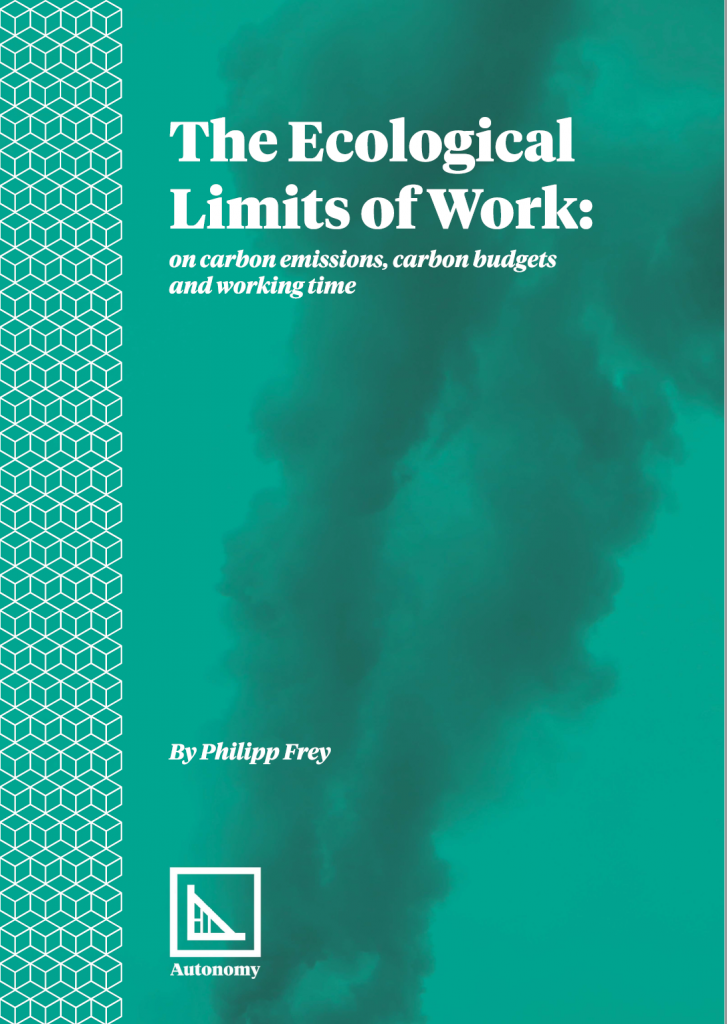
The Ecological Limits of Work: on Carbon Emissions, Carbon Budgets and Working Time

By staff - Autonomy, April 2019

Faced with accelerating technological progress and a deepening ecological crisis, a growing discussion sees a reduction in working hours as a multiple dividend policy, increasing, among other things, individual wellbeing, productivity and gender equality whilst simultaneously potentially contributing to a reduction in unemployment and greenhouse gas (GHG) emissions. One cannot help but feel reminded of some earlier sociotechnical visions of a society in which productivity gains would be shared broadly to allow for radically shorter working hours and thus a qualitatively better life.

Read the report (PDF).

What We Should Really Do for the Climate

By Samuel Miller-McDonald - The Trouble, March 16, 2019

Even after decades of talk, hundreds of campaigns, thousands of articles, and millions of dollars spent building momentum to prevent climate change, the public still doesn't know how best to nudge the economy toward collective safety and survival. While it may not still be possible to ensure safety and survival for anyone, it’s worth working to save lives, human and non-, until we can’t. It’s still important to figure out and communicate actions people should be taking to move the economy and atmosphere toward decarbonization. 

So what can we each be doing in our lives to slow climate collapse and why should we do those particular actions?  Toward the bottom of this article you’ll find a substantial, though incomplete, list of things people can do to effectively aid progress on decarbonization. I divide the list between actions for people with and without discretionary income as this is probably the single greatest factor determining how people can impact the issue in their lives. Importantly, in figuring out how individuals should act, the key difference doesn’t lie between consumption changes and political action, but in the degree to which one’s actions are coordinated with others: i.e., a movement. The list is unordered because such rankings are unhelpful in this issue. Every intervention will be more or less impactful depending on their particular circumstance and there’s no rigorous way to hierarchize effective actions. Climate change is too big for that. 

Before we get to the list, let’s first consider some of the factors that have caused such confusion on how to impact the issue so that we can strive for greater clarity now and avoid similar pitfalls going forward. 

An Ecosocialist Green New Deal: Guiding Principles

By the DSA Ecosocialist Working Group - Democratic Socialists of America - February 28, 2019

The IWW has not endorsed this document; however, individual members of the IWW EUC have helped shape it.

Humankind has reached a moment of existential crisis. Human activity is causing disastrous climate disruption and Earth’s sixth mass extinction event, triggering critical losses of biodiversity. We are already locked in for global warming that will have catastrophic effects, and we are on a slippery path to our own extinction. The 2018 Special Report from the Intergovernmental Panel on Climate Change (IPCC) warns unequivocally that “without societal transformation and rapid implementation of ambitious greenhouse gas reduction measures, pathways to limiting warming to 1.5°C and achieving sustainable development will be exceedingly difficult, if not impossible, to achieve.”

Yet, the crisis we face exceeds ecological breakdown. Deepening inequality, suppressed democracy, precarious jobs, racial and gendered violence, border hostility, and endless wars make up the terrain on which climate destabilization will be unleashed. The most vulnerable members of society will be hit hardest, first, and suffer most.

We must solve the climate crisis and the inequality crisis together. Climate remedies in the context of austerity will produce a popular backlash, as we see in the yellow vest protests against a fuel tax. Corporations profiting from fossil extraction have long worked to turn workers against environmentalists, claiming that clean energy would be a job killer. But working class and poor people’s quality of life, gravely threatened by climate disruption, would greatly improve in a just transition. Because corporate capitalism rewards extraction to concentrate wealth, it must be replaced by a sustainable economy. A Green New Deal can begin the transition from exploitative capitalism to democratic ecological socialism.

The urgency and scale of the crisis we face demand solutions that meet the magnitude of this moment. The ineffectual gradualism and corporate obedience demonstrated by the U.S. government’s climate response has proven to be a dead-end for humanity. We need rapid, systemic transformation that heals the stratification of wealth and power while putting decarbonization and justice at the forefront.

We need a Green New Deal. We demand a Green New Deal, and we demand that it serve people and planet—not profit.

Read the report (PDF).

Energy Democracy: Taking Back Power

By Johanna Bozuwa - Next System Project, February 27, 2019

Executive summary

Electric utility (re)municipalization is gaining popularity as a strategy to shift away from a reliance on fossil fuel extraction in the context of combating climate change. Across the world—from Berlin to Boulder—communities have initiated campaigns to take back their power from investor-owned (private) utilities and create publicly owned and operated utilities. Moreover, such efforts are increasingly taking on the perspective and language of energy democracy.

Energy democracy seeks not only to solve climate change, but to also address entrenched systemic inequalities. It is a vision to restructure the energy future based on inclusive engagement, where genuine participation in democratic processes provides community control and renewable energy generates local, equitably distributed wealth (Angel, 2016; Giancatarino, 2013a; Yenneti & Day, 2015). By transitioning from a privately- to a publicly owned utility, proponents of energy democracy hope to democratize the decision-making process, eliminate the overriding goal of profit maximization, and quickly transition away from fossil fuels.

Utilities are traditionally profit-oriented corporations whose structures are based on a paradigm of extraction. Following the path of least resistance, they often burden communities who do not have the political or financial capital to object to the impacts of their fossil fuel infrastructure. Residents living within three miles of a coal plant, for instance, are more likely to earn a below-average annual income and be a person of color (Patterson et al., 2011); similar statistics have been recorded for natural gas infrastructure (Bienkowski, 2015).

These utilities are in a moment of existential crisis with the rise of renewables. From gas pipelines to coal power plants, their investments are turning into stranded assets, as political leaders and investors realize that eliminating fossil fuels from the energy mix is paramount to creating healthy communities and stemming climate change.

Unfortunately, often publicly owned utilities in the United States have similar energy generation profiles to their privately owned counterparts (American Public Power Association, 2015). This paper explores the extent to which publicly owned utilities are reticent to take on the new energy paradigm and evaluates their ability to provide energy democracy compared to investor-owned utilities.

One, Two, … Many Green New Deals: An Ecosocialist Roundtable

By Carol Dansereau, John Foran, Ted Franklin, Brad Hornick, Sandra Lindberg, Jennifer Scarlott - Resilience, February 26, 2019

Introduction by John Foran

There was a saying in the Green Party – perhaps I made it up: “Two Greens, three opinions.” Ecosocialists, perhaps, tend to be slightly more in agreement with a few basic principles, or “Points of Unity.”  Yet there are a number of ecosocialist responses to the Green New Deal, converging for the most part around the recognition that though it is not the Green New Deal most of us would prefer, it is the opportunity to move the paralysis of the climate change movement very far in the right – left – direction that our times so desperately need.

This is an essay in six voices, from long-time activists who participate in the North American ecosocialist network System Change Not Climate Change.  Each challenged to make their point in 500 words or less, we intend this as a constructive contribution to the wonderful storm of discussion that the Green New Deal has opened up, and we welcome your comments on the essay below, as well as in the discussion space of SCNCC!

Pages

The Fine Print I:

Disclaimer: The views expressed on this site are not the official position of the IWW (or even the IWW’s EUC) unless otherwise indicated and do not necessarily represent the views of anyone but the author’s, nor should it be assumed that any of these authors automatically support the IWW or endorse any of its positions.

Further: the inclusion of a link on our site (other than the link to the main IWW site) does not imply endorsement by or an alliance with the IWW. These sites have been chosen by our members due to their perceived relevance to the IWW EUC and are included here for informational purposes only. If you have any suggestions or comments on any of the links included (or not included) above, please contact us.

The Fine Print II:

Fair Use Notice: The material on this site is provided for educational and informational purposes. It may contain copyrighted material the use of which has not always been specifically authorized by the copyright owner. It is being made available in an effort to advance the understanding of scientific, environmental, economic, social justice and human rights issues etc.

It is believed that this constitutes a 'fair use' of any such copyrighted material as provided for in section 107 of the US Copyright Law. In accordance with Title 17 U.S.C. Section 107, the material on this site is distributed without profit to those who have an interest in using the included information for research and educational purposes. If you wish to use copyrighted material from this site for purposes of your own that go beyond 'fair use', you must obtain permission from the copyright owner. The information on this site does not constitute legal or technical advice.

