You are here

labor and environment

International action on Just Transition: what’s been accomplished, and proposals for the future

By Elizabeth Perry - Work and Climate Change Report, September 27, 2017

Just Transition – Where are we now and what’s next? A Guide to National Policies and International Climate Governance  was released on September 19 by the International Trade Union Confederation, summarizing what has been done to date by the ITUC and through  international agencies such as the  ILO, UNFCCC, and the  Paris Agreement.  It also provides short summaries of some transition situations, including the Ruhr Valley in Germany, Hazelwood workers in the LaTrobe Valley, Australia, U.S. Appalachian coal miners and the coal mining pension plan, Argentinian construction workers, and Chinese coal workers.  Finally, the report calls for concrete steps to advance Just Transition and workers’ interests.

The report defines Just Transition on a national or regional scale, as  “an economy-wide process that produces the plans, policies and investments that lead to a future where all jobs are green and decent, emissions are at net zero, poverty is eradicated, and communities are thriving and resilient.” But the report also argues that Just Transition is important for companies, with social dialogue and collective bargaining as key tools to manage the necessary industrial transformation at the organizational level.  To that end, the ITUC is launching “A Workers Right To Know” as an ITUC campaign priority for 2018, stating, “Workers have a right to know what their governments are planning to meet the climate challenge and what the Just Transition measures are. Equally, workers have a right to know what their employers are planning, what the impact of the transition is and what the Just Transition guarantees will be. And workers have a right to know where their pension funds are invested with the demand that they are not funding climate or job destruction.”

The ITUC report makes new proposals. It calls on the ILO to take a more ambitious role and to negotiate a Standard for Just Transition by 2021, carrying on from the Guidelines for a just transition towards environmentally sustainable economies and societies forAll  (2015).   The ITUC also states “expectations” of how Just Transition should be given greater priority in the international negotiation process of the United Nations Framework Convention on Climate Change (UNFCC), so that:  Just Transition commitments are incorporated into the Nationally Determined Contributions (NDCs) of countries; Just Transition for workers becomes a permanent theme within the forum on response measures under the Paris Agreement, and Just Transition is included in the 2018 UNFCCC Facilitative Dialogue. It also calls for the launch of a “Katowice initiative for a Just Transition” at the COP23 meetings to take place in Katowice, Poland in 2018, “to provide a high-level political space”.  Finally, the ITUC calls for expansion of the eligibility criteria of the Green Climate Fund to allow  the funding of Just Transition projects.

Just Transition – Where are we now and what’s next? is a Climate Justice Frontline Briefing from the International Trade Union Confederation, with support from the Friedrich Ebert Stiftung and is based upon Strengthening Just Transition Policies in International Climate Governance by Anabella Rosemberg, published as a Policy Analysis Brief by the Stanley Foundation in 2017.

California’s progressive policies yield better job growth and wage growth than Republican comparators

By Elizabeth Perry - Work and Climate Change Report, January 15, 2018

A November 2017 report from the Labor Center at University of California Berkeley  examined the “California Policy Model” –  defined as a collection of 51 pieces of legislation and policy implementations enacted in California between 2011 and 2016 – and found that with progressive policies such as minimum wage increases, increased access to health insurance, reduction of carbon emissions and higher taxes on the wealthy, the state showed  superior economic  performance  in comparison to Republican-controlled states and to a simulated version of California without such policies.  According to  “California is Working: The Effects of California’s Public Policy on Jobs and the Economy since 2011,  the suite of progressive policies resulted in superior total employment growth , superior private sector employment growth, and higher wage growth for low-wage workers from 2014 to 2016. All the while, keeping the state on track to meet its 2020 GHG emissions targets.  The  environmental policies included in the analysis were: starting in 2006, AB 32, which committed the state to lowering its greenhouse gas emissions to 1990 levels by 2020;  regulations under AB 32 in 2012 and 2013, which introduced the state cap and trade program;  SB 350 in 2015 and 2016,  committing the state to greater use of renewable energy and further improvements in energy efficiency ; and SB 32, which raised the emissions reduction goal to 40 percent below 1990 levels by 2030.  The report warns that  enforcement of labour standards and a lack of affordable housing remain as challenges facing the state, and also admits to possible weakness  regarding the second of its two methods of analysis, the synthetic control statistical method.

Just Transition for the coal industry is expensive – but cheaper than failure to address the needs

By Elizabeth Perry - Work and Climate Change Report, September 5, 2017

July 2017 saw the release of  Lessons from Previous Coal Transitions:  High-level Summary for Decision-makers , a synthesis report of case studies of past coal mining transitions in Spain, U.K., the Netherlands, Poland, U.S., and the Czech Republic – some as far back as the 1970’s.  Some key take-aways from the report:  “Because of the large scale and complexity of the challenges to be addressed, the earlier that actors (i.e. workers, companies and regions) anticipated, accepted and began to implement steps to prepare and cushion the shock of the transition, the better the results”; “the aggregate social costs to the state of a failure to invest in the transition of workers and regions are often much higher that the costs of not investing from an overall societal perspective.” While the level of cost details varies in the case studies, it is clear that costs are significant.  For example, the case study of Limburg, Netherlands states that the national government spent approximately 11.6 billion Euros (in today’s prices) on national subsidies to support coal prices and regional reconversion, in addition to  several 100 million per year in EU funds. “One estimate also suggested that in the Dutch case, all told, regional reinvestment in new economic activities also cost about 300 to 400 000€/per long-term job created.”  Limburg is also cited as “remarkable for the relatively consensual nature of the transition between unions, company and government.”  (see page 10).

The Synthesis report and individual case study reports of the six countries are available here . These are the work of the Research and Dialogue on Coal Transitions project, a large-scale research project led by Climate Strategies and the Institute for Sustainable Development and International Relations (IDDRI) , which also sponsors the Deep Decarbonization Pathways Project.  Future reports scheduled for 2018: a Global report, and a Round Table on the Future of Coal.

A New Horizon: Innovative Reclamation for a Just Transition

By various - Reclaiming Appalachia Coalition, 2019

The certainty of an Appalachian transition has become self-evident. The questions that remain are “What shape will that transition take?” and “Will our region seize the opportunity to establish just and sustainable economic models that invest in our strengths and set the region up for meaningful and healthy participation in the new economy?” Foundational to our coalition’s work is the understanding that specific, targeted intervention is necessary to ensure that an equitable vision becomes reality.

Appalachia is at the threshold of a paradigm shift into the new economy, ushered in by communities that are taking their futures into their own hands like never before and implementing innovative ways to address long-standing economic issues with degraded lands. The table on page 6 shows funded projects illustrating this shift that have been supported by our coalition, ranging from ecotourism, renewable energy, arts and culture, and creative waste recycling.

This report highlights the successes achieved in 2019 from previously submitted projects and showcases a brand new round of innovative projects. We’re very excited about both the successes that have already been funded and implemented, as well as the new opportunities that are currently being considered for Abandoned Mine Lands (AML) Pilot funding.

Read the report (Link).

Pope’s encyclical sets the tone for June 29th Trade Union Climate Summit in New York

By Sean Sweeney - Trade Unions for Energy Democracy, June 17, 2015

Just 11 days after Pope Francis released his encyclical on the environment, New York will host a major gathering of 40 unions from 14 countries. With resistance to ‘extreme extraction,’ austerity and inequality all rising, unions see opportunities to begin to build a united global movement for fundamental change.  The Pope’s radical critique of the existing system is sure to resonate with the 100-person gathering.

More than 40 unions from 14 countries will participate in a one-day Trade Union Climate Summit in New York City on June 29th, 2015.  Hosted by 32BJ SEIU, approximately 25 unions from the US will be present, representing workers in energy, nursing and health care, public transport, food and retail, building services, as well as new organizing efforts among precarious workers in the New York City area. Roughly 30 allied organizations will also participate, including the Climate Justice Alliance, 350.org, and the Emerald Cities Collaborative. A full list of registered participants is here.

Why a summit?

The summit is being organized nine months after the massive People’s Climate March on September 21, 2014, and just 5 months before the ‘last chance’ UN climate negotiations (COP 21) in Paris in early December 2015. Unions and close allies will come together in New York determined to find ways to help better connect the rising climate movement with the growing global struggle against austerity and inequality.  Unions have been playing an important role in both movements, but in most instances fighting for climate protection (read: people protection) and building opposition to austerity, low pay and precarious work remain separate struggles. But the potential for building a new and tranformational ‘climate and class movement’ appears to be growing.

This potential seems particularly visible in Southern Europe where the left has won impressive electoral victories in recent months. Importantly, this is a left for which atmospheric and ecological degradation is not an afterthought, but a central question that reveals a basic truth: we live in a political economy that takes but does not give back. Both nature and labor are inseparable, and both are treated as a ‘resource’ from which value is extracted as needed and then dumped.

The June 29 summit in New York will hear from unions from Greece (Thessaloniki water workers) and Spain (Comisiones Obreras) as well as from Italy (CGIL) where the traditional political parties are also losing support. With an eye on the Paris climate talks, the summit will hear from two representatives from the main French trade union federation (CGT) regarding the preparations for the events around COP21.  The UN climate meetings have been the scene of large mobilizations in recent years, particularly Copenhagen in late 2009 and Durban in late 2011.

The Ruhr or Appalachia: Deciding the Future of Australia’s Coal Power Workers and Communities

By Peter Sheldon, Raja Junankar, and Anthony De Rosa Pontello - CFMMEU Mining and Energy, December 3, 2018
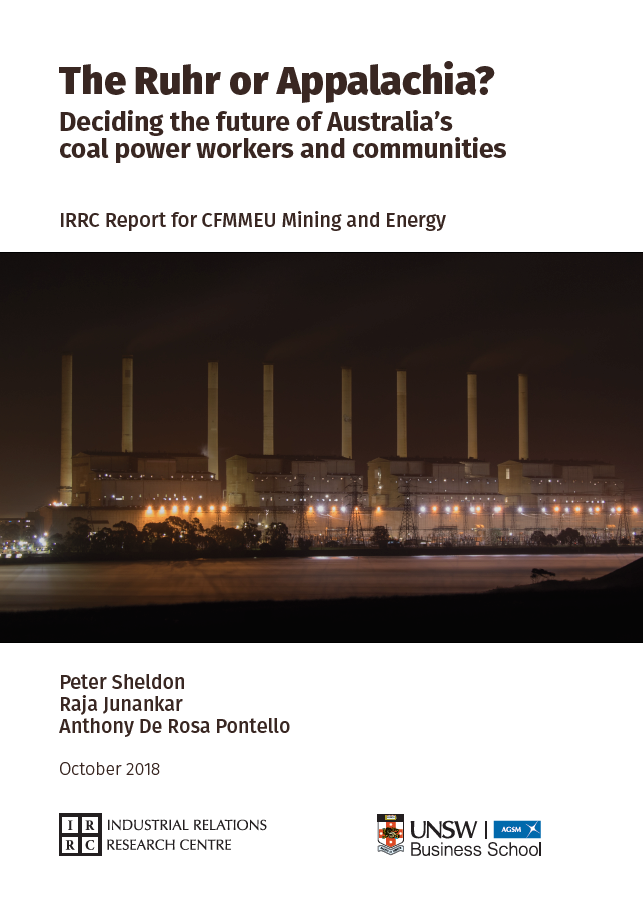
Australia’s coal-fired power stations will all close in the next two or three decades. We know this because the companies that operate the 23 power stations currently operating nation-wide have told us so.

Despite the empty rhetoric of some, it is unlikely that the economic case for investing in new coal-fired power stations in Australia will stack up. Those who currently own and operate coal power stations have no plans to build new ones.

The bad news is that the transition in how we produce power will bring great change to the workers and communities we have relied on to provide Australian homes and industry with reliable energy over many decades.

The good news is that we have the lead time to make smart decisions about what that change looks like—or at least, we now have the lead time after being caught unprepared by earlier closures, including Hazelwood in 2017.We have the choice to manage this structural economic change so that individuals, families and regions aren’t abandoned to unemployment, low-value jobs, poverty and associated health and social decline. Even better, we have the evidence about what works to deliver just transitions for coal power workers and communities, with skills, jobs, opportunities and hope for the future.

Communities grow around power stations and the mines that supply them. They are unique communities bonded in many cases by history, geography, difficult and dangerous working conditions and good unionised jobs. They are also uniquely vulnerable in their heavy dependence on the coal power industry.

This analysis of transitions in resource economies internationally and here in Australia provides valuable insights into the ingredients of success and the wide scope of outcomes.The Appalachian region in the United States is a heart-breaking story of industry transition characterised by short-term, reactive and fragmented responses to closures of coal mines, resulting in entrenched, intergenerational poverty and social dysfunction.

Compare this with the transition away from a heavy reliance on coal mining in Germany’s Ruhr region, where forward planning, investment in industry diversification, staggering of mine closures and a comprehensive package of just transition measures delivered a major reshaping of the regional economy with no forced job losses.

Central to these vastly different outcomes is the presence of a national, coordinated response. To this end, a major recommendation of this report is the establishment of a national, independent statutory authority to plan, coordinate and manage the transition.

In the energy debate to date, the impact of the transition on workers and communities has been almost completely ignored. This is an omission we can’t afford. After all, the costs of investing in a Just Transition need to be balanced against the costs of doing nothing and abandoning whole communities to a bleak future.

While global trends suggest that Australian export coal for steelmaking and energy production will be in demand for decades to come, coal-fired power generation in Australia is winding down. On the information available, there are no excuses for not taking action to protect the best interests of those affected.</p.

I thank Peter Sheldon and the team at UNSW Sydney’s Industrial Relations Research Centre for this important piece of work. I call on all power industry stakeholders to engage with its findings and consider how we can work together to deliver a Just Transition for coal power workers and communities.

Read the report (PDF).

Climate Stability, Worker Stability: are they compatible?

By Dr. Louise Comeau, JD, PhD and Devin Luke - Adapting Canadian Work and Workplaces to Respond to Climate Change, December 3, 2018

It appears we face a low- carbon transition dilemma. On the one hand, climate change solutions, like greenhouse gas regulation and carbon pricing, raise concerns about potential job displacement for workers in traditional energy sectors like oil and gas production and fossil-fuel generated electricity. Hence the calls for just transition. Our research, however, suggests that this blame may be at least partially misplaced. Energy workforce changes are currently affected by broader societal changes relating to fuel-cost differentials (i.e., natural gas cheaper than coal), automation, and the societal transition to non-unionized, unstable and lower-paying work. Greenhouse gas regulations and carbon pricing are certainly not the only driver of workforce change, and likely not, at least currently, not the primary driver.

Should proponents of renewable energy, energy efficiency and the low-carbon transition address these broader societal trends? If so, how? Is the solution to focus on collective responses such as energy cooperatives, public sector ownership of renewable energy supply, utility-scale and managed energy efficiency programs, rather than market- based, privatized solutions? These questions are worth answering. Our goal with this study was to better understand the training needs associated with renewable energy and energy efficiency job projections. There appears, however, to be a greater need to better integrate climate change and low-carbon economy discussions into a broader discourse on the nature of work.

Read the report (PDF).

Jobs, Justice, and the Clean-Energy Future

By Jeremy Brecher - Dollars and Sense, September & October, 2016

Today, there are 400 parts per million (PPM) of carbon dioxide in the atmosphere, far above the 350 ppm climate scientists regard as the safe upper limit. Even in the unlikely event that all nations fulfill the greenhouse gas (GHG) reduction pledges they made at the Paris climate summit at the end of 2015, carbon in the atmosphere is predicted to increase to 670 ppm by the end of this century. The global temperature will rise an estimated 3.5 degrees Celsius (6.3 degrees Fahrenheit) above pre-industrial levels. For comparison, a one-degree increase was enough to cause all the effects of climate change we have seen so far, from Arctic melting to intensified hurricanes to desertification.

Limiting climate catastrophe will require drastic cuts in the burning of the fossil fuels that cause climate change. But many workers and their unions fear that such cuts will lead to drastic loss in jobs and economic well-being for working people—aggravating the shortage of good jobs and the burgeoning inequality we already face. Is there a way to escape the apparent lose-lose choice between saving the climate and saving jobs?

How Labor and Climate United Can Trump Trump

By Jeremy Brecher - Labor Network for Sustainability, January 2017

Donald Trump and his congressional Republican allies have taken control of the U.S. government. The result threatens to be devastating for both labor and the climate — not to mention immigrants, African Americans, Muslims, women, children, the elderly, the disabled, LGBTQ people, and many others.

The Trump regime is potentially vulnerable because it only represents the interests of the top 1% of the top 1%. But it has a potentially winning strategy to rule nonetheless: keep those who might stand up in the interest of the 99.9 percent divided and therefore powerless. While Trump has played black against white, Latino against Anglo, women against men, gay against straight, and exploited many other divisions, his “trump card” may well be his ability to divide labor and climate advocates.

The Trump ascendancy creates a new context for addressing long-standing tensions between organized labor and the environmental movement, between workers’ job concerns and everyone’s need to protect the climate. Trump and his congressional Republican allies intend to exploit these tensions to the max. But their threat to workers, the earth’s climate, and society as a whole make cooperation against them imperative for both organized labor and the climate protection movement. Forging a force that can effectively counter Trumpism requires change that will involve tension within each movement as well as between them, but that may be necessary if either is to have a future. The alternative is most likely decimation of both movements and of everything they are fighting for.

New Report: Protect the Climate, Save Money, and Create Jobs

By Joe Uehlein - Labor Network for Sustainability, October 14, 2015

Disclaimer: The views expressed here are not the official position of the IWW (or even the IWW’s EUC) and do not necessarily represent the views of anyone but the author’s.

Today labor and environmental organizations released a new report, The Clean Energy Future: Protecting the Climate, Creating Jobs and Saving Money, showing that the United States can reduce greenhouse gas [GHG] emissions 80 percent by 2050 — while adding half-a-million jobs and saving Americans billions of dollars on their electrical, heating, and transportation costs.

Joe Uehlein of the Labor Network for Sustainability says, “This report is good news for American workers. Protecting the climate has often been portrayed as a threat to American workers’ jobs and the U.S. economy. But this report shows that a clean energy future will produce more jobs than “business as usual” with fossil fuels.”

May Boeve of 350.org says, “This report presents a practical, realistic way for the United States to address the climate crisis and proves that we don’t have to choose between jobs and the environment.”

The Clean Energy Future: Protecting the Climate, Creating Jobs and Saving Money refutes the claim that meeting the IPCC targets will cause economic devastation. Indeed, not only can these targets can be met, but meeting them will create more jobs and save money. This report, prepared by the Labor Network for Sustainability and 350.org, with research conducted by a team led by economist Frank Ackerman of Synapse Energy Economics, lays out an aggressive strategy for energy efficiency and renewable energy that will:

Transform the electric system, cutting coal-fired power in half by 2030 and eliminating it by 2050; building no new nuclear plants; and reducing the use of natural gas far below business-as-usual levels.

  • Reduce greenhouse gas emissions 85 percent below 1990 levels by 2050, in the sectors analyzed (which account for three-quarters of US GHG emissions).
  • Save money – the cost of electricity, heating, and transportation under this plan is $78 billion less than current projections from now through 2050.
  • Create new jobs – more than 500,000 per year over business as usual projections through 2050.

This program will help bring together environmental and labor advocates around their common interest in putting Americans to work saving the earth’s climate. Climate protection has caused significant friction between labor unions and environmentalists around whether to create jobs or address climate change. The report demonstrates that this is a false choice. For unions and other jobs advocates, climate protection is also a great jobs program. We can create many more jobs by protecting the environment than by expanding the fossil fuel infrastructure.

Read the full report here: PDF

Pages

The Fine Print I:

Disclaimer: The views expressed on this site are not the official position of the IWW (or even the IWW’s EUC) unless otherwise indicated and do not necessarily represent the views of anyone but the author’s, nor should it be assumed that any of these authors automatically support the IWW or endorse any of its positions.

Further: the inclusion of a link on our site (other than the link to the main IWW site) does not imply endorsement by or an alliance with the IWW. These sites have been chosen by our members due to their perceived relevance to the IWW EUC and are included here for informational purposes only. If you have any suggestions or comments on any of the links included (or not included) above, please contact us.

The Fine Print II:

Fair Use Notice: The material on this site is provided for educational and informational purposes. It may contain copyrighted material the use of which has not always been specifically authorized by the copyright owner. It is being made available in an effort to advance the understanding of scientific, environmental, economic, social justice and human rights issues etc.

It is believed that this constitutes a 'fair use' of any such copyrighted material as provided for in section 107 of the US Copyright Law. In accordance with Title 17 U.S.C. Section 107, the material on this site is distributed without profit to those who have an interest in using the included information for research and educational purposes. If you wish to use copyrighted material from this site for purposes of your own that go beyond 'fair use', you must obtain permission from the copyright owner. The information on this site does not constitute legal or technical advice.