






You are here
Donald Trump
 A municipalist revolution is impossible without the support and cooperation of labor unions. In some cases, labor unions might themselves take the lead in promulgating a municipalist shift. To effectively pursue this path, the left must grapple with the diverse composition and structure of the working class — joining calls for union democracy with nascent municipalist movements. Experiments in participatory democracy can then be tried and tested at the intra-union level, nourishing possibilities for subsequent municipal-wide implementation.
 Like the sections of pipe they are assembled from, pipelines with names like Algonquin, Dominion and Kinder Morgan/TCG CT Expansion are interconnected, and affect a long string of communities crisscrossing the country. The 2.5 million miles of oil and natural gas pipelines frequently leak and rupture, a
  The Trump administration has made
  This June I traveled to the heart of coal country in southern West Virginia, my native state. Over recent years films and news stories have exposed the ravages of mountaintop-removal mining on that land and its people’s health and livelihood. The documentary Blood on the Mountain, a feature last year and this in our metro DC LaborFest, is one such source. It portrays this most intensely mechanized technology as an acceleration of a century of Appalachian exploitation by the mining industry. Shaving off mountain tops, it now extracts many more tons of coal with fewer workers. That has shrunk the scope for comparatively well-paid work that the United Mine Workers (UMWA) long struggled hard to negotiate. Mountaintop-removal has intensified risks of damage from flooding, blasting, ambient coal dust, sludge storage and water pollution. State – and now federal – officials fail to enforce what regulations exist against workers’ risks, water pollution and greenhouse gas emissions. Fracked cheap natural gas nevertheless outcompetes coal.
 There has been no drought of media attention about coal, coal miners, and Appalachia over the past year. I myself have fielded more than a dozen calls from media outlets wanting to know more about the region, each looking for new angles or “ins” with coal mines and coal miners. Though a few have done a decent job contextualizing Appalachia’s deeper issues, many still manage to skip over some very important details about our situation—and that’s a problem. It’s this lack of depth that allows authors like J.D. Vance, and his book Hillbilly Elegy to reach national best seller status and thereby define our existence among an international audience.
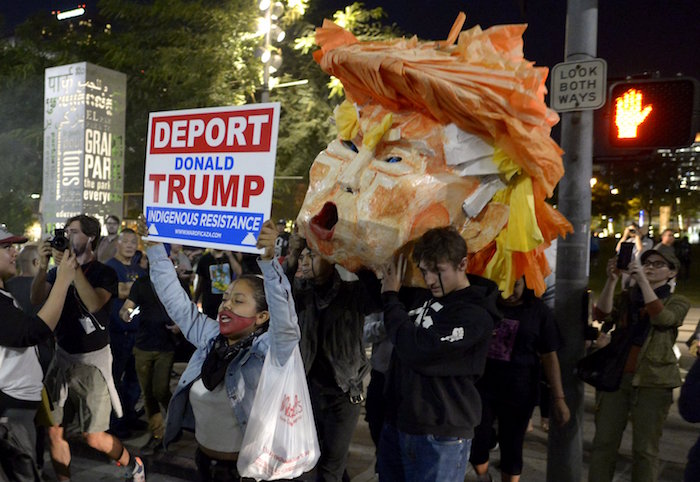 Arshiya Chime is a union member helping to rescue the world from climate change. Once she gets her doctorate degree later this year from the University of Washington, she will become a highly prized mechanical engineer, helping economies become less dependent on oil while protecting the environment and creating jobs. But Chime, a leader in her graduate student employees union, United Auto Workers Local 4121, is not welcome in Donald Trump’s vision of America. As an Iranian immigrant, she’s denied the right to freely travel. If Trump’s Muslim travel ban orders ultimately are upheld, Chime would probably have to take her expertise to another country, because U.S. firms won’t want to hire someone unable to work on foreign projects and attend international conferences.
 According to reports from the
  On July 7-9, I was in London (UK) to speak at the Marxism Festival, an annual conference organized by the Socialist Workers Party. I have some political differences with the SWP, but I was impressed by the enthusiasm and commitment of the 2500 participants, and by the number of sessions that were devoted to environmental and scientific questions.
  This guide is a project of Save EPA, an all-volunteer organization based in Colorado and made up of former employees of the U.S. Environmental Protection Agency. We have expertise in environmental science, law and policy. We are using our collective expertise to educate and advocate about environmental science, environmental protections and the Trump Administration’s assault on EPA and our public health.
 Our beloved world is entering an increasingly unstable period, full of dangers and also full of possibilities. In many countries, old political parties are crumbling faster and anyone thought imaginable. Old geopolitical alliances have come unglued as the US comes to exercise its role as world hegemon in new and unpredictable ways. The development of the internet, of mobile phones and of apps has led to incredible disruption of many aspects of many societies: from how we pay for and listen to music, to how we consume and propagate information and news, to how we shop for almost anything. All that is solid is melting into air.
The Fine Print I:
Disclaimer: The views expressed on this site are not the official position of the IWW (or even the IWW’s EUC) unless otherwise indicated and do not necessarily represent the views of anyone but the author’s, nor should it be assumed that any of these authors automatically support the IWW or endorse any of its positions.
Further: the inclusion of a link on our site (other than the link to the main IWW site) does not imply endorsement by or an alliance with the IWW. These sites have been chosen by our members due to their perceived relevance to the IWW EUC and are included here for informational purposes only. If you have any suggestions or comments on any of the links included (or not included) above, please contact us.
The Fine Print II:
Fair Use Notice: The material on this site is provided for educational and informational purposes. It may contain copyrighted material the use of which has not always been specifically authorized by the copyright owner. It is being made available in an effort to advance the understanding of scientific, environmental, economic, social justice and human rights issues etc.
It is believed that this constitutes a 'fair use' of any such copyrighted material as provided for in section 107 of the US Copyright Law. In accordance with Title 17 U.S.C. Section 107, the material on this site is distributed without profit to those who have an interest in using the included information for research and educational purposes. If you wish to use copyrighted material from this site for purposes of your own that go beyond 'fair use', you must obtain permission from the copyright owner. The information on this site does not constitute legal or technical advice.
 This site is not the official webpage of the Industrial Workers of the World.