

You are here

sacrifice zones

A Train Bound for Tragedy

By Kari Lydersen - In These Times, October 18, 2013 (used by permission)

Disclaimer: The views expressed here are not the official position of the IWW (or even the IWW’s EUC) and do not necessarily represent the views of anyone but the author’s.

On July 6, a derailed oil train crashed into the small Quebec town of Lac-Mégantic, killing 47 people. The tragedy highlighted a distressing practice in the freight train industry: Namely, that thanks to technological developments over the last few decades, a single engineer might now be expected to operate a 100-car train. Because of the lack of oversight, say many railroad workers, that lone man’s mistake could end in disaster.

“The Canada accident really put the spotlight on what can happen if you have one person responsible for such a big piece of machinery,” says J.P. Wright, a locomotive engineer with CSX Transportation in Kentucky and organizer with Railroad Workers United, a national group of progressive labor activists including members from different rail unions, in an interview with In These Times.

RWU, along with the Brotherhood of Locomotive Engineers and Trainmen (BLET), has highlighted the Montreal disaster as an example of potential tragedies workers think will increase if the industry continues its push for one-man trains. 

However, Ed Burkhardt, chairman of Montreal, Maine & Atlantic Railways, the company running the Quebec train, tells In These Times that one-man crews had nothing to do with the July accident. He argues that the derailment, which occurred when the train’s sole operator left it parked unmanned to spend the night at an inn, could have happened with a two-man crew as well.

“This was a situation where the hand brakes were not properly applied. An employee failed in his duties there. It could be an employee of a two-man crew just as well as an employee of a one-man crew,” Burkhardt says.

But rail workers say that inevitable human errors or unforeseeable accidents will become more frequent and more deadly with only one person running a train.

EagleRidge Ignores Fracking Worker Safety

By Sharon Wilson - Originally published on Earthblog, October 16, 2013

Disclaimer: The views expressed here are not the official position of the IWW (or even the IWW’s EUC) and do not necessarily represent the views of anyone but the author’s.

We already know that EagleRidge is a terrible neighbor!

  • An EagleRidge Operating worker was indicted in June 2012 on a felony charge of illegally dumping. City employees visiting the company’s well site in the 3100 block of Airport Road found a pump forcing contaminated water into a tributary of Hickory Creek. LINK
  • EagleRidge was operating wells in Denton without a permit. LINK
  • EagleRidge had a blowout in Denton that got "sanitized." LINK But it didn't stay "sanitized." LINK
  • EagleRidge is drilling in a Denton neighborhood less than 200 feet from homes.
  • EagleRidge is drilling in Mansfield and polluting air, violating sound ordinances and dividing neighbors. LINK

So it's no surprise to learn that EagleRidge is an awful employer that lacks regard for worker safety. Yesterday I stopped to take photos and video when I passed the EagleRidge drill site directly across from the University of North Texas athletic facility. (Yes, I know: polluting the air our young people are gulping in while practicing sports is reckless.) The video shows workers walking amidst swirling clouds of silica sand aka frack sand. In May 2012, OSHA and NIOSH issued a HAZARD ALERT regarding exposure to silica during hydraulic fracturing. The OSHA info sheet details steps industry needs to take to limit the amount of silica exposure. While they recommend breathing protection, they caution that respirators alone are not sufficient at the levels of exposure seen during fracking. Media reported that workers in Texas were exposed to over 10 times the safe limit.

Railroading Quebec

By Jonathan Flanders - Reproduced from Counterpunch, August 12, 2013

Disclaimer: The views expressed here are not the official position of the IWW (or even the IWW’s EUC) and do not necessarily represent the views of anyone but the author’s.

The bad news for the beleaguered trackside inhabitants of Lac Megantic, Quebec, continues to roll relentlessly downhill, just as the The Montreal, Maine & Atlantic Railway(MM&A)  train did before it exploded in their town, incinerating more that forty of their citizens. After MM&A CEO Edward Burkhardt assured them that his railroad would pay for all the expenses of a cleanup, in the more or less immediate period after the crash(he took a few days to show up), his railroad has sought bankruptcy protection both in Canada and the US, and it has been revealed that it had only 25 million dollars in liability insurance. This is a fraction of what the ultimate cost will be to remediate the environmental disaster created by the wreck. Never mind making whole the families of the dead in Lac Megantic.

According the CBC “ “Burkhardt said that the railway wishes to continue to work with municipal and provincial authorities “on environmental remediation and cleanup as long as is necessary, and will do everything within its capacity to achieve completion of such goal.””

Evidently this railroad’s capacity only extends as far as hiring lawyers, since it has welshed on its bills for the cleanup so far, leaving Lac Megantic and Quebec to step in to pay cleanup workers. And as we know, once the corporate lawyers start circling  a disaster, the settlement will take years, not months.

Lac-Mégantic and the Presumed Innocence of Capitalism

The Lac-Mégantic disaster shows once again that capitalists  are self-interested, uncaring, anti-social actors, not worthy of presumptions in their favor.

By Harry Glasbeek - Reposted from Climate and Capitalism, July 24, 2013

Disclaimer: The views expressed here are not the official position of the IWW (or even the IWW’s EUC) and do not necessarily represent the views of anyone but the author’s.

“If the soul is left in darkness, sins will be committed. The guilty one is not he who commits the sin, but he who creates the darkness.”

-Victor Hugo, Les Misérables-

It is always the same.

First the shock and horror, then the anger. A terrible environmental disaster inflicted by Beyond Petroleum in the Gulf of Mexico; a horrendous explosion at Union Carbide’s Bhopal plant; a mine disaster, burying people at Westray in Nova Scotia; a factory building collapsing in Bangladesh; a train’s cargo exploding and incinerating people and the city of Lac-Mégantic.

Each time there are the same questions:

  • Why was anyone allowed to engage in this activity, given its known risks?
  • Why, more specifically, were people with poor reputations in respect of safety and/or people with little experience allowed to run these risky activities?
  • Why did governments not have better laws and regulations?
  • Why did governments not have better monitoring and policing of such laws and regulations they had enacted?
  • How dared the leaders of these risk-creating entities try to blame their hapless underlings?
  • How could they be so cavalier, so callous, so arrogant? Who was to pay for the compensation?
  • Should anyone go to jail?

The reasons for the shock and anger are obvious: the burned bodies, destroyed lives and livelihoods, ravaged environments, disrupted communities, misery all round. And each time, sombre-looking politicians and policy-makers walk around the sites, solemnly promise to learn from the event, assuring the stunned public that they will not let it happen again, that heads will roll if legal justice demands it.

Each time people are shocked and horrified because they believe that they live under a regime of a mature and civilized political economy.

They have been told that for-profit entrepreneurs care about their health and safety; they are taught that their elected governments will force entrepreneurs to put health and safety and environments ahead of profit-maximization.

By Rail or Pipeline: Can Tar Sands be Safely Transported at All?

By Jonathan Flanders - Reproduced from Counterpunch, July 8, 2013

Disclaimer: The views expressed here are not the official position of the IWW (or even the IWW’s EUC) and do not necessarily represent the views of anyone but the author’s.

My last years working as a railroad machinist were spent working on locomotive air brakes. In most situations, the system is fail safe. I always chuckle when I see a movie where a train separates, as it did in the latest James Bond thriller, and  both ends of the train keep going. This is close to impossible in real life, the air brake system automatically will go into emergency braking if there is a break in two. When a locomotive engineer applies the brakes to a train, he or she makes a “reduction”

of the equalizing or control air, which then triggers a brake application. This reduction of equalizing air, in the case of a break is the key to emergency brake applications. There is much more to the system, of course as it was refined over time, but its all based on this concept.

What we know so far in Quebec, is that the oil train was parked on a grade. The brakes were set by the crew, at some point the brakes came off, and the train rolled into the little town of Lac-Megantic, derailed and exploded, leaving many dead and the town devastated.

Animation of Fire at Chevron's Richmond Refinery, August 6, 2012

Crisis in California: Everything Touched by Capital Turns Toxic

By Gifford Hartman - January 2010

In California toxic capitalist social relations demonstrated their full irrationality in May 2009 when banks bulldozed brand-new, but unsold, McMansions in the exurbs of Southern California.

Across the United States an eviction occurs every thirteen seconds and there are at the moment at least five empty homes for every homeless person. The newly homeless are finding beds unavailable as shelters are stretched well beyond capacity. Saint John’s Shelter for Women and Children in Sacramento regularly turns away 350 people a night. Many of these people end up in the burgeoning tent cities that are often located in the same places as the ‘Hoovervilles’—similar structures, named after then President Herbert Hoover—of the Great Depression of the 1930s.

Read More - Download the PDF version of this document.

Capitalism, Right Libertarianism and the problem of “externalities?”

By Gary Elkin - December 3, 2009 [date uncertain] [PDF File Available]

Ecology.IWW.ORG web editor's note: "right-libertarian" is more or less synonymous with "anarcho-capitalism", although the latter is the most extreme expression of the former. Essentially, that economic theory and political ideology is championed by the Austrian School of Economics whose adherents include Ludwig Von Mises, F. A. Hayek, Henry Hazlitt, Robert Nozick, and Murray Rothbard. Their ideas have been vulgarized by "libertarian" dogmatist and novelist, Ayn Rand, and were revived in the 1980s by Milton Friedman, Margaret Thatcher, and Ronald Reagan after being discredited following the Great Depression of the 1920s and 30s in the United States and Europe. That being said, essentially the following rules really apply to ALL forms of capitalism, even the Keynesian social democracy so vehemently despised by the aforementioned laissez-faire ideologues:

Right libertarians have great difficulty in dealing with the problem of “externalities”: that is, harmful environmental effects (e.g. pollution, global warming, ozone depletion, destruction of wildlife habitat) not counted as “costs of production” in standard methods of accounting. Such costs must be born by everyone in the society who is affected by them, and not only by the capitalists who produce them; hence it is possible for capitalist to ignore such effects when planning future production. But this means that such effects will be ignored, since competition forces firms to cut as many costs as possible and concentrate on short-term profits.

Right libertarians typically address the problem of externalities by calling for public education which will raise people’s awareness of ecological problems to the point where there will be enough demand for environment-friendly technologies and products that they will be profitable.

This argument, however, ignores two crucially important facts: (1) that environment-friendly technologies and products by themselves are not enough to avert ecological disaster so long as capitalism retains its need for high growth rates (which it will retain because this need is inherent in the system); and (2) that in a right-libertarian world in which private property is protected by a “night-watchman State” or private security forces, a wealthy capitalist elite will still control education, as it does now — and this because education is an essential indoctrination tool of the capitalist elite, needed to promote capitalist values and train a large population of future wage-slaves in proper habits of obedience to authority. For this reason, capitalists cannot afford to lose control of the educational system, no matter how much it costs them to maintain competitive schools. And this means that such schools will not teach students what is really necessary to avoid ecological disaster: namely, the dismantling of capitalism itself.

Another ecological problem that right libertarians cannot deal with satisfactorily is that capitalist firms must be committed to short-term profitability rather than long-term environmental responsibility in order to survive economically in the competitive market .

Coal’s Assault on Human Health

By Alan H Lockwood, Kristen Welker-Hood, Molly Rauch, and Barbara Gottlieb - Physicians for Social Responsibility, November 2009

Coal pollutants affect all major body organ systems and contribute to four of the five leading causes of mortality in the U.S.: heart disease, cancer, stroke, and chronic lower respiratory diseases. This conclusion emerges from our reassessment of the widely recognized health threats from coal. Each step of the coal lifecycle—mining, transportation, washing, combustion, and disposing of postcombustion wastes—impacts human health. Coal combustion in particular contributes to diseases affecting large portions of the U.S. population, including asthma, lung cancer, heart disease, and stroke, compounding the major public health challenges of our time. It interferes with lung development, increases the risk of heart attacks, and compromises intellectual capacity.
Oxidative stress and inflammation are indicated as possible mechanisms in the exacerbation and development of many of the diseases under review. In addition, the report addresses another, less widely recognized health threat from coal: the contribution of coal combustion to global warming, and the current and predicted health effects of global warming.

Read the report (PDF).

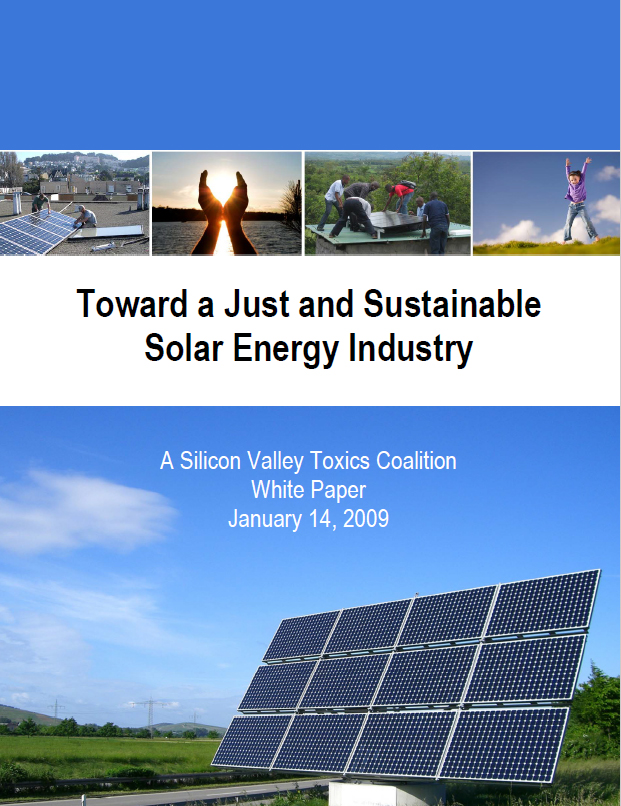
Towards a Just and Sustainable Solar Energy Industry

Towards a Just and Sustainable Solar Energy Industry - A Silicon Valley Toxics Coalition White Paper, January 14, 2009.

Every hour, enough solar energy reaches the Earth to meet human energy needs for an entire year. Solar photovoltaic (PV) technology is widely seen as a “win-win” solution that can harness this “free energy” to address global warming, reduce U.S. dependence on energy imports, create “green jobs,” and help revitalize the U.S. economy.

Solar energy will play an essential role in meeting these challenges, but as the solar PV sector expands, little attention is being paid to the potential environmental and health costs of that rapid expansion. The most widely used solar PV panels are based on materials and processes from the microelectronics industry and have the potential to create a huge new wave of electronic waste (e-waste) at the end of their useful lives, which is estimated to be 20 to 25 years. New solar PV technologies are increasing cell efficiency and lowering costs, but many of these use extremely toxic materials or materials with unknown health and environmental risks (including new nanomaterials and processes).

With the solar PV sector still emerging, we have a limited window of opportunity to ensure that this extremely important industry is truly “clean and green,” from its supply chains through product manufacturing, use, and end-of-life disposal. The solar industry has taken a leadership role in addressing the world’s pressing energy and environmental challenges and will serve as a model for how other innovative “green” industries address the lifecycle impacts of their products.

In this white paper, the Silicon Valley Toxics Coalition (SVTC) provides an overview of the health and safety issues faced by the solar PV industry, including the toxic materials used in manufacturing and the potential end-of-life disposal hazards of solar PV products. The report also lays out recommendations to immediately address these problems to build a safe, sustainable, and just solar energy industry. These recommendations include:

  • Reduce and eventually eliminate the use of toxic materials and develop environmentally sustainable practices.
  • Ensure that solar PV manufacturers are responsible for the lifecycle impacts of their products through Extended
    Producer Responsibility (EPR).
  • Ensure proper testing of new and emerging materials and processes based on a precautionary approach.
  • Expand recycling technology and design products for easy recycling.
  • Promote high-quality “green jobs” that protect worker health and safety and provide a living wage throughout the
    global PV industry, including supply chains and end-of-life recycling.
  • Protect community health and safety throughout the global PV industry, including supply chains and recycling.

Read the report (PDF)

Pages

The Fine Print I:

Disclaimer: The views expressed on this site are not the official position of the IWW (or even the IWW’s EUC) unless otherwise indicated and do not necessarily represent the views of anyone but the author’s, nor should it be assumed that any of these authors automatically support the IWW or endorse any of its positions.

Further: the inclusion of a link on our site (other than the link to the main IWW site) does not imply endorsement by or an alliance with the IWW. These sites have been chosen by our members due to their perceived relevance to the IWW EUC and are included here for informational purposes only. If you have any suggestions or comments on any of the links included (or not included) above, please contact us.

The Fine Print II:

Fair Use Notice: The material on this site is provided for educational and informational purposes. It may contain copyrighted material the use of which has not always been specifically authorized by the copyright owner. It is being made available in an effort to advance the understanding of scientific, environmental, economic, social justice and human rights issues etc.

It is believed that this constitutes a 'fair use' of any such copyrighted material as provided for in section 107 of the US Copyright Law. In accordance with Title 17 U.S.C. Section 107, the material on this site is distributed without profit to those who have an interest in using the included information for research and educational purposes. If you wish to use copyrighted material from this site for purposes of your own that go beyond 'fair use', you must obtain permission from the copyright owner. The information on this site does not constitute legal or technical advice.
