By various - Re:Common, April 2016
 By presenting the horrors suffered under the domination of multinational companies, this work by Re:Common will dispel any lingering doubt that the current economic system based on extractivism is a war against the poor (what subcommander Marcos called the “Fourth World War”).
If someone who trusts the mainstream media and academic analyses thinks that at some point colonialism disappeared from the face of the Earth, this work, based on documents and testimonies, demonstrates otherwise.
For those who believe that progress is the most striking characteristic of our times, starting with the post-World War II period, the voices of the missing that populate these pages will convince you that present-day capitalism is a just a revamped version of the Spanish conquest of five centuries ago.
Throughout this work, all the variables of extractivism can be seen: from occupation of the territory and displacement of people to the role of the offshore banking and financial system, as two complementary and inseparable parts of accumulation by theft/dispossession. In the occupied territories, the displacement occurs in the form of war, with the participation of military, paramilitary, guerrilla and the greatest variety of imaginable armed actors.
The victims are always the weak: poor women and their children, elderly men and women, peasants, Indians, blacks, mestizos, the “wretched of the Earth,” as Frantz Fanon calls them. I want to emphasize, though it may seem anachronistic, and without reference to academic sources, how the extractive model coincides with colonialism, despite the different eras. This is not only due to the violent occupation of territories and the displacement of populations, but also to the salient features of the model.
Economically, extractivism has generated enclave economies, as it did in the colonies, where the walled port and plantations with slaves were its masterworks. This colonial/extractive model held populations 6 hostage in both 1500 and 2000.
Extractivism produces powerful political interventions by multinational enterprises, often allied with States, which manage to modify legislation, co-opting municipalities and their governors. It is an asymmetrical relationship between powerful multinationals and weak states, or better, states weakened by their own local elite who benefit from the model.
Like colonialism, the extractive model promotes the militarization of the territories, because it is the only way to eradicate the population, which, recalling Subcommander Marcos, is the real enemy in this fourth world war. Militarization, violence, and systematic rape of women and girls are not excesses or errors; they are part of the model because the population is the military objective.
To understand extractivism, we must consider it not as an economic model, but as a system. Like capitalism. Certainly there is a capitalist economy, but capitalism is not just the economic aspect. Extractivism (as stated by Re:Common) is capitalism in its financial phase and cannot be understood only as an economic variable. It implies a culture that promotes not work but consumption, which has (systemic) corruption as one of its central features. Put in another way, corruption is the extraction mode of governing.
Therefore, extractivism is not an economic actor; it is a political, social, cultural, and of course also economic actor. At this point, it’s crucial that the central part of this work describes human beings and the Earth as the subjects for looting, which is much more than the theft of the commons. Understanding dispossession only as robbery places property ownership at the center of the matter, in the place of people and land; e.g., life.
Read the text (PDF).






 This report documents massive exports of federally owned coal from 2000-15. The US Bureau of Land Management sold private companies the right to mine this coal for a pittance—in some cases, for less than 20 cents per ton. And when Asian demand was red-hot, these companies made massive profits selling millions of tons of federal coal overseas. Nonetheless, the Bureau of Land Management (BLM) has essentially ignored export economics when setting the “fair market value” that it will accept for federal coal leases. Now that the Department of Interior has placed a three-year moratorium on new coal leases pending a thorough review of federal coal policies, BLM has an ideal opportunity for a thorough review of the economics of exports. And our report points to evidence that by ignoring exports, the BLM has been selling many federal coal leases at just a fraction of their true economic value.
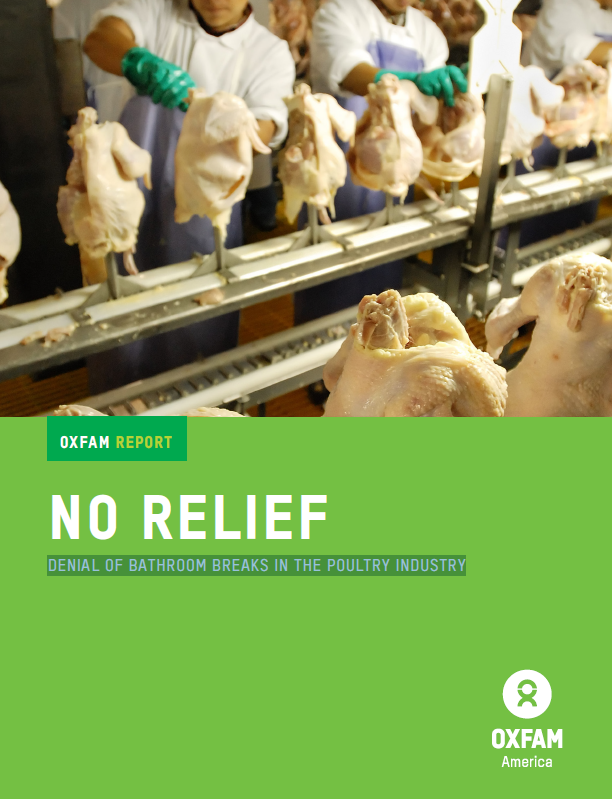 As poultry workers are routinely denied adequate bathroom breaks, they face dangers to their health and blows to their dignity.
 Eradicating global poverty is within reach, but under threat from a changing climate. Left unchecked, climate change will put at risk our ability to lift people out of extreme poverty permanently by 2030, the first target of the Sustainable Development Goals. Coal is the world’s number one source of CO2 emissions. Most historic emissions came from the coal industry in the developed world in the last century, with China joining the biggest emitters at the beginning of this one. It is widely accepted that a rapid and just response to climate change will require the urgent replacement of coal with low-carbon energy sources in rich economies.
 The Paris Climate Agreement of December 2015 is a dangerous distraction that threatens all of us. Marked by the heavy influence of the fossil fuel industry, the deal reached at the United Nations Framework Convention on Climate Change (UNFCCC) never mentions the need to curb extractive energy, and sets goals far below those needed to avert a global catastrophe. The agreement signed by 196 countries does acknowledge the global urgency of the climate crisis, and reflects the strength of the climate movement. But the accord ignores the roots of the crisis, and the very people who have the experience and determination to solve it.
 The global development of ‘unconventional’ fossil fuels (UFF) such as shale gas has provoked much debate involving scientists,industry, political decision-makers, environmental groups and civil society. More than a decade of large- scale development in North America has left a legacy of environmental damage, primarily resulting from the use of high- volume horizontal hydraulic-fracturing (also known as ‘fracking’) to extract the unconventional oil and gas. Despite the controversy surrounding this technique, the numerous unknowns and uncertainties concerning its impacts and the growing number of questions about the economic benefits of this industry, oil and gas operators are eager to identify new opportunities and so are engaged in a battle to make frackingpublicly and socially acceptable worldwide.
 Uranium mining and milling comprise the first phase of the nuclear fuel cycle, and is one of the most polluting ones. The aim of this report is to give workers and communities basic information about radioprotection. The document deals with the radiological characteristics of materials and waste from the mines, principles of radiation protection, and methods of dose evaluation.
 Multinational corporations are relentlessly expanding their operations into ever more vulnerable and remote regions of the planet. As they do so they both drive the climate crisis and exacerbate its impacts. They bear responsibility for a global crisis which affects us all, and they bring social and environmental destruction to the local communities where they operate. A further legacy of their oil drilling, industrial mining and mega hydroelectric projects is the erosion of those communities’ resilience just as the impacts of climate change begin to take effect. These same multinationals are also the biggest barrier to meaningful action on climate change, blocking urgently needed regulations and genuine transformational solutions.
 This site is not the official webpage of the Industrial Workers of the World.