You are here

energy

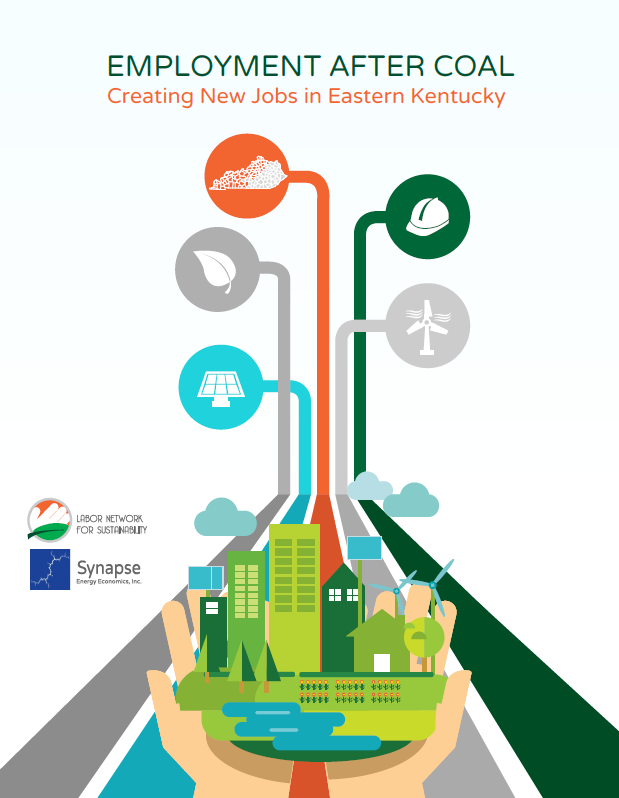
Employment After Coal: Creating new jobs in eastern Kentucky

By Frank Ackerman, PhD and Tyler Comings - MACED, December 30, 2015

The steep, ongoing decline of coal mining has caused the loss of 30,000 coal jobs in eastern Kentucky in the last 30 years. Trends in energy markets and public policy make it clear that a coal‐based economy is not coming back. A successful response to this crisis, replacing the lost kingdom of coal with a sustainable, community‐controlled economy, is crucial to the hopes for forward‐looking economic development in the region.

The issue reverberates far beyond the coalfields, as the national search for clean energy alternatives confronts impassioned claims about the need to protect coal mining jobs. In Kentucky and in the nation, a common but misleading frame on the debate suggests that there is no alternative, that “real” jobs can only be created by traditional industries, even if they are environmentally damaging.

In fact, the narrow, coal‐centered vision of “real” jobs is fading away, and discussion of newer, cleaner alternatives is already underway. Community organizations such as the Mountain Association for Community Economic Development (MACED) and Kentuckians for the Commonwealth (KFTC) have sponsored grassroots job creation initiatives, and have identified key sectors where employment growth should be possible. Both MACED and KFTC advocate for a Just Transition, a bigger picture that combines existing initiatives into a single vision of a working economy, mapping the sustainable occupations and industries that will fill the void left by coal.

Our analysis describes a new pattern of employment that Appalachian Kentucky could aspire to reach by 2030. It is a more challenging and longer‐term goal than is usually found in immediate grass‐roots campaigns. At the same time, it is more limited, detailed and practical than a grand statement of ultimate objectives. It occupies an intermediate level of abstraction, a mid‐range strategic vision of what the regional economy could look like in ten to twenty years.

Read the text (PDF).

Replace Hazelwood Primer

By David Spratt - Climate Action Moreland, June 2015

Hazelwood Power Station (HPS) was built between 1964 and 1971, and comprises 1542 megawatt (MW) of capacity over eight generators. It was privatised by the Victorian Liberal Party Kennett government in 1996 for $2.35 billion.If HPS had stayed in public hands, it would likely have been decommissioned in 2005, but in 2004 the Bracks Labor government extended its operations till 2031, allowing Hazelwood to move a road and a river to access 43 million tonnes of brown coal deposits in a realignment of the mining licence boundaries. The owners have a 30-year mining licence due for renewal in 2026.HPS and the land on which it operates are owned by the Hazelwood Power Partnership. Since 7 June 2013, the four partners have been subsidiaries of International Power (Australia) Holdings Pty Ltd. This company is in turn jointly owned by subsidiaries of Engie (formerly GDF Suez SA) (72 per cent ownership) and Mitsui & Co Ltd (28 per cent ownership). Engie is a global energy company with corporate headquarters in France. Mitsui & Co Ltd is a global trading company with corporate headquarters in Japan.Currently HPS produces more than 10,000 gigawatt hours (GWh) of energy annually and is supplied with up to 18 million tonnes of coal each year from the adjacent Hazelwood mine, releasing around 16 million tonnes of greenhouse gases annually. Today HPS provides approximately 21 per cent of Victoria’s baseline electricity supply.

The Victorian Government has expressed a desire (though it does not yet have a policy) for a significant expansion of renewable energy in Victoria. This has widespread community support and must be done quickly and at a large scale because climate change is already dangerous. Scientists warn that two degrees Celsius of warming could occur in just two decades, so preserving a safe climate and a healthy future requires rapid de-carbonisation.

Expanding renewable energy requires coal-generating capacity to be removed from the market because oversupply is crowding out and preventing new investment. The Australian energy market operator says there are about eight gigawatts of surplus generating capacity across the national market, equivalent to five Hazelwood power stations. This includes up to 2.2 gigawatts of brown coal generation that is no longer required in Victoria in 2015, which is greater than Hazelwood’s capacity. Power companies have been lobbying government for capacity to be reduced, and senior Victorian energy department bureaucrats are aware of the need to close coal power stations in order to roll out renewables.

The Victorian Government has committed to being a leader on climate change. Closing down excess coal generation is a key test of the government’s climate credentials. Coal-fired power stations are the world’s largest source of planet-warming carbon dioxide emissions. Victoria cannot make the necessary emissions reductions without addressing the operations of Hazelwood and/or Yallourn power stations.

Hazelwood power station is old, unsafe and dirty. Based on emissions intensity, it is the third-dirtiest coal power station in the world and the dirtiest in Australia, releasing around 16 million tonnes of greenhouse gases annually, almost three per cent of total Australian greenhouse emissions. The Hazelwood majority owner, Engie (formerly GDF Suez), owns the third-most polluting coal-power station fleet in the world. The full – health and carbon pollution – social costs of Hazelwood totalling $900 million per year are borne by the community, rather than the plant’s owners.

A steady stream of local jobs can be created in the Latrobe Valley with the rehabilitation of mines and decommissioning of plant, which will require a significant workforce stretching well over a decade. The Latrobe Valley needs a strong jobs package and an economic transition plan and new industries because the move from coal to clean wind and solar renewable energy is now both urgent and inevitable.

Hazelwood power station and mine are a health hazard to local residents, exemplified by the autumn 2014 mine fire. The owners of Hazelwood have abused their social licence and forfeited the right to profit from a power station that is now a major health hazard – both to local people and to all peoples who face the uncertainties of living in a hotter and more extreme climate.

In July 2010, the Victorian Labor government promised to start shutting Hazelwood and passed climate legislation providing the reserve power to regulate emissions from existing brown coal-fired generators. Restoring the government’s capacity to regulate emissions would be complementary to actions being taken by other governments, including in the United States and Europe.

Read the report (PDF).

The U.S. Export-Import Bank’s Dirty Dollars: U.S. tax dollars are supporting human rights, environment, and labor violations at the Sasan Coal-Fired Power Plant and Mine in India

By various - Sierra Club, 350.org, Carbon Market Watch, Pacific Environment, and FOE, October 2014

In January and May 2014, a coalition of non-governmental organizations (NGOs), the Sierra Club, 350.org, Carbon Market Watch, Pacific Environment, and Friends of the Earth U.S. (hereafter referred to as the Fact Finding Team), undertook two field visits to Singrauli, India, to meet with communities affected by Reliance Power’s Sasan Ultra Mega Power Project (UMPP) and its associated mine to assess the project’s effect on local communities and the environment.

Since the U.S. Export-Import Bank (Ex-Im Bank) approved over $900 million in financing for the coal project in October 2010, little information has been provided by the agency about Sasan’s compliance with Ex-Im environmental, social, human rights, and corruption policies. This includes the Bank’s commitments under the Equator Principles1 and the International Finance Corporation (IFC) Performance Standards,2 the agency’s environmental, social, human rights and corruption policies, as well whether or not the project has lived up to the expectations laid out in the Environmental and Social Impact Assessment (ESIA) documents for the mine and the power plant. An apparent lack of oversight prompted the NGOs involved in this report to conduct this independent investigation. The Fact Finding Team has uncovered numerous reports of corruption and human rights and labor violations associated with the Sasan coal project, all of which have largely been ignored by the Ex- Im Bank.

Read the report (PDF).

Energy Crisis and Social Crisis

By Miquel Amorós - libcom.org, March 13, 2014

Disclaimer: The views expressed here are not the official position of the IWW (or even the IWW’s EUC) and do not necessarily represent the views of anyone but the author’s.
Every sector of the economy depends on it: energy of one kind or another. Energy makes the world go round and the power that rules the world is linked to the way energy is produced and consumed. The capitalist regime did not really gain momentum until the steam engine and the energy produced by the combustion of coal could be harnessed to industry. The initial dependence on coal was the cause of the vast size and appalling filth of the first industrial factories and cities; as the basis of the productive process, this dependence was responsible for the centralization of the entire system and the intensive exploitation of labor power. The internal combustion engine and the turbine put an end to the rule of coal, but not to the basic characteristics of society that had been created by it. Although the generalized use of electricity and gasoline made production more flexible and extended the range of consumption, facilitating the decentralization of factory production and the unlimited geographical expansion of the cities, social development continued to proceed within the framework that had been established by “carboniferous” capitalism: not only was the model of concentrated and hierarchical power maintained, but it was further reinforced by the new technologies. The refinement of machine production only reduced the role of the workers in the productive process, intensified exploitation and stabilized the class order. The new technologies consolidated class society and reinforced the foundations of domination.

Petroleum and electricity allowed productive activities to be relocated far from primary energy sources, that is, they capitalized the world. The extreme separation between the production and consumption of energy made transport the main strategic factor and at the same time the weak link of the system. Any serious disruption in the energy supply would cause all of society to collapse very quickly. Capitalism cannot exist without an extremely robust privatized distribution network to connect energy sources, which are under the control of financial enterprises or state-based mafias, with their consumer hostages. The expropriation of energy resources is a most instructive characteristic of social inequality: the proletarian from this perspective is the person who does not have unrestricted access to free energy. This explains why the ruling class strives to maintain the private ownership of energy resources and thus to keep the population in the most complete dependence. By fighting against the socialization of energy resources, locally controlled power generation and distribution networks and consumption, the ruling class is simply defending its social status.

Without cheap, inexhaustible and easily accessible energy, industrial society cannot continue to grow. The ruling class became aware of this “energy reality” when oil prices spiked after the creation of OPEC in 1973. The response was two-pronged: on the one hand, massive investments in nuclear power; on the other, the arms race of the great powers that was required by geopolitics, that is, the art of controlling of the world’s main oil and gas fields. The militarization of the world became indispensable for the system’s survival. This was a deliberate choice: it was the only way that power and servitude could be maintained.

Why 100% Renewable Energy Requires Libertarian Eco-Socialism

Disclaimer: The views expressed here are not the official position of the IWW (or even the IWW’s EUC) and do not necessarily represent the views of anyone but the author’s.

By Dan Fischer - Capitalism vs. the Climate, November 15, 2013 (used by permission)

It’s old news that humans can power society with 100% renewable energy. Back in 1964, the anarchist Murray Bookchin wrote a prescient essay on global warming and other ecological issues. “Solar devices, wind turbines, and hydroelectric resources taken singly do not provide a solution…Pieced together as a mosaic…they could amply meet the needs of a decentralized society,” he wrote (Ecology and Revolutionary Thought).

Grow or Die

This transition can only take place when we start confronting the system that caused climate change: capitalism. Capitalism is a system based on private property and wage labor, where a ruling class of people own and manage most of the economy. It is inherently anti-ecological.

Capitalism presents each business with a stark “grow or die” imperative. As a result, businesses have no choice but to keep producing more stuff and using more energy (see chart above). When a business buys a more expensive form of energy like wind, it will lose market share to its competitors who buy oil and natural gas. To appear sustainable, they sell false “solutions” like mega-hydro, fracking, nuclear power and cap-and-trade. These proposals are insulting to those who care about the planet.

Capital Blight: a Green-Syndicalist Responds to David Walters "Socialist" Defense of Nuclear Energy

By x344543 - November 22, 2013

Disclaimer: The views expressed here are not the official position of the IWW (or even the IWW’s EUC) and do not necessarily represent the views of anyone but the author’s.

I read with interest David Walters's recent article, "A Socialist Defends Nuclear Energy, wondering what I would find. I soon discovered there was very little credible "defense" and for that matter, not much "socialism" (other than the citation of various Marxist quotations that Marx and Engels would have bristled at given their context here) in it. In fact, it read to me as a typical capitalist defense of its standard operations wrapped in a rather threadbare and tattered red flag.

Michael Friedman has thoroughly debunked Walters's claims about the "safety" of (conventional) nuclear (fission) energy and the "ease" at dealing with the nuclear waste in his own piece so there is no utility in elaborating further on that matter. It is my intention to address the issues that Friedman didn't cover.

To begin with, if David Walters is so willing to overlook peer reviewed science and factual evidence that clearly shows that conventional nuclear fission energy is unsafe and the problem of nuclear waste not easily handled, he may as well also argue in favor of thorium based breeder reactors, nuclear fusion power, fracking, tar sands, "clean" coal, or even hydrogen fuel cells which are equally questionable technologies (and please note that I am not arguing in favor of any of these things here, though I think hydrogen fuel cells are worth a look at least).

Additionally, Walters lumps in all greens into a single, monolithic group, dominated by primitivism and Malthusianism. This is as inaccurate as arguing that all communists take their marching orders from Stalin. This is the rhetoric one expects to hear from the most reactionary elements of the capitalist class's punditocracy rather than an informed anti-capitalist. To me this is a clear indication that his entire argument is mere propaganda and has very little substance.

How Science is Telling us All to Revolt: Is our relentless quest for economic growth killing the planet? Climate scientists have seen the data; and they are coming to some incendiary conclusions

By Naomi Klein - New Statesman, October 29, 2013

In December 2012, a pink-haired complex systems researcher named Brad Werner made his way through the throng of 24,000 earth and space scientists at the Fall Meeting of the American Geophysical Union, held annually in San Francisco. This year’s conference had some big-name participants, from Ed Stone of Nasa’s Voyager project, explaining a new milestone on the path to interstellar space, to the film-maker James Cameron, discussing his adventures in deep-sea submersibles.

But it was Werner’s own session that was attracting much of the buzz. It was titled “Is Earth F**ked?” (full title: “Is Earth F**ked? Dynamical Futility of Global Environmental Management and Possibilities for Sustainability via Direct Action Activism”).

Standing at the front of the conference room, the geophysicist from the University of California, San Diego walked the crowd through the advanced computer model he was using to answer that question. He talked about system boundaries, perturbations, dissipation, attractors, bifurcations and a whole bunch of other stuff largely incomprehensible to those of us uninitiated in complex systems theory. But the bottom line was clear enough: global capitalism has made the depletion of resources so rapid, convenient and barrier-free that “earth-human systems” are becoming dangerously unstable in response. When pressed by a journalist for a clear answer on the “are we f**ked” question, Werner set the jargon aside and replied, “More or less.”

There was one dynamic in the model, however, that offered some hope. Werner termed it “resistance” – movements of “people or groups of people” who “adopt a certain set of dynamics that does not fit within the capitalist culture”. According to the abstract for his presentation, this includes “environmental direct action, resistance taken from outside the dominant culture, as in protests, blockades and sabotage by indigenous peoples, workers, anarchists and other activist groups”.

Serious scientific gatherings don’t usually feature calls for mass political resistance, much less direct action and sabotage. But then again, Werner wasn’t exactly calling for those things. He was merely observing that mass uprisings of people – along the lines of the abolition movement, the civil rights movement or Occupy Wall Street – represent the likeliest source of “friction” to slow down an economic machine that is careening out of control. We know that past social movements have “had tremendous influence on . . . how the dominant culture evolved”, he pointed out. So it stands to reason that, “if we’re thinking about the future of the earth, and the future of our coupling to the environment, we have to include resistance as part of that dynamics”. And that, Werner argued, is not a matter of opinion, but “really a geophysics problem”.

Plenty of scientists have been moved by their research findings to take action in the streets. Physicists, astronomers, medical doctors and biologists have been at the forefront of movements against nuclear weapons, nuclear power, war, chemical contamination and creationism. And in November 2012, Nature published a commentary by the financier and environmental philanthropist Jeremy Grantham urging scientists to join this tradition and “be arrested if necessary”, because climate change “is not only the crisis of your lives – it is also the crisis of our species’ existence”.

Capital Blight - The Root of the Problem

By x344543 – October 8, 2013

Disclaimer: The views expressed here are not the official position of the IWW (or even the IWW’s EUC) and do not necessarily represent the views of anyone but the author’s.

I really would rather not be writing this; I honestly wish that I didn’t feel that it was necessary. However, some things simply cannot be left unaddressed.

As one of the half dozen or so charter members of the IWW’s Environmental Unionism Caucus, I comb through a good deal of class struggle and/or environmental news sources, since one of our goals is raising awareness. These sources come from a variety of directions, including syndicalist, socialist, anarchist, progressive environmentalist, and deep green (though not Deep Green Resistance, because of the latter’s transphobia and rigid primativist tendencies). Naturally, one of the most logical sources for this last tendency is Earth First!. Rarely is any source 100% in line with what I and my fellow “Green Wobblies” think represents our position (loosely defined though that may be), and Earth First! is no exception. That which doesn’t fit is generally ignored, and we “stand aside” as they say in the language of modified consensus process. Sometimes, however, our sources will publish something so egregiously wrong, in our opinion, that we feel compelled to respond.

Saturday, October 5, 2013, Earth First! re-published just such a story, called Thanks A Lot, Nebraska, by the Tucson chapter of Root Force (TURF).

What is Root Force you ask? Here’s their mission statement:

Root Force (Fuerza Raíz) is a campaign that recognizes the fundamental connection between the oppression of the Earth and the oppression of its people. The precursor to ecocide and genocide is the separation of people from the land so that both can be exploited. Thus Root Force is a biocentric campaign, asserting that no oppression can be overcome without addressing the relationship a society has with the Earth. To achieve either social or ecological justice, we must achieve both.

Therefore, Root Force aims to help dismantle the system that is killing and enslaving our planet and its people. This will be achieved by (1) identifying the system’s strategic weak points, and (2) targeting those points, thus providing an offensive component to existing ecodefense, international solidarity, and anti-colonialist efforts.

One strategic weak point is the U.S. dependence on the resources of Latin America. The exploitation of these resources is dependent on transportation, energy, and communications infrastructure. Hence this U.S.-based campaign focuses its efforts on opposing infrastructure expansion projects in Latin America, such as Plan Puebla Panama (PPP) and the South American Regional Infrastructure Integration Initiative (IIRSA).

The campaign provides a framework for people to take effective action in solidarity with local resistance to these projects without traveling to Latin America. It is structured to allow for a diversity of tactics, to be undertaken by a wide network of autonomous individuals and groups.

This seems reasonable enough; in fact, I cannot find any really objectionable position in this mission statement at all. Much of it could easily mesh with the Preamble to the IWW Constitution, so having established that, I find the content of the article itself to be quite disturbing.

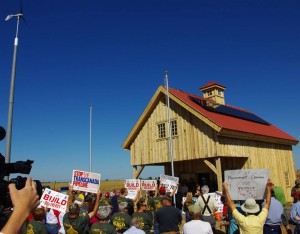
Essentially, TURF is miffed that a coalition including Nebraska ranchers and farmers, the Nebraska Farmer’s Union, Bold Nebraska, 350.org, Sierra Club, Credo, and billionaire Tom Steyer are protesting the impending construction of the controversial Keystone XL Pipeline by constructing a wind- and solar- powered barn in its projected pathway.

Granted there are many criticisms one could make of this action, such as the fact that a great many of these folks are capitalists or enablers of capitalists, the fact that Keystone XL is not the only pipeline we need to worry about, or the obvious fact that Keystone could simply build the pipeline somewhere else (there are enough rural counties sufficiently beholden to corporate fossil fuel interests to ram through the permits barn or no barn), but in spite of these shortcomings, there are lot of good things that could be said about the project as well, including—in my opinion at least—the advocacy of renewable energy, such as wind and solar which could allow a state such as Nebraska which has a fairly good abundance of both to potentially generate all of its own electricity and perhaps even export a bit.

No doubt doing so would lessen that state’s reliance on fossil fuels, and though some of those are extracted and refined locally, the impact of those on the environment effects us globally in ways that greatly outweigh any significant impact from wind and solar. Certainly that would seem to fit the mission of Root Force would it not? Evidently the answer is a resounding “no”. Root Force is overwhelmingly opposed to renewable energy arguing that it simply props up the existing system and perpetuates the destruction of the Earth (and to be certain, the Earth First! Journal published Root Force's position paper on renewables in February 2009).

Climate Change and Capitalism

By Michael Roberts - Originally published at The Next Recession, September 28, 2013

The 5th report by the International Panel for Climate Change (IPCC) was released this weekend. The IPCC brings together hundreds of scientists in the field of climate change to cooperate in drawing up a comprehensive analysis of the state of the earth’s climate and forecasts about its future.  The IPCC report raised its estimate of the probability that human activities, led by the burning of fossil fuels, are the main cause of global warming since the mid-20th century to “extremely likely”, or at least 95 percent, from “very likely” (90 percent) in its previous report in 2007 and “likely” (66 percent) in 2001.

The IPCC said that short periods are influenced by natural variability and do not, in general, reflect long-term climate trends.  So the argument of those whom deny global warming is man-made or is not getting worse cannot rely on the recent slowing of the rise in average atmospheric temperatures in the last 15 years.  The IPCC went on to say that temperatures were likely to rise by between 0.3 and 4.8 degrees Celsius (0.5 to 8.6 Fahrenheit) by the late 21st century.  Sea levels are likely to rise by between 26 and 82 cm (10 to 32 inches) by the late 21st century, after a 19 cm rise in the 19th century.   In the worst case, seas could be 98 cm higher in the year 2100.

The IPCC estimates that a doubling of carbon dioxide concentrations in the atmosphere would lead to a warming of between 1.5 and 4.5 degrees Celsius (2.7 and 8.1F), lowering the bottom of the range from 2.0 degrees (3.6F) estimated in 2007 report. The new range, however, is the same as in other IPCC reports before 2007.  It said the earth was set for more heatwaves, floods, droughts and rising sea levels from melting ice sheets that could swamp coasts and low-lying islands as greenhouse gases built up in the atmosphere.

The IPCC admitted that it was still unclear about the causes for the slowdown in climate change in the past 15 years, but insisted that the long-term trends were beyond doubt and that a decade and a half was far too short a period in which to draw any firm conclusions. The temperature rise has slowed from 0.12C per decade since 1951 to 0.05C per decade in the past 15 years – a point seized upon by climate skeptics to discredit climate science.  Professor Stocker said:

“People always pick 1998 but that was a very special year, because a strong El Niño made it unusually hot, and since then there have been a series of medium-sized volcanic eruptions that have cooled the climate.”

Explaining a recent slower pace of warming, the report said the past 15-year period was skewed by the fact that 1998 was an extremely warm year with an El Nino event – a warming of the ocean surface – in the Pacific.  It said warming had slowed “in roughly equal measure” because of random variations in the climate and the impact of factors such as volcanic eruptions when ash dims sunshine, and a cyclical decline in the sun’s output.

But the deniers of climate change and manmade global warming remain unconvinced. Professor Judith Curry of the Georgia Institute of Technology in Atlanta responded by saying that “Well, IPCC has thrown down the gauntlet – if the pause continues beyond 15 years (well it already has), they are toast.” But Rajendra Pachauri, chair of the IPCC, retorted that the reduction in warming would have to last far longer - “three or four decades” – to be a sign of a new trend.  And the IPCC report predicted that the reduction in warming would not last, saying temperatures from 2016-35 were likely to be 0.3-0.7 degree Celsius (0.5 to 1.3 Fahrenheit) warmer than in 1986-2005.

Capital Blight - They Really Don't Know Clouds At All.

By x344543 - September 9, 2013

Disclaimer: The views expressed here are not the official position of the IWW (or even the IWW’s EUC) and do not necessarily represent the views of anyone but the author’s.

A recent discussion among IWW members about whether or not to change the default delivery option for the union's official organ, the Industrial Worker, from hard copy to PDF has touched on a larger debate over the "greenness" of "the cloud."(the many data centers that form the backbone of the Internet).

My attention was drawn to this debate by one of my fellow worker's reaction to the following statement from the current editor of our union's venerable publication, the Industrial Worker in reference to a change in the default option from a paper copy to an emailed PDF:

Go paperless, live in harmony with the earth and help save the union money!"

The union implemented this change to cut costs. The apparent environmental benefits are merely coincidental, though it's gratifying to see that the membership is taking the environmental tenets of the IWW Preamble seriously.

My aforementioned fellow Wobbly took exception to this statement thusly:

From some of what I have read, the physical maintenance of the digital world is anything but green, even though the idea that computers = lower pollution and energy consumption is to be found pretty much everywhere these days.

Below is a link to an article from the New York Times on the subject.  One of the key points is how much of the energy -- about 90-94% -- is wasted just keeping servers idling in case they need to be pulled in as backups.

The specific article he referenced, Power, Pollution, and the Internet actually quotes a slightly lower figure of 88 - 93%, but more about that later.

He then offered the following quotation to emphasize a comparison between data centers and the paper industry:

Nationwide, data centers used about 76 billion kilowatt-hours in 2010, or roughly 2 percent of all electricity used in the country that year, based on an analysis by Jonathan G. Koomey, a research fellow at Stanford University who has been studying data center energy use for more than a decade.

Datacenter Dynamics, a London-based firm, derived similar figures.

The industry has long argued that computerizing business transactions and everyday tasks like banking and reading  library books has the net effect of saving energy and resources. But the paper industry, which some predicted would be replaced by the computer age, consumed 67 billion kilowatt-hours from the grid in 2010, according to Census Bureau figures reviewed by the Electric Power Research Institute for The Times.

Skepticism of any capitalist industry's claims to be "green" should be regarded as healthy, but that skepticism should be followed by careful examination of all of the facts.

Pages

The Fine Print I:

Disclaimer: The views expressed on this site are not the official position of the IWW (or even the IWW’s EUC) unless otherwise indicated and do not necessarily represent the views of anyone but the author’s, nor should it be assumed that any of these authors automatically support the IWW or endorse any of its positions.

Further: the inclusion of a link on our site (other than the link to the main IWW site) does not imply endorsement by or an alliance with the IWW. These sites have been chosen by our members due to their perceived relevance to the IWW EUC and are included here for informational purposes only. If you have any suggestions or comments on any of the links included (or not included) above, please contact us.

The Fine Print II:

Fair Use Notice: The material on this site is provided for educational and informational purposes. It may contain copyrighted material the use of which has not always been specifically authorized by the copyright owner. It is being made available in an effort to advance the understanding of scientific, environmental, economic, social justice and human rights issues etc.

It is believed that this constitutes a 'fair use' of any such copyrighted material as provided for in section 107 of the US Copyright Law. In accordance with Title 17 U.S.C. Section 107, the material on this site is distributed without profit to those who have an interest in using the included information for research and educational purposes. If you wish to use copyrighted material from this site for purposes of your own that go beyond 'fair use', you must obtain permission from the copyright owner. The information on this site does not constitute legal or technical advice.