

You are here

energy

The justice and equity implications of the clean energy transition

By Sanya Carley and David Konisky - Nature Energy, August 2020

The transition to lower-carbon sources of energy will inevitably produce and, in many cases, perpetuate pre-existing sets of winners and losers. The winners are those that will benefit from cleaner sources of energy, reduced emissions from the removal of fossil fuels, and the employment and innovation opportunities that accompany this transition. The losers are those that will bear the burdens, or lack access to the opportunities. Here we review the current state of understanding—based on a rapidly growing body of academic and policy literature—about the potential adverse consequences of the energy transition for specific communities and socio-economic groups on the frontlines of the transition. We review evidence about just transition policies and programmes, primarily from cases in the Global North, and draw conclusions about what insights are still needed to understand the justice and equity dimensions of the transition, and to ensure that no one is left behind.

Read the text (PDF).

ReImagine Appalachia: a (Green) New Deal That Works for Us

By staff - ReImagine Appalachia, August 2020

Appalachians have a long history of hard work, resilience, and coming together to face enormous challenges. Our region is a place of ingenuity. A place where families and neighbors look out for one another.

Now is the time to put our ingenuity to use and imagine a 21st century economy that works for the people in the Ohio River Valley of Appalachia. An economy that is good for working people, communities, our health and the health of our neighbors. One that is grounded in the land and centered on creating wealth locally. One that relies on working people, already skilled in service, industry, trades and farming. One that offers hope to the next generation’s workers—regardless of the color of their skin, ethnicity or gender. And one that does our region’s part to meet the nation’s climate challenge, just as we met the call to provide coal energy to fuel a growing nation a century ago.

Right now, our nation is in crisis. We face the COVID epidemic, a deep economic downturn, extreme inequality, racism, police brutality, and the consequences of a changing climate such as severe storms and flooding. These crises demand from us real, lasting and structural change. It is not a matter of if, but when. When the nation rises to the occasion, people in Appalachia need to be at the table and helping to lead the charge. Together, we can build a vision for the Appalachia we want to live in.

Read the text (PDF).

Forward Together: A Good Jobs and Climate Action Budget

By staff - Canadian Labour Congress, August 2020

The Canadian Labour Congress (CLC) believes that saving lives, protecting public health, and containing the coronavirus outbreak must remain the federal government’s overriding priority. In the near term, this includes continued income support for individuals unable to work due to COVID-19, as well as proper personal protective equipment, workplace health and safety precautions, and training for workers.

As public health measures permit, fiscal policy measures responding to the recession and unemployment crisis will need to prioritize helping Canadians return to decent jobs. The economic crisis has disproportionately affected low-paid, vulnerable workers in precarious employment, especially women, young workers, newcomers, workers of colour, and workers with disabilities. Accordingly, the plan for economic recovery must be gendered, inclusive, inequality-reducing, and sustainable.

Read the report (PDF).

Draft Colorado Just Transition Plan

By Dennis Dougherty, Ray Beck, et, al. - Colorado Just Transition Advisory Committee, August 1, 2020

Coal has played an important role in Colorado’s economy since before statehood, from heating homes and powering industry to fueling railroads and generating electricity. Today, coal is mostly used for electricity in Colorado.
Increasing price competition from natural gas and renewables, along with environmental concerns, has led to a significant decline in the use of coal over the last dozen years. In 2019, Colorado set aggressive goals for reducing greenhouse gas emissions that will require major changes in how we fuel our cars, heat our homes, and generate electricity. As a result of these combined factors, the era of coal appears to be coming to an end in Colorado.

The decline of coal has serious implications for the Coloradans who work in the coal industry (mostly in mines and power plants) and the communities where they do this work. Approximately 2,000 coal workers stand to lose their mostly high-paying jobs by 2030, and many communities will lose significant percentages of their local job base and of property tax revenues when mines and power plants close.

Colorado has the opportunity to lead the nation in achieving more constructive outcomes. In 2019, the Colorado General Assembly passed and the Governor signed House Bill 19-1314, which makes a “moral commitment” to a “just transition” for these workers and communities. It established the nation’s first state Office of Just Transition (OJT), and it created a Just Transition Advisory Committee (JTAC) to develop a draft plan for how the state will fulfill this commitment.

Read the text (PDF).

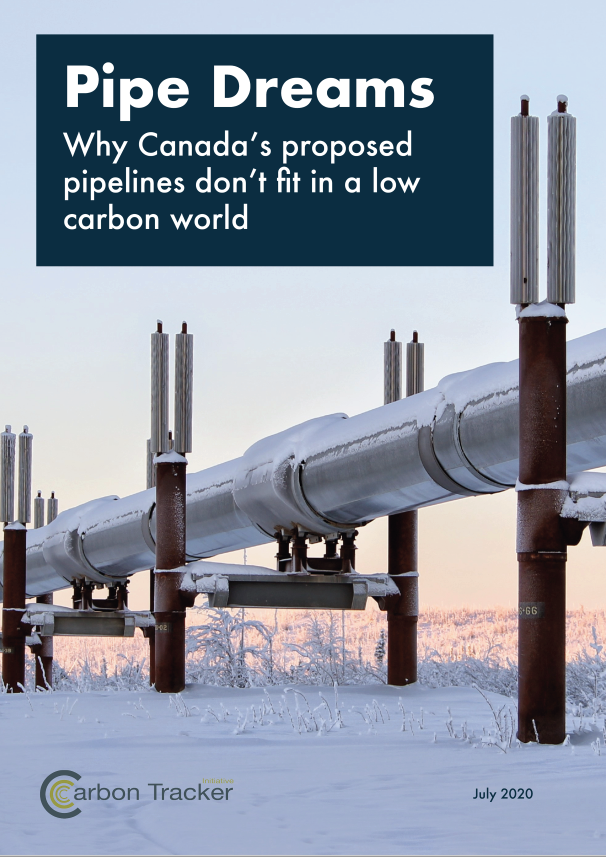
Pipe Dreams: Why Canada’s proposed pipelines don’t fit in a low carbon world

By Axel Dalman and Andrew Grant - Carbon Tracker - July 2020

Carbon Tracker’s modelling shows no new oil sands are needed in a low carbon world.

Prospective pipeline projects represent a significant expansion of capacity, with taxpayer support. However, new pipelines are surplus to requirements under Paris Agreement demand levels.

Canadian authorities face the challenge of trying to reconcile their natural resources development plans with their positioning on climate. Canada has previously having shown leadership on climate change issues, but its government support for pipelines – which are reliant on the failure of the Paris Agreement – risks damaging its credibility.

Key Findings:

Our research has previously shown that no new oil sands projects are needed in a low carbon world. All unsanctioned oil sands projects are uncompetitive under both the International Energy Agency’s 1.7-1.8°C Sustainable Development Scenario (SDS) and c.1.6°C Beyond 2 Degrees Scenario (B2DS).

All proposed new pipelines from Western Canada, in particular Keystone XL and Trans Mountain expansion, are surplus to requirements in a Paris-compliant world. Pipeline capacity may have proved a constraint in recent years, but under SDS, all future oil supplies from Western Canada can be accommodated by upgrades and replacements to existing pipelines, local refining and limited rail freight.

Even if discounts for Canadian crude narrow, new oil sands projects remain uneconomic. Western Canadian heavy oil trades at a steep discount to international benchmarks due to quality and transport challenges, averaging $25 below Brent over the last decade. Even if greater pipeline capacity reduces this to $10 in the future, in line with levels seen during previous periods of unconstrained supply, new projects still remain uneconomic under the SDS. Indeed, even if Canadian heavy oil were to trade at parity with Brent, which is extremely unlikely due to its lower quality, there would still be no new oil sands production under the B2DS and just 120,000 bbl/d would enter the market in the SDS – a level which would be covered by existing rail capacity.

Investors in oil sands face depressed cash flows in a low carbon world of falling oil demand and weak pricing, but will be forced to produce or pay the price due to inflexible “take-or-pay” transport fees for excess new pipeline capacity.

While take-or-pay contracts spread the impacts, pipeline investors still face financial risks as upstream production weakens. Uncontracted capacity will probably remain unused by producers, and contracts may cannibalise tariffs from other pipelines. Even take-or-pay commitments are subject to counterparty risk in a falling oil market.

The Canadian government’s stakes in Keystone XL and Trans Mountain could well prove to be a drain on the public purse. Under the SDS, government tax revenues and the value of the assets are unlikely to reach the levels anticipated at the time of sanction.

Canada’s leadership position on climate change may be undermined by its support for projects reliant on the failure of the Paris Agreement.

Read the report (Link).

It’s Time to Nationalize the Fossil Fuel Industry

Robert Pollin interviewed by C.J. Polychroniou - Truthout, June 26, 2020

The COVID-19 pandemic’s impact on the economy provides a golden opportunity for creating a fairer, more just and sustainable world as it shatters long-held assumptions about the economic and political order. Its impact on the energy industry in particular can boost support for tackling the existential threat of global warming by raising the prospect of nationalizing and eventually dismantling fossil fuel producing companies, a position argued passionately by one of the world’s leading progressive economists, Robert Pollin, distinguished professor of economics and co-director of the Political Economy Research Institute at the University of Massachusetts at Amherst.

C.J. Polychroniou: It has been argued by many that the coronavirus pandemic is a game changer for numerous industries, and could change the way we work and the way we use energy. We could also see the possible return of the social state and thus the end of austerity. First of all, are there any comparisons to be made between the current health and economic crises and what took place during the Great Depression?

Robert Pollin: There is one big similarity between the economic collapse today and the 1930s Great Depression. That is the severity of the downturns in both cases. The official U.S. unemployment rate coming from the Labor Department as of May 2020 was 13.3 percent. But a more accurate measure of the collapsing job market is the number of workers who have applied for unemployment insurance since the lockdown began in mid-March. That figure is 44 million people, equal to about 27 percent of everyone in the current U.S. labor market, employed or unemployed. By contrast, during the Great Recession of 2007-09, official unemployment peaked, and for one month only, at 10.0 percent.

Cracked: The Case for Green Jobs Over Pterochemicals in Pennsylvania

By staff - Food and Water Watch, September 2020

While the national economy struggled to recover from the Great Recession, wage and employment growth in Pennsylvania was anemic. This experience mirrored national trends of increasing inequality and a hollowing out of the middle class. Despite the state’s aggressive embrace of fracking as a driver of economic growth, fracking jobs remain scarce and temporary. As frackers suffocate in a glut of natural gas (including ethane) and as Pennsylvanians struggle with the environmental damage wrought by fracking and other dirty industries, Pennsylvania lawmakers are attempting to artificially sustain the boom by offering lucrative concessions to mega-corporations and dirty petrochemical producers.

Doubling down on toxic industries won’t fix the region’s economic woes, but will instead foreclose opportunities for long-term, sustainable growth through green energy manufacturing. Given the economic uncertainties of the coronavirus pandemic, an aggressive commitment to public works investment in green energy is more important now than ever. Solar, wind and energy efficiency are necessary to avert catastrophic climate change. Wind and solar manufacturing would also employ more people than comparable investments in oil, gas, coal or plastics.

Read the text (Linked PDF).

Putting California on the High Road: a Jobs and Climate Action Plan for 2030

By Carol Zabin, et. al. - University of California, Berkeley Center for Labor Research and Education, June 2020

Over the last 15 years, California has emerged as a national and world leader in the fight to avoid climate disaster, passing a comprehensive and evolving suite of climate measures to accelerate the transition to a carbon- neutral economy. The state has also emerged as a national leader in embracing economic equity as a goal for state policy, charting a path towards a new social compact for shared prosperity in a rapidly changing world. Meaningful commitment to both of these goals—ensuring that all Californians thrive in the transition to a carbon-neutral economy—requires the development and implementation of a bold agenda that aligns California’s ambitious climate and workforce action plans. This report presents a framework for California to advance that agenda.

Assembly Bill 398 (E. Garcia, Chapter 135, Statutes of 2017) required that the California Workforce Development Board (CWDB) present a report to the Legislature on strategies “to help industry, workers, and communities transition to economic and labor-market changes related to statewide greenhouse gas emissions reduction goals.” To fulfill this mandate, the CWDB commissioned the Center for Labor Research and Education at the University of California, Berkeley, to review the existing research in the field and prepare this report. The summary presented here describes the key concepts, findings, and recommendations contained in UC Berkeley’s full work.

The statutory language of AB 398 makes clear that this report should address workforce interventions to ensure that the transition to a carbon-neutral economy:

  • Creates high-quality jobs;
  • Prepares workers with the skills needed to adapt to and master new, zero- and low-emission technologies;
  • Broadens career opportunities for workers from disadvantaged communities; and
  • Supports workers whose jobs may be at risk.

This report presents a comprehensive strategy that identifies roles for state and local climate, economic development, and workforce development agencies in achieving these goals, alongside key partners such as business, labor, community, and education and training institutions. All recommendations align with the CWDB’s Unified Strategic Workforce Development Plan, which has put forth a set of actions to leverage and coordinate the state’s myriad workforce and education programs to support high-quality careers for Californians. In keeping with the statutory directive, the report discussion is further enriched by comments provided to the CWDB through a series of stakeholder meetings held in July and August 2018.

This report builds upon the framework established in California’s 2017 Climate Change Scoping Plan (Scoping Plan), which presents a roadmap of policies and programs to reach the climate protection target in Senate Bill 32 (Pavley, Chapter 42, Statutes of 2016) of a 40 percent reduction in greenhouse gas emissions by 2030 from 1990 levels. The Scoping Plan is organized into sectors based on the state’s major sources of greenhouse gas emissions and corresponding climate action measures: Transportation, Industry, Energy, Natural and Working Lands (including Agricultural Lands), Waste, and Water. This report organizes the available information from existing academic research, economic models, and industry studies for the Scoping Plan sectors and presents for each of them:

  • Information about current labor conditions and the impact on jobs of the major climate measures;
  • Guidance for policymakers, agencies, and institutions that implement climate and/or workforce policy on how to best generate family-supporting jobs, broaden career opportunities for disadvantaged workers, deliver the skilled workforce that employers need to achieve California’s climate targets, and protect workers in declining industries; and
  • Examples of concrete, scalable strategies that have connected effective climate action with workforce interventions to produce good outcomes for workers.

Understanding and Responding to the Changing Nature of Work in the Bay Area

By various - ReWork the Bay, Working Partnerships USA, and Jobs with Justice San Francisco, May 2020

New technologies, accelerating climate change, shifting migration patterns, changes in economic and political norms, and a host of other trends are likely to impact—and indeed already are impacting—key features of work and employment, including management relationships, the types of jobs available, compensation patterns, and other issues that shape the day-to-day lives of working people.

This report presents a framework for understanding why and how work is changing in the San Francisco Bay Area. It provides a scan of strategies that Bay Area workers, communities, businesses, educators and elected leaders are deploying to address changes, and offers a suggested rubric for evaluating the potential effects of such strategies.

In the Bay Area and Silicon Valley, a global epicenter of innovation and extraordinary wealth, low-income communities and communities of color struggle with crises in housing and economic stability, and climate change makes itself felt through increasingly destructive wildfires. If Bay Area funders, advocates, policymakers, and worker organizations ever hope to realize quality, empowered jobs for all, we must be able to articulate how work is changing and identify the systemic interventions that will push change to benefit working people.

Read the text (PDF).

Still Digging: G20 Governments Continue to Finance the Climate Crisis

By Bronwen Tucker and Kate DeAngelis - Oil Change International and Friends of the Earth - May 2020

In 2015, governments around the world committed to hold global warming to well below 2 degrees Celsius (°C) and to strive to limit warming to 1.5°C by adopting the Paris Agreement. This analysis shows that since the Paris Agreement was made, G20 countries have acted directly counter to it by providing at least USD 77 billion a year in finance for oil, gas, and coal projects through their international public finance institutions. These countries provided more than three times as much support for fossil fuels as for clean energy.

With the health and livelihoods of billions at immediate risk from COVID-19, governments around the world are preparing public spending packages of a magnitude they previously deemed unthinkable. In normal times, development finance institutions (DFIs), export credit agencies (ECAs), and multilateral development banks (MDBs) already had an outsized impact on the overall energy landscape and more capacity than their private sector peers to act on the climate crisis. In the current moment, their potential influence has multiplied, and it is imperative that they change course. The fossil fuel sector was showing long-term signs of systemic decline before COVID-19 and has been quick to seize on this crisis with requests for massive subsidies and bailouts.1 We cannot afford for the wave of public finance that is being prepared for relief and recovery efforts to prop up the fossil fuel industry as it has in the past. Business as usual would exacerbate the next crisis— the climate crisis—that is already on our doorstep.

Read the report (PDF).

Pages

The Fine Print I:

Disclaimer: The views expressed on this site are not the official position of the IWW (or even the IWW’s EUC) unless otherwise indicated and do not necessarily represent the views of anyone but the author’s, nor should it be assumed that any of these authors automatically support the IWW or endorse any of its positions.

Further: the inclusion of a link on our site (other than the link to the main IWW site) does not imply endorsement by or an alliance with the IWW. These sites have been chosen by our members due to their perceived relevance to the IWW EUC and are included here for informational purposes only. If you have any suggestions or comments on any of the links included (or not included) above, please contact us.

The Fine Print II:

Fair Use Notice: The material on this site is provided for educational and informational purposes. It may contain copyrighted material the use of which has not always been specifically authorized by the copyright owner. It is being made available in an effort to advance the understanding of scientific, environmental, economic, social justice and human rights issues etc.

It is believed that this constitutes a 'fair use' of any such copyrighted material as provided for in section 107 of the US Copyright Law. In accordance with Title 17 U.S.C. Section 107, the material on this site is distributed without profit to those who have an interest in using the included information for research and educational purposes. If you wish to use copyrighted material from this site for purposes of your own that go beyond 'fair use', you must obtain permission from the copyright owner. The information on this site does not constitute legal or technical advice.
