You are here

energy

Ukraine: neither NATO nor Moscow!

By staff - Anarchist Communist Group, January 29, 2022

The Western media is pounding the drum for a conflict between Putin’s Russia and the Western powers over Ukraine.

Let us be clear. Vladimir Putin leads a gangster regime in Russia, sometimes referred to as a kleptocracy (rule by thieves). He runs an oppressive regime and as an ex-high up in the Russian secret police, the KGB, he has extremely close relations with its latest incarnation, the FSB (Federal Service Bureau of the Russian Federation). He has come down heavily on any form of opposition, and the anarchist movement in Russia has suffered, with anarchist militants, arrested tortured and given heavy prison sentences. The Putin regime is massing large numbers of troops on Ukraine’s borders for a number of reasons. The domestic situation is far from healthy and the Covid pandemic has aggravated this. Putin is wary of growing discontent and hopes that his belligerent attitude will unite the Russian masses behind him and make them forget their economic woes. This is a gamble, as the Russian masses are in general not keen to engage in warfare with their fellow Slavs in Ukraine, and remember the disastrous consequences of the war in Afghanistan, when Russian troops sent in to save the pro-Russian regime there were bogged down for years with massive casualties.

With the collapse of the Soviet Union in 1991, a number of republics emerged that had separated from the Russian Federation. Among these was Ukraine, the largest in terms of landmass and the most important in terms of industrial development, an industrial development that had reached its climax under Stalin and his successors.

The fall of the Soviet Union seriously weakened Russia but thanks to rising oil prices coupled with the rise to power of Putin, it began to re-assert itself. It was determined to control and influence the surrounding countries on its borders, both for defence reasons and to re-affirm its control over those regions which it had established after World War Two.

The political-military alliance it had established with its satellites, the Warsaw Pact, was dissolved. However, the corresponding political-military alliance developed by the United States and the Western European powers, NATO, was not wound up and remains an instrument of both the USA and various component Western countries. In fact, NATO sought to increase its influence and has intervened in Kosovo, Afghanistan and Libya. Despite promising the Russian regime that it would not expand its influence east of what was East Germany, it has invested its forces in the countries surrounding Russia, including the Baltic States.

NATO is an aggressive military machine, not a body there to passively defend the West. It has intervened in Libya, in Afghanistan and Iraq. It actively seeks to recruit not just former Soviet republics like Ukraine and Georgia into its alliance, but also so called neutral countries like Finland and Sweden, both very close to Russia. It demands that each component country of NATO spends at least 2% of its Gross Domestic Product on military expenditure.

Defending Public Energy, French Energy Unions Build International Support

By Staff - Trade Unions for Energy Democracy, January 17, 2021

As we reported in TUED Bulletin 104, in recent weeks French electricity and gas workers have been striking in defense of the country’s publicly owned energy. These actions have been led by French energy union federations FNME-CGT, CFE-CGC Énergies, FO Energie et Mines and FCE-CFDT.

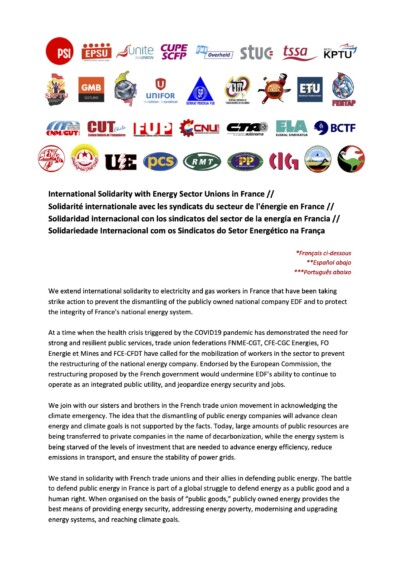
Over the holiday period, 33 union bodies from 20 countries and regions signed a statement of solidarity with the striking unions and workers.

The target of the strikes is a set of proposals being advanced by the French government, at the heart of which is a plan to “restructure” the country’s major national power utility, EDF. According to the unions, the proposed changes would undermine EDF’s ability to continue to operate as an integrated public utility, would jeopardize energy security and jobs, and would be against the general public interest.

During the week of January 11, 2021, TUED received a letter from the leadership of FNME-CGT, which welcomed the international support that has been expressed, and reaffirmed the union’s commitment to the struggle underway. Jointly signed by Sébastien Menesplier, General Secretary for International Affairs, and Muriel Marcilloux, Federal Secretary for European Affairs, the letter reads, in part:

We are taking action in France for energy: a basic common good and not a commodity that must remain at the service of the general interest. At a time when the challenge of climate change is global, in order to gain the 2°C of the COP 21 in Paris, we will need to switch to electric power, with low- carbon electricity. This will require a commitment from each country. This challenge for the future cannot be met in a market logic where the priority is financial return.

This issue of energy under public control is essential for the future of future generations.

For France, the fight is being waged now. We must lead the fight until the withdrawal of these harmful projects and show that another way other than finance is possible.

Your international support clearly shows that we are not alone in fighting for a quality public energy service accessible to all. Trade unions and their allies know that a just transition cannot be achieved by relying solely on the privatisation, liberalisation and commodification of energy, which is vital for just and sustainable human and economic development.

The letter also stated FNME-CGT’s intention to develop the international dimension of the struggle for public energy, noting in particular the upcoming UN COP26 climate talks scheduled for November of this year. The full letter is available in English here, and in French here.For additional background information, you can read the recent Letter from CGT EDF Directors (in French; English translation available here).

As a next step, the unions will hold a “Day of Action” on Tuesday, January 19th, in a continuing display of opposition to the government’s proposals. On Twitter, you can follow developments directly (in French) via @FNMECGT.

IndustriALL Global Union has also expressed solidarity with the striking workers as part of its ongoing reporting on this crucial struggle over many months.

We encourage unions to share news of this important ongoing struggle in the fight for climate protection and a sustainable future with their members and networks.

The Road Towards a Carbon Free Society: A Nordic-German Trade Union Cooperation on Just Transition

By Dr Philipp Fink - Friedrich Ebrt Stiftung, December 2020

This project, “The Road Towards a Carbon Free Society A Nordic-German Trade Union Cooperation on Just Transition”, is a collaboration between the Council of Nordic Trade Unions (NFS), the Friedrich-Ebert Stiftung (FES) and the German Trade Union Confederation (DGB).

Represented by the Council of Nordic Trade Unions (NFS) in the project are 13 national Trade Union Confederations within NFS, from five Nordic Countries: Denmark (FH, Akademikerne), Finland (SAK, STTK), Iceland (ASÍ, BSRB, BHM), Norway (LO-N, Unio, YS) and Sweden (LO-S, TCO, Saco).

About the reports

A total of six country reports on the Just Transition path of the participating countries (Denmark, Finland, Germany, Iceland, Norway, and Sweden) have been formulated.

Each contains an analysis of the climate policies, economic and societal consequences, an evaluation of the respective national instruments and offers European perspectives.

The main findings of the country reports are brought together in a synthesis. It features policy recommendations that aim to help guide the transition to a decarbonised society and an economy that is just and sustainable. The reports and their results are presented and discussed in a series of events nationally as well as in terms of Nordic and European cooperation and at the international level.

Synthesis

A Just Transition towards a carbon neutral future is the most urgent environmental, social and economic issue of our times. This project aims to develop strategies and requirements from a trade union perspective on how to manage the process to a carbon free society.

The participating labour organisations are united in their vision that this goal can only be reached if the social costs of this transition process are socially mitigated.

This means harmonising efforts to combat climate change with the aim of ensuring decent working and living conditions.

To this end, the participating labour organisations have not only analysed their respective countries’ transition path towards a fossil free future but have also formulated joint policy recommendations for the national and European arenas, jointly adopted by the NFS and the DGB in November and December 2020.

The ensuing discussions and debate have strengthened the cooperation and dialogue between the Nordic and the German trade union movements on common challenges and solutions.

Read the text (Link).

Climate Jobs and Just Transition Summit: Green Recovery - Building Clean Energy Industries and a Low-Carbon Economy that Works for All

Climate Jobs and Just Transition Summit: The Importance of Labor Leading on Climate

Why Unions Are the Key to Passing a Green New Deal

By Dharna Noor - Gizomodo, September 25, 2020

There’s a persistent conservative myth that the clean energy transition must come at the expense of employment. Nothing could be further from the truth, though. The Congressional resolution on a Green New Deal, introduced by Rep. Alexandria Ocasio-Cortez and Sen. Ed Markey last February, includes a proposal guarantee employment to all those who want it. And increasingly, climate activists are focusing on the potential to create millions of good jobs in clean energy.

These pro-worker proposals—and the knowledge that it will take an economy-wide effort to kick fossil fuels and the curb to avert climate catastrophe—have won the platform support from swaths of the labor movement. Yet some powerful unions still oppose the sweeping proposal. The president of the AFL-CIO—the largest federation of unions in the U.S.—criticized the Green New Deal resolution, and heads of the Laborers’ International Union of North America, the United Mine Workers of America, and the International Brotherhood of Electrical Workers have outright opposed it. That poses a political roadblock to achieving the necessary transformation of the U.S. economy. 

“The Green New Deal movement needs broader support from the labor movement to be successful,” Joe Uehlein, founding president of the Labor Network for Sustainability and former secretary-treasurer of the AFL-CIO’s Industrial Union Department, said. “As long as labor isn’t a central player in this movement, they will they have the power to block pretty much anything. on Capitol Hill. They contribute in electoral campaigns. They’re a very powerful force.”

Resilience Before Disaster: The Need to Build Equitable, Community-Driven Social Infrastructure

By Zach Lou, et. al. - Asian Pacific Environmental Network and Blue Green Alliance, September 21, 2020

This report, jointly released by APEN, SEIU California, and BlueGreen Alliance, makes the case for California to make long-term and deep investments in the resilience of its most vulnerable communities.

As California faces devastating wildfires, extreme heat, power outages, and an ongoing pandemic, the need to proactively advance climate adaptation and resilience is more clear than ever. However, these efforts typically focus on improving hard infrastructure–roads, bridges, and other physical infrastructure–to the detriment of social infrastructure, the people, services, and facilities that secure the economic, health, cultural, and social well-being of the community.

Traditional models of disaster planning have also proven deeply inadequate: They are coordinated through militarized entities like local sheriff’s departments and rely upon protocols like evacuating to faraway and unfamiliar sites, sharing emergency alerts in only one or two languages, and requiring people to present identification to access services, thus shutting out many from the support they need.

Through these crises, we’ve seen new models of disaster response emerge. In some places, neighbors have formed mutual aid networks to share their resources with one another, schools provided food to tens of thousands of families each day, and libraries were turned into cooling centers during extreme heat waves. What these approaches have in common is that they are rooted in the existing social and public infrastructure of communities.

This report provides a policy framework for community resilience by building out models for Resilience Hubs and In-Home Resilience. This dual approach to resilience captures the need for both centralized spaces and distributed systems that promote resilience within a community. Importantly, these are not models for just disaster response and recovery. Resilience is built before disaster.

Read the report (PDF).

Why Every Job in the Renewable Energy Industry Must Be a Union Job

By Mindy Isser - In These Times, September 3, 2020

The renewable energy industry in the United States is booming. Prior to the start of the Covid-19 pandemic, which has put millions out of work, over 3 million people worked in clean energy — far more than those who worked in the fossil fuel industry. And though the decline of fossil fuel jobs appears unstoppable, the unions that represent those workers are very protective of their members’ jobs. Similarly, they’ve also been resistant to legislation like the Green New Deal, which would create more green jobs while also transitioning away from work in extractive industries. Environmental activists believe that green jobs are the future — for both workers and our world — but unionization rates in the renewable energy industry are extremely low. In order to get unions on board with green jobs, the environmental movement will have to fight for those jobs to be union. And unions will have to loosen their grip on fossil fuels in an effort to embrace renewables.

Fossil fuel jobs can pay well (both oil rig and refinery workers can take home around $100,000 per year), but due to automation and decreased demand, the number of jobs is shrinking. And so are the unions that represent them. At its peak, the United Mine Workers of America boasted 800,000 members, but hundreds of thousands of workers have been laid off in the last few decades. Now UMWA is mostly a retirees’ organization and only organizes a few thousand workers in the manufacturing and health care industries, as well as workers across the Navajo Nation. When a union like UMWA hemorrhages members, many see it as an insular problem that doesn’t concern anybody else — environmentalists may even celebrate the closure of mines and refineries, potentially paying lip service to lost jobs, without doing much to create new ones.

“An injury to one is an injury to all” is not just a slogan in the labor movement because it sounds good, but because it’s true. When union density is low and unions are weak, the jobs that are created are more likely to have low pay, lack benefits, and be unsafe. And because union density in this country is already so low (33.6% in the public sector, 6.2% in the private), every time an employer of union labor outsources or shuts down, it affects not only those newly unemployed workers, but all workers, union and not. When oil refineries and other fossil fuel employers close their doors, union members and other workers lose their jobs. And while that may feel like a win for environmentalists, it’s also a loss for all working people, even those concerned about climate change. Unions are one of the only ways working people have power in this country — without them, there will be very few organizations equipped to fight for the programs and services we deserve, including ones that are tasked with fighting climate change. These kinds of contradictions have caused tension between both movements, and corroded trust between them. And while there have been some inroads made in the last few years — including unions endorsing the Green New Deal — there’s still a long way to go until unions eschew fossil fuels.

The End of Oil Is Near: the pandemic may send the petroleum industry to the grave

By Antonia Juhasz - Sierra, August 24, 2020

This past spring, coastlines around the globe took on the feel of an enemy invasion as hundreds of massive oil tankers overwhelmed seaports from South Africa to Singapore. Locals and industry analysts alike used the word armada—typically applied to fleets of warships—to describe scenes such as when a group of tankers left Saudi Arabia en masse and another descended on China. One distressed news article proclaimed that a “floating hoard” of oil sat in tankers anchored across the North Sea, “everywhere from the UK to France and the Netherlands.” In April, the US Coast Guard shared an alarming video that showed dozens of tankers spread out for miles along California’s coast.

On May 12, Greenpeace activists sailed into San Francisco Bay to issue a challenge to the public. In front of the giant Amazon Falcon oil tanker—which had been docked in the bay for weeks, loaded up with Chevron oil—they unfurled a banner reading, “Oil Is Over! The Future Is Up to You.”

The oil industry has turned the oceans into aquatic parking lots—floating storage facilities holding, at their highest levels in early May, some 390 million barrels of crude oil and refined products like gasoline. Between March and May, the amount of oil “stored” at sea nearly tripled, and it has yet to abate in many parts of the world.

This tanker invasion is only one piece of a dangerous buildup in oil supply that is the result of an unprecedented global glut. The coronavirus pandemic has gutted demand, resulting in the current surplus, but it merely exacerbated a problem that’s been plaguing the oil industry for years: the incessant overproduction of a product that the world is desperately trying to wean itself from, with growing success.

Today, the global oil industry is in a tailspin. Demand has cratered, prices have collapsed, and profits are shrinking. The oil majors (giant global corporations including BP, Chevron, and Shell) are taking billions of dollars in losses while cutting tens of thousands of jobs. Smaller companies are declaring bankruptcy, and investors are looking elsewhere for returns. Significant changes to when, where, and how much oil will be produced, and by whom, are already underway. It is clear that the oil industry will not recover from COVID-19 and return to its former self. What form it ultimately takes, or whether it will even survive, is now very much an open question.

Under President Donald Trump, the United States has joined other petroleum superpowers in efforts to maintain oil’s dominance. While government bailout programs and subsidies could provide the lifeline the industry needs to stay afloat, such policies will likely throw good money after bad. As Sarah Bloom Raskin, a former Federal Reserve governor and former deputy secretary of the Treasury, has written, “Even in the short term, fossil fuels are a terrible investment. . . . It also forestalls the inevitable decline of an industry that can no longer sustain itself.”

In contrast to an agenda that doubles down on dirty fuels, a wealth of green recovery programs aim to keep fossil fuels in the ground as part of a just transition to a sustainable and equitable economy. If these policies prevail, the industry will rapidly shrink to a fraction of its former stature. Thus, as at no other time since the industry’s inception, the actions taken now by the public and by policymakers will determine oil’s fate.

The Greenpeace activists are right. Whether the pandemic marks the end of oil “is up to you.”

The Green New Deal Just Won a Major Union Endorsement. What's Stopping the AFL-CIO?

By Mindy Isser - In These Times, August 12, 2020

The American Federation of Teachers (AFT), the second largest teachers’ union in the country, passed a resolution in support of the Green New Deal at its biennial convention at the end of July. The Green New Deal, federal legislation introduced in early 2019, would create a living-wage job for anyone who wants one and implement 100% clean and renewable energy by 2030. The endorsement is huge news for both Green New Deal advocates and the AFL-CIO, the largest federation of unions in the United States. The AFT’s endorsement could be a sign of environmental activists’ growing power, and it sends a message to the AFL-CIO that it, too, has an opportunity to get on board with the Green New Deal. But working people’s conditions are changing rapidly, and with nearly half of all workers in the country without a job, the leaders of the AFL-CIO and its member unions may choose to knuckle down on what they perceive to be bread-and-butter issues, instead of fighting more broadly and boldly beyond immediate workplace concerns.

The AFT endorsement follows that of the Association of Flight Attendants-CWA (AFA-CWA), Service Employees International Union (SEIU), National Nurses United (NNU) and the Maine AFL-CIO — all of which declared their support for the Green New Deal in 2019. And while local unions have passed resolutions in support of the Green New Deal, the AFT, NNU and AFA-CWA are the only national unions in the AFL-CIO to endorse the Green New Deal. (SEIU is affiliated with another labor federation, Change to Win.)

Yet the AFL-CIO has remained resistant. When Sen. Ed Markey (D‑Mass.) and Rep. Alexandria Ocasio-Cortez (D‑N.Y.) introduced the Green New Deal legislation in February 2019, AFL-CIO President Richard Trumka told reporters, ​“We need to address the environment. We need to do it quickly.” But he also noted that, ​“We need to do it in a way that doesn’t put these communities behind, and leave segments of the economy behind. So we’ll be working to make sure that we do two things: That by fixing one thing we don’t create a problem somewhere else.”

Where Trumka has been skeptical and resistant, some union leaders in the federation have been more forceful in their opposition; many unions with members who work in extractive industries, including the building trades, slammed the legislation. Cecil Roberts, president of the United Mine Workers of America (UMWA), and Lonnie Stephenson, president of the International Brotherhood of Electrical Workers, wrote a letter to both Markey and Ocasio-Cortez on behalf of the AFL-CIO Energy Committee that said, ​“We will not accept proposals that could cause immediate harm to millions of our members and their families. We will not stand by and allow threats to our members’ jobs and their families’ standard of living go unanswered.”

Pages

The Fine Print I:

Disclaimer: The views expressed on this site are not the official position of the IWW (or even the IWW’s EUC) unless otherwise indicated and do not necessarily represent the views of anyone but the author’s, nor should it be assumed that any of these authors automatically support the IWW or endorse any of its positions.

Further: the inclusion of a link on our site (other than the link to the main IWW site) does not imply endorsement by or an alliance with the IWW. These sites have been chosen by our members due to their perceived relevance to the IWW EUC and are included here for informational purposes only. If you have any suggestions or comments on any of the links included (or not included) above, please contact us.

The Fine Print II:

Fair Use Notice: The material on this site is provided for educational and informational purposes. It may contain copyrighted material the use of which has not always been specifically authorized by the copyright owner. It is being made available in an effort to advance the understanding of scientific, environmental, economic, social justice and human rights issues etc.

It is believed that this constitutes a 'fair use' of any such copyrighted material as provided for in section 107 of the US Copyright Law. In accordance with Title 17 U.S.C. Section 107, the material on this site is distributed without profit to those who have an interest in using the included information for research and educational purposes. If you wish to use copyrighted material from this site for purposes of your own that go beyond 'fair use', you must obtain permission from the copyright owner. The information on this site does not constitute legal or technical advice.