You are here

Big Oil

Keystone XL Has a Job for You!

By Movement Generation - February 5, 2014

Disclaimer: The views expressed here are not the official position of the IWW (or even the IWW’s EUC) and do not necessarily represent the views of anyone but the author’s

Obama’s State of the Union: Fantasy, Fact, Fiction or All of the Above?

By Anne Petermann, Executive Director, Global Justice Ecology Project

Disclaimer: The views expressed here are not the official position of the IWW (or even the IWW’s EUC) and do not necessarily represent the views of anyone but the author’s.

During Obama’s State of the Union address last night the presence of the star of the reality TV show Duck Dynasty might have been the most real part of a very surreal evening.

Of particular note were Obama’s comments on energy and climate change.

While the US Southeast was being hammered by a highly unusual winter storm which stranded thousands in the metro Atlanta area, (no, this does not disprove climate change you nitwits, climate scientists have warned for years that a warming globe means extreme and unpredictable weather) Obama was proclaiming a desire to address climate change so that “when our children’s children look us in the eye and ask if we did all we could to leave them a safer, more stable world, with new sources of energy, [we can say] yes we did.”

This sounds wonderful until we consider the “all of the above” energy strategy Obama touted earlier in the speech, which gives a nod to some of the dirtiest, most polluting and destructive energy sources.  It includes shale oil from the Bakken oil fields in North Dakota–the gas flares of which can be seen from space.  This shale oil is so extremely volatile that in the past year two trains carrying bakken oil have exploded.  It means more coal; it means more deep water offshore drilling of the type that caused the BP oil spill disaster.  It means more nukes, even in the shadow of the ongoing catastrophe at Fukushima.  And it means more fracking.  Obama made a big show of his support for natural gas “if extracted safely,” which it is not.

This Bay Area Town is Taking on Big Oil’s Expansion Plans - And Winning

By Ethan Bucker, US Organizer - Forest Ethics, January 24, 2014

Disclaimer: The views expressed here are not the official position of the IWW (or even the IWW’s EUC) and do not necessarily represent the views of anyone but the author’s

Just over the golden hills of Martinez, the descent into Pittsburg on California's Highway 4 opens a view of the Carquinez Strait. The strait is a narrow segment of the tidal estuary that accepts the rushing waters of the Sacramento and San Joaquin rivers as they empty into the San Francisco Bay. The vista paints a portrait of the transition to a clean energy economy: on the northern side of the strait, enormous turbines of the Shiloh Wind Power Plant revolve gracefully. Along the southern waterfront, an aging former PG&E power plant casts a shadow over massive, decaying fuel tanks next to Pittsburg’s newly revitalized downtown.

This is the stage of the Bay Area’s latest and biggest energy battle, between residents of Pittsburg and energy infrastructure company WesPac.

WesPac Energy wants to transform the PG&E site into a mega crude-by-rail facility, marine oil terminal, and refurbished tank farm. With plans to handle 242,000 barrels per day, the terminal would process one-fifth of all crude coming through California. The facility would deliver Bakken crude and tar sands to all five of the Bay Area’s refineries via new and expanded pipelines. In simple terms, WesPac is looking to turn Pittsburg into the crude hub of Northern California.

WesPac had been developing its proposal with the Pittsburg planning department for two years, but it wasn’t until a sunny Sunday in August 2013 that anyone really knew about it.

On this particular Sunday, longtime Pittsburg resident Lyana Monterrey happened upon a tiny notice in the Contra Costa Times for a public hearing on an environmental impact report. Alarmed at the tremendous risks and dangers posed by the project, Lyana knocked on her neighbor Kalli Graham’s door to tell her about the story she had read. Kalli and Lyana immediately started going door-to-door to alert their neighbors of WesPac’s plans. Neither of them had participated in community organizing before. They attended the city hearing the following day, met a few other concerned residents, and decided to take action.

“I just could not sit still. I could not do nothing about this,” Lyana recalled.

What started as a few neighbors raising their voices quickly grew into a tidal wave of community-led activism that’s swept the town of Pittsburg into the regional and national spotlight. 2013 has been tainted by a half dozen oil train derailments and explosions, including a deadly disaster in Lac Megantic, Quebec that leveled a small town and killed 47 people. So, the prospect of “bombs-on-wheels” (as one community resident put it) rolling through Pittsburg on the daily has set the community ablaze with fierce opposition to WesPac.

Two diverse community led groups--the Pittsburg Defense Council and the Pittsburg Ethics Council--have emerged within the last six months to lead the campaign against the WesPac project, alongside ForestEthics and other NGO allies. Together, we’ve gathered over 4,000 petition signatures, organized a riveting Toxic Tour of the city’s heavy industrial sites, and conducted a bucket brigade air monitoring project that reveals striking levels of pollution in the community. We’ve flooded downtown Pittsburg with lawn signs, mobilized a January 11 march and rally that brought out over 300 residents, and organized a rally that packed Tuesday’s City Council meeting. Community leaders are meeting with city officials, training and empowering volunteers, and generating dozens of media hits. We’re gearing up to come out in full force as the Pittsburg Planning Commission and City Council vote on the project in coming months.

Stop WesPac: Pittsburg Workers Stand Up

By John Reimann - Oakland Socialist, January 15, 2013

Disclaimer: The views expressed here are not the official position of the IWW (or even the IWW’s EUC) and do not necessarily represent the views of anyone but the author’s.

Pittsburg, California, is a solidly working class town if there ever was one. Like workers in other parts of the country and the world, residents here are building a working-class environmental movement, in this case to stop the construction of a facility to receive and store the highly volatile oil from the Bakken deposit. 

>

Here is a video of a protest on January 11 in Pittsburg.

This movement is taking up the most immediate effects of the destruction of the environment – from pollution of the air, water and soil to threats posed by tanker car explosions. Much of this threat is due to capitalism’s determination to burn every last drop of fossil fuel, and ultimately this working class environmental movement will have to take up the struggle for the alternatives.

More Crude Spilled in 2013 Than Previous Four Decades Combined

By Jacob Chamberlain - Common Dreams, January 21, 2014

Disclaimer: The views expressed here are not the official position of the IWW (or even the IWW’s EUC) and do not necessarily represent the views of anyone but the author’s.

More crude oil spilled from train accidents in 2013 alone than in the previous four decades combined—an alarming number reported by McClatchy News on Monday that points towards a drastic shift in the highly toxic, yet growing, crude oil business to rail transport.
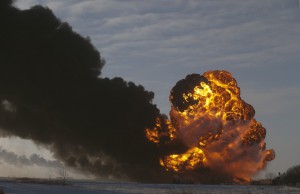
According to data from the Pipeline and Hazardous Materials Safety Administration, in the four decades that such records have been taken between 1975 to 2012, U.S. rail spilled a combined 800,000 gallons of crude oil. This pales in comparison to the damage done in the 12 months of 2013, in which 1.15 million gallons of crude oil was spilled.

In total, U.S. railroads shipped 400,000 carloads of crude oil in 2013, or over 11.5 billion gallons.

"The spike underscores new concerns about the safety of such shipments as rail has become the preferred mode for oil producers amid a North American energy boom," McClatchy reports.

Another Oil Train Derailment – Rail Crews Call Them “Bomb Trains”

From the blog Railroaded - January 6, 2014 (used by permission)

Disclaimer: The views expressed here are not the official position of the IWW (or even the IWW’s EUC) and do not necessarily represent the views of anyone but the author’s.

Twenty-one cars and 2 locomotives of a mile-long Burlington Northern Santa Fe (BNSF) Railway train derailed December 30, 2013, near Casselton, North Dakota, overturning oil tanker cars that exploded and burned for more than 24 hours (Star TelegramAsbury Park PressAssociated PressDuluth News TribuneValleynewslive.comAssociated Press 2McClatchy Interactive).

Another BNSF mile-long train carrying grain derailed first (13 cars) and some of the grain cars fell onto an adjacent track carrying the BNSF oil train. About a minute after the grain train derailed, the oil train struck one of the derailed cars filled with soybeans, causing the oil train to fall off the tracks. 20 crude oil tank cars derailed, of which 18 were punctured. Subsequent explosions and fires lasted for hours. One observer noted at least 6 separate explosions in the 2 hours following the derailments, which sent huge fireballs and clouds of hazardous toxic black smoke into the air. The fire burned so hot emergency crews didn’t even attempt to put out the blaze.

475,000 gallons of oil were spilled in the derailment, some of it burning off and some of it leaking into the soil. Investigators estimate that at least 7,300 tons of dirt contaminated with oil must be removed from the site.

Most of Casselton’s 2,400 residents followed a call from the Cass County Sheriff’s Office to evacuate the town due to health concerns about exposure to the toxic burning crude which can cause shortness of breath, coughing and itching, watery eyes. North Dakota Governor Jack Dalrymple visited Casselton and called it a “major catastrophe” that would prompt concern no matter where it happened.

A preliminary investigation by the U.S. National Transportation Safety Board (NTSB) suggests the derailment occurred at a mechanical switching point between 2 tracks. The oil tanker cars that derailed and exploded and burned were the older-model DOT-111 cars which have been known for years to rupture easily in derailments and other accidents. The NTSB, Transportation Safety Board (TSB) of Canada and most rail safety experts have been recommending for many years that the DOT-111 model cars be replaced or upgraded. Unfortunately, railway companies and shippers have been inordinately slow, and in some cases unwilling, to replace this antiquated model with sturdier built and safer models.

Canada: Land of the Toxic Lakes

By Richard Mellior, AFSCME Local 444, retired - Facts for Working People, November 27, 2013

Disclaimer: The views expressed here are not the official position of the IWW (or even the IWW’s EUC) and do not necessarily represent the views of anyone but the author’s.

In the aftermath of the crash, polls have indicated that as much as 36% of the US population looks more favorably to socialism, and a recent Pew survey of America's youth between 18 and 29 found that more have a positive view toward Socialism than they do toward Capitalism, Socialism: 49% Capitalism 46%.  While there is no doubt what people mean by socialism varies I think it is fairly accurate to say it means a more egalitarian society, or more accurately, a more just social system.

The problem is that capitalism cannot deliver these goods.  Capitalism is an exploitive system of production in which production or the production of social needs is set in to motion on the basis of profit, on how it can enrich that small minority that own the means of producing human needs and the production process itself. Human needs are secondary as are the needs of the natural world.

Hunger, disease, war, these are the by-products of capitalism.  But so is environmental degradation as land, water, and the natural world is simply there to be exploited regardless of the long-term damage. I read now that Chevron is fighting back against an $18 billion judgment against the company by Judge Nicolas Zambrano in Ecuador. The ruling supported villagers, claims that Texaco had contaminated an oil field in northeastern Ecuador between 1964 and 1992. Texaco was bought by Chevron. Ecuador's Supreme Court has since reduced the amount to $9.5 billion.  Chevron attorneys have accused the US lawyer for the villagers, Steven Donziger, of orchestrating an international criminal conspiracy by using bribery and fraud in Ecuador to secure a multibillion-dollar pollution judgment against the oil company.”

Meanwhile, BP which is responsible for the catastrophic spill in the Gulf of Mexico, has been accused of lying about the amount of the spill and is resisting paying reparations saying claimants who were not harmed are demanding payment.

No amount of court theatrics will stop the catastrophic environmental destruction that will at some point reach a tipping point with vast swathes of the planet becoming uninhabitable. Life on this planet cannot survive the ravages of capitalism forever, or more accurately, a system of production which places profit above all else and in which the means of producing humanity’s needs like energy, are owned by private individuals. We have absolutely no say in how decisions about these issues are made, decisions that have life and death consequences for all of us.

Warsaw Climate Talks Go Up in Smoke

By Chris Williams - reprinted by permission from Truthout, November 21, 2013

Disclaimer: The views expressed here are not the official position of the IWW (or even the IWW’s EUC) and do not necessarily represent the views of anyone but the author’s.

"The smell of inaction" is how Dipti Bhatnagar, Friends of the Earth Mozambique's international program director for climate justice and energy, summed up the atmosphere inside the giant Narodowy Stadium after the first week of the latest round of international climate negotiations, Conference of the Parties, otherwise known as COP 19, taking place Nov 11-22, 2013, in Warsaw.

Given that this is the 19th consecutive year of annual negotiations and with a meaningful global treaty more distant now than it was almost two decades ago, Bhatnagar's olfactory deduction seems likely to be highly accurate.

As the pervasive smell of inaction seeped like a suffocating gas throughout the inside of the conference, outside, the choking effects of coal smoke waft from all corners of a country that obtains 90 percent of its electricity from coal and whose government has pledged to keep it that way until 2060.

As if to emphasize the point, just on the other side of the banks of the Vistula River, a stone's throw from the international climate negotiations, another conference is being held at the Polish Ministry of the Economy. Intent on sending a none-too-subtle message to government negotiators at COP 19, coal industry executives have gathered at the International Coal and Climate Conference, November 18-19, to discuss the future of coal in light of climate change.

If this were a rational system set up to benefit humanity, one might think that, as coal burning releases more carbon than other fossil fuels in addition to small particulates that infiltrate and cause chronic lung damage as well as other toxic chemicals that increase the risk of cancer and cause acid rain - coal industry leaders might be discussing how to shift their investments, to phase out coal and transition to alternative energy production methods that don't rely on burning such a noxious substance.

In reality, the conference was put on for precisely the opposite reasons. Attendees, with the blessing of the Polish government, were there to argue for the future of "clean coal." This technology is known as CCS (carbon capture and storage). And although it seeks to trap and bury carbon emissions from coal plants, it doesn't exist in any meaningful commercial form. Even some supporters harbor increasing doubts that it ever will be made to work on the scale necessary. But, nevertheless, it is being touted as the way to "safely" continue burning coal.

The Obama Dirty Energy Doctrine - Part 1: A Petroleum-Based National Security Policy

By Burkely Herrman - Interesting Blogger, November 3, 2013

Disclaimer: The views expressed here are not the official position of the IWW (or even the IWW’s EUC) and do not necessarily represent the views of anyone but the author’s.

Already, I am mad as hell, and can’t take it anymore. Then, the President of my home country goes before the UN, and tells them that we are an imperialist country. In this speech, part of what outlined the new Obama Doctrine, noted the following American policy for the rest of his 3 years in office:

“…let me take this opportunity to outline what has been U.S. policy toward the Middle East and North Africa and what will be my policy during the remainder of my presiden[cy]…The United States of America is prepared to use all elements of our power, including military force, to secure our core interests in the region…We will ensure the free flow of energy from the region to the world. Although America is steadily reducing our own dependence on imported oil, the world still depends on the region’s energy supply and a severe disruption could destabilize the entire global economy. We will dismantle terrorist networks that threaten our people….when it’s necessary, defend the United States against terrorist attack, we will take direct action. And finally, we will not tolerate the development or use of weapons of mass destruction…we’ll continue to promote democracy and human rights and open markets because we believe these practices achieve peace and prosperity…these objectives are best achieved when we partner with the international community and with the countries and peoples of the region…Now, the notion of American empire may be useful propaganda, but it isn’t borne out by America’s current policy or by public opinion.”(1)

Rising Tide and Allies Shut Down Port of Vancouver

Portland Rising Tide North American - Monday, November 4th, 2013

Disclaimer: The views expressed here are not the official position of the IWW (or even the IWW’s EUC) and do not necessarily represent the views of anyone but the author’s.

Vancouver and Portland Rising Tide are joining with other friends, allies, and activists in the Pacific Northwest to shut down the Port of Vancouver, Washington, right now in solidarity with the ILWU.

This from Portland Rising Tide’s Facebook page: “Good morning Port of Vancouver, if you can’t keep your grain terminal safe for workers, how can you make an oil terminal safe? You can’t so this morning Rising Tide is shutting you down!”

The ILWU has been locked out of a grain shipment terminal by United Grain. “United Grain and its Japanese owners at Mitsui have failed to negotiate in good faith with the men and women of the ILWU for months and instead chose to aggressively prepare for a lockout, spending enormous resources on an out-of-state security firm,” according to a statement made by ILWU spokeswoman Jennifer Sargent earlier this year.

On July 15, 2011, hundreds of ILWU protestors blockaded a mile-long train coming into the terminal in protest. The struggle has continued through numerous actions of resistance, including this June, when ILWU members blocked a transport van from leaving the port.

Today, the ILWU’s struggle in the area is spilling over into a new terminal as Rising Tide activists are calling out the unaccountable and irresponsible behavior of the Port of Vancouver in both the ILWU lockout and the approval of a new oil terminal. The terminal would process 380,000 barrels of oil coming in by rail from the Bakken shale and probably the tar sands.

Many activists have pointed to recent oil disasters, such as the explosion of an oil train in Lac-Megantic, Canada, that incinerated the entire town square.

Pages

The Fine Print I:

Disclaimer: The views expressed on this site are not the official position of the IWW (or even the IWW’s EUC) unless otherwise indicated and do not necessarily represent the views of anyone but the author’s, nor should it be assumed that any of these authors automatically support the IWW or endorse any of its positions.

Further: the inclusion of a link on our site (other than the link to the main IWW site) does not imply endorsement by or an alliance with the IWW. These sites have been chosen by our members due to their perceived relevance to the IWW EUC and are included here for informational purposes only. If you have any suggestions or comments on any of the links included (or not included) above, please contact us.

The Fine Print II:

Fair Use Notice: The material on this site is provided for educational and informational purposes. It may contain copyrighted material the use of which has not always been specifically authorized by the copyright owner. It is being made available in an effort to advance the understanding of scientific, environmental, economic, social justice and human rights issues etc.

It is believed that this constitutes a 'fair use' of any such copyrighted material as provided for in section 107 of the US Copyright Law. In accordance with Title 17 U.S.C. Section 107, the material on this site is distributed without profit to those who have an interest in using the included information for research and educational purposes. If you wish to use copyrighted material from this site for purposes of your own that go beyond 'fair use', you must obtain permission from the copyright owner. The information on this site does not constitute legal or technical advice.

