You are here

Appalachia

After years of decline, the crippling disease is rebounding, worse than before

By Dan Radmacher - Appalachian Voices, August 22, 2017

“There is an epidemic here in Southwest Virginia, in Eastern Kentucky, in Southern West Virginia,” says Ron Carson, director of the Black Lung Program at Virginia’s Stone Mountain Health Services. “Miners are getting sicker and dying at a much younger age. A lot of people are going to be shocked when they see the numbers.”

Carson has been working with researchers from the National Institute for Occupational Safety and Health to put hard numbers to this deadly resurgence, and he says they have been astounded by the number of cases Carson’s clinic is seeing of progressive massive fibrosis cases, the most serious form of black lung disease.

In a report from similar research released last December, NIOSH researchers found a cluster of 60 such cases from one Eastern Kentucky radiology practice over a nine-month period — three times the number of cases the national Coal Workers’ Health Surveillance Program found from 2011 to 2016.

Around the same time the NIOSH report was released, an NPR investigation by Howard Berkes aired that identified more than 1,000 cases of progressive massive fibrosis during the past decade — 10 times the number officially recognized by the federal government.

Complicated black lung is debilitating in the extreme, Carson says. “Some young miners come in to this clinic in wheelchairs because they don’t have enough breath to walk,” he says. “We have miners at age 28 with eight years of exposure to coal dust waiting for a lung transplant.”

Progressive massive fibrosis, like other forms of black lung disease, cannot be cured and is eventually fatal. Carson says the clinic focuses on easing the miners’ suffering. “We make every effort to give them a better quality of life,” he says. “Therapists do pulmonary rehab and work on patient education. They talk to them about winterizing their lungs — cold air has drastic effects on this condition.”

Jill Hutchison, the first director of the Black Lung Clinics Program in West Virginia and retired CEO of the West Virginia Primary Care Association, said the number of miners treated in West Virginia’s 18 black lung clinics increased by 26 percent last year.

“Black lung is not going away,” she says. “It is an ugly disease. It’s heart-breaking to watch a miner struggle just to breathe. The clinic’s helping black lung patients use medicine, dietary recommendations and exercise to improve their quality of life as much as possible.”

The Mono-Economy of Coal or: How to Maintain a Captive Workforce

By Nick Mullins - The Thoughtful Coal Miner, August 19, 2017

There has been no drought of media attention about coal, coal miners, and Appalachia over the past year. I myself have fielded more than a dozen calls from media outlets wanting to know more about the region, each looking for new angles or “ins” with coal mines and coal miners. Though a few have done a decent job contextualizing Appalachia’s deeper issues, many still manage to skip over some very important details about our situation—and that’s a problem. It’s this lack of depth that allows authors like J.D. Vance, and his book Hillbilly Elegy to reach national best seller status and thereby define our existence among an international audience.

So here is something for everyone to consider—the forces that control Appalachia’s economy also seek to maintain a captive workforce aimed at exploiting miners and their families.

As Coal Production Ramps Up, Companies Should Pay Their Debts to Mining Communities

By Nick Mullins - The Thoughtful Coal Miner, August 8, 2017

According to reports from the Energy Information Administration, coal production will be on the rise due to increases in electrical generation from coal fired power plants and coal exports. This means that coal companies, who have come out ahead by shirking their financial responsibilities in bankruptcy court, will be primed to make yet another killing.

For a select group of people living in coal mining regions across the nation, this boom will be a short reprieve from the economic suffering felt during the most recent downturn. But those  “lucky” enough to return to the mines will see that the economic desperation created in the last five years has changed the game. Companies will not be begging for workers as they did in the mid-2000s.  Miners will be competing with each other to get what jobs do come available, and those who are hired will face the constant threat of losing their job to the next desperate miner waiting in line. Coupled with reduced mine safety regulations, a concession given by state legislators to help the industry “create jobs,” coal mining families will be facing some truly dangerous times.

Many of us know this will be one of the last booms, if not THE last boom in the coal industry, especially in Appalachia. There is a long term movement away from coal in the global markets, and what accessible coal is left in our mountains will be retrieved through increased mechanization. Coal will not bring our towns back to life. If anything, it is acting as short term life support.

We need to make sure the coal industry does not come out of this smelling like roses as they always have. It is time we make them do what’s right by the miners who dig their profits out of the ground. Not one ton of coal should be removed until miners have the right to shut down an operation if it’s unsafe…without fear of losing their jobs.

It’s also time we make companies pay their debts to both the land and people where their operations have pillaged our resources. Along with a thorough reform of each state’s coal severance tax system, additional taxes should be levied against every ton of coal and  used to pay for mined land reclamation, developing clean water projects for communities, shoring up pension funds and health care benefit funds for retired miners and their families, building new infrastructure, and providing an honest-to-god just economic transition so people can lead healthier, happier lives in the region—not just participate in more economic development that sets the stage for opportunistic companies to come in and exploit our labor with the ancillary benefit of tax breaks.

It’s time for reparations, and this is our chance to get them.

Citizens living within the coalfields need to watch their politicians like hawks and vote in the people who are going to make sure this happens. This last boom shouldn’t be for the benefit of investors and company officials. This last boom should be about taking care of coal mining communities, just like Donald Trump promised.

The Ongoing Fight Against Media’s Misrepresentation of Appalachia

By Nick Mullins - The Thoughtful Coal Miner, August 2, 2017

A few weeks ago, I was contacted by Daniel Flatley from Bloomberg News. He was working on a story aimed at understanding why coal miners were not retraining into healthcare careers as the healthcare industry grew in Appalachia. I tried my best to answer his questions and give a broader understanding of miner retraining and economic development issues in the region. Unfortunately, the article was published just as I was heading back home to help with a family emergency. I became aware of it just today.

Let me start by saying that I am beyond angry with the title of the article and the image Bloomberg chose. The photo was a quick snapshot, catching two coal workers off guard with the intent of portraying them as senseless animals being enticed with a treat. Is it any wonder that we are upset with urban elitism and the so called “left” media? As I stated in my Yes! Magazine article, stereotyping Appalachians (in this case as being unintelligent) feeds directly into the divisive rhetoric spread by conservative politicians and coal industry associations. It is often so brazen, I honestly wonder if this isn’t the intent.

In terms of my quotes, I did NOT infer that people were actively avoiding retraining or other careers because of gender stereotypes and gender roles within the region. My quote, like the photo, was a snippit of a conversation that lasted 15 minutes. The issue is complex and leaves a great deal of room for speculation.

There is a lot of pride and heritage in coal mining, but very few coal miners would stick with a career in the mines if job alternatives with similar wages and benefits were available in the region.

When it comes to why miners weren’t jumping at job opportunities created by the health care industry, I did state that miners who were already involved in local emergency medical services and rescue squads could easily transition into such work, but there are many miners who would not consider it. This was not to say that they are incapable of the job, or that they have been institutionalized by the coal industry. I tried to explain that it would be a different environment to work in, and many would not pursue it for the same reason a large portion of our population does not pursue jobs in the healthcare industry. It takes a specific type of person to engage in the duties fulfilled by nurses and surgical staff.

I did speculate that many miners were holding out hope for Trump bringing back coal jobs and that many do not participate in retraining because of the lack of jobs available as they exit retraining. I also mentioned that some may fear that companies would not hire them if officials believed they were pursuing career alternatives. The coal industry has a very captive workforce at the moment, and they are seeking only the most dedicated miners to exploit.

This article is just more media misrepresentation of Appalachia not unlike what Ivy Brashear spoke to in her article “Why Media Must Stop Misrepresenting Appalachia.” Speaking of which, stay tuned as I will be addressing Hillbilly Elegy in the near future.

Citizens Begin Reclaiming Coal Country After Decades of Corporate Land Grabs

By Emma Eisenberg - Yes Magazine!, July 2017

Across central Appalachia, once-thriving mining communities have been ravaged by the collapse of the coal industry and the flight of jobs from the region. For a region that remains rich in natural resources, Appalachia’s local governments continue to struggle to fund basic services such as housing, education and roads.

One significant factor in the region’s decline is the land. Since the coal industry began its decline, and even beforehand, millions of acres have essentially been removed from the region’s economic production and tax rolls, and nothing has replaced them.

“Land is the most important thing to us, yet it’s not clear at all who owns it,” says Karen Rignall, assistant professor of community and leadership development at the University of Kentucky. “Without broad-scale knowledge of the patterns of land ownership this region cannot work together to move forward. But who owns it on paper is not always who owns it in actuality. That takes time and money to find out.”

The coal industry of central Appalachia has been on the decline for more than 30 years, with West Virginia and Kentucky losing more than 38,000 coal jobs in that time. As coal companies pulled out, they took with them the dollars that small towns used to use to fund their schools and infrastructure, and left behind abandoned mines, polluted rivers and vast swaths of vacant land.

All over Appalachia, communities and organizations are working around the clock to come up with a way to “justly transition” the Appalachian economy to whatever comes next.

Rignall and postdoctoral researcher Lindsay Shade are collaborating with a growing group of citizens that think a part of the answer to a post-coal economy may lie with an old land ownership study—and have been inspired by it to do a new one.

DOJ Withdraws Funding Request for Kentucky Prison on Mountaintop-Removal Site

By Zoe Loftus-Farren - Truthout, June 30, 2017

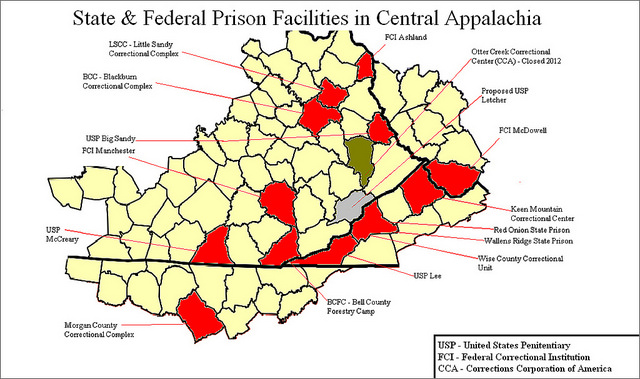
Last month the United States Department of Justice (DOJ) withdrew its request for funding for construction of a maximum-security prison atop a former mountaintop-removal coal-mining site in eastern Kentucky.

The proposed $444 million facility, planned for Letcher County, has faced ongoing opposition from environmental and human rights organizations who have expressed a wide range of concerns about potential ecological and health impacts of the project. "Building this prison would have been terrible for the health of prisoners, the surrounding community and all the wildlife in the area," said Lori Ann Bird, who is environmental health program director with the nonprofit Center for Biological Diversity.

Read Earth Island Journal and Truthout's special investigation into America's toxic prisons.

The Human Rights Defense Center, a nonprofit that advocates on behalf of people held in US detention facilities, pointed to the history of mining-related pollution in the area -- including contamination of drinking water that could be used for the prison. The Human Rights Defense Center also noted the ongoing risk posed by more than a dozen active gas wells near the proposed site, as well as possible radon intrusion linked to coal mining in the area.

In a comment filed in response to the Federal Bureau of Prisons' (BOP) 2015 environmental impact statement for the facility, opponents also cited impacts on the local community -- including potential water pollution from the prison itself -- as well as on nearby habitat and wildlife. Two federally endangered species, the Indiana bat and the gray bat, are found in the region, as are some 60 other species with varying levels of state and federal protections. 

"It's a pretty huge step toward victory," Panagioti Tsolkas, cofounder of the Prison Ecology Project, a program of the Human Rights Defense Center, said of the DOJ's decision to abandon the plan.

The Prison Ecology Project and the Center for Biological Diversity point to growing local opposition, in conjunction with a coordinated campaign by advocates, as triggering the withdrawal. "This has been a tremendous effort by a lot of diverse groups coming together to oppose this prison, and shows the powerful impact we can achieve when the community comes together with activists from around the country to oppose a destructive project," Bird said.

In its announcement of the withdrawal of its request for funding, the DOJ cited a declining prison population over the past several years, and noted that the BOP could expand capacity at existing facilities and through private prisons if necessary. (The Federal Bureau of Prisons is a subdivision of the US Department of Justice.)

Not everyone has expressed support for the DOJ's decision. Local representative Hal Rogers (R-KY) argues that overcrowding in federal prisons necessitates new construction. In a June hearing on the Department of Justice's fiscal year 2018 budget, Representative Rogers argued that the project should proceed, emphasizing that Congress had already appropriated funding for the prison: "Congress has decided this and it's the Congress that controls the purse strings of the country… The money is there -- appropriated, authorized, everything in order." Rogers has also noted that the prison would be an important source of new jobs for an economically moribund region (though research shows that prisons generally don't improve the local economy and are, in fact, more likely to harm rather than help host communities).  

Opponents of the project remain cautiously optimistic while acknowledging that the victory may be temporary -- Congress hasn't yet passed the 2018 budget, and there's always the possibility that the DOJ could reverse course again at a later time. For now, the Prison Ecology Project is setting its sights on the next battle or battles, which might include: FMC Carswell, a women's prison in Texas built on a military base and surrounded by Superfund sites; a proposal to build a new prison on a landfill in Utah; a Hawaiian prison where the BOP has tried to skirt the environmental review process; and a proposal to build a women's jail on a toxic Superfund site in Los Angeles County.   

Tsolkas thinks the Letcher County win will lend momentum to these other fights. "The DOJ said basically they don't want the prison, they don't need it…. That's a powerful position to be fighting from."

Against Our Own Best Interest: Why Working People Shouldn’t Elect Businessmen Into Office

By Nick Mullins - The Thoughtful Coal Miner, June 28, 2017

In my experiences, I’ve run across many people who believe business executives are a good choice to be our lawmakers. Many of these same people also complain about the poor treatment of employees and off-shoring of manufacturing jobs, decisions that are often made by business executives.  So why exactly do people elect them into public office?

After getting into a variety of debates, I’ve found many people’s logic can be summed up in this statement, “Business leaders are smart people and hard workers who know how to make the right decisions to build companies from the ground up. They are good employers and will use their expertise to fix our government and provide more and better jobs.” If these were the businessmen and women that actually made it into office, I might consider the notion, but this is rarely the case.

Rural conservatives have a strange admiration for business executives as being job creators. Yet, these are the same people who make the big company decisions like downsizing, placing freezes on pay increases, reducing healthcare benefits while increasing employee insurance premium contributions, requring mandatory overtime, all while giving the green light for human resources to treat everyone like a literal resource—or as a threat if they have been harassed or injured in the workplace. Business executives loyalty is always to the stockholders and other investors. They are legally bound to make a profit. If this means eliminating labor overhead, they do.

Our national business culture breeds a superiority complex among corporate executives, making it difficult for them to be kind to their laborers. The free market mandates competition, which good or bad, results in a survival of the fittest mentality that ends up in a quest for the cheapest sources of both labor and materials (like coal). This is the mentality that drives people beyond having a conscious when it comes to the average laborer. For some well-to-do business leaders, it translates into the divine right to take a massive dump on anyone beneath them because, after all, “It’s just business.”

People also seem to forget the golden rule of business that allowed many of our now elected officials to make their fortunes—”It takes money to make money.” The majority of the super wealthy who own the majority of businesses, did not come by their fortunes through a rags to riches story. It came from prior wealth inherited from their predecessors.  They have never had to work hard just to survive and provide for their families. They have no understanding of the people who work for them, and therefore, no reason to care about them.

Searching for Justice in Appalachia: Part II

By Nick Mullins - The Thoughtful Coal Miner, June 21, 2017

In my original post, I skirted along the edges of some personal beliefs that I often spare my readership, beliefs that I must admit, cause me to doubt myself and this work. As I mentioned in my first post, one of the downsides to being a justice advocate is realizing just how bleak the situation can be. I get up every morning, wondering if we can ever truly achieve justice.

Just to recap, coal companies have billions in assets, lawyers on retainer, political campaign contributions, and they own the majority of our resources in Appalachia. Coal companies use the money they make from our resources to hire marketing firms, pay for advertising time on TV networks, and print thousands upon thousands of Friends of Coal stickers to convince us they are benefiting our communities. For many of us, it’s a struggle just to pay our bills and buy food, let alone stand up against it.

And then there’s something I don’t often admit. There are times I question whether we have anything left to fight for. Hundreds of thousands of acres have been surface mined. Millions of acres have been underground mined leaving voids that will eventually cause subsidence, sinking more wells in the decades to come, and creating more acidic mine drainage laden with heavy metals and whatever waste we left in there. Then there’s the billions of gallons of coal sludge dammed up in hollows all across Appalachia, and tens of thousands of natural gas wells belching out “residual waste” water.

The picture becomes even darker when I realize that the issues we have in Appalachia apply on a global scale. Everywhere there are natural resources to be had, companies have undertaken similar initiatives, and it’s all driven by the insatiable desire of millions and millions of people competing for social status and seeking all things comfortable and convenient. Add in all the social, racial, and environmental injustices that go along with it, and how the mainstream discredits justice seekers as eccentric or extremist and well… there just doesn’t seem to be any hope left out there in the world. I constantly go in and out of states of depression and the idea of throwing my hands in the air to run screaming into the woods where I would live out the remainder of my life as a hermit becomes more and more appealing.

But I never will. I can’t give up.

People on both sides of these debates are so often on the same page but don’t realize it, and therein lies some hope. Most folks working in extractive industries are conservationists, and that’s not a far cry from environmentalists. True, they’d rather be beaten about the head and shoulders with a roof jack than to be considered a “treehugger,” but many would stand up to preserve their hunting grounds or local lake. The problem always seems to be a break down in communications between environmentalists and the working class, and the industry always knows exactly where to place the dynamite on the bridges that are built between them. It’s always in the industry’s interests to keep people at odds—it’s been that way since the union days.

I’m going to keep trying to build those bridges. Some environmentalists consider me arrogant and self-serving when I criticize their methods, and some miners like to call me a “disgruntled employee” or a “treehugger,” but I’m none of it. What I am is crazy. Crazy enough to believe that if we can just clear away the bull****, we might have a chance at gaining our freedom, our land, and our children’s future back. This is where the rubber meets the road for me, this is where the past 20 years of my adult life comes to a head; getting up every morning, putting everything I have out there, taking the licks I get for opening my mouth, trying to scrape by on what little money comes our way, and forging ahead.

Using Miners for Political Gain is Nothing New, Still Repulsive

By Rob Byers - CounterPunch, June 9, 2017

Earlier this spring, I was asked a question about my late father, who had been a coal miner in the 1970s and ’80s. It had to do with a familiar romantic storyline:

Did he feel at home underground? Was it a calling that tugged at him during the layoffs, a longing to get back to the job he loved?

Short answer: No. Long answer: Hell, no.

Best I could tell as a kid, he hated it. It was back-breaking, dangerous, cold, dusty, dirty. He did it for the same reason miners do it today – because it was the best-paying job around for a man with a high-school education.

As a coal miner’s son, you might think I would be proud of all the attention miners are getting nowadays from President Trump and the media. You’d be wrong, though. Actually, I find the whole thing pretty demeaning, as the coal miner is used as a political pawn and an excuse to trash the planet.

Then again, maybe I should be used to it by now. The miner-as-economic-victim thing has been hanging around for quite a while.

After the first Obama election in November 2008, Republican lawmakers, industry groups and political strategists needed a human face for their cause, which was eliminating environmental regulations and ignoring climate change. The noble miner, toiling away underground to power America, was perfect.

Never mind that the cause was much more about making money for political donors and industry partners than it was about any miner’s paycheck.

Now, how about a nice, sound-bite slogan? One that mining families and local politicos could easily spout. Enter the “war on coal” — a purely fictitious battle, of course, but nobody ever said politics was about honesty. And talk about effective marketing. So catchy.

The villain? Well, that was really too easy. Everybody was blaming Obama for everything anyway. Plus, it was a two-for-one deal: They could bash the union at the same time after the UMWA backed Obama in 2008.

Fast forward to 2016 and an out-of-context Hillary Clinton quote later (“we’re going to put a lot of coal miners and coal companies out of business”) and it was time to trot out the “war on coal” political machine once more.

Trump plays dress-up in a hard hat at a rally at the Charleston Civic Center, feigns what he thinks it must be like to hold a shovel and fakes his way to the White House.

And so, at long last, the Republicans – and many West Virginia Democrats — are getting what they want as Trump rolls back Obama environmental laws and ignores climate change.

By backing out of the Paris climate agreement, Trump gets to act like he’s helping out his base in West Virginia, while really doing nothing – except, of course, forfeiting America’s well-earned perch as the world’s problem solver. And all the while, our congressional delegation dutifully stands back and applauds.

True help for unemployed miners and other West Virginians would mean tackling climate change head-on, embracing renewable energy and re-training people to work in the emerging industries.

But Trump is a champion only for himself … and his golf courses and hotels.

After all, we’ve watched him propose gutting the Appalachian Regional Commission, Legal Aid, low-income heating aid, college tuition assistance and other programs that benefit West Virginians.

I find no value in the argument that West Virginians, miners and other working-class communities across the nation are getting what they deserve. It’s precisely that kind of divisiveness that landed us in this mess.

It’s not foolish for someone to vote for a candidate who promises to represent their specific interests. It’s not surprising for someone to pine for an earlier time, a time they perceive to have been better. That’s been going on since the first time anyone referred to the “good ol’ days.”

In a place where drug abuse and unemployment are rampant, it can be easy to look back instead of ahead. It’s simpler to think back fondly to the busy, bustling mines — and conveniently forget about the slag heaps and polluted streams. The men, women and children buried alive by coal waste at Buffalo Creek. The dust that turns lungs black and slowly chokes lives away.

It’s even simpler when the powerful spend lavishly to make damn sure it happens.

Coal mining can be a dirty business. But so is toying with West Virginia’s hope.

Getting Out of Our Coal Hole

By Oscar Reyes - CounterPunch, May 11, 2017

When you’re in a hole, it’s usually best to stop digging. But when President Trump told supporters at his 100th day rally in Pennsylvania that “we are putting our coal miners back to work,” he just burrowed deeper into the bed of administration lies on energy.

The truth of the matter is that climate regulations aren’t a “war on coal,” and no amount of presidential photo-ops will bring mining jobs back. A recent report from the Center for Global Energy clearly shows why.

The demand for U.S. coal has collapsed in the past six years, it explains, following big improvements in energy efficiency (like better lighting and appliances), cheaper gas and renewables, and a decline in coal exports as other countries look to cleaner sources of energy.

Three of the four largest coal mining companies have filed for bankruptcy, while Bob Murray — CEO of the largest remaining one — recently warned Trump that coal jobs are unlikely to return. The CEO should know, as Murray Energy’s formula for avoiding bankruptcy has largely involved slashing jobs, compromising safety, and worsening labor conditions.

America’s main competitors get the point and have already planned to phase out coal. On April 21, the United Kingdom met its energy needs without burning any coal at all — for the first time since the Industrial Revolution. And the country’s last coal-burning power station will close within the next decade.

Meanwhile, a majority of energy companies in the European Union have promised to stop investing in new coal plants by 2020.

China is also fast reducing its reliance on coal. It recently canceled over 100 planned new coal-fired power plants, as well as slashing production at state-controlled coal mines. China has pledged to reduce coal production by 800 million tons per year by 2020, more than the entire annual output of all U.S. mines combined.

Instead of trying to revive the mining sector, in short, we should be planning for its replacement.

Pages

The Fine Print I:

Disclaimer: The views expressed on this site are not the official position of the IWW (or even the IWW’s EUC) unless otherwise indicated and do not necessarily represent the views of anyone but the author’s, nor should it be assumed that any of these authors automatically support the IWW or endorse any of its positions.

Further: the inclusion of a link on our site (other than the link to the main IWW site) does not imply endorsement by or an alliance with the IWW. These sites have been chosen by our members due to their perceived relevance to the IWW EUC and are included here for informational purposes only. If you have any suggestions or comments on any of the links included (or not included) above, please contact us.

The Fine Print II:

Fair Use Notice: The material on this site is provided for educational and informational purposes. It may contain copyrighted material the use of which has not always been specifically authorized by the copyright owner. It is being made available in an effort to advance the understanding of scientific, environmental, economic, social justice and human rights issues etc.

It is believed that this constitutes a 'fair use' of any such copyrighted material as provided for in section 107 of the US Copyright Law. In accordance with Title 17 U.S.C. Section 107, the material on this site is distributed without profit to those who have an interest in using the included information for research and educational purposes. If you wish to use copyrighted material from this site for purposes of your own that go beyond 'fair use', you must obtain permission from the copyright owner. The information on this site does not constitute legal or technical advice.