You are here

capital blight

Capital Blight News #121

Compiled by x344543 - IWW Environmental Unionism Caucus, September 13, 2016

A supplement to Eco Unionist News:

Lead Stories:

The Man Behind the Curtain:

Capitalist Saboteurs

By R. H. Lossin - Jacobin, September 1, 2016

This April, a natural gas pipeline exploded in Salem Township, Pennsylvania, shooting flames well above the tree line and producing enough heat to send a man to the hospital with third-degree burns. Such explosions, if uncommon, aren’t rare: according to ProPublica, they’ve killed five hundred people and injured four thousand more in the past thirty years.

When infrastructure fails in such a dramatic fashion, it is usually considered an accident. In the rare instances in which events like pipeline explosions are addressed as structural failures, it is only in the most literal sense of the word “structural,” prompting demands for repairs, regulation, and safety measures. But calls for oversight and technological fixes only reassert the accidental nature of what is in fact a problem of class society.

Pipeline explosions are a perfect example of what the late nineteenth-century French syndicalist Emile Pouget called “capitalist sabotage”: the regular and systematized damage done by capitalists to industry, commerce, workers, and consumers in the service of profit.

This is quite different from the sabotage periodically carried out by workers. For workers, Pouget explains, sabotage is “aimed only at the means of exploitation against the machines and the tools, that is against inert, painless and lifeless things.” Capitalist sabotage — “the very life essence of modern society” — “reaps human victims and deprives men of their health by sticking a leech at the very sources of life.”

Capitalists, of course, are well aware of the difference. The energy industry is again instructive. The initial investment in pipeline infrastructure was not necessarily a safety measure — it was a self-conscious assertion of class power.

Pipelines allow oil to flow across vast distances without human labor, wresting control from workers who would otherwise control crucial checkpoints in its distribution network. They decrease workers’ ability to, as Industrial Workers of the World (IWW) organizer Elizabeth Gurley Flynn put it, “consciously withdraw their efficiency” — in other words, sabotage the operation.

Capital Blight News #120

Compiled by x344543 - IWW Environmental Unionism Caucus, September 7, 2016

A supplement to Eco Unionist News:

Lead Stories:

The Man Behind the Curtain:

Green is the New Red:

Greenwashers:

Disaster Capitalism:

Breathing in the benefits: How an accelerated coal phase-out can reduce health impacts and costs for Albertans

By Benjamin Israël, Kim Perrotta, Joe Vipond, Leigh Allard, and Vanessa Foran - Pembina Institute, September 2016

With the phase-out of coal power announced by the provincein November 2015, Albertans stand to avoid significant health impacts caused by coal pollution. By extension, afurtheraccelerated phase out of coal power facilities would both hastenand amplify those avoided health impacts.The health benefits and costs savings in avoided health outcomes would be significant, and should be consideredin the government’s planning of the coal phase-out from now to 2030.

While the provincial government has announced a coal phase-out, they have not yet released a transition schedule. This analysis assesses the relative benefits of an accelerated stepwise transition away from coal, as proposed by the Pembina Institute,versus the back-loaded phase-out that otheranalyses haveposited.

In 2012, when the federal government finalized its coal regulations that —in effect —reduce electricity generation from coal plants, Environment Canada(as it was called at that time)estimated considerable health impacts would be avoided, usinghighly regarded modelling techniques. Logically, thesesignificantbenefits from reducing coal necessarily mean that the use of coal for power generation causesconsiderablehealth impacts in the first place.

By extrapolating the health benefit results from Environment Canada’s analysis, this report highlights the full impact of coal-fired generation in Albertaand indicates attainable benefits associated with the province’s coal phase- out.When the federal government weakened its proposed coal regulations back in 2012 in response to lobbying from some coal generators, allowing coal plants to continue unabated longer than first proposed,it left health savings on the table. Alberta can now grasp these savings byaccelerating our transition away from coal-fired electricity.

Read the report (PDF).

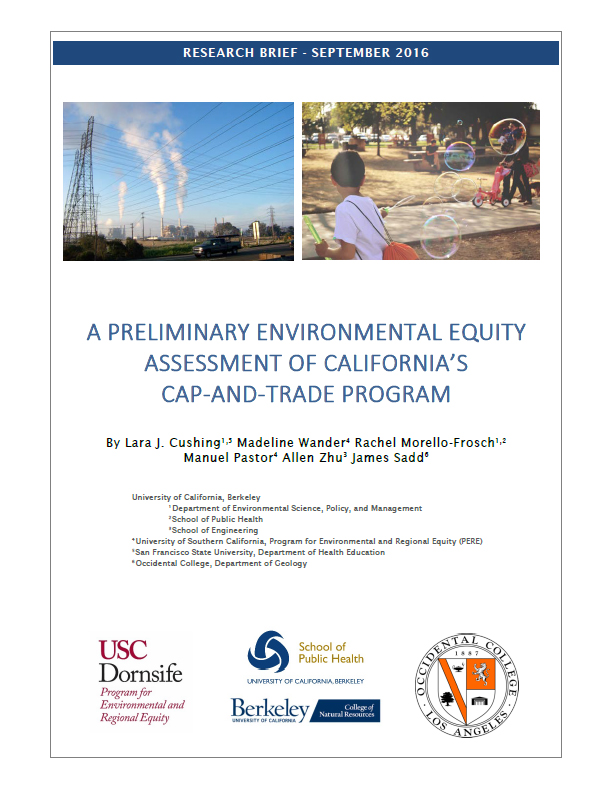
“A Preliminary Environmental Equity Assessment of California’s Cap-And-Trade Program

By Rachel Morello-Frosch, Manuel Pastor, James Sadd, Lara Cushing, Madeline Wander, and Allen Zhu - California Environmental Justice Alliance, September 2016

California’s cap-and-trade program is a key strategy for achieving reductions in greenhouse gas (GHG) emissions under AB32, the California Global Warming Solutions Act. For residents living near large industrial facilities, AB32 offered the possibility that along with reductions in GHGs, emissions of other harmful pollutants would also be decreased in their neighborhoods. Carbon dioxide (CO2), the primary GHG, indirectly impacts health by causing climate change but is not directly harmful to health in the communities where it is emitted. However, GHG emissions are usually accompanied by releases of other pollutants such as particulate matter (PM10) and air toxics that can directly harm the health of nearby residents.

In this brief, we assess inequalities in the location of GHG-emitting facilities and in the amount of GHGs and PM10 emitted by facilities regulated under cap-and-trade. We also provide a preliminary evaluation of changes in localized GHG emissions from large point sources since the advent of the program in 2013. To do this, we combined pollutant emissions data from California’s mandatory GHG and criteria pollutant reporting systems, data on neighborhood demographics from the American Community Survey, cumulative environmental health impacts from the California Environmental Protection Agency’s CalEnviroScreen tool, and information from the California Air Resources Board (CARB) about how regulated companies fulfilled their obligations under the first compliance period (2013-14) of the cap-and-trade program. Our methodology is described in greater detail in the appendix to this report.

In this analysis, we focus primarily on what are called “emitter covered emissions,” which correspond to localized, in-state emissions (derived mostly from fossil fuels) from industries that are subject to regulation under cap-and-trade. The cap-and-trade program also regulates out-of-state emissions associated with electricity imported into the state and, beginning in 2015, began regulating distributed emissions that result from the burning of fuels such as gasoline and natural gas in off-site locations (e.g., in the engines of vehicles and in homes).

We found that regulated GHG-emitting facilities are located in neighborhoods with higher proportions of residents of color and residents living in poverty. In addition, facilities that emit the highest levels of both GHGs and PM10 are also more likely to be located in communities with higher proportions of residents of color and residents living in poverty. This suggests that the public health and environmental equity co-benefits of California’s cap-and-trade program could be enhanced if there were more emissions reductions among the larger emitting facilities that are located in disadvantaged communities. In terms of GHG emission trends, in-state emissions have increased on average for several industry sectors since the advent of the cap-and-trade program, with many high emitting companies using offset projects located outside of California to meet their compliance obligations. Enhanced data collection and availability can strengthen efforts to track future changes in GHG and co-pollutant emissions and inform decision making in ways that incentivize deeper in-state reductions in GHGs and better maximize public health benefits and environmental equity goals.

Read the report (PDF).

(Working Paper #7) An Illness to One is the Concern of All: The Health Impacts of Rising Fossil Fuel Use

By Svati Shah and Sean Sweeney - Trade Unions for Energy Democracy, September 2016

This paper has been written to help unions representing workers in all sectors get a clear sense of what is presently happening in terms of the health impact of fossil fuel use and what could also happen if present patterns in energy use continue into the future. The data are presented in a way that unions can use to more effectively advocate both for their members and the broader public.

Unions in health care can play—indeed are playing—an important role in addressing both the climate-related and the pollution-related dimensions of the unfolding health crisis, as can health and safety personnel working with or for unions in different sectors. But the health-related impacts of rising pollution levels and climate change are expected to affect the lives of workers across a range of occupations. Unions representing workers in emergency services, workers in transport systems, or workers who must work outdoors in agriculture or construction also have a particularly important role to play. The situation requires as unified a response as possible.

One of the striking features of fossil fuel use today is how much it reflects and reinforces class inequalities. It is well known that rich countries consume far more energy per per-son than poorer ones, but within both rich and poor countries there is often a huge gulf between the energy consumed by the rich and the energy consumed by the poor and working class. The same is true of emissions. A December 2015 study released by Oxfam calculated that the poorest half of the global population are responsible for only around 10% of global emissions yet live overwhelmingly in the countries most vulnerable to climate change while the richest 10% of people in the world are responsible for around 50% of global emissions.

Trade unions with the capacity to play more of an active role in resisting the expansion of fossil fuel use can be confident of the fact that they will be intersecting with a rising global movement that is confronting fossil fuel extraction, including “unconventional fuels” like shale gas and shale oil. The concerns that drive this movement are numerous. Along with climate and air quality concerns, struggles have been built around questions of water scarcity and contamination and the fight to defend land and livelihoods from “extractivist” energy companies.

Read the report (PDF).

An Ecologically Sound and Socially Just Economy

By Fred Magdoff - Monthly Review, September 2016

Two weeks ago I returned from my fiftieth class reunion at Oberlin College in Ohio. The brief discussions I had there with environmental faculty and students left me feeling a bit dazed. So many good and intelligent people, so concerned, and doing what they think and hope will help heal the environment—this college has one of the best environmental education programs in the country. However, I was left disappointed and profoundly discouraged by the lack of discussion—or even interest in having a real continuing discussion and debate—regarding the root causes of our environmental disasters. Not just climate change, but also pollution of the air, water, soil, and living organisms, the loss of biodiversity both aboveground and in the soil, the extinction of species, and the overuse and misuse of both renewable and nonrenewable natural resources.

It is as though there is a flat tire with perhaps a thousand holes and people are working on the best way to patch this hole or that one. No one there seems to consider that the problem might be the tire itself—that the design and materials utilized are not appropriate to the way it is being used. And, if that is the case, then no amount of patching can solve the flat tire problem. It is of the utmost importance to be able to distinguish between symptoms (that most people call “problems” or “crises”) and underlying causes.

I ran into this confusion between symptoms and underlying causes time and time again in agricultural science and farming practices. Soils may be prone to erosion, store little water, grow crops that are susceptible to diseases and insect attack, become compacted, or have low fertility. Farmers (and extension specialists), usually think of and deal with these as individual problems—using pesticide applications, lots of commercial fertilizers, irrigating more frequently, using heavier equipment, and so on. In fact, I spent a significant portion of my career as a soil scientist helping to deal with the negative side effects of one of these responses—excess fertilizer use, especially nitrogen and phosphorus.

(As an aside, as I was preparing this talk, an unbelievable thirty-five tons of nitrogen in the nitrate form, worth approximately $35,000, flowed down the Raccoon River past Des Moines, Iowa, on the way to the Mississippi and the “dead zone” in the Gulf of Mexico. This flushing of nitrate out of the soil by prolonged spring rains, partially the result of nitrate left over after last year’s drought [2012], was mainly a consequence of an ecologically damaging, but profitable, emphasis on growing corn and soybeans without an ecologically sound crop rotation.)

However, what I learned over time was that in reality these are symptoms of an unhealthy soil and a simplified approach to soil and crop management. The same is true of never-ending unemployment, inequality and poverty, the systemic necessity of perpetual growth, and pollution of air, water, soil, and organisms. As harmful as each of these is, they are all only symptoms—of an economic system that is essentially unmanaged. Of course large corporations and politicians that represent them try to manage national and international laws, regulations, and markets in such ways that it becomes easier for them to make more money. But with individual corporations and other private capital making decisions which consider only their own interests, the system as a whole alternates between periods of growth (that nowadays are pretty lackluster) and periods of recession. Addressing individual symptoms alone is not sufficient for the tasks we need to undertake—either to create healthy soils or to create an ecologically based and humane society.

One of the neglected issues regarding thinking and acting about the environment—perhaps the most critical of all—is, to borrow a phrase from the first President Bush, the vision thing. The environmental movement is lacking any kind of meaningful vision as to what a truly ecologically sound and socially just society would look like and how it might operate. I am not talking about a blueprint with all sorts of details, but rather an agreement on essential characteristics of such a system. Without a vision—including some conception of the essential parts of such a system, the chances of actually getting to such a society are essentially zero. Or, as James Baldwin put it in a commonly cited but still very appropriate passage, “Not everything that is faced can be changed; but nothing can be changed until it is faced.” It is my contention that we are not facing the root cause of our problems, and until we do, there is no hope of solving the social and ecological problems confronting the world.

Capital Blight News #119

Compiled by x344543 - IWW Environmental Unionism Caucus, August 31, 2016

A supplement to Eco Unionist News:

Lead Stories:

The Man Behind the Curtain:

Greenwashers:

Disaster Capitalism:

Other News:

For more green news, please visit our news feeds section on ecology.iww.org; Twitter #IWWEUC; Hashtags: #greenunionism #greensyndicalism #IWW. Please send suggested news items to include in this series to euc [at] iww.org.

Capital Blight News #118

Compiled by x344543 - IWW Environmental Unionism Caucus, August 24, 2016

A supplement to Eco Unionist News:

Lead Stories:

The Man Behind the Curtain:

Green is the New Red:

As Flint Water Crisis "Emergency" Ends, Bigger Heads Need to Roll

By Michele Oberholtzer - Occupy.Com, August 18, 2016

This week, the emergency is officially over following the Flint Water Crisis. One year ago, the city of Flint, Mich., joined the ranks of Sandy Hook, Ferguson and other previously obscure cities that became a metaphor for man-made tragedy. In Flint the trauma came not at the barrel of a gun but through the faucet of a sink, as the infrastructure that was meant to provide life-sustaining water was made toxic through a negligent cost-cutting measure that altered water sources and treatment procedures. Flint entered a Federal State of Emergency to respond to the crisis, and that emergency expired this week.

First, the good news. Reports have showed significant improvements to water quality in a large number of Flint homes. State money amounting to $25 million and additional federal money is under consideration to address the temporary and long-term needs of residents, while charges have been brought against nine past and current state employees for their involvement in the crisis.

However satisfying one's reaction to this might be, the reality is that the water emergency in Flint continues. The ending of the state of emergency and the felony charges have a mollifying effect on the accumulated outrage, but no amount of federal appropriations or scape-goated employees can begin to address the root of the crimes that transgressed human rights in Flint.

Before considering the charges now being brought again Michigan employees, consider the true crimes of the Flint Water Crisis. First, there was the poisoning of the water itself, which involved switching from treated Detroit water to improperly treated water taken out of the industrial and highly polluted Flint River. Second, there was the failure of local and state governments to identify the problem or heed the immediate vocal outcries coming from residents and local businesses for over a year. Third, there was the capitalization of government that started with “emergency management” and ended with single-bottom-line decisions like the water conversion.

The charges brought against these individuals address a small aspect of issue number two: specifically, that government officials destroyed emails with incriminating evidence of lead level tests. Those emails revealed that the information about the low water quality was known and not acted on. According to Michigan Attorney General Bill Schuette, “Each of these individuals attempted to bury … information that contradicted their own narrative… and their narrative was ‘there’s nothing wrong with Flint water.'”

There appears to be convincing evidence of a coordinated effort between Department of Health and Human Services (DHHS) employees (those who received the lead reports) and Department of Environmental Quality employees (those who issued the lead reports) to delete emails that contained alarming and actionable data showing high levels of lead in the blood of Flint residents.

What reason could these people have for deleting emails that contained such alarming information? A person is not guilty of neglect unless s/he fails to act, yet these emails contained new and vital information that the recipients could have conceivably acted on and avoided any need for burying information. The destruction of the emails suggests that either the employees already considered that they had previously ignored information, or knew that they would be unable to correct the problem (since that would involve acknowledging the city's failed water system). Righting this kind of wrong would be terribly expensive, and the whole premise of Flint’s new water system was to cut costs. Delete.

As offensive as the willful neglect of these individuals has been, the fact is that the charges against those people refer to events that took place in July 2015, when the water crisis had already been ongoing for more than a year.

Conspicuously absent are charges against the engineers of the water switchover plan – including Flint Emergency Manager Darnell Earley, the architect of Flint's subverted democracy, and Gov. Rick Snyder – not to mention the premise that these individuals represent government-as-business and profit-over-people. Those pillars will go unshaken regardless of whether a few middlemen take the heat. A recent report by the Water Advisory Task Force placed the responsibility for the crisis on the state (specifically the DHHS). Note: This task force was appointed by Gov. Snyder.

Michigan can lock up the guys who buried the dirt, but people should not be distracted from the individuals who created the mess in the first place. The cognitive leap here, for the Attorney General’s investigation, is not to necessarily uncover hidden actions but to consider the crimes that took place in broad daylight. The decision of Flint leadership to switch from Detroit to Flint water sources was a financial one, made under the guardianship of emergency management. (“Emergency” in this case refers to a financial emergency, not a human one, which only came later). In this crisis, it is clear that decisions to prioritize money over people were not incidental, but rather inherent in the emergency management process.

Much has been said about the destruction to the physical infrastructure of Flint in recent years. But just as important was the destruction to the political infrastructure that began deteriorating not when the water sources were switched, but when emergency management was declared. The checks and balances between government and constituents were dismantled across cities in Michigan, with a direct hierarchy that led all the way to the governor. While a total of nine former state employees spend time awaiting trial, the architects of democratic deconstruction rest easy. Meanwhile, the rest of Michigan dreams of a world where “emergency management” is only used for human crises, not financial ones – in which case it may be about time find an Emergency Governor.

Pages

The Fine Print I:

Disclaimer: The views expressed on this site are not the official position of the IWW (or even the IWW’s EUC) unless otherwise indicated and do not necessarily represent the views of anyone but the author’s, nor should it be assumed that any of these authors automatically support the IWW or endorse any of its positions.

Further: the inclusion of a link on our site (other than the link to the main IWW site) does not imply endorsement by or an alliance with the IWW. These sites have been chosen by our members due to their perceived relevance to the IWW EUC and are included here for informational purposes only. If you have any suggestions or comments on any of the links included (or not included) above, please contact us.

The Fine Print II:

Fair Use Notice: The material on this site is provided for educational and informational purposes. It may contain copyrighted material the use of which has not always been specifically authorized by the copyright owner. It is being made available in an effort to advance the understanding of scientific, environmental, economic, social justice and human rights issues etc.

It is believed that this constitutes a 'fair use' of any such copyrighted material as provided for in section 107 of the US Copyright Law. In accordance with Title 17 U.S.C. Section 107, the material on this site is distributed without profit to those who have an interest in using the included information for research and educational purposes. If you wish to use copyrighted material from this site for purposes of your own that go beyond 'fair use', you must obtain permission from the copyright owner. The information on this site does not constitute legal or technical advice.