You are here

crude-by-rail

Wrong Side of the Tracks: Why Rail is Not the Answer to the Tar Sands Market Access Problem

By Lorne Stockman, et. al. - Oil Change International, September 2014

Tar sands pipelines face increasing resistance both in the United States and Canada. As existing pipelines reach capacity, the delay and possible cancellation of new pipelines is costing tar sands producers billions of dollars and reducing investment in the sector. The success of anti-pipeline campaigns has forced industry to look to rail in an attempt to address these losses and open new markets for their product.

The crude oil produced from the Albertan tar sands is a semi-solid substance called bitumen, rather than a liquid crude oil. Shipping bitumen by rail is more expensive than shipping it by pipeline and the added cost is a substantial challenge to the long-term viability of the tar sands industry. Despite significant evidence, market analysis, and real world experience to the contrary, some prominent institutions - including the U.S. Department of State - continue to assert that rail has the potential to replace tar sands pipeline capacity, and thus the rapid pace of tar sands development will continue regardless of whether new pipeline capacity is built or not.

This report details why this is not the case.

Read the report (English PDF).

Rail-union Agreement Raises Concerns Over Safety

By Sarah Case - Gilette News Record, August 26, 2014

Disclaimer: The views expressed here are not the official position of the IWW (or even the IWW’s EUC) and do not necessarily represent the views of anyone but the author’s.

If things go the way BNSF and some union leaders hope, the trains that haul coal out of the Powder River Basin soon could be driven by a lone engineer, instead of an engineer working with a conductor.

A pending contract would mandate single-person crews on trains equipped with a technology called Positive Train Control. Conductors, in a new role called a master conductor, would work off site and would oversee an unknown number of trains at any given time.

It’s a cost-saving maneuver that embraces technology mandated by a 2008 law. Many rail employees say it’s too risky to slash crews that help each other out and keep each other awake during long hauls across isolated stretches of territory.

Those opposed to the deal point to the remains of a small Canadian town as evidence that single-person crews are a deadly mistake.

Brain Labor Report August 20, 2014 - Ron Kaminkow and J.P. Wright on the Danger of Single Employee Train Crews

Radio Show hosted by Wes Brain - KSKQ 89.5 FM, August 20, 2014

Disclaimer: The views expressed here are not the official position of the IWW (or even the IWW’s EUC) and do not necessarily represent the views of anyone but the author’s.

On the Brain Labor Report we talk with Ron Kaminkow, an engineer and general secretary of Railroad Workers United about the problems of single employee train crews. Federal legislation HR 3040 would mandate full crews. We are also joined by J.P Wright an engineer with CSX Transportation. He shares his story about organizing with RWU, current RR technology and the campaign to improve cooperation and safety among railroad unions.

"They are always going to need someone in that seat when something goes wrong." ~JP Wright

Download

Download here 45.6 MB - via Archive.org

www.railroadworkersunited.org
www.railroadmusic.org

Featuring the following songs:

Anne Feeney - War on the Workers
Workers independent news
George Mann, Rik Palieri - Union Train
Nancy Spencer - Morningtown Ride
Anne Feeney - We just come to work here

Report Reveals Cost Cutting Measures At Heart Of Lac-Megantic Oil Train Disaster

By Justin Mikulka - DeSmog Blog, August 19 2014

Disclaimer: The views expressed here are not the official position of the IWW (or even the IWW’s EUC) and do not necessarily represent the views of anyone but the author’s.

Today the Transportation Safety Board of Canada (TSB) released its final report on the July 6th, 2013 train derailment in Lac-Megantic, Quebec. The report produced a strong reaction from Keith Stewart, Greenpeace Canada’s Climate and Energy Campaign coordinator.

“This report is a searing indictment of Transport Canada’s failure to protect the public from a company that they knew was cutting corners on safety despite the fact that it was carrying increasing amounts of hazardous cargo. This lax approach to safety has allowed the unsafe transport of oil by rail to continue to grow even after the Lac Megantic disaster. It is time for the federal government to finally put community safety ahead of oil and rail company profits or we will see more tragedies, Stewart said.”

Throughout the report there is ample evidence to support Stewart’s position and plenty to show why the people of Lac-Megantic want the CEO of Montreal, Maine & Atlantic Railway (MMA), the rail company responsible for the accident, held accountable in place of the engineer and other low level employees currently facing charges.

At the press conference for the release of the report the TSB representatives often noted that they had found 18 factors that contributed to the actual crash and they were not willing to assign blame to anyone, claiming that wasn’t their role.

But several critical factors stand out and they are the result of MMA putting profits ahead of safety and Transport Canada (TC), the Canadian regulators responsible for overseeing rail safety, failing to do its job.

This Documentary About “Bomb Trains” Filled with Crude Oil Will Make Your Head Explode

By Ted Alvarez - Grist, July 29 2014

Disclaimer: The views expressed here are not the official position of the IWW (or even the IWW’s EUC) and do not necessarily represent the views of anyone but the author’s.

VICE News just released Bomb Trains: The Crude Gamble of Oil by Raila 23-minute-long documentary investigating the explosive oil trains that regularly run from the Bakken shale to the Pacific Northwest. That might seem a bit long for web video, but you should watch it anyway — mostly because Thomas the Terror Engine is headed to your town, but also because Jerry Bruckheimer has nothing on the terrifying explosions at the 5:09 and 6:00 marks.

Oh, and you can find out if you live near a bomb-train blast zone right here. (Spoiler alert: You probably do.)

Rail Workers Revolt against Driving Solo

By Alexandra Bradbury - Labor Notes, August 12, 2014

Disclaimer: The views expressed here are not the official position of the IWW (or even the IWW’s EUC) and do not necessarily represent the views of anyone but the author’s.

“There’s a real rank-and-file rebellion going on right now,” says Jen Wallis, a Seattle switchman-conductor for Burlington Northern Santa Fe (BNSF) Railway. “People who’ve never been involved in the union, never went to a union meeting, they are showing up and they’re joining Railroad Workers United in droves.
“People are saying, ‘We have to take action now to stop it. We can’t let our union officers do this to us.’”

What’s all the fuss? On July 16, thousands of railroaders abruptly learned their union officers had held secret negotiations with BNSF, one of the country’s biggest freight carriers, and reached a deal to allow single-person train crews: a safety disaster.

Ballots on the tentative agreement went out in early August, and are due back in early September. If the vote goes up, huge freight trains could rumble through towns across the western U.S. with just an engineer onboard, no conductor.

This would be a first on a major railway, and a foot in the door for the whole industry. BNSF is owned by Warren Buffett, one of the world’s richest people.

“Members had no clue this was even coming,” said John Paul Wright, a locomotive engineer working out of Louisville, Kentucky. “The membership is basically saying, “What in the hell is going on? We never thought our own union would sell us out.’”

Wright is co-chair of the cross-union, rank-and-file group Railroad Workers United, which has been campaigning against the looming threat of single-person crews for a decade. With just weeks to go, its members are suddenly busy sending out “vote no” stickers and appealing to local labor councils to pass resolutions backing two-person crews.

“We weren’t expecting it this soon,” says Robert Hill, a BNSF engineer in Spokane, Washington. “We were expecting it.”

Railroaders are seeking out RWU and a new Facebook group, “Spouses & Families Against One-Man Crews,” to get information and coordinate the push for a “No” vote. Much of the opposition is being led by railroaders’ family members.

Engineers and conductors are represented by separate unions. The conductors, members of SMART, are the ones voting on this contract.

“This vote will affect far more people than just the ones that vote on it,” said James Wallace, a BNSF conductor in Lincoln, Nebraska, and RWU co-chair, “because it is going to set a precedent for all freight railroads in the U.S., and potentially endanger the job of every conductor in this country.”

Jim M. Garrett, Iowa State Legislative Director SMART-Transportation Division (UTU), Speaks Out AGAINST Single Employee Train Crews

By Jim M Garrett - August 10th, 2014

Disclaimer: The views expressed here are not the official position of the IWW (or even the IWW’s EUC) and do not necessarily represent the views of anyone but the author’s.

Brothers and Sisters,

I would like to share with you my many concerns surrounding the proposed conductor elimination agreement between BNSF and GO-001. I encourage you to share this with anyone who works for a railroad. These thoughts are in no particular order of importance.

Whether a curse or a benefit, I have been here 35 year and I have seen this type of push down, fear promotion before. What I have never seen is the level of secrecy involved and the lack of member participation seen here.

I first would ask that everyone read the proposed TA as if you were a railroad manager. View it in the light of how you would exploit it. Trust me, if you perceive a hole somewhere, BNSF has seen it and is already making preparations to use it. But even without the holes, how would you use it?

The TA should also be considered for what is NOT in it as much as for what is.

If you attend an informational session or have heard of its content, you will hear and see via the PowerPoint the usual 'fear' issues: crew consist is expiring, we probably can't do better in the future, laws and regulations can change, we lost past battles on crew consist, etc. First, there is no expiration date on crew consist. There is a moratorium that protects us from having to negotiate it while a protected person still falls under it. So consider this: If we will be in a weaker position in the future, why is BNSF settling now and locking themselves in for 40 plus years? I submit it is because they have got a sweetheart deal. While laws and regulations can change, it is very unlikely any two person mandate will. We have public support on our side. 83% + of our community neighbors support mandating two person crews. This is huge support in the political world. And finally, the fear propagated by noting past crew consist losses. Lets put some perspective on that. In those battles we could not with a straight face argue that having two or even one brakeman riding behind the conductor (or in a trailing locomotive) was a necessity and required for safety. But we do have that argument now, it is valid, and we have political and public support. Further more, those crew consists were written under duress account of PEB mandates and "featherbedding" claims. Brother Knutson has voiced that the legal remedy is weak and yet HE approached the BNSF with the proposal to eliminate conductors some 8 or 10 years before the issue needs to be discussed and feels HE is in a stronger position. Again I ask you, if BNSF felt they are in a weaker position now, why would they seemingly be give up so much? It is a serious question and one you should reflect on when reading the agreement as a corporate railroad officer. I submit to you that since Brother Knutson initiate the talks, that BNSF though, "What the hell, lets see what we can get and if it isn't enough we'll just wait 8 years". I mean, wouldn't you?

Brother Knutson says laws and regulations are resendable and that any two person law or regulation can be revoked and yet later said PTC is here to stay. Please pick a side and stick to it.

Look at the clause regarding elimination of brakemen and yard helpers. What does that have to do with PTC protected trains and how is safety enhanced for the remaining sole conductor or switchman? And with no additional pay. Brother Knutson said, with an incredible lack of sarcasm, that he doubts BNSF will exploit that right because of the drop in productivity. Say what?!! BNSF uses two man remotes everywhere they can without concern for productivity. CSX has one man remotes across their system with the resulting drop in productivity but it doesn't stop them. Expect them to remove those jobs.

Brother Knutson has opened his monologue by parroting the carriers lines in their support for one man operations. First, he has used the AAR's line that "there is no proof that a second person leads to safer operations".

Well, um...since all operations except for a few shortline, assigned trains are already two person, can you disprove it? That should be the question.

Seattle Activists Blocking Oil Trains Include City Council Member

By Jay Burney - Climate Connections, August 6, 2014

Disclaimer: The views expressed here are not the official position of the IWW (or even the IWW’s EUC) and do not necessarily represent the views of anyone but the author’s.

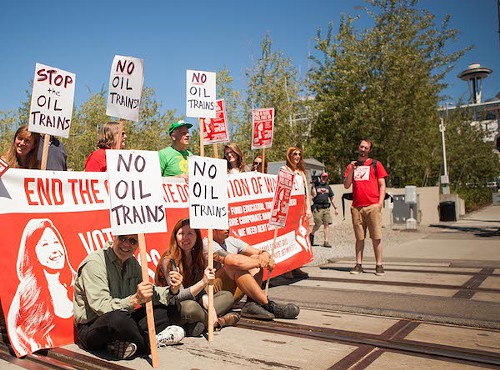
Rising Tide Portland blogger Mike M posted that five protestors including  Seattle City Council member Kshama Sawant, and a candidate for the State House of Representatives Jess Spear, occupied railroad tracks in order to call attention to the proliferation of oil trains also known as “bomb trains” running through the streets of Seattle and throughout the Northwest. The protest took place at tracks along the Seattle waterfront near the Olympic Sculpture Park. Four were arrested, but not Sawant.

The protest was launched in part as a reaction to a July 24 derailment of a 100 car train carrying Bakken Oil.

Spear is quoted in the Rising Tide blog as saying:

“These oil trains running right through the downtown area pose a huge risk to life and to the environment. Luckily, last week’s derailment did not spill any oil; but we cannot rely on luck. We cannot stand idly by while these bombs on wheels roll through Seattle”.

Ms Sawant was quoted in another Seattle publication, The Stranger,  as saying that she is

“in solidarity with the three activists who have the courage of their convictions. It’s an enormous sacrifice to be arrested to raise awareness… I’m also here as someone who is on the city council and who takes the task of governance seriously. This is a matter of emergency that needs to be addressed”.

In a prepared statement read before the protest Ms. Sawant told those assembled:

One year ago, a similar train derailed and destroyed half the downtown area in Lac-Mégantic, Quebec, and led to 42 deaths. The fact that these train tracks run right by the stadiums, and through Belltown, where tens of thousands of people regularly gather, mean that there is potential for major catastrophe.

Warren Buffett Really Likes Oil Trains - Despite the Explosions

By Eric de Place - Vice News, July 29, 2014

Disclaimer: The views expressed here are not the official position of the IWW (or even the IWW’s EUC) and do not necessarily represent the views of anyone but the author’s.

Watch the VICE News documentary "Bomb Trains" here.

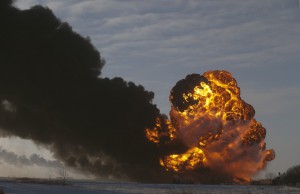
The people in the Musi-Café had no idea what hit them. At about 1am on July 6, 2013, a train parked on a slope a couple miles away slipped its brakes. Seventy-two tank cars loaded with crude oil accelerated into the town of Lac-Mégantic, Quebec, and began to tumble off the tracks, detonating and burning with a force so powerful that it leveled several city blocks. Forty-seven people were killed — most of whom were inside the Musi-Café.

In the months that followed, Lac-Mégantic became a rallying cry, a bloody shirt waved by activists across North America who were growing increasingly concerned about a relatively new phenomenon: ultra-long trains loaded with a peculiar variety of crude oil.

Months later, after several other oil train accidents, Warren Buffett went on CNBC claiming that oil train explosions were “very, very, very, very rare.”

If Buffett sounded defensive, it may have been because he is the single most important person in the world of oil-by-rail, an industry that he dominates and that has proven to be highly profitable for oil companies and railroads — and singularly dangerous to the public.

Worker Safety Questioned as Trains and Accidents Multiply

By Blake Sobczak - Energywire [Paywall Site], August 4, 2014

Disclaimer: The views expressed here are not the official position of the IWW (or even the IWW’s EUC) and do not necessarily represent the views of anyone but the author’s.

The recent surge in oil train traffic along North America’s freight network has been a boon for railroads struggling to cope with falling coal shipments.

But though the crude-by-rail boom has kept workers busy, it has also raised questions about their safety and preparedness following a series of oil train derailments and explosions.

A tentative agreement between BNSF Railway Co. and a major transportation union last month would allow certain trains to operate with just one engineer on board, provided they were outfitted with Positive Train Control. PTC technology allows for the train to be stopped or slowed automatically if it exceeds a speed limit or is on track for an unseen collision.

BNSF spokeswoman Roxanne Butler pointed out that the PTC labor deal would not apply to any trains hauling hazardous materials such as crude oil. The agreement is now being considered by members of the International Association of Sheet Metal, Air, Rail and Transportation Workers’ Transportation Division (SMART TD).

But union representatives have worried that the agreement could clear the way to phase out oil train conductors in the future, setting what they consider a dangerous precedent.

“You can’t talk about this issue without mentioning the terrible lessons that we learned at Lac-Mégantic,” said SMART TD National Legislative Director James Stem, referring to a fiery oil train derailment and explosion in Quebec last year that killed 47 people.

The train was not manned when it jumped the tracks in downtown Lac-Mégantic, but it had been operated by a lone engineer the previous night. The worker is now facing charges of criminal negligence for allegedly failing to apply enough hand brakes that could have prevented the train from breaking free from its parking place and hurtling toward town.

In that case, Stem explained, safety “had nothing to do with the size of the tank car — it had to do with management decisions that were made based around the fact that they had a crew of one.”

“Based on our experience and multiple fatalities, a crew of at least two certified employees is necessary for the safe operation of the train,” he said.

The Federal Railroad Administration, part of the U.S. Department of Transportation, is now crafting regulations that will likely require oil trains to be staffed by at least one conductor and one engineer. An FRA spokesman said the regulator expects to issue a notice of proposed rulemaking on the topic by the end of the year.

The U.S. rail industry already uses at least two employees on oil or ethanol trains as standard practice.

But in a statement supporting the FRA’s two-person crew proposal in April, Edward Wytkind, president of the Transportation Trades Department at the union confederation AFL-CIO, noted that railroads’ “previous collective bargaining pursuits have included attempts to employ one-person crews.”

Railroads have sought to use smaller crews in recent decades to cut down on labor costs, arguing that technologies such as PTC and improved operating practices preclude the need for many workers. But regulators and labor groups have maintained that larger crews boost safety.

Pages

The Fine Print I:

Disclaimer: The views expressed on this site are not the official position of the IWW (or even the IWW’s EUC) unless otherwise indicated and do not necessarily represent the views of anyone but the author’s, nor should it be assumed that any of these authors automatically support the IWW or endorse any of its positions.

Further: the inclusion of a link on our site (other than the link to the main IWW site) does not imply endorsement by or an alliance with the IWW. These sites have been chosen by our members due to their perceived relevance to the IWW EUC and are included here for informational purposes only. If you have any suggestions or comments on any of the links included (or not included) above, please contact us.

The Fine Print II:

Fair Use Notice: The material on this site is provided for educational and informational purposes. It may contain copyrighted material the use of which has not always been specifically authorized by the copyright owner. It is being made available in an effort to advance the understanding of scientific, environmental, economic, social justice and human rights issues etc.

It is believed that this constitutes a 'fair use' of any such copyrighted material as provided for in section 107 of the US Copyright Law. In accordance with Title 17 U.S.C. Section 107, the material on this site is distributed without profit to those who have an interest in using the included information for research and educational purposes. If you wish to use copyrighted material from this site for purposes of your own that go beyond 'fair use', you must obtain permission from the copyright owner. The information on this site does not constitute legal or technical advice.