

You are here

crude-by-rail

Greenpeace Supports Railroad Workers Safety

By Brian Manning - Greenpeace Blog, March 20, 2015

Disclaimer: The views expressed here are not the official position of the IWW (or even the IWW’s EUC) and do not necessarily represent the views of anyone but the author’s. It should also be emphasized that the IWW is not affiliated with Greenpeace, nor has Greenpeace yet admitted to any wrong doing when they closed several canvassing offices in 1988 to avoid an IWW unionization effort by the workers there. Nevertheless, the fact that Greenpeace is willing to go on record supporting the (quite reasonable and modest) demands by railroad workers is significant.

Communities across the globe are working together to keep coal in the ground everywhere and promote a just transition to a renewable energy future. In the Pacific Northwest, we’re working with a broad, diverse and growing coalition of environmental, business, faith, and health groups to stop coal exports. People are coming together to shutter coal-fired power plants, holding big polluters accountable, grassroots efforts at the mines for a greener and safer future.

As we continue moving forward together to stop coal and other fossil fuels most responsible for climate change, the workers that would carry the dangerous cargo have a big fight on their hands to prevent the industry from changing to one-person train crew restrictions. Railroad workers like conductors already are facing chronic fatigue that increase the risk of accidents.

Report on (Richmond, California) #Railcon15

By Tom Wetzel - Ideas and Action, March 15, 2015

Disclaimer: The views expressed here are not the official position of the IWW (or even the IWW’s EUC) and do not necessarily represent the views of anyone but the author’s.

More than 120 people attended the Future of Railroads Conference (RailCon15) in Richmond, California, March 14th, organized by Railroad Workers United, with support from local environmental groups and others.

Ron Kaminkow of Railroad Workers United talked about the history of railway worker attempts to build industry wide solidarity and unity, going back to the American Railway Union of Gene Debs in the 1890s. These efforts were stymied by the persistence of the conservative craft unions. The railroads are able to play one craft union off against the other to the detriment of rail workers. Railroad Workers United is an effort to build solidarity and unity of the workers across occupations and unions.

At present operating crews belong to two remaining unions, Brotherhood of Locomotive Engineers and United Transportation Union (mostly derived from the former Brotherhood of Railway Trainmen). BLE is now affiliated to the Teamsters union and UTU recently merged with the Sheet Metal Workers union to form SMART.

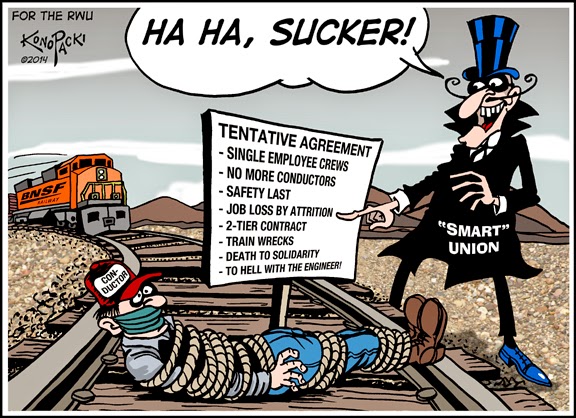
When the UTU recently signed a concessionary agreement with Burlington Northern-Santa Fe (BNSF) in one of its regions, this would have allowed BNSF (owned by Warren Buffett's venture capital firm, Berkshire Hathaway) to go to one-person crews. This would have iced out the engineers union, stabbing them in the back. The RWU organized a "Vote No" campaign among conductors, brakepersons and other UTU members which soundly defeated this destructive proposal by seven to one.

Pipelines or Rail for Fossil Fuels are False Choices

By Dory Hippauf - No Fracking Way, March 11, 2015

Disclaimer: The views expressed here are not the official position of the IWW (or even the IWW’s EUC) and do not necessarily represent the views of anyone but the author’s.

The so called “train bombs” are gaining public attention, mainly due to the media reporting. We have to keep in mind the first rule of reporting news – If it bleeds, it leads.

A train derailment with a spectacular fireball is more “entertaining” than a pipeline leak.

Transport of fossil fuels by rail is more expensive than transport via pipeline. Due to the cost considerations of rail or pipelines it is obvious the industry would prefer to use a pipeline.

The frequency of news reporting around rail accidents involving fossil fuels has put the public in “scare mode” with every train being looked at as a potential disaster. This works to the industry’s benefit in proposing more and more pipelines.

Who Regulates?

Pipelines and Rail transport are regulated by two sub-administrations under the US Department of Transportation (USDOT).
Pipeline and Hazardous Material Safety Administration (PHMSA) regulates pipelines, with the Office of Pipeline Safety (OPS) charged with carrying out “a national program to ensure the safe, reliable, and environmentally-sound operation of the Nation’s pipeline transportation system.”

EcoUnionist News #43

Compiled by x344543 - IWW Environmental Unionism Caucus, March 19, 2015; image by Jon Flanders

Disclaimer: The views expressed here are not the official position of the IWW (or even the IWW’s EUC) and do not necessarily represent the views of anyone but the author’s.

The following news items feature issues, discussions, campaigns, or information potentially relevant to green unionists:
Lead Stories:

USW Refinery Workers Strike News:

Carbon Bubble:

Health and Safety:

Other News:

For more green news, please visit our news feeds section on ecology.iww.org; Twitter #IWWEUC

Exploding Trains and Crude Oil

By Jon Flanders - CounterPunch, March 1, 2015

Disclaimer: The views expressed here are not the official position of the IWW (or even the IWW’s EUC) and do not necessarily represent the views of anyone but the author’s.

On the eve of the first conference bringing together rail workers and environmentalists in Richmond, California, we’ve had one oil train after another go off the tracks and explode. The latest was in Ontario, Canada. According to a news report, “Ontario Provincial Police said the derailment happened near Gogama, Ont., around 2:45 a.m. Saturday morning, with some of the cars catching fire and others falling into the Mattagami River.”

Environmentalists around the country have been protesting the “bomb trains” for several years now, but the 100 car unit trains are continuing to roll through hill and dale, towns and cities. Over a hundred years of the rail carriers influence in the halls of government make sure of this, up to now. This, despite the fact that we now know that fracked Bakken crude is more explosive than gasoline. The fireballs that have erupted lately dramatically illustrate this point.

As a retired railroad machinist, I have long been aware of the dangerous cargoes that travel by rail. I still remember the propane car that blew up near my shop while I was working, that propelled by the explosion, jetted a mile down the track through the departure yard, thankfully without killing anyone.

Nothing freight-wise from those years I spent on, under and over locomotives compare, however, to the vast quantities of explosive crude now running down a track probably not too far from you.

Can Labor and Environmental Groups Work Together?

By John Paul Wright - AHTV, March 1, 2015

Disclaimer: The views expressed here are not the official position of the IWW (or even the IWW’s EUC) and do not necessarily represent the views of anyone but the author’s.

Register now for the Future of Railroads: Safety, Workers, Community & the Environment Conferences: Richmond, California (March 14, 2015) and Olympia, Washington (March 21, 2015) - railroadconference.org

EcoUnionist News #41

Compiled by x344543 - IWW Environmental Unionism Caucus, March 10, 2015

Disclaimer: The views expressed here are not the official position of the IWW (or even the IWW’s EUC) and do not necessarily represent the views of anyone but the author’s.

The following news items feature issues, discussions, campaigns, or information potentially relevant to green unionists:

Lead Stories:

USW Refinery Workers Strike News:

Carbon Bubble:

Energy Democracy:

Health and Safety:

Other News:

For more green news, please visit our news feeds section on ecology.iww.org; Twitter #IWWEUC

EcoUnionist News #40

Compiled by x344543 - IWW Environmental Unionism Caucus, March 5, 2015

Disclaimer: The views expressed here are not the official position of the IWW (or even the IWW’s EUC) and do not necessarily represent the views of anyone but the author’s.

The following news items feature issues, discussions, campaigns, or information potentially relevant to green unionists:

Lead Stories:

USW Refinery Workers Strike News:

Carbon Bubble:

Health and Safety:

Other News:

For more green news, please visit our news feeds section on ecology.iww.org; Twitter #IWWEUC

REGISTER NOW!: The Future of Railroads: Safety, Workers, Community & the Environment

By Railroad Workers United and Others - railroadconference.org, March 1, 2015

Disclaimer: The views expressed here are not the official position of the IWW (or even the IWW’s EUC) and do not necessarily represent the views of anyone but the author’s.

The Future of Railroads: Safety, Workers, Community & the Environment is the title of two back-to-back conferences; the first on Saturday, March 14, 2015 in Richmond, California; the second on Saturday, March 21 in Olympia, Washington.

Everyday a tragic trail derailment occurs, often transporting highly flammable Bakken Shale or Tar Sand, from North Dakota or Alberta, to refineries across North America. The 47 -- preventable-- deaths in Lac-Mégantic has wakened people to the dangers of oil trains and the movement of trains in general through their communities. Environmental activists are up-in-arms about the amounts of fossil fuels moving by rail. Farmers and other shippers are concerned about the congestion that has occurred in recent months, but in part to the oil boom. The rail networks in the U.S. and Canada and clogged with crude-by-rail, displacing the already heavy traffic of grains headed to port for export.

The public generally has no idea what goes on daily on America’s railroads. Chronic crew fatigue, single employee train crews, excessively long and heavy trains, draconian availability policies, short staffing, limited time off work create challenging safety issues of concern not just to railroaders, but to the entire population.

Please join us at this cutting edge conference that brings together railroad workers, environmentalists, community activists and concerned workers from other sectors, in order to build the movement for a safer and greener railroad, on that is more responsive to the needs of workers, trackside communities, citizens in general, and society as a whole.

Richmond is a perfect confluence for this conference as it has always been a company town, first for Santa Fe Railroad as the western terminus of its transcontinental railroad in 1900, then for Standard Oil (later becoming Chevron) in 1901 and its massive refinery complex, and again for Kaiser Industries with its four assembly line-like shipyards in the late 1930s through World War II. From 1910 until 1959 the Pullman Company located its largest West Coast rail car repair shop adjacent to the Southern Pacific and Santa Fe lines in the center of Richmond. It also fronts the San Francisco Bay with access to a channel of 40-60 feet deep, allowing the largest seagoing ships (mostly oil tankers these days) to call its ports. Despite still being the location of the Burlington Northern Sante Fe rail yard and Chevron's massive refinery, Richmond is a bottomed out deindustrialized city that puts its largely working class people of color population in the toxic shadow of oil, chemical and other polluting heavy industries.

In adjacent cities of Rodeo there is the Conoco Phillips Refinery, Benecia has Valero Refinery, and Martinez has both Shell and Tesoro Refineries (the latter currently on strike). They are served by both BNSF and Union Pacific Railroads and maritime wharfs. This area along the San Francisco and San Pablo Bays is statistically known as a "cancer cluster."

OSHAgate

By Steve Zeltser - The Daily Censored, February 16, 2015

Disclaimer: The views expressed here are not the official position of the IWW (or even the IWW’s EUC) and do not necessarily represent the views of anyone but the author’s.

The epidemic of refinery explosions and derailments  leading to massive explosions seem to increase by the week. Behind this collapse of health and safety protection according to advocates is the failure to protect health and safety whistleblowers. The fear of workers to complain about serious health and safety problems is a key part of this failure. Now a Federal lawyer at OSHA Darrell Whitman has charged along with health and safety whistleblowers that the agency management and the DOL have not been enforcing the law to protect not only the whistleblowers but the health and safety of all Americans.

In an explosive document sent to Secretary of Labor Thomas Perez in May 2014, Federal OSHA attorney Darrell Whitman, charged that there is systemic corruption in the agency that is preventing the protection of health and safety whistleblowers. As a result of making these charges with extensive documentation, Whitman has himself become a target of workplace bullying and moves to terminate him from the agency. In fact according to Whipple his supervisor Joshua Paul who is also an attorney at the agency ordered him to falsify federal documents  which is a criminal felony. On February 21, 2015 the agency sent a mover to his house and took his documents and badge preventing him from doing his work.
Whitman has a lot of years under his belt. He has been working over 10 years for state and Federal agencies so he knows a bit about how the Federal government operates.

His latest job was as an investigator in the OSHA program that investigates health and safety complaints by workers in industries from oil, rail, trucking and other companies in OSHA region 9 which covers nearly 40 million workers in the West.
As one of the 6 OSHA staff in this unit, there have been only three that actually doing investigations. Whitman investigates whether OSHA complaints by workers are valid and then makes a determination of whether or not their complaints are serious enough to gain a merit status. Under Federal law this merit status provides full back pay and can provide punitive damages to workers who are terminated for making their health and safety complaints.

Pages

The Fine Print I:

Disclaimer: The views expressed on this site are not the official position of the IWW (or even the IWW’s EUC) unless otherwise indicated and do not necessarily represent the views of anyone but the author’s, nor should it be assumed that any of these authors automatically support the IWW or endorse any of its positions.

Further: the inclusion of a link on our site (other than the link to the main IWW site) does not imply endorsement by or an alliance with the IWW. These sites have been chosen by our members due to their perceived relevance to the IWW EUC and are included here for informational purposes only. If you have any suggestions or comments on any of the links included (or not included) above, please contact us.

The Fine Print II:

Fair Use Notice: The material on this site is provided for educational and informational purposes. It may contain copyrighted material the use of which has not always been specifically authorized by the copyright owner. It is being made available in an effort to advance the understanding of scientific, environmental, economic, social justice and human rights issues etc.

It is believed that this constitutes a 'fair use' of any such copyrighted material as provided for in section 107 of the US Copyright Law. In accordance with Title 17 U.S.C. Section 107, the material on this site is distributed without profit to those who have an interest in using the included information for research and educational purposes. If you wish to use copyrighted material from this site for purposes of your own that go beyond 'fair use', you must obtain permission from the copyright owner. The information on this site does not constitute legal or technical advice.
