You are here

climate change

How Houston was left to drown under Harvey

By Seth Uzman - Socialist Worker, August 30, 2017

STORMS ARE natural, but what happens in response to them is not. Flooding in the wake of Hurricane Harvey, which smashed into the Gulf Coast on August 25, has left at least nine people dead, thousands in need of rescue on rooftops or in boats, hundreds of thousands more without power and tens of thousands in need of shelter.

Yet characterizations of the carnage by the National Weather Service as "historic," "unprecedented" or "beyond anything experienced" should not be conflated with the spurious claim that the devastation wrought by Harvey is "unpreventable" or "unexpected."

The outcry by advocates, experts and activists against the unplanned, for-profit development of cities like Houston has been consistently ignored by city officials, leaving millions--especially the poor and people of color--in the fourth-largest city in the U.S. in a death trap.

"Houston is the fourth-largest city, but it's the only city that does not have zoning," Dr. Robert Bullard, a Houston resident and a professor who studies environmental racism, told Democracy Now! on August 29. "[As a result], communities of color and poor communities have been unofficially zoned as compatible with pollution...We call that environmental injustice and environmental racism. It is that plain, and it's just that simple."

The image of elderly people in a nursing home sitting in waist-deep water is a shocking illustration of how the most vulnerable segments of the population are struggling to deal with the effects of Harvey. Thankfully, all of those people have been rescued and brought to safety.

But, as Dr. Bullard points out, the nightmare for tens of thousands of the city's poorest residents living in close proximity to Houston's vast petrochemical industry is just beginning. They are literally being gassed by and steeped in the toxic materials unleashed by the floodwaters that have damaged the oil refineries and chemical manufacturers that surround their homes and neighborhoods.

The choices facing people in these neighborhoods are gut-wrenching. Should you and your family stay as toxic floodwaters rise all around you? If you decide to go, where do you go?

Houston’s “Unrestrained Capitalism” Made Harvey “Catastrophe Waiting to Happen”

Dr. Robert Bullard interviewed by Amy Goodman and Juan González - Democracy Now, August 29, 2017

AMY GOODMAN: This is Democracy Now!, Democracynow.org, The War and Peace Report. I’m Amy Goodman.

JUAN GONZÁLEZ: And I’m Juan González. Welcome to all of our listeners and viewers around the country and around the world. The death toll is rising as massive amounts of rain from Hurricane Harvey continue to flood Houston and other parts of Texas and Louisiana. The Houston police and Coast Guard have rescued over 6,000 people from their homes, but many remain stranded. Meteorologists forecast another foot of rain could fall on the region in the coming days. Harvey, which is now a tropical storm, is heading back to the Gulf of Mexico and is expected to make landfall again on Wednesday.

AMY GOODMAN: So much rain has already fallen that the National Weather Service has had to add two new colors to its maps to indicate rainfall levels. Parts of Texas are expected to top 50 inches of rain. And the rivers keep rising. Southwest of Houston in Richmond, the Brazos River reached flood stage overnight at 45 feet, and the National Weather Service forecasts it will peak at 59 feet on Friday and remain over 50 feet through Sunday. Houston’s KHOU described the epic amount of rain fall.

KHOU REPORTER: I want to show you what a meteorologist has done. There it is. The meteorologist calculates by the end of Wednesday, Harvey will have saturated all of Southeast Texas with enough water to fill all the NFL and college stadiums, all of those stadiums, more than 100 times. Think about that. More than 100 times. So so far, the meteorologist is saying 15 trillion gallons of rain has fallen on a large area and another 5 trillion or 6 trillion gallons forecast by the end of Wednesday.

JUAN GONZÁLEZ: The official death toll is 14, but authorities warn it could rise dramatically once the floodwaters recede. Six people from one family died after their van was swept away by floodwaters. Emergency shelters are approaching capacity.

RESIDENT: …crowded. But all they said that we are getting 800 more people. And it’s like, what? Where are they going to put us all? You know, what about us from Corpus? What are we going to do? And FEMA is here right now, but the line is enormous. Yesterday we were in line for three hours and couldn’t even see FEMA. So, I don’t know what’s going to happen. Buses just keep rolling in. And we need everybody’s help.

JUAN GONZÁLEZ: Concern is also growing over the environmental impact of the storm. The Houston area is home to more than a dozen oil refineries. The group Air Alliance Houston is warning the shutdown of the petrochemical plants will send more than one million pounds of harmful pollution into the air. Residents of Houston’s industrial communities are already reporting unbearable chemical-like smells coming from the many plants nearby. According to Bryan Parras, an activist at the environmental justice group t.e.j.a.s., "Fenceline communities can’t leave or evacuate, so they are literally getting gassed by these chemicals." The communities closest to these sites in Houston are disproportionately low income and minority.

Meanwhile, on Saturday, a massive fuel storage tank at Kinder Morgan’s Pasadena terminal began spilling after being toppled in the storm. The tank held 6.3 million gallons of gasoline, but it is unclear how much of that leaked. And in the city of La Porte, residents were asked to go to the nearest shelter, close doors and windows after a chemical spill was reported last night.

Trade unions in the UK engagement with climate change

By Catherine Hookes - Campaign against Climate Change Trade Union Group, August 15, 2017

Despite being faced with many immediate battles to fight, it is to the credit of many trade unions that they are also addressing the long term wellbeing of their members, and of future generations, by introducing policies to tackle climate change. A new report providing the first ever overview of the climate change policies of 17 major UK trade unions could help raise wider awareness of this important work.

The author, Catherine Hookes, is studying for a masters degree at Lund University, Sweden, and her research drew on a comprehensive web review of policies in these unions, going into more depth for many of the unions, interviewing key figures and activists. The research was facilitated by the Campaign against Climate Change.

For anyone within the trade union movement concerned about climate change (or for campaigners wishing to engage with trade unions on these issues) this report is of practical use in understanding the context, the diversity of different trade unions' approaches, and the progress that has been made in the campaign for a just transition to a low carbon economy.

While every attempt was made to ensure the report is comprehensive, and accurately reflects union positions, there are clearly controversies and different viewpoints over issues such as fracking and aviation. Trade unions with members in carbon intensive industries will always have a challenging task in addressing climate change, but their engagement in this issue is vital. And, of course, this is a rapidly changing field. It is very encouraging that since the report was written, Unison has voted to campaign for pension fund divestment. This is an important step in making local authority pension funds secure from the risk (both financial and moral) of fossil fuel investment.

Anyone attending TUC congress this September is welcome to join us at our fringe meeting, 'Another world is possible: jobs and a safe climate', to take part in the ongoing discussion on the role of trade unions in tackling climate change.

Read the text (PDF).

Prisoners and Climate Injustice

By Natalia Cardona - 350.Org, August 8, 2017

Recent headlines are full of dire warnings about heat-related deaths. Just the other day a headline in the Washington Post stated that a third of the world’s people already face deadly heat waves. And it could be nearly three-quarters by 2100.

Recently I came across disturbing footage from a St. Louis jail showing inmates without air conditioning calling for help from inside the stiflingly hot facility. This is not the first time these type of headlines have showed up in the news this summer.

In June of this year, deadly heat waves in the Southwestern United States also led to prisoners facing inhumane conditions due to extreme heat. In Arizona, while the weather channel warned that locals should stay indoors and temperatures climbed upwards of 120 degrees Fahrenheit, 380 prisoners were left living in tents in unbearable heat.

The impacts of climate change add to the layers of injustice prisoners already face. The U.S. holds the largest number of prisoners per capita in the world. Since the 1970’s the U.S. has seen a 700% increase in the growth of prisons. Prisons are already at the frontline of injustice, because of the criminalization of people of color through failed policies like the “war on drugs”. Not only that, holding large numbers of people in enclosed facilities leads to health hazards and human rights violations. Prisons and prisoners also find themselves on the frontlines of environmental injustice. The toxic impact of prisons extends far beyond any individual prison.

Is Capitalism in Crisis? Latest Trends of a System Run Amok

By C.J. Polychroniou - Truthout, August 4, 2017

Having survived the financial meltdown of 2008, corporate capitalism and the financial masters of the universe have made a triumphant return to their "business as usual" approach: They are now savoring a new era of wealth, even as the rest of the population continues to struggle with income stagnation, job insecurity and unemployment.

This travesty was made possible in large part by the massive US government bailout plan that essentially rescued major banks and financial institutions from bankruptcy with taxpayer money (the total commitment on the part of the government to the bank bailout plan was over $16 trillion). In the meantime, corporate capitalism has continued running recklessly to the precipice with regard to the environment, as profits take precedence not only over people but over the sustainability of the planet itself.

Capitalism has always been a highly irrational socioeconomic system, but the constant drive for accumulation has especially run amok in the age of high finance, privatization and globalization.

Today, the question that should haunt progressive-minded and radical scholars and activists alike is whether capitalism itself is in crisis, given that the latest trends in the system are working perfectly well for global corporations and the rich, producing new levels of wealth and increasing inequality. For insights into the above questions, I interviewed David M. Kotz, professor of economics at the University of Massachusetts at Amherst and author of The Rise and Fall of Neoliberal Capitalism (Harvard University Press, 2015).

Answering Annihilation: Some Notes on Earth’s Execution

By Dan Fischer - Dragonfly Collective, July 17, 2017

Half of all wild animals on Earth have been wiped out. You may have missed the news. It came from a scientific study mentioned on page 5 of last Wednesday’s New York Times. You had to flip past the usual stories of Trump regime scandals, four jewelry advertisements, and an ode to a slain officer from the New York Police Department.

“’Biological Annihilation’ Said to Be Underway.” The article took up only as much space as a Sootheby’s ad on the same page announcing jewelry sales in New York City.

While “biological annihilation” sounds like an evil plot thought up by a Bond villain, the term actually comes from a peer-reviewed study in the prestigious Proceedings of the National Academy of Sciences (PNAS). The authors Gerardo Ceballos, Paul Ehrlich, and Rodolfo Dirzo use it to describe the ongoing destruction of local populations within different species.

Due to the pressures of habitat destruction, pollution, and climate change, species are going extinct at 100 times the rate they normally would. The PNAS study shows that populations within species are disappearing much, much faster.

Ian Angus interview: How can we save the planet?

Ian Angus interview - Climate and Capitalism, July 18, 2017

On July 7-9, I was in London (UK) to speak at the Marxism Festival, an annual conference organized by the Socialist Workers Party. I have some political differences with the SWP, but I was impressed by the enthusiasm and commitment of the 2500 participants, and by the number of sessions that were devoted to environmental and scientific questions. 

I was the featured speaker at two sessions, one on Facing the Anthropocene, and one launching my new book, A Redder Shade of Green. Both sessions were recorded: I will post links when they are available. After my second talk, I was interviewed by Dave Sewell for the SWP’s weekly newspaper Socialist Worker.


HOW CAN WE SAVE THE PLANET AND STOP CATASTROPHIC CLIMATE CHANGE?

The environmental conditions that have sustained human civilisation throughout its history are collapsing, capitalism is to blame and only socialism has the solution. That’s the warning sounded by Ian Angus, author and editor of Climate and Capitalism website. He told Socialist Worker,

“The planet is going to change substantially. Big parts of it will be uninhabitable by the end of this century if we don’t do something now. It’s very likely that in this century ocean levels will rise by at least a meter or two, maybe more. That would mean the Thames is going to overflow and flood much of inner London. Many cities are right next to oceans. They will be flooded—not tomorrow but within our children’s lifetime or our grandchildren’s lifetime.

“In some parts of the world it’s going to be too hot to work. Many of these are places where a lot of our food comes from, so we’ll have to deal with problems with food production too.”

Ian has played an important role in popularising the concept of the “Anthropocene” on the left. Many geologists argue that the relatively stable environment conditions in place since the Ice Ages ended are giving way to something much more chaotic.

EcoWobbles - EcoUnionist News #160 (Special Parexit Edition)

Compiled by x344543 - IWW Environmental Unionism Caucus, June 7, 2017

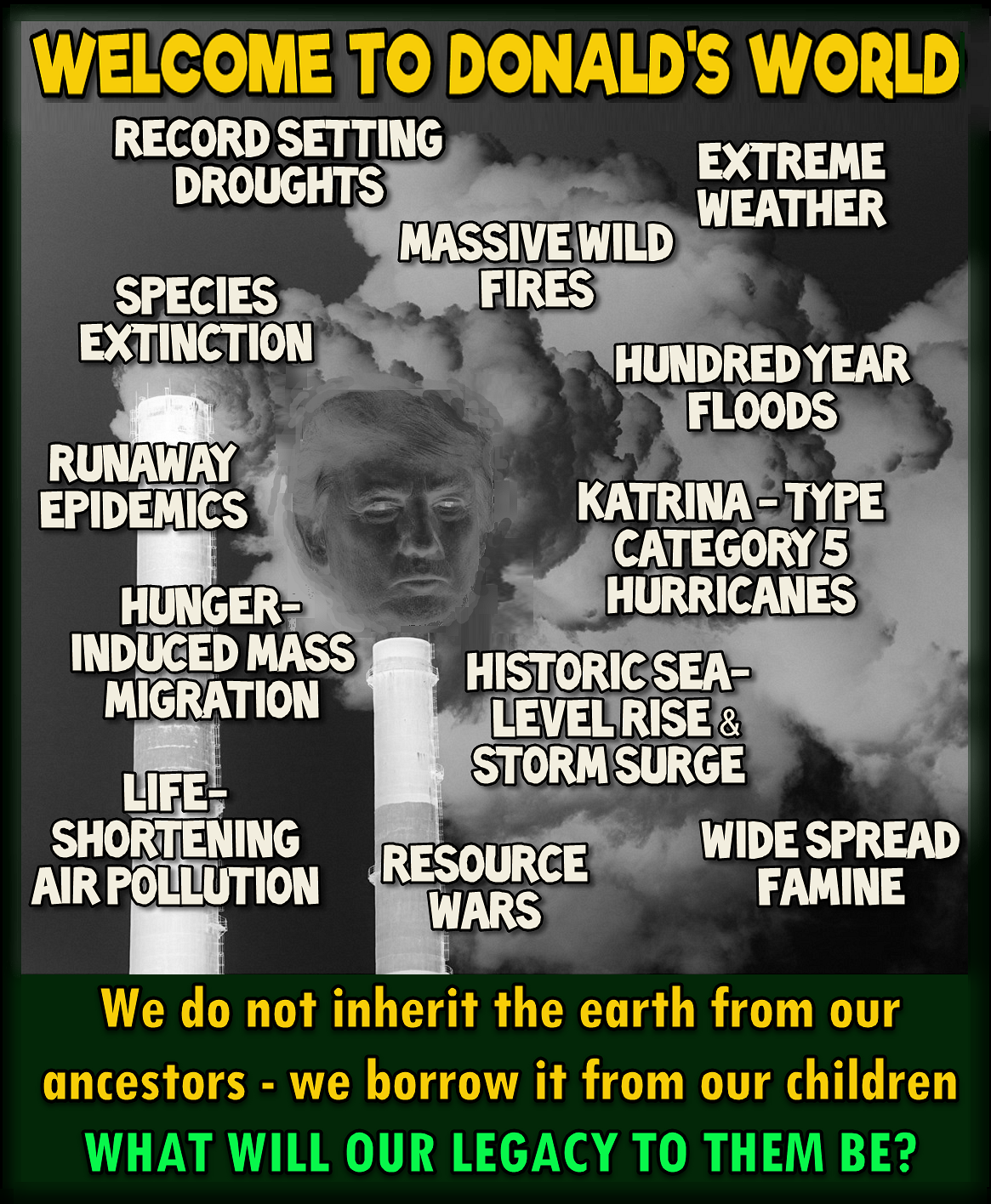
The reactions to President Donald J Trump's reckless and unstrategic decision to pull the US out of the Paris Agreement are numerous and range from condemnation to disdianful. We present an extensive but far from exhaustive collection here:

Trump's Decision

Fact Check

Trump goes for bust on the national-populist trail. What did you expect?

By Daniel Tanuro - International Viewpoint, June 15, 2017

The United States has denounced the Paris climate agreement, cancelled all the measures decided by the United States in application of this agreement and withdrew from the Green Fund for the Climate. These are the major decisions that Donald Trump finally announced, on Thursday, June 1, after a long period of suspense.

These decisions are in line with the promises made by the new President during his election campaign. In the past few months, some observers had wanted to believe that Trump would change his tune, but he did no such thing. On the contrary, the speech he delivered in the Rose Garden of the White House flowed from a disturbing nationalist and populist demagogy. What did you expect? - as the advertisers say...

Victimization and nationalism

For Trump, the Paris agreement was nothing but a scandalous piece of trickery imposed on the USA. "The Paris agreement is not about the climate," he said, "it’s about the financial advantage that other countries get compared to the United States. The rest of the world applauded when we signed the agreement. They were happy, for the simple reason that we suffer from a very great economic disadvantage."

Drawing an apocalyptic picture of the implications of the agreement, the president said it would lead to the loss of 2.7 million jobs, cost the US $3 trillion and would result in a loss of purchasing power for US citizens of up to $7,000 a year. He listed the figures of the reductions in economic activity that would affect the industrial sectors: "86 per cent in the coal sector", he said... omitting of course to mention that solar energy already gives employment to 800,000 US workers (against 67,000 in coal) and creates more jobs than the coal industry loses.[1]

For Trump, it is simple, there is a conspiracy: the poor Americans, who are too honest, are victims of an enormous injustice hatched by an evil machination of all the other countries. The denunciation of the agreement is therefore an elementary reaction of sovereignty and national dignity: "The heads of state of Europe and China should not have more to say about the policy of the United States than American citizens do. We do not want to be the laughing stock of the world. We will not be."

Donald Trump, the Paris Agreement, and the Meaning of America

By Paul Arbair - Paul Arbair, June 12, 2017

Donald Trump’s decision to withdraw the United States from the Paris Agreement on climate change has sparked a global uproar. Yet America’s reluctance to reduce its use of fossil fuels is, in fact, logical. Not only because of the U.S. president’s overt denial of man-made climate change, but also and more fundamentally because it reflects America’s historical essence and trajectory.

So he did it. Donald J. Trump, 45th president of the United States of America, finally announced his decision to withdraw his country from the Paris Agreement on climate change. According to the White House occupant, this agreement negotiated by the Obama administration was a ‘bad deal’ for America, undermining its competitiveness and jobs, costing millions to its taxpayers, imposing disproportionate and unfair restrictions on its carbon emissions, and weakening its sovereignty. This agreement, he said, “is less about the climate and more about other countries gaining a financial advantage over the United States”. It is “a massive redistribution of United States wealth to other countries”, and “the American family will suffer the consequences in the form of lost jobs and a very diminished quality of life.” Such a bad deal is unacceptable to a president who has pledged to ‘Make America Great Again’ and to put America and its workers first.

Obviously, Trump’s core supporters have cheered this momentous decision. The billionaire real estate mogul-turned-president, they say, has made good on a pledge he made during last year’s campaign, showing once again that he meant what he said. The rest of America, on the other hand, as well as much of the world, couldn’t be more outraged. By reneging on its commitment to help fight climate change alongside the international community, America is abdicating its claim to global leadership, many argue. By joining the group of countries that are not signed up to deal reached in the French capital in December 2015, a group that so far comprises only Nicaragua and Syria, it is even turning into a ‘rogue state’, some suggest. A state that rejects science, progress and enlightened values, choosing instead a one-way trip back to the ‘Dark Ages’. A state that cannot anymore be relied upon, as German Chancellor Angela Merkel put it just a few days ago, or even that represents a growing danger to the world. Sad!

In the U.S., Trump’s announcement has triggered a sharp reaction from cities, states and businesses, which have vowed to meet U.S. climate commitments regardless of what Washington says or does. More than 1,000 city mayors, state governors, college and university leaders, businesses, and investors signed a “We Are Still In” open letter to the international community, saying they are committed to delivering concrete carbon emissions reductions that will help meet America’s emissions pledge under the Paris Agreement. Billionaire and former New York City mayor Michael Bloomberg even promised to provide up to $15 million in funding that he says the United Nations will lose as a result of President Trump’s decision to pull out from the climate deal. Emblematic CEOs such as Tesla’s Elon Musk and Disney’s Robert Iger announced they would quit Trump advisory councils, and anti-Trump demonstrations have been held across the country.

Outside the U.S., the reaction has been no less virulent, and Donald Trump’s decision has been vehemently condemned across the international community. Emmanuel Macron, the young and newly elected French president, rebuked his U.S. counterpart in a televised speech – the first speech ever given in English by a French President from the Elysée Palace – condemning his decision as a historic “mistake” and issuing a call to “make our planet great again“. This call, a direct jibe at Trump’s ‘Make America Great Again’ election slogan, went immediately viral on social media… The leaders of the European Union and China, backed by India and Japan, announced they would fully implement the Paris Agreement despite Washington’s withdrawal. The deal, they insisted, is not up for renegotiation, despite what the U.S. president might say. Trump’s decision, many observers suggested, could actually trigger a wide-ranging geopolitical shake-up that would isolate the U.S., or even make it a ‘global pariah’, and hand China a chance for global leadership.

Beyond America’s geopolitical standing and diplomatic reputation, the reactions to Donald Trump’s decision have of course focused on what it may mean for the planet’s climate. A number of observers have suggested that the American president might actually be doing the world and global climate a favour: outside of the Paris deal, the U.S. will not be in a position to block progress as it has done so many times in the past on climate negotiations, and the rest of the world will therefore be able to step up its efforts. The ‘climate revolution’ they say, is already unstoppable anyway, including in the U.S. The stunning growth of renewable energies, fuelled by rapid technological progress and by their falling costs, will ensure that the ‘decarbonisation’ of the global economy accelerates in the coming years, whatever Mr. Trump may say or do.

Most analysts and climate activists, however, consider that the U.S. withdrawal will severely undermine the international community’s fight against climate change. The disengagement of the world’s only superpower and current second largest CO2 emitter – and by far the biggest carbon polluter in history – might in fact weaken the Paris Agreement in many ways. Not only because it may reduce incentives for some countries that only reluctantly signed up to the deal to meet their voluntary emissions reductions pledges, but also because it may slow down the pace of technological progress needed to enable the transition to ‘clean energy’. The U.S. indeed remains the world’s technological powerhouse, and a lot of the ‘solutions’ required to accelerate the deployment and use of renewable energies (e.g. concerning electricity storage or carbon capture) are expected to come from its research labs and tech companies. Without sufficient political support and government funding, these solutions may take longer to be developed, or even never emerge. In addition, America’s withdrawal will also undermine the Green Climate Fund, which aims to help developing countries reduce emissions and adapt to the changes already set in motion by past emissions, and to which the U.S. was the largest contributor in absolute terms. Trump’s decision, hence, appears to many as an irresponsible move, a ‘moral disgrace’ or even a ‘crime against humanity’. Future generations will reap catastrophes and conflicts, and “people will die” because of this reckless withdrawal, some have warned.

Pages

The Fine Print I:

Disclaimer: The views expressed on this site are not the official position of the IWW (or even the IWW’s EUC) unless otherwise indicated and do not necessarily represent the views of anyone but the author’s, nor should it be assumed that any of these authors automatically support the IWW or endorse any of its positions.

Further: the inclusion of a link on our site (other than the link to the main IWW site) does not imply endorsement by or an alliance with the IWW. These sites have been chosen by our members due to their perceived relevance to the IWW EUC and are included here for informational purposes only. If you have any suggestions or comments on any of the links included (or not included) above, please contact us.

The Fine Print II:

Fair Use Notice: The material on this site is provided for educational and informational purposes. It may contain copyrighted material the use of which has not always been specifically authorized by the copyright owner. It is being made available in an effort to advance the understanding of scientific, environmental, economic, social justice and human rights issues etc.

It is believed that this constitutes a 'fair use' of any such copyrighted material as provided for in section 107 of the US Copyright Law. In accordance with Title 17 U.S.C. Section 107, the material on this site is distributed without profit to those who have an interest in using the included information for research and educational purposes. If you wish to use copyrighted material from this site for purposes of your own that go beyond 'fair use', you must obtain permission from the copyright owner. The information on this site does not constitute legal or technical advice.