You are here

fossil fuel capitalism

Climate Change and Eco-Socialism

By Jason O’ Neal, Founding Member Green Party, UC Berkeley - Facts for Working People, December 31, 2016

Climate change is a fact of life in the twenty-first century. Our society’s dependence on fossil fuels to encourage more economic growth is directly contributing to the global warming crisis. Climate models accounting for changes in surface air temperatures, ocean currents, land masses, and polar ice cover have forecast extreme weather events occurring on a more regular basis.  Organizations such as the Pentagon, the UN, NASA, and 90% of the world’s scientists forecast the end of life on Earth as we know it in the decades ahead unless things are changed.

For the past several decades, scientists and government policy makers have modeled possible solutions to the problem based on stabilizing the amount of carbon dioxide in the air at 350 ppm, (parts per million) a level that is probably no longer feasible. If CO2 concentrations within the atmosphere continue to increase, the ability of the planet to sustain the environment will diminish. Possibly crashing the entire ecosystem. How did we arrive at such a dangerous precipice? And, can we do anything about it? Current debates are between market-based approaches of taxes on emissions or trading programs against stricter government regulation. What is left out of this discussion on the economic front is how to rapidly reduce emissions and improve carbon sequestering capabilities, both natural and technological. With the easiest path to 350 ppm by the year 2030 becoming an unrealistic expectation, where do we set the next target? And, how did climate science and our political and economic goals become so disconnected?

The use of carbon-dense fossil fuels helped to industrialize America as productivity exploded and the economy expanded. Two hundred years had passed since the transition from feudal labor relations to industrial labor relations created the Second Industrial Revolution. Rural communities were realigned with workers migrating to urban areas where they were forced to sell their labor for income. The emerging economy became one based on social relations and interactions that were held in place by commodities. Like the arguments between early economists during the transition between mercantilism and capitalism, questions about who was best equipped to responsibly manage surpluses from the economic boom remained. Because ‘capital’ needs to be free and allowed to work in a global economy, neoclassical economics became the preferred economic system in the United States by the end of the nineteenth century. The downside of this heightened productivity was that it was based on energy from fossil fuels and the risks associated with climate change were an unknown threat at the time.

Together We Can Cool the Planet

By Eugenia Izquierdo and IvanZigarán - La Via Campesina and GRAIN - December 2016

Based on the video Together we can cool the planet! co-produced by La Vía Campesina and GRAIN in 2015, we have created a comic book to support training activities of social movements and civil society organisations around climate change. This comic book looks at how the industrial food system impacts our climate and also explains what we can do to change course and start cooling the planet.

La Via Campesina and GRAIN have pointed out that the industrial food system is responsible for half of all greenhouse gas emissions. In the Americas, Asia, Europe and Africa, we have been denouncing the false solutions to climate change such as GMOs, the “green economy” and "climate-smart agriculture".

We say loud and clear: it is peasants and small farmers, along with consumers who choose agroecological products from local markets, who hold the solution to the climate crisis.

We must all rise to the challenge!

Read the report (PDF).

Watch the video, too:

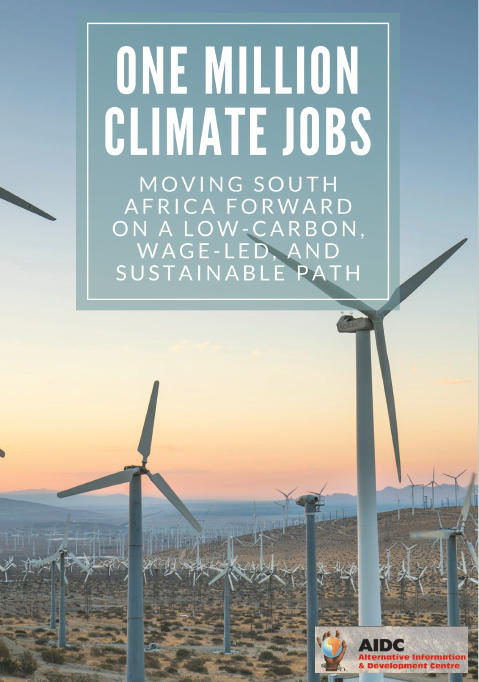
One Million Climate Jobs: Moving South Africa Forward on a Low-Carbon, Wage-Led, and Sustainable Path

By Brian Ashley, et. al. - One Million Climate Jobs - December 2016

The One Million Climate Jobs Campaign is an alliance of labour, social movements and popular organisations in South Africa that is campaigning for the creation of a million climate jobs as part of a collective approach to the crisis of unemployment and climate change. The Campaign was launched in 2011 and since then has been mobilising thousands of South Africans around real solutions to slowing down climate change, protecting the natural environment, improving the quality of life for all and moving towards a sustainable development path. Climate change will exacerbate inequality and poverty because it reduces access to food, water, energy and housing. Thus it is vital that social justice struggles around these issues incorporate struggles around climate change.

This booklet is a follow-up, six years later, to the first booklet that was produced in 2011. It is based on well- researched solutions for how South Africa can immediately begin a just transition, away from the Minerals-Energy Complex that continues to dominate the South African capitalist economy, to a low carbon economy in which the basic needs of communities are met in an equitable, sustainable and affordable way.

It recognizes that in these six years there have been many developments – for instance, renewable energy is now firmly established as part of the energy mix (although still a minor part); retrofitting buildings, and the development of environmentally friendly construction methods, is being developed, and the Rapid Bus Transit system is being slowly implemented in some municipalities.

But most of these solutions are being pursued within the logic of the market. It is not possible, we would argue, within these market parameters, to respond adequately to the enormous challenges facing us – what is needed is a publicly-driven solution for the shift to a sustainable, low-carbon future. The research that this booklet is based on begins to set out what such a transition could look like. We hope that it will be an important contribution to the ongoing work of building a political movement to struggle around these issues.

Download (PDF).

Reclaiming Alberta’s Future Today

By Regan Boychuk and Brent O’Neil - Reclaiming Alberta’s Future Today, November 3, 2016

As the first step towards reducing Alberta’s dependence on fossil fuels as our primary source of income we must embrace our current environmental deficit. We must admit that climate change is real and that man-made contributions to global warming can be reduced.

After 100 years of exploration we must acknowledge that our provinces conventional oil and gas resources have been depleted. Technically speaking our low hanging fruit has been plucked and what is left is 444,000 oil and gas wells, 430,000 km of pipe lines (the distance to the moon is 384,000 km), 30,000 oil and gas facilities, 900 km of oil sands development, 220 km of tailing ponds, and a 11.2 million ton sulfur pile that dwarfs the great pyramids of Egypt.

Tackling this shameful legacy will be the biggest environmental cleanup project undertaken to date. It will take 1000 rigs 50 years and every willing Canadian to clean up our mess. This change in industry requires a paradigm shift in thinking. Our province no longer see the economic benefit from drilling new conventional oil wells as it once did. The real opportunity for Albertans will come from cleaning up our mess.

No longer can we tackle climate change with taxes and levy’s. We need to start making a real reduction in man-made emissions so our future generations have the same opportunities we once did.

Read the report (PDF).

The Chevron Way: Polluting California and Degrading California

By various - International Transport Federation, et. al., November 2016

In the recent election, Chevron-backed campaigns lost bigtime, despite the $61 million the company has spent to influence California elections since 2009. That’s far more than any other oil company spend in state elections. The report, by the International Transport Workers Federation, was released Nov. 17 at the Chevron gates by a coalition including the Richmond Progressive Alliance (RPA), Alliance of Californians for Community Empowerment (ACCE), Communities for a Better Environment (CBE), and more.

Members of the coalition said the report, The Chevron Way: Polluting California and Degrading Democracy, will educate the public about the corrupting influence of corporate money and alert politicians that they will be judged on whether they act in the public interest or in Chevron’s interest.

In this election, in State Assembly and State Senate races, candidates heavily backed by Chevron lost. In Monterey County, Chevron spent $1.5 to oppose a ballot measure to ban fracking and expanded oil drilling. Despite being outspent 33 to 1, the measure passed.

In Richmond, Chevron sat out this election, having spent $3 million in the last election, when its candidates lost anyway. This year, two additional progressive candidates won seats on the city council and a longstanding Chevron candidate was voted out.

Chevron makes billions in profits from its huge retail and refining business in California, but has aggressively cut tax payments to federal, state and local governments. In 2015, the company paid no net income tax in the US, but instead banked nearly $1.7 billion in tax credits.

In 2015, Chevron had over $45 billion stashed in offshore accounts, including the company’s 211 active Bermuda subsidiaries, and the company’s global effective tax rate fell to below 3%.

Read the report (PDF).

The Economics of Just Transition: a Framework for Supporting Fossil Fuel-Dependent Workers and Communities in the United States

By Robert Pollin and Brian Callaci - Department of Economics and Political Economy Research Institute (PERI), University of Massachusetts-Amherst, September 9, 2016

ABSTRACT: We develop a Just Transition framework for U.S. workers and communities that are currently dependent on domestic fossil fuel production. Our rough high-end estimate for such a program is a relatively modest $600 million per year. This level of funding would pay for

  • 1) income, retraining and relocation support for workers facing retrenchments;
  • 2) guaranteeing the pensions for workers in the affected industries; and
  • 3) mounting effective transition programs for what are now fossil- fuel dependent communities.

The paper first summarizes the evidence on how much the U.S. fossil fuel industry will need to contract to achieve CO2 emissions reduction targets consistent with the global targets established by the Intergovernmental Panel on Climate Change (IPCC). We then consider the impact of fossil fuel cutbacks on five ancillary U.S. industries, including support activities for coal and oil/gas as well as oil refining, electric power generation, and natural gas distribution.

Section 3 presents estimates on job cuts that will occur in the fossil fuel and ancillary industries due to U.S. fossil fuel production cutbacks. Combining all fossil fuel and ancillary industries, we show that fully 83% of the job losses can be covered through attrition-by-retirement. To address the remaining 17% of job losses through fossil fuel industry cutbacks, we propose reemployment guarantees in the growing clean energy industries for displaced workers. As part of this job guarantee program, we estimate the costs of three provisions for the displaced workers: 100 percent compensation insurance for five years; retraining; and relocation support.

Section 4 reviews the status of pension programs in the fossil fuel and ancillary industries and propose measures to maintain these pension programs at full funding int o the future.

Section 5 examines measures to support communities that are presently heavily dependent on the U.S. fossil fuel industry.

The concluding Section 6 brings together our cost estimates for the three components of our Just Transition program.

The Sky’s Limit: Why the Paris Climate Goals Require a Managed Decline of Fossil Fuel Production

By Greg Muttitt, et. al. - Oil Change International, et. al., September 2016

In December 2015, world governments agreed to limit global average temperature rise to well below 2°C, and to strive to limit it to 1.5°C. This report examines, for the first time, the implications of these climate boundaries for energy production and use. Our key findings are:

  • The potential carbon emissions from the oil, gas, and coal in the world’s currently operating fields and mines would take us beyond 2°C of warming
  • The reserves in currently operating oil and gas fields alone, even with no coal, would take the world beyond 1.5°C
  • With the necessary decline in production over the coming decades to meet climate goals, clean energy can be scaled up at a corresponding pace, expanding the total number of energy jobs.

One of the most powerful climate policy levers is also the simplest: stop digging for more fossil fuels. We therefore recommend:

  • No new fossil fuel extraction or transportation infrastructure should be built, and governments should grant no new permits for them
  • Some fields and mines –primarily in rich countries –should be closed before fully exploiting their resources, and financial support should be provided for non-carbon development in poorer countries
  • This does not mean stopping using all fossil fuels overnight. Governments and companies should conduct a managed decline of the fossil fuel industry and ensure a just transition for the workers and communities that depend on it.

In August 2015, just months before the Paris climate talks, President Anote Tong of the Pacific island nation of Kiribati called for an end to construction of new coal mines and coal mine expansions. This report expands his call to all fossil fuels.

Read the report (PDF).

Breathing in the benefits: How an accelerated coal phase-out can reduce health impacts and costs for Albertans

By Benjamin Israël, Kim Perrotta, Joe Vipond, Leigh Allard, and Vanessa Foran - Pembina Institute, September 2016

With the phase-out of coal power announced by the provincein November 2015, Albertans stand to avoid significant health impacts caused by coal pollution. By extension, afurtheraccelerated phase out of coal power facilities would both hastenand amplify those avoided health impacts.The health benefits and costs savings in avoided health outcomes would be significant, and should be consideredin the government’s planning of the coal phase-out from now to 2030.

While the provincial government has announced a coal phase-out, they have not yet released a transition schedule. This analysis assesses the relative benefits of an accelerated stepwise transition away from coal, as proposed by the Pembina Institute,versus the back-loaded phase-out that otheranalyses haveposited.

In 2012, when the federal government finalized its coal regulations that —in effect —reduce electricity generation from coal plants, Environment Canada(as it was called at that time)estimated considerable health impacts would be avoided, usinghighly regarded modelling techniques. Logically, thesesignificantbenefits from reducing coal necessarily mean that the use of coal for power generation causesconsiderablehealth impacts in the first place.

By extrapolating the health benefit results from Environment Canada’s analysis, this report highlights the full impact of coal-fired generation in Albertaand indicates attainable benefits associated with the province’s coal phase- out.When the federal government weakened its proposed coal regulations back in 2012 in response to lobbying from some coal generators, allowing coal plants to continue unabated longer than first proposed,it left health savings on the table. Alberta can now grasp these savings byaccelerating our transition away from coal-fired electricity.

Read the report (PDF).

(Working Paper #7) An Illness to One is the Concern of All: The Health Impacts of Rising Fossil Fuel Use

By Svati Shah and Sean Sweeney - Trade Unions for Energy Democracy, September 2016

This paper has been written to help unions representing workers in all sectors get a clear sense of what is presently happening in terms of the health impact of fossil fuel use and what could also happen if present patterns in energy use continue into the future. The data are presented in a way that unions can use to more effectively advocate both for their members and the broader public.

Unions in health care can play—indeed are playing—an important role in addressing both the climate-related and the pollution-related dimensions of the unfolding health crisis, as can health and safety personnel working with or for unions in different sectors. But the health-related impacts of rising pollution levels and climate change are expected to affect the lives of workers across a range of occupations. Unions representing workers in emergency services, workers in transport systems, or workers who must work outdoors in agriculture or construction also have a particularly important role to play. The situation requires as unified a response as possible.

One of the striking features of fossil fuel use today is how much it reflects and reinforces class inequalities. It is well known that rich countries consume far more energy per per-son than poorer ones, but within both rich and poor countries there is often a huge gulf between the energy consumed by the rich and the energy consumed by the poor and working class. The same is true of emissions. A December 2015 study released by Oxfam calculated that the poorest half of the global population are responsible for only around 10% of global emissions yet live overwhelmingly in the countries most vulnerable to climate change while the richest 10% of people in the world are responsible for around 50% of global emissions.

Trade unions with the capacity to play more of an active role in resisting the expansion of fossil fuel use can be confident of the fact that they will be intersecting with a rising global movement that is confronting fossil fuel extraction, including “unconventional fuels” like shale gas and shale oil. The concerns that drive this movement are numerous. Along with climate and air quality concerns, struggles have been built around questions of water scarcity and contamination and the fight to defend land and livelihoods from “extractivist” energy companies.

Read the report (PDF).

An Ecologically Sound and Socially Just Economy

By Fred Magdoff - Monthly Review, September 2016

Two weeks ago I returned from my fiftieth class reunion at Oberlin College in Ohio. The brief discussions I had there with environmental faculty and students left me feeling a bit dazed. So many good and intelligent people, so concerned, and doing what they think and hope will help heal the environment—this college has one of the best environmental education programs in the country. However, I was left disappointed and profoundly discouraged by the lack of discussion—or even interest in having a real continuing discussion and debate—regarding the root causes of our environmental disasters. Not just climate change, but also pollution of the air, water, soil, and living organisms, the loss of biodiversity both aboveground and in the soil, the extinction of species, and the overuse and misuse of both renewable and nonrenewable natural resources.

It is as though there is a flat tire with perhaps a thousand holes and people are working on the best way to patch this hole or that one. No one there seems to consider that the problem might be the tire itself—that the design and materials utilized are not appropriate to the way it is being used. And, if that is the case, then no amount of patching can solve the flat tire problem. It is of the utmost importance to be able to distinguish between symptoms (that most people call “problems” or “crises”) and underlying causes.

I ran into this confusion between symptoms and underlying causes time and time again in agricultural science and farming practices. Soils may be prone to erosion, store little water, grow crops that are susceptible to diseases and insect attack, become compacted, or have low fertility. Farmers (and extension specialists), usually think of and deal with these as individual problems—using pesticide applications, lots of commercial fertilizers, irrigating more frequently, using heavier equipment, and so on. In fact, I spent a significant portion of my career as a soil scientist helping to deal with the negative side effects of one of these responses—excess fertilizer use, especially nitrogen and phosphorus.

(As an aside, as I was preparing this talk, an unbelievable thirty-five tons of nitrogen in the nitrate form, worth approximately $35,000, flowed down the Raccoon River past Des Moines, Iowa, on the way to the Mississippi and the “dead zone” in the Gulf of Mexico. This flushing of nitrate out of the soil by prolonged spring rains, partially the result of nitrate left over after last year’s drought [2012], was mainly a consequence of an ecologically damaging, but profitable, emphasis on growing corn and soybeans without an ecologically sound crop rotation.)

However, what I learned over time was that in reality these are symptoms of an unhealthy soil and a simplified approach to soil and crop management. The same is true of never-ending unemployment, inequality and poverty, the systemic necessity of perpetual growth, and pollution of air, water, soil, and organisms. As harmful as each of these is, they are all only symptoms—of an economic system that is essentially unmanaged. Of course large corporations and politicians that represent them try to manage national and international laws, regulations, and markets in such ways that it becomes easier for them to make more money. But with individual corporations and other private capital making decisions which consider only their own interests, the system as a whole alternates between periods of growth (that nowadays are pretty lackluster) and periods of recession. Addressing individual symptoms alone is not sufficient for the tasks we need to undertake—either to create healthy soils or to create an ecologically based and humane society.

One of the neglected issues regarding thinking and acting about the environment—perhaps the most critical of all—is, to borrow a phrase from the first President Bush, the vision thing. The environmental movement is lacking any kind of meaningful vision as to what a truly ecologically sound and socially just society would look like and how it might operate. I am not talking about a blueprint with all sorts of details, but rather an agreement on essential characteristics of such a system. Without a vision—including some conception of the essential parts of such a system, the chances of actually getting to such a society are essentially zero. Or, as James Baldwin put it in a commonly cited but still very appropriate passage, “Not everything that is faced can be changed; but nothing can be changed until it is faced.” It is my contention that we are not facing the root cause of our problems, and until we do, there is no hope of solving the social and ecological problems confronting the world.

Pages

The Fine Print I:

Disclaimer: The views expressed on this site are not the official position of the IWW (or even the IWW’s EUC) unless otherwise indicated and do not necessarily represent the views of anyone but the author’s, nor should it be assumed that any of these authors automatically support the IWW or endorse any of its positions.

Further: the inclusion of a link on our site (other than the link to the main IWW site) does not imply endorsement by or an alliance with the IWW. These sites have been chosen by our members due to their perceived relevance to the IWW EUC and are included here for informational purposes only. If you have any suggestions or comments on any of the links included (or not included) above, please contact us.

The Fine Print II:

Fair Use Notice: The material on this site is provided for educational and informational purposes. It may contain copyrighted material the use of which has not always been specifically authorized by the copyright owner. It is being made available in an effort to advance the understanding of scientific, environmental, economic, social justice and human rights issues etc.

It is believed that this constitutes a 'fair use' of any such copyrighted material as provided for in section 107 of the US Copyright Law. In accordance with Title 17 U.S.C. Section 107, the material on this site is distributed without profit to those who have an interest in using the included information for research and educational purposes. If you wish to use copyrighted material from this site for purposes of your own that go beyond 'fair use', you must obtain permission from the copyright owner. The information on this site does not constitute legal or technical advice.