You are here

fossil fuel capitalism

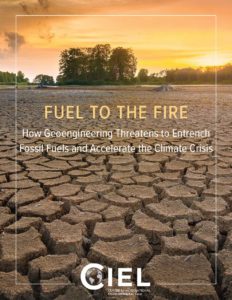
Fuel to the Fire: How Geoengineering Threatens to Enrich Fossil Fuels and Accelerate the Climate Crisis

By Carroll Muffett and Steven Felt - Center for International Environmental Law, February 2019

The present report investigates the early, ongoing, and often surprising role of the fossil fuel industry in developing, patenting, and promoting key geoengineering technologies. It examines how the most heavily promoted strategies for carbon dioxide removal and solar radiation modification depend on the continued production and combustion of carbon-intensive fuels for their viability.

It analyzes how the hypothetical promise of future geoengineering is already being used by major fossil fuel producers to justify the continued production and use of oil, gas, and coal for decades to come. It exposes the stark contrast between the emerging narrative that geoengineering is a morally necessary adjunct to dramatic climate action, and the commercial arguments of key proponents that geoengineering is simply a way of avoiding or reducing the need for true systemic change, even as converging science and technologies demonstrate that shift is both urgently needed and increasingly feasible. Finally, it highlights the growing incoherence of advocating for reliance on speculative and risky geoengineering technologies in the face of mounting evidence that addressing the climate crisis is less about technology than about political will.

Read the report (Link).

Beyond the Nation State: A Critical Look at Venezuela’s Current Crisis

By Brooke Anderson and Mateo Nube - Movement Generation, February 2019

Venezuela has made headlines in the last few weeks, as Venezuelan opposition leader and National Assembly head Juan Guaidó has declared himself interim President, throwing the country into turmoil. Current President, Nicolás Maduro has called the effort a coup. Meanwhile, thousands of people have taken to the streets on both sides, with a death toll of 26 and rising. The Trump administration, many Western European countries, and the right-leaning bloc of Latin American governments have recognized Guaidó as the legitimate president of Venezuela.  Meanwhile Russia, China and others are backing Maduro. A third bloc, most notably Mexico and Uruguay, are calling for a peaceful transition through new elections.

I recently sat down with my co-worker Mateo Nube, collective member of the Movement Generation Justice & Ecology Project, for more political and economic context to the current crisis. In the interview, Nube unpacks the history and promise of the Bolivarian Revolution in Venezuela and beyond; the roots and early warning signs of the authoritarianism we’re now seeing play out in Venezuela; the lost opportunity for Venezuela to leverage its oil money wealth toward a just transition away from extractivism and toward a regenerative economy; and the dangers of U.S. interventionism in the conflict.

Brooke Anderson: Your family came up under dictatorships in both Venezuela and Bolivia, so this is personal for you. Give us some context to how you come to the question of Venezuela.

Mateo Nube: My family has roots in Venezuela. We originally  fled the Holocaust in the 30’s and 40’s and settled in Caracas [Venezuela] from Berlin. My mom grew up under Marcos Pérez Jiménez, the military dictatorship that really marked and traumatized Venezuelans. In turn, I was born in Bolivia in 1971 and spent the first 10 years of my life under military dictatorship there. So I’m politically steeped in resisting military authoritarianism and building social movements to not only overthrow the military but to redistribute wealth and power. So the Venezuelan context really marked my family and informed my political orientation.

So the Venezuelan context really marked my family and informed my political orientation.

Brooke Anderson: What’s actually happening on the ground in Venezuela right now?

Mateo Nube: The situation in Venezuela right now is dire and painful to witness. It is a mixture of a political, economic, and humanitarian crisis. The man who is controlling the state of Venezuela is Nicolás Maduro. He is the successor of Hugo Chávez, who led the Bolivarian Revolution for the last two decades, prior to his death in 2013. Maduro is currently facing a challenge from Juan Guaidó, the current head of the National Assembly. Guaidó is arguing that Maduro is not a legitimate President and that the constitution dictates that he, Guaidó, is the next in line. This contestation coming from the opposition is largely the right wing.

Neither of these leaders has tremendous legitimacy. There are two men (representing two political factions) who are calling themselves President of Venezuela. They are both claiming power in a way that disrespects the constitutional process of Venezuela. We can definitely call Guaidó’s move an attempted coup and unconstitutional. If we do, we also have to recognize that Maduro won the 2018 elections after banning the main opposition leader, Henrique Capriles, and multiple opposition parties from running and dissolved the opposition-controlled National Assembly in March 2017 through a stacked Supreme Court. If a right-wing political party had made these moves, we would have loudly denounced them.

I am Not a Criminal; The Air Polluters are the Criminals

By Allan Todd - London Green Left, January 28, 2019

In Milton Keynes, on Friday 25 January, I was one of 24 Greenpeace activists found guilty of ‘aggravated trespass’. All those (myself included) without any previous criminal convictions, were given 12-month conditional discharges, with damages and court costs of £105 each. Those who had got previous convictions were, in addition, fined £200 each.

Our case arose from a Greenpeace ‘air pollution’ action back in August 2018, which peacefully locked-down VoltsWagon's (VW) UK HQ in Milton Keynes for most of one day - according to VW, this prevented 960 employees from getting into work, costing the company £166,000.

After the verdicts, I was minded of what the Ancient Greek playwright, Euripides, wrote: 

‘Those whom the gods wish to destroy, they first make mad.’

The background

Many companies - such as Volvo - have already committed to phasing out the production of diesel vehicles. However, the VW ‘stable’ - which is responsible for 1 in 5 of all new diesel vehicles being put on UK roads today - had refused, for over a year, all Greenpeace requests to discuss this issue.

But, on the very day of that Greenpeace action, VW finally agreed to discuss the issue; and, 3 months later, have announced they will phase out all diesel production by 2040.

Labour and the ecological crisis: The eco-modernist dilemma in western Marxism(s) (1970s-2000s)

By Stefania Barca - Geoforum, January 2019

The article offers an intellectual critique of Marxist political ecology as developed in western Europe between the 1970s and 2000s, focusing on the labour/ecology nexus. My critique is based on the intersection of two levels of analysis: 1) the historical evolution of labour environmentalism, focusing on what I will call the eco-modernist dilemma of labour; 2) the meaning of class politics in relation to the politics of the environment, with a special focus on the production/reproduction dialectic.

Focusing on the work of four Marxist intellectuals whose ideas resonated with various social movements across the Left spectrum (labour, environmentalism, feminism and degrowth), the article shows how the current entrenchment of labour within the politics of eco-modernization hides a number of internal fractures and alternative visions of ecology that need to be spelled out in order to open the terrain for a rethinking of ecological politics in class terms today.

Read the text (PDF).

The Sky's Limit: Why Denmark Must Phase Out North Sea Oil and Gas Extraction

By Bronwen Tucker, et. al. - Oil Change International, September 2019

Over the past thirty years, Denmark has positioned itself as a global climate leader through its policies to support wind power, district heating, and energy efficiency, amongst other actions.5Building on this, in June 2019, the newly elected Danish government committed to a new climate target of reducing emissions 70 percent below 1990 levels by 2030, surpassing its previous goal of 40 percent by 2020.

However, Denmark’s plans to expand North Sea oil and fossil gas extraction undermine this record of climate action. This is because the potential carbon emissions from the oil, gas, and coal in the world’s currently operatingfields and mines would already fully exhaust and exceed carbon budgets consistent with the Paris goals. Simply put, we cannot afford to bring new extraction online — in Denmark or anywhere else.

This report applies these stark global carbon budget limits to the outlook for oil and gas production in Denmark. We find that Denmark’s plans to allow new North Sea oil and gas projects in the 2020s and 2030s would undermine its aspirations of climate leadership. The carbon dioxide (CO2) emissions from burning Danish-produced oil and gas would be substantial, overtaking Denmark’s total expected domestic CO2 emissions from energy by mid-2025 (see Figure 1, with details on the domestic reduction curves in Section 1). In other words, if current plans to expand North Sea extraction are left unaddressed, Denmark will either (a) meet its domestic emissions targetsbut export oil and gas with associated emissions that overshadow this domestic progress, or (b) fail to meet its emissions targets and continue to consume more oil and gas domestically than is Paris-aligned.

Source: Oil Change International analysis based on data from Rystad UCube, Danish Energy Agency, and 92 Group.8There is a cumulative 665 million tonnes (Mt) of CO2 associated with Danish oil and gas between 2019 and 2050. Of these potential CO2 emissions, 401 Mt of CO2 would come from new projects yet to be developed that would peak between the mid-2020s and mid-2030s. This means over 60 percent of anticipated emissions related to Denmark’s oil and gas extraction in the coming decades are not yet committed — the projects they are associated with will either require new licenses from the Danish government or final investment decisions (and final government approval) to be developed.

Read the report (PDF).

Banking on Climate Change: Fossil Fuel Finance Report 2020

By Alison Kirsch, et. al. - Rainforest Action Network, et. al., January 2019

Financial companies are increasingly being recognized — by their clients, shareholders, regulators, and the general public — as climate actors, with a responsibility to mitigate their climate impact. For the banks highlighted in this report, the last year has brought a groundswell of activism demanding banks cut their fossil fuel financing, at the same time that increasingly extreme weather events have further underscored the urgency of the climate crisis.

This report maps out case studies where bank financing for fossil fuels has real impact on communities — from a planned coal mine expansion in Poland, to fracking in Argentina, to LNG terminals proposed for South Texas. Short essays throughout highlight additional key topics, such as the need for banks to measure and phase out their climate impact (not just risk) and what Paris alignment means for banks. Traditional Indigenous knowledge is presented as an alternative paradigm for a world increasingly beset with climate chaos. November’s U.N. climate conference in Glasgow, on the fifth anniversary of the adoption of the landmark Paris climate agreement, will be a crucial deadline for banks to align their policies and practices with a 1.5° Celsius world in which human rights are fully respected. The urgency of that task is underlined by this report’s findings that major global banks’ fossil financing has increased each year since Paris, and that even the best future-facing policies leave huge gaps.

Read the report (PDF).

Drilling Towards Disaster: Why US Oil and Gas Expansion is Incompatible With Climate Limits

By Kelly Trout and Lorne Stockman - Oil Change International, et. al., January 2019

World governments, including the United States, committed in 2015 in the Paris Agreement to pursue efforts to limit global average temperature rise to 1.5 degrees Celsius above pre-industrial levels and, at a maximum, to keep warming well below 2 degrees Celsius (°C). This report is part of The Sky’s Limit series by Oil Change International examining why governments must stop the expansion of fossil fuel production and manage its decline – in tandem with addressing fossil fuel consumption – to fulfill this commitment.

The global Sky’s Limit report, released in 2016, found that the world’s existing oil and gas fields and coal mines contain more than enough carbon to push the world beyond the Paris Agreement’s temperature limits. This finding indicates that exploring for and developing new fossil fuel reserves is incompatible with the Paris goals. In fact, some already-operating fields and mines will need to be phased out ahead of schedule.

Since the global Sky’s Limit report in 2016, new scientific evidence has added urgency to this call for a managed decline of fossil fuel production. The latest report from the Intergovernmental Panel on Climate Change warns that reaching 2°C of warming would significantly increase the odds of severe, potentially irreversible impacts to human and natural systems, compared to limiting warming to 1.5°C. The difference could be the wipeout or resilience of whole communities and ecosystems. The report underscores that a 1.5°C path is possible but will require “rapid and far- reaching” transitions and “deep emissions reductions in all sectors” so that carbon pollution nears zero by 2050.

Unfortunately, existing climate measures aren’t cutting it – literally. Current national policy pledges under the Paris Agreement would put the world on course for 2.4 to 3.8°C of warming, a catastrophic outcome.

This glaring gap in ambition has been driven in part by a systemic policy omission. Over the past three decades, climate policies have primarily focused on addressing emissions where they exit the smokestack or tailpipe. Meanwhile, they have largely left the source of those emissions – the oil, gas, and coal extracted by fossil fuel companies – to the vagaries of the market.

Basic economics tells us that the consumption of any product is shaped by both supply and demand. It follows that reducing supply and demand together, or ‘cutting with both arms of the scissors,’ais the most efficient and effective way to reduce a harmful output. Putting limits on fossil fuel extraction – or ‘keeping it in the ground’ – is a core yet underutilized lever for accelerating climate action.

Curbing the supply of fossil fuels does not mean turning off the taps overnight. Rather, it means stopping new projects that would lock in new pollution for the coming decades. It means managing an orderly and equitable wind-down of existing fossil fuel infrastructure and extraction projects within climate limits. It makes it possible to plan for a just transition for workers and communities.

If the world is to succeed in meeting the Paris goals, this type of comprehensive and clear-eyed approach is urgently needed everywhere, and particularly in the United States – one of the world’s top producers and users of fossil fuels.

Read the report (PDF).

A New Horizon: Innovative Reclamation for a Just Transition

By various - Reclaiming Appalachia Coalition, 2019

The certainty of an Appalachian transition has become self-evident. The questions that remain are “What shape will that transition take?” and “Will our region seize the opportunity to establish just and sustainable economic models that invest in our strengths and set the region up for meaningful and healthy participation in the new economy?” Foundational to our coalition’s work is the understanding that specific, targeted intervention is necessary to ensure that an equitable vision becomes reality.

Appalachia is at the threshold of a paradigm shift into the new economy, ushered in by communities that are taking their futures into their own hands like never before and implementing innovative ways to address long-standing economic issues with degraded lands. The table on page 6 shows funded projects illustrating this shift that have been supported by our coalition, ranging from ecotourism, renewable energy, arts and culture, and creative waste recycling.

This report highlights the successes achieved in 2019 from previously submitted projects and showcases a brand new round of innovative projects. We’re very excited about both the successes that have already been funded and implemented, as well as the new opportunities that are currently being considered for Abandoned Mine Lands (AML) Pilot funding.

Read the report (Link).

Realizing a Just and Equitable Transition Away From Fossil Fuels

By Georgia Piggot, Michael Boyland, Adrian Down, and Andreea Raluca Torre - Stockholm Environment Institute, January 2019

Meeting agreed climate goals requires a rapid decarbonization of the global energy system, which in turn necessitates a reduction in fossil fuel production. While limiting fossil fuel use will likely bring a multitude of societal benefits — related to reduced climate risks, sustainable economic growth, air quality and human health — it is important to recognize that not everyone will benefit equally from a transition to a low-carbon economy. In particular, those who rely on fossil fuel production for their livelihood, or who were anticipating using fossil-fuelled energy to meet development needs, may carry a disproportionate share of the burdens of an energy transition.

The need for a “just transition” to a low-carbon economy — namely, a transition that minimizes disruption for workers and communities reliant on unsustainable industries and energy sources — is gaining traction in climate policy and political discourse. A call for “a just transition of the workforce” was included in the preamble to the Paris Agreement, and the United Nations Framework Convention on Climate Change (UNFCCC) secretariat has prepared a technical paper on transition planning.10 In addition, several national and regional governments have recently announced new transition planning processes, including Canada, Germany, Spain, Scotland, New Zealand, and the European Union.

A central concern of just transition efforts is to ensure that low-carbon transitions address social and economic inequality. The UNFCCC calls for a transition that “contribute(s) to the goals of decent work for all, social inclusion and the eradication of poverty.” Likewise, the European Commission aims to “boost the clean energy transition by bringing more focus on social fairness.” And the Scottish Government is seeking a transition that “promotes inclusive growth, cohesion and equality.”

Key messages:

  • Governments are introducing new “just transitions” policies to help workers and communities move away from fossil fuels.
  • Most policies assume that justice goals will be achieved by helping those dependent on coal, oil and gas move into new roles; however, there is little critical reflection on what justice means in the context of an energy transition away from fossil fuels.
  • There are a number of gaps in current just transition policies when viewed through a justice lens. For example, no policies contain measures to improve the lives of people currently marginalized in the energy system.
  • Creating just and equitable transition policies requires collecting data on the current distribution of the harms and benefits of the energy system, and mapping out how this will change as fossil fuels become a less-prominent part of the energy mix.
  • By taking justice considerations into account, transition policies are more likely to limit social and political resistance, win a broad consensus, and achieve effective implementation.

Read the text (PDF).

Beyond Coal by 2030

By Florent Marcellesi and Joanna Flisowska - Green European Journal, November 29, 2018

The COP24 climate talks in Katowice, Poland are set to start on December 2. This year, the negotiations follow a clear warning from the global climate science community, which highlighted in the recent IPCC report that urgent steps are needed to slow global warming. Without action, the world faces the grim prospect of extreme weather events and a massive loss of species. Florent Marcellesi, Green MEP, and Joanna Flisowska, coal policy coordinator at Climate Action Network Europe, discuss COP, the energy global transition, and the gender dimension of climate change.

Green European Journal: In a matter of days, almost 200 countries will meet in Katowice, a city at the heart of a Polish coal mining region, to try and finalise the details of how the Paris Agreement will be put into force. Increasingly, the main timeline for taking steps to keep the global temperature rise well below 2 degrees, preferably to 1.5, now seems impossible. Where are we going into the talks?

Joanna Flisowska: The objective of limiting temperature rise to 1.5 degrees was in the Paris agreement from the very beginning. But with the latest Intergovernmental Panel on Climate Change (IPCC) report, we found out just how urgent it has become to act on climate change. The report brings the impact of climate change beyond the 1.5-degree mark to light and shows how disastrous and far-reaching it will be.

Florent Marcellesi: The IPCC report is a tipping point. We can now clearly say that we have to go faster and act with greater ambition for two main reasons. First, the drastic consequences if we do not. In Spain, from now to the end of the century the soil could become a desert and Spanish people could end up as climate refugees. Second, the opportunities. Achieving the 1.5-degrees limit means people living healthier lives and the creation of new and better jobs. Climate change will have negative consequences for the economy and for identity, traditions, and culture too as it disrupts ways of life. But we must turn it into an opportunity and act with commitment to achieve the goals of the Paris agreement.

The IPCC report sets out some potential pathways for the world to stabilise global warming at 1.5 degrees. These depend on an unprecedented effort to cut fossil-fuel use, among which coal is a particularly high source of carbon emissions. How can we transition from coal to clean energy sources?

Joanna Flisowska: The way forward is somewhat different depending on whether we look at the global perspective or the EU one. The EU has to consider its historical contribution to today’s climate change and must therefore reduce emissions even faster than the rest of world. According to many scientific studies, the fastest and most effective way to stay on the path to 1.5 degrees is to phase out coal by 2030 at the latest. This assessment is certainly true and is why environmentalists are emphasising that coal has to be phased out in order for the EU to reduce its emissions in a timely and cost-effective manner. Today’s reliance on coal can be overcome through renewables, investments in energy efficiency, storage, and with better management of electricity networks.

Florent Marcellesi: We are phasing out of coal for two reasons. The first is economic: coal is not profitable right now. Many plants are closing simply because it cannot compete with renewables. But second, we need to phase out coal well before 2040 for ecological reasons. The IPCC was very clear on that point and, for Europe, a coal phase-out has to mean 2030 at the latest. In some countries like Spain, coal plants must be closed even earlier by 2025.

Pages

The Fine Print I:

Disclaimer: The views expressed on this site are not the official position of the IWW (or even the IWW’s EUC) unless otherwise indicated and do not necessarily represent the views of anyone but the author’s, nor should it be assumed that any of these authors automatically support the IWW or endorse any of its positions.

Further: the inclusion of a link on our site (other than the link to the main IWW site) does not imply endorsement by or an alliance with the IWW. These sites have been chosen by our members due to their perceived relevance to the IWW EUC and are included here for informational purposes only. If you have any suggestions or comments on any of the links included (or not included) above, please contact us.

The Fine Print II:

Fair Use Notice: The material on this site is provided for educational and informational purposes. It may contain copyrighted material the use of which has not always been specifically authorized by the copyright owner. It is being made available in an effort to advance the understanding of scientific, environmental, economic, social justice and human rights issues etc.

It is believed that this constitutes a 'fair use' of any such copyrighted material as provided for in section 107 of the US Copyright Law. In accordance with Title 17 U.S.C. Section 107, the material on this site is distributed without profit to those who have an interest in using the included information for research and educational purposes. If you wish to use copyrighted material from this site for purposes of your own that go beyond 'fair use', you must obtain permission from the copyright owner. The information on this site does not constitute legal or technical advice.