You are here

fossil fuel capitalism

This Bay Area Town is Taking on Big Oil’s Expansion Plans - And Winning

By Ethan Bucker, US Organizer - Forest Ethics, January 24, 2014

Disclaimer: The views expressed here are not the official position of the IWW (or even the IWW’s EUC) and do not necessarily represent the views of anyone but the author’s

Just over the golden hills of Martinez, the descent into Pittsburg on California's Highway 4 opens a view of the Carquinez Strait. The strait is a narrow segment of the tidal estuary that accepts the rushing waters of the Sacramento and San Joaquin rivers as they empty into the San Francisco Bay. The vista paints a portrait of the transition to a clean energy economy: on the northern side of the strait, enormous turbines of the Shiloh Wind Power Plant revolve gracefully. Along the southern waterfront, an aging former PG&E power plant casts a shadow over massive, decaying fuel tanks next to Pittsburg’s newly revitalized downtown.

This is the stage of the Bay Area’s latest and biggest energy battle, between residents of Pittsburg and energy infrastructure company WesPac.

WesPac Energy wants to transform the PG&E site into a mega crude-by-rail facility, marine oil terminal, and refurbished tank farm. With plans to handle 242,000 barrels per day, the terminal would process one-fifth of all crude coming through California. The facility would deliver Bakken crude and tar sands to all five of the Bay Area’s refineries via new and expanded pipelines. In simple terms, WesPac is looking to turn Pittsburg into the crude hub of Northern California.

WesPac had been developing its proposal with the Pittsburg planning department for two years, but it wasn’t until a sunny Sunday in August 2013 that anyone really knew about it.

On this particular Sunday, longtime Pittsburg resident Lyana Monterrey happened upon a tiny notice in the Contra Costa Times for a public hearing on an environmental impact report. Alarmed at the tremendous risks and dangers posed by the project, Lyana knocked on her neighbor Kalli Graham’s door to tell her about the story she had read. Kalli and Lyana immediately started going door-to-door to alert their neighbors of WesPac’s plans. Neither of them had participated in community organizing before. They attended the city hearing the following day, met a few other concerned residents, and decided to take action.

“I just could not sit still. I could not do nothing about this,” Lyana recalled.

What started as a few neighbors raising their voices quickly grew into a tidal wave of community-led activism that’s swept the town of Pittsburg into the regional and national spotlight. 2013 has been tainted by a half dozen oil train derailments and explosions, including a deadly disaster in Lac Megantic, Quebec that leveled a small town and killed 47 people. So, the prospect of “bombs-on-wheels” (as one community resident put it) rolling through Pittsburg on the daily has set the community ablaze with fierce opposition to WesPac.

Two diverse community led groups--the Pittsburg Defense Council and the Pittsburg Ethics Council--have emerged within the last six months to lead the campaign against the WesPac project, alongside ForestEthics and other NGO allies. Together, we’ve gathered over 4,000 petition signatures, organized a riveting Toxic Tour of the city’s heavy industrial sites, and conducted a bucket brigade air monitoring project that reveals striking levels of pollution in the community. We’ve flooded downtown Pittsburg with lawn signs, mobilized a January 11 march and rally that brought out over 300 residents, and organized a rally that packed Tuesday’s City Council meeting. Community leaders are meeting with city officials, training and empowering volunteers, and generating dozens of media hits. We’re gearing up to come out in full force as the Pittsburg Planning Commission and City Council vote on the project in coming months.

Coal Miners and the Green Agenda

By Robert Pollin - New Labor Forum, Winter 2014

From 2014...

In June 2012, President Obama announced his “Climate Action Plan.” This is his administration’s major second-term initiative to re-energize its agenda around fighting climate change and supporting major new investments in clean energy.

The primary focus of the Action Plan is the administration’s program to dramatically reduce carbon emissions from the country’s electricity utility plants. These emissions result primarily from burning coal, but also natural gas, to produce electricity. Carbon emissions from electricity generation represent about one-third of all greenhouse gas emissions produced by all sources within the U.S. economy today. It is evident that these emissions need to be cut dramatically if we are going to stop playing Russian roulette with the environment.

New Regulations and Technologies Are Not Enough

The administration’s strategy for achieving these emissions cuts is to begin strictly enforc-ing the existing air pollution regulations estab-lished as part of the 1990 Clean Air Act.

The administration is taking this approach because it allows them to avoid asking Congress to either spend more money or pass new regulations.The administration expects that the utility companies can achieve the needed emissions reductions through a technological fix: the introduction of carbon capture and sequestra-tion (CCS) processes, through which, they believe, coal and natural gas could burn cleanly. This is how the phrase “clean coal” has begun to emerge on billboards and TV commercials. CCS encompasses several specific technolo-gies that aim to capture carbon emissions from power plants and other industrial facilities. The captured carbon is then transported, usually through pipelines, to locations where it is then stored permanently—that is, for all time—in subsurface geological formations.

Opponents of the administration’s Action Plan claim that CCS remains unproven and, even if it becomes technically feasible, would impose heavy new costs on utilities.

In this instance, the administration’s critics have the weight of evidence on their side. As such, the Action Plan faces two fundamental problems. First, as there is no proven technol-ogy for delivering clean coal—or, for that mat- ter, clean oil or natural gas—the only viable path for dramatically reducing carbon emis-sions is to sharply reduce fossil fuel consump-tion. This, in turn, means that workers and communities dependent on the fossil fuel indus-tries will face job losses and retrenchment. It is therefore no surprise that even Democratic pol-iticians representing the affected communities are actively opposing Obama’s initiative.

Read the report (PDF).

Appalachia Rising

By Grant Mincy - Counterpunch, January 17-19, 2014

Disclaimer: The views expressed here are not the official position of the IWW (or even the IWW’s EUC) and do not necessarily represent the views of anyone but the author’s.

On Thursday, January 9 a dangerous toxin, 4-methylcyclohexane methanol, leaked from a busted tank and into the Elk River in West Virginia. It is believed that nearly 7,500 gallons of the toxin made its way from the 40,000-gallon tank into the river. It’s unclear how much actually entered the public water supply.
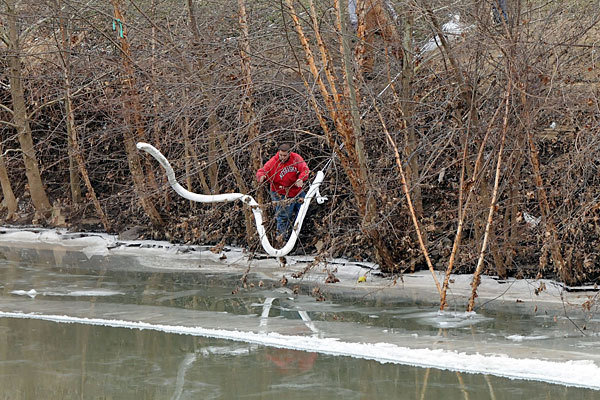
The busted tank is owned by Freedom Industries, which uses the chemical for coal processing. Some 300,000 people have been directly impacted by the disaster, forced to wait in long lines at fire stations to receive potable water. There’s been a constant run on stores for the precious resource as well.

This is a story to often told in Appalachia. The Massey Energy coal slurry spill in Martin County, Kentucky (where 306,000,000 gallons of toxic slurry hit the town) and the TVA coal ash disaster in Kingston, Tennessee, are also part of the history of industrial disaster in the region. This history is wrought with class struggle, environmental degradation and corporatism. From the expulsion of Native Americans to the rise of King Coal, the Hawks Nest incident, the labor struggle, the Battle of Blair Mountain and the wholesale destruction of mountain ecosystems via Mountaintop Removal, Appalachia is on the front lines of the war with the politically connected.

The coalfields of Appalachia have long been home to impoverished people, overlooked by the affluent in the United States. Still, the “War on Poverty” has made its way into the Appalachian hills several times. Most famously, US president Lyndon Johnson singled out the region for his “Great Society” programs, and presidents 42, 43 and 44 have all tried to help the region as well. Instead of offering a new way forward, their programs further damage the area.

Much of the “War On Poverty” has been fought via economic engineering, centralizing the economies of West Virginia and Eastern Kentucky (along with parts of Tennessee and Virginia) into the hands of extractive fossil resource industries — notably coal and natural gas. The mechanization of these industries, however, has reduced the labor force. Specialized labor moving to the region has caused short-term booms and long-term busts. Once an extractive resource is exploited and gone,  communities are left to deal with mono economies and irreversible ecological destruction.

They Poisoned the River for a “Clean Coal” Lie

By Trish Kahle - Socialist Worker, January 13, 2014

Disclaimer: The views expressed here are not the official position of the IWW (or even the IWW’s EUC) and do not necessarily represent the views of anyone but the author’s.

IMAGINE YOURSELF in the rugged countryside of the Appalachian Mountains, where you and your neighbors have lived with a history of poverty and lack of economic development–and you learn that the water piped into your home has been poisoned and can’t be used, even after it is boiled, until further notice.

Imagine trying to run a hospital when the city’s water is unusable–even for hand washing. Imagine having to ration drinking water to school-age children in the fourth most water-rich country on earth.

All of these nightmares and more came true in West Virginia on January 9 after residents reported that their tap water tasted like licorice. The contaminant turned out to be 4-methylcyclohexane methanol, or MCMH–a chemical used to produce misleadingly named “clean coal” through a froth flotation process that “scrubs” the coal prior to burning it in power plants.

The chemical spilled into the Elk River from a 48,000-gallon tank owned by Freedom Industries. The full extent of the leak remained unclear over the weekend. West Virginia Gov. Earl Ray Tomblin claimed the spill didn’t exceed 5,000 gallons, but Freedom Industries President Gary Southern could only say for certain that less than 35,000 gallons leaked out.

Tom Aluise of the West Virginia Environmental Protection Association noted that MCMH cannot be removed from the water–and residents will simply have to wait for thousands of miles of pipelines to be flushed before water safety can be reassessed. “This material pretty much floats on the water, and it’s floating downstream, and eventually it will dissipate, but you can’t actually get in there and remove it,” Aluise said.

That begs the question of why a hazardous chemical that is impossible to clean up if spilled was being stored near a river only one mile upstream from a treatment plant providing water to West Virginia’s capital of Charleston and nine counties that span the surrounding area.

The Keystone Pipeline Debate: An Alternative Job Creation Strategy

By Kristen Sheeran, Noah Enelow, Jeremy Brecher, and Brendan Smith - Economics for Equity and the Environment and Labor Network for Sustainably, November 5, 2013

The Keystone XL pipeline has been touted as a means to address America's jobs crisis. But how does its job creation compare to other possible projects?

This study compares the jobs that would be created by the KXL pipeline to the jobs that could be created by water, sewer, and gas infrastructure projects in the five states the pipeline crosses.

It finds that meeting unmet water and gas infrastructure needs in the five relevant states along the KXL pipeline route will create:

  • More than 300,000 total jobs across all sectors;
  • Five times more jobs, and better jobs, than KXL;
  • 156% of the number of direct jobs created by Keystone XL per unit of investment.
  • President Barack Obama and others have criticized the KXL pipeline for its meager promise of 50 to 100 longer‐ term jobs. In contrast, water infrastructure operation and maintenance in the five relevant states alone will create 137 times as many direct long‐term jobs, and over 95 times more total long‐term jobs, than Keystone XL.

Proponents of KXL maintain it will be built by private investment without public subsidy. But the oil refineries that will use KXL oil, along with the rest of the oil industry, receive large government subsidies. All of the infrastructure work described in this study can be financed just by closing three Federal tax loopholes for fossil fuel companies. Indeed, taking just one tax subsidy now received by the refineries that would use KXL oil and using it instead for water infrastructure would create as many jobs as the KXL pipeline.

Download the complete report (PDF) here.

Fracking Capitalism: Action plans for the eco-social crisis

By staff - A World to Win, November 2013

The message has gone out to corporations everywhere: Britain is open for fracking. In response, campaign groups now exist the length and breadth of Britain in opposition to the plans to industrialise the countryside with tens of thousands of drilling sites. They are taking legal action, lobbying their representatives and protesting and occupying sites at considerable risk of police brutality.

But this grass roots movement is up against formidable adversaries. Corporations have the backing of the state and a public relations campaign led by the government is promoting the lie that fracking is safe and will lead to cheaper energy.

Yet public support for shale gas extraction continues to fall while backing for renewables grows. Government claims about jobs and lower gas prices are exposed for the grand deceptions they are. None of this will deter the Cameron government, however, which has thrown the weight of the state behind the frackers.

Read the report (Link).

Exaggerating the Employment Impacts of Shale Drilling: How and Why

By Frank Mauro, Michael Wood, Michele Mattingly, Mark Price, Stephen Herzenberg, and Sharon Ward - Multi-State Shale Research Collaborative, November 2013

Over the last five years, firms with an economic interest in the expansion of drilling in the Marcellus and Utica shale formations — and their allies, supporters, and trade associations — have used a variety of tools and techniques to exaggerate the employment impacts of shale drilling. These strategies have ranged from the use of inappropriate measures, such as data on new hires, to represent job growth to the misleading attribution of all jobs in “ancillary” industries to the shale industry.

A review of statements by representatives of shale drilling firms and their allies makes the motivation for this exaggeration clear — to preclude, or at least to minimize, taxation, regulation, and even careful examination of shale drilling.

Read the report (PDF).

EagleRidge Ignores Fracking Worker Safety

By Sharon Wilson - Originally published on Earthblog, October 16, 2013

Disclaimer: The views expressed here are not the official position of the IWW (or even the IWW’s EUC) and do not necessarily represent the views of anyone but the author’s.

We already know that EagleRidge is a terrible neighbor!

  • An EagleRidge Operating worker was indicted in June 2012 on a felony charge of illegally dumping. City employees visiting the company’s well site in the 3100 block of Airport Road found a pump forcing contaminated water into a tributary of Hickory Creek. LINK
  • EagleRidge was operating wells in Denton without a permit. LINK
  • EagleRidge had a blowout in Denton that got "sanitized." LINK But it didn't stay "sanitized." LINK
  • EagleRidge is drilling in a Denton neighborhood less than 200 feet from homes.
  • EagleRidge is drilling in Mansfield and polluting air, violating sound ordinances and dividing neighbors. LINK

So it's no surprise to learn that EagleRidge is an awful employer that lacks regard for worker safety. Yesterday I stopped to take photos and video when I passed the EagleRidge drill site directly across from the University of North Texas athletic facility. (Yes, I know: polluting the air our young people are gulping in while practicing sports is reckless.) The video shows workers walking amidst swirling clouds of silica sand aka frack sand. In May 2012, OSHA and NIOSH issued a HAZARD ALERT regarding exposure to silica during hydraulic fracturing. The OSHA info sheet details steps industry needs to take to limit the amount of silica exposure. While they recommend breathing protection, they caution that respirators alone are not sufficient at the levels of exposure seen during fracking. Media reported that workers in Texas were exposed to over 10 times the safe limit.

Good Energy, Bad Energy

Friends of the Earth International, 2013 - copied according to Creative Commons License

The world’s current energy system – the way we produce, distribute and consume energy – is unsustainable, unjust and harms communities, workers, the environment and the climate. Friends of the Earth International's new report demonstrates why a just, sustainable, climate-safe energy system is more urgent than ever.

Key points

  • Our current energy system is unsustainable, unjust, and harming communities, workers, the environment and the climate.  This is fundamentally an issue of power: of corporate and elite power and interests outweighing the power of ordinary citizens and communities.
  • The destructive energy sources on which the world current relies are driving climate change and many social and environmental problems and conflicts, including land grabbing, pollution, deforestation and the destruction of ecosystems, human rights abuses, health problems and premature deaths, and unsafe, insecure jobs and the rupture and collapse of local economies.

Friends of the Earth International believes that it is possible to build a climate-safe, just and sustainable energy system which ensures the basic right to energy for everyone and respects the rights and different ways of life of communities around the world.  To get there we need to challenge corporate power and exert real democratic control over the energy decisions of our governments.

  • We urgently need to invest in locally-appropriate, climate-safe, affordable and low impact energy for all, and reduce energy dependence so that people don’t need much energy to meet their basic needs and live a good life.
  • We need to end new destructive energy projects and phase out existing destructive energy sources, all the while ensuring that the rights of affected communities and workers are respected and that their needs are provided for during the transition.
  • To make the transition happen we also need to tackle the trade and investment rules that prioritise corporations' needs over those of people and the environment.
  • Our vision is guided by an idea called energy sovereignty.  This is the right of people to have access to energy, and to choose sustainable energy sources and sustainable consumption patterns that will lead them towards sustainable societies.

PDF File

The Kochs and Clean Energy Jobs

By staff - International Forum on Globalization, October 2012

This IFG Special Report, “The Kochs and Clean Energy Jobs,” documents spending by the world’s two biggest billionaires intent on dealing a deathblow to green energy jobs and a low-carbon future.

IFG’s report reveals that the Kochs are today’s single largest funder of anti-environment and anti-worker activities, including:At least $643M in spending to block or rollback legal protections for the clean air, clean energy, clean water, and other environmental issues through sketchy scientific research, lobbying lawmakers, contributing to electoral candidates’ campaigns, media manipulation etc.At least $12M in spending to weaken the labor movement’s power through attacking collective bargaining rights, weakening worker protections, and stopping the financing for labor unions’ political activities.

Read the report (PDF).

Pages

The Fine Print I:

Disclaimer: The views expressed on this site are not the official position of the IWW (or even the IWW’s EUC) unless otherwise indicated and do not necessarily represent the views of anyone but the author’s, nor should it be assumed that any of these authors automatically support the IWW or endorse any of its positions.

Further: the inclusion of a link on our site (other than the link to the main IWW site) does not imply endorsement by or an alliance with the IWW. These sites have been chosen by our members due to their perceived relevance to the IWW EUC and are included here for informational purposes only. If you have any suggestions or comments on any of the links included (or not included) above, please contact us.

The Fine Print II:

Fair Use Notice: The material on this site is provided for educational and informational purposes. It may contain copyrighted material the use of which has not always been specifically authorized by the copyright owner. It is being made available in an effort to advance the understanding of scientific, environmental, economic, social justice and human rights issues etc.

It is believed that this constitutes a 'fair use' of any such copyrighted material as provided for in section 107 of the US Copyright Law. In accordance with Title 17 U.S.C. Section 107, the material on this site is distributed without profit to those who have an interest in using the included information for research and educational purposes. If you wish to use copyrighted material from this site for purposes of your own that go beyond 'fair use', you must obtain permission from the copyright owner. The information on this site does not constitute legal or technical advice.