You are here

green unionism

Climate Stability, Worker Stability: are they compatible?

By Dr. Louise Comeau, JD, PhD and Devin Luke - Adapting Canadian Work and Workplaces to Respond to Climate Change, December 3, 2018

It appears we face a low- carbon transition dilemma. On the one hand, climate change solutions, like greenhouse gas regulation and carbon pricing, raise concerns about potential job displacement for workers in traditional energy sectors like oil and gas production and fossil-fuel generated electricity. Hence the calls for just transition. Our research, however, suggests that this blame may be at least partially misplaced. Energy workforce changes are currently affected by broader societal changes relating to fuel-cost differentials (i.e., natural gas cheaper than coal), automation, and the societal transition to non-unionized, unstable and lower-paying work. Greenhouse gas regulations and carbon pricing are certainly not the only driver of workforce change, and likely not, at least currently, not the primary driver.

Should proponents of renewable energy, energy efficiency and the low-carbon transition address these broader societal trends? If so, how? Is the solution to focus on collective responses such as energy cooperatives, public sector ownership of renewable energy supply, utility-scale and managed energy efficiency programs, rather than market- based, privatized solutions? These questions are worth answering. Our goal with this study was to better understand the training needs associated with renewable energy and energy efficiency job projections. There appears, however, to be a greater need to better integrate climate change and low-carbon economy discussions into a broader discourse on the nature of work.

Read the report (PDF).

Jobs, Justice, and the Clean-Energy Future

By Jeremy Brecher - Dollars and Sense, September & October, 2016

Today, there are 400 parts per million (PPM) of carbon dioxide in the atmosphere, far above the 350 ppm climate scientists regard as the safe upper limit. Even in the unlikely event that all nations fulfill the greenhouse gas (GHG) reduction pledges they made at the Paris climate summit at the end of 2015, carbon in the atmosphere is predicted to increase to 670 ppm by the end of this century. The global temperature will rise an estimated 3.5 degrees Celsius (6.3 degrees Fahrenheit) above pre-industrial levels. For comparison, a one-degree increase was enough to cause all the effects of climate change we have seen so far, from Arctic melting to intensified hurricanes to desertification.

Limiting climate catastrophe will require drastic cuts in the burning of the fossil fuels that cause climate change. But many workers and their unions fear that such cuts will lead to drastic loss in jobs and economic well-being for working people—aggravating the shortage of good jobs and the burgeoning inequality we already face. Is there a way to escape the apparent lose-lose choice between saving the climate and saving jobs?

Labor Must Embrace the Anti-Trump Resistance to Fight for the Working Class

By Jeremy Brecher and Joe Uehlein - In These Times, March 2, 2017
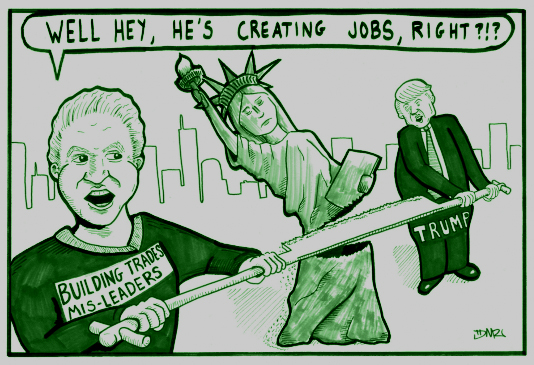
The Trump presidency presents organized labor with a dilemma.

On the one hand, Trump’s advocacy for fossil fuel, infrastructure and military expansion promises to provide jobs for some union workers. His proposals to end trade deals and put tariffs on manufacturing imports align with long-standing labor opposition to pro-corporate globalization.

On the other hand, Trump and his Republican allies in Congress propose tax, budget and social welfare policies that would impoverish most workers. His Cabinet nominees are proven enemies of organized labor and the rights of workers. And his executive policies, legislative priorities and likely Supreme Court appointments point towards catastrophic restrictions on organized labor.

A portent of the future: Vice-President Mike Pence recently discussed with Wisconsin Gov. Scott Walker how to go national with Wisconsin’s restrictions on collective bargaining and union rights. Union membership has dropped some 40 percent in the state since Walker’s collective bargaining law passed in 2011. Only 8 percent of Wisconsin’s workers were in unions last year.

Some in organized labor, especially in the buildings trades, have met with Trump, provided photo ops, and advocated that unions try to work with him, particularly on trade, energy and infrastructure. They know that many union members voted for him. Others have called for resistance to the entire Trump agenda.

The effort to embrace and work with Trump is short-sighted at best, and it may be short-lived. The survival of the labor movement depends on denying Trump the power to implement his agenda. The Trump presidency is likely to be catastrophic even for those unions that are currently seeking his favor. If the power of organized labor and its allies is further diminished, governments and corporations will be free to create a “union-free environment” for the building trades as for everybody else.

Trump’s infrastructure proposals are based on tax credits to private investors, private equity, and low-cost construction. The result is likely to be the banning of prevailing-wage rules and union security provisions for construction workers. Case in point: The Republican-led Kentucky legislature recently passed not only “right-to-work” and “paycheck protection” laws, but repealed the state’s prevailing wage law—a crucial support for building trades unions.

The attack by Trump and his Republican allies comes at a time when organized labor is already weakened. Less than 11 percent of all wage and salary workers are in unions, compared to some 20 percent in 1983. Less than 7 percent of private sector workers are in unions. Close to 35 percent of public sector workers are union members, but they are already under attack that will intensify under Trump.

While Trump’s actions will be devastating for organized labor, they may also have a silver lining. The Trump era is seeing the emergence of what has been called “social self-defense,” a massive self-organization of millions of Americans to resist Trump’s agenda. It has been manifested by the millions who participated in the Women’s March, the spontaneous actions against Trump’s Muslim ban, the mass demonstrations and community meetings in cities around the country, the millions of calls that have tied up politicians’ phone lines and myriad other forms of resistance.

The term “social self-defense” is borrowed from the struggle against the authoritarian regime in Poland 40 years ago. In the midst of harsh repression, Polish activists formed a loose network to provide financial, legal, medical and other help to people persecuted by police or unjustly dismissed from work. They organized free trade unions to defend the rights of workers and citizens, and nurtured many of the networks, strategies, and ideas that eventually helped topple the repressive regimes in Poland and other countries.

Social Self-Defense: Protecting People and Planet against Trump and Trumpism

By Jeremy Brecher - Labor Network for Sustainability, January 14, 2017

Introduction: These are times to try our souls

Donald Trump and a powerful collection of anti-social forces have taken control of the U.S. government. They seek permanent domination in service of their individual and class wealth and power. Trump’s presidency threatens immigrants, African Americans, Muslims, workers, women, children, the elderly, the disabled, LGBTQ people, and many others. Indeed, it threatens all that holds us together as a society. We the people – society — need to defend ourselves against this threat and bring it to an end. We need what resisters to repressive regimes elsewhere have called “Social Self-Defense.”

The term “Social Self-Defense” is borrowed from the struggle against the authoritarian regime in Poland forty years ago.  In the midst of harsh repression, Polish activists formed a loose network to provide financial, legal, medical, and other help to people who had been persecuted by the police or unjustly dismissed from their work. Calling themselves the Committee for Social Self-Defense (KOR), they aimed to “fight political, religious and ideological persecution”; to “oppose breaches of the law”; to “provide help for the persecuted”; to “safeguard civil liberties”; and to defend “human and civil rights.” KOR organized free trade unions to defend the rights of workers and citizens. Its members, who insisted on operating openly in public, were soon blacklisted, beaten, and imprisoned. They nonetheless persisted, and nurtured many of the networks, strategies, and ideas that came to fruition in Solidarity – and ultimately in the dissolution of repressive regimes in Poland and many other countries.[1]

From the day Donald Trump was elected President of the United States, thousands of people began to resist his agenda. Demonstrations against Trump broke out in American cities; police chiefs, mayors, and governors declared they would not implement his attack on immigrants; thousands of people signed up to accompany threatened immigrants, religious minorities, and women; technical workers pledged they would not build data bases to facilitate discrimination and deportation. Discussion of how to resist the Trump regime broke out at dining room tables, emails among friends, social media, and community gatherings.

It is impossible to know whether the Trump regime will rapidly self-destruct; successfully impose a reign of terror that dominates the U.S. for years or decades to come; or deadlock indefinitely with anti-Trump forces. We do know that the future of the planet and its people depends on resisting and overcoming Trump’s agenda. The struggle against Trump and Trumpism is nothing less than the defense of society – Social Self-Defense.

Seattle Labor Unions Join Call Saying “Shell No”

By Tom Geiger - Labor Network for Sustainability, June 11, 2015

Disclaimer: The views expressed here are not the official position of the IWW (or even the IWW’s EUC) and do not necessarily represent the views of anyone but the author’s.

In a strong show of support for a better future, local labor unions have signed a letter to oppose the decision by the Port of Seattle Commission to permit the Shell Oil rig to have safe harbor in our Elliott Bay.

We recognize that other labor unions have a position of support for this Oil Rig here. We respect their decision, but we feel compelled to speak today given the stakes of climate change and the immediate and long term effects that this has on all people in the US and around the world. Shell brought this Rig to our shores; this has catapulted us to the frontlines of climate change and called to question the policies we make as a society to address the global crisis. Would we be taking this position at this moment without this Rig here in our local waters? Probably not. But we would be taking a position soon on Climate Change anyway and this has simply fast-forwarded that historic necessity.

Below is the statement and the list of labor organizations signed onto it:

Unions Say Shell No! 


The following labor unions, which represent over 60,000 workers in various industries across Washington State, declare our opposition to Royal Dutch Shell’s drilling in our Arctic waters and the use of our Port of Seattle’s Terminal 5 as their staging site. We stand alongside the many environmental, faith, social justice and retiree organizations, indigenous peoples and the thousands of individuals who oppose the drilling. We hope that adding our voice encourages others to join the Shell No! Movement. At the same time we declare our support for a strong climate policy at the state, regional and national level to reduce our global warming pollution and ensure that as we reduce this pollution we do so with equitable transition at its core.

How Labor and Climate United Can Trump Trump

By Jeremy Brecher - Labor Network for Sustainability, January 2017

Donald Trump and his congressional Republican allies have taken control of the U.S. government. The result threatens to be devastating for both labor and the climate — not to mention immigrants, African Americans, Muslims, women, children, the elderly, the disabled, LGBTQ people, and many others.

The Trump regime is potentially vulnerable because it only represents the interests of the top 1% of the top 1%. But it has a potentially winning strategy to rule nonetheless: keep those who might stand up in the interest of the 99.9 percent divided and therefore powerless. While Trump has played black against white, Latino against Anglo, women against men, gay against straight, and exploited many other divisions, his “trump card” may well be his ability to divide labor and climate advocates.

The Trump ascendancy creates a new context for addressing long-standing tensions between organized labor and the environmental movement, between workers’ job concerns and everyone’s need to protect the climate. Trump and his congressional Republican allies intend to exploit these tensions to the max. But their threat to workers, the earth’s climate, and society as a whole make cooperation against them imperative for both organized labor and the climate protection movement. Forging a force that can effectively counter Trumpism requires change that will involve tension within each movement as well as between them, but that may be necessary if either is to have a future. The alternative is most likely decimation of both movements and of everything they are fighting for.

New Report: Protect the Climate, Save Money, and Create Jobs

By Joe Uehlein - Labor Network for Sustainability, October 14, 2015

Disclaimer: The views expressed here are not the official position of the IWW (or even the IWW’s EUC) and do not necessarily represent the views of anyone but the author’s.

Today labor and environmental organizations released a new report, The Clean Energy Future: Protecting the Climate, Creating Jobs and Saving Money, showing that the United States can reduce greenhouse gas [GHG] emissions 80 percent by 2050 — while adding half-a-million jobs and saving Americans billions of dollars on their electrical, heating, and transportation costs.

Joe Uehlein of the Labor Network for Sustainability says, “This report is good news for American workers. Protecting the climate has often been portrayed as a threat to American workers’ jobs and the U.S. economy. But this report shows that a clean energy future will produce more jobs than “business as usual” with fossil fuels.”

May Boeve of 350.org says, “This report presents a practical, realistic way for the United States to address the climate crisis and proves that we don’t have to choose between jobs and the environment.”

The Clean Energy Future: Protecting the Climate, Creating Jobs and Saving Money refutes the claim that meeting the IPCC targets will cause economic devastation. Indeed, not only can these targets can be met, but meeting them will create more jobs and save money. This report, prepared by the Labor Network for Sustainability and 350.org, with research conducted by a team led by economist Frank Ackerman of Synapse Energy Economics, lays out an aggressive strategy for energy efficiency and renewable energy that will:

Transform the electric system, cutting coal-fired power in half by 2030 and eliminating it by 2050; building no new nuclear plants; and reducing the use of natural gas far below business-as-usual levels.

  • Reduce greenhouse gas emissions 85 percent below 1990 levels by 2050, in the sectors analyzed (which account for three-quarters of US GHG emissions).
  • Save money – the cost of electricity, heating, and transportation under this plan is $78 billion less than current projections from now through 2050.
  • Create new jobs – more than 500,000 per year over business as usual projections through 2050.

This program will help bring together environmental and labor advocates around their common interest in putting Americans to work saving the earth’s climate. Climate protection has caused significant friction between labor unions and environmentalists around whether to create jobs or address climate change. The report demonstrates that this is a false choice. For unions and other jobs advocates, climate protection is also a great jobs program. We can create many more jobs by protecting the environment than by expanding the fossil fuel infrastructure.

Read the full report here: PDF

Beyond Coal by 2030

By Florent Marcellesi and Joanna Flisowska - Green European Journal, November 29, 2018

The COP24 climate talks in Katowice, Poland are set to start on December 2. This year, the negotiations follow a clear warning from the global climate science community, which highlighted in the recent IPCC report that urgent steps are needed to slow global warming. Without action, the world faces the grim prospect of extreme weather events and a massive loss of species. Florent Marcellesi, Green MEP, and Joanna Flisowska, coal policy coordinator at Climate Action Network Europe, discuss COP, the energy global transition, and the gender dimension of climate change.

Green European Journal: In a matter of days, almost 200 countries will meet in Katowice, a city at the heart of a Polish coal mining region, to try and finalise the details of how the Paris Agreement will be put into force. Increasingly, the main timeline for taking steps to keep the global temperature rise well below 2 degrees, preferably to 1.5, now seems impossible. Where are we going into the talks?

Joanna Flisowska: The objective of limiting temperature rise to 1.5 degrees was in the Paris agreement from the very beginning. But with the latest Intergovernmental Panel on Climate Change (IPCC) report, we found out just how urgent it has become to act on climate change. The report brings the impact of climate change beyond the 1.5-degree mark to light and shows how disastrous and far-reaching it will be.

Florent Marcellesi: The IPCC report is a tipping point. We can now clearly say that we have to go faster and act with greater ambition for two main reasons. First, the drastic consequences if we do not. In Spain, from now to the end of the century the soil could become a desert and Spanish people could end up as climate refugees. Second, the opportunities. Achieving the 1.5-degrees limit means people living healthier lives and the creation of new and better jobs. Climate change will have negative consequences for the economy and for identity, traditions, and culture too as it disrupts ways of life. But we must turn it into an opportunity and act with commitment to achieve the goals of the Paris agreement.

The IPCC report sets out some potential pathways for the world to stabilise global warming at 1.5 degrees. These depend on an unprecedented effort to cut fossil-fuel use, among which coal is a particularly high source of carbon emissions. How can we transition from coal to clean energy sources?

Joanna Flisowska: The way forward is somewhat different depending on whether we look at the global perspective or the EU one. The EU has to consider its historical contribution to today’s climate change and must therefore reduce emissions even faster than the rest of world. According to many scientific studies, the fastest and most effective way to stay on the path to 1.5 degrees is to phase out coal by 2030 at the latest. This assessment is certainly true and is why environmentalists are emphasising that coal has to be phased out in order for the EU to reduce its emissions in a timely and cost-effective manner. Today’s reliance on coal can be overcome through renewables, investments in energy efficiency, storage, and with better management of electricity networks.

Florent Marcellesi: We are phasing out of coal for two reasons. The first is economic: coal is not profitable right now. Many plants are closing simply because it cannot compete with renewables. But second, we need to phase out coal well before 2040 for ecological reasons. The IPCC was very clear on that point and, for Europe, a coal phase-out has to mean 2030 at the latest. In some countries like Spain, coal plants must be closed even earlier by 2025.

Renewable energy: planning a just transition

By Sandeep Pai and Savannah Carr-Wilson - The Ecologist, November 28, 2018

As the transition to renewables speeds up, governments will have to seriously think about what will happen to people working in the fossil fuel industry.

When governments start planning for national renewable energy transitions, it is important that they are clear about new job creation (in renewables or any other sector) and how to rehabilitate fossil fuel workers and connected communities.

Forward planning 

Ken Smith of Unifor explained the need for governments to have a just transition plan. “Suppose there is a man living by the river in a fire zone. He has children and belongings. He doesn’t want to lose things when fire comes. What should he do?

"He should build the bridge before fire comes. That’s what is required. Similarly, countries have to plan a transition. Give training, and deploy fossil fuel workers in other industries. Create jobs before the transition.” 

Sandeep asked Ken whether he thinks oil sands workers need a transition plan. He replied, “Yes, absolutely. There are all kinds of things that can be done. There is lots for all of us in Canada. The future doesn’t have to be so gloomy. But we have to plan a transition for workers.

"I was unemployed so I had to move here. But I moved away from my family. Now Fort McMurray is my home and people here are my family members.

"It’s like a temporary community. However, it can’t just work on oil. We need to diversify, get training and develop industries like wind, solar and hydro. This will prevent a collapse.”

Pages

The Fine Print I:

Disclaimer: The views expressed on this site are not the official position of the IWW (or even the IWW’s EUC) unless otherwise indicated and do not necessarily represent the views of anyone but the author’s, nor should it be assumed that any of these authors automatically support the IWW or endorse any of its positions.

Further: the inclusion of a link on our site (other than the link to the main IWW site) does not imply endorsement by or an alliance with the IWW. These sites have been chosen by our members due to their perceived relevance to the IWW EUC and are included here for informational purposes only. If you have any suggestions or comments on any of the links included (or not included) above, please contact us.

The Fine Print II:

Fair Use Notice: The material on this site is provided for educational and informational purposes. It may contain copyrighted material the use of which has not always been specifically authorized by the copyright owner. It is being made available in an effort to advance the understanding of scientific, environmental, economic, social justice and human rights issues etc.

It is believed that this constitutes a 'fair use' of any such copyrighted material as provided for in section 107 of the US Copyright Law. In accordance with Title 17 U.S.C. Section 107, the material on this site is distributed without profit to those who have an interest in using the included information for research and educational purposes. If you wish to use copyrighted material from this site for purposes of your own that go beyond 'fair use', you must obtain permission from the copyright owner. The information on this site does not constitute legal or technical advice.

