You are here

green unionism

Report on TUED Strategy Meeting at COP23

By staff - Trade Unions for Energy Democracy, November 28, 2017

On November 10th, during COP23, Trade Unions for Energy Democracy (TUED) convened a “Strategy Roundtable” in Bonn, Germany. The meeting was attended by more than 40 representatives of roughly 25 unions from 14 countries as well as several allies from the environmental movement, media and research bodies.

Union participants came from Argentina, Australia, Belgium, Brazil, Canada, Dominican Republic, Germany, Italy, Netherlands, Norway, Philippines, UK and USA. The meeting was organized with support from the New York office of Rosa Luxemburg Stiftung (RLS–New York). Participants were welcomed by Stefanie Ehmsen of RLS-NYC, and TUED Coordinator Sean Sweeney of the Joseph S. Murphy Institute, City University of New York.

The meeting provided a rare opportunity for unions that are not yet part of the network to be exposed to TUED’s analysis and to participate in a lively debate about the struggle for the future of global energy systems. Copies of TUED’s most recent working paper, “Preparing a Public Pathway: Confronting the Investment Crisis in Renewable Energy,” were circulated.

Setting the context for the meeting, Sweeney provided a brief overview of the 5-year history of the 60-union network, and the political origins of the “Resist, Reclaim, Restructure” framework. There was broad consensus among participants that the current, market-driven approach, focused on “mobilizing the private sector,” is failing to produce a just energy transition and that, given the Paris targets, there is an urgent need to pursue public alternatives that advance social ownership and democratic control of the power sector and the broader energy economy, including energy options, management, and research and development.

Participants also provided updates on recent developments in their regions, including reports on: the Philippines and the challenges facing trade unions under Duterte’s government; the September meeting in Buenos Aires on “The Energy Grid and the Commons”; the UK Trades Union Congress resolution to support public ownership of energy; developments and next steps to follow the June 2017 meeting in Geneva of TUED unions in Europe; why “Public Renewable Power” is gaining support among unions in Australia; latest developments in Canada, particularly Alberta and Quebec; and the recent sharp debate around the AFL-CIO resolution on climate change in the US. Participants also heard about ITF’s campaigning work on public transportation.

Identifying points of agreement and shared analysis, representatives of Friends of the Earth International (FOE-I) and Friends of the Earth Europe (FOE-E) also participated in the discussion.

Unions in Philippines Commit to Defend Power Generation Cooperatives, Drive Public Renewables

By Wilson Fortaleza - Trade Unions for Energy Democracy, October 4, 2016

Pasig City, Philippines, Sept 24th, 2016 — The Center for Power Issues and Initiatives (CPII) was very grateful to have, as its main speaker to the Conference on Financing Renewable Energy and Energy Democracy, Prof. Sean Sweeney of the Murphy Institute, City University of New York, and Trade Unions for Energy Democracy (TUED).

Held in 23-24 of September 2016, the conference, composed mainly of unions from the power sector, NGOs, and members of the academe, energetically discussed the concept of energy democracy and whether the Philippine government’s policies, specifically on financing renewable energy, would lead to the advancement of this alternative framework. Unions present were from the electric cooperatives and power generation and are affiliated to SENTRO. Unions from NAGKAISA also sent representatives. Finally, the unions resolved to include in their collective bargaining provisions on the shift to RE and just transition for those needing it.

The conference, which got a generous support from the Friedrich Ebert Stiftung (FES) Philippine Office, was the fourth of a series on renewable energy organized by FES and the CPII. The first was on the proposed re-commissioning of the Bataan Nuclear Power Plant (BNPP); the second was on the impending power crisis; and the third was Getting There, which discussed about the gaps in policies and program implementation that hinder the advance of green energy in the Philippines.

While acknowledging that energy democracy is a “contested” concept, Sweeney insisted that an alternative framework, which is an independent trade union and working class approach based on eco-socialist principles, must be vigorously pursued by the trade unions and social movements in addressing energy emergency, climate change, and the continuing control of private monopolies of the energy sector.

In his presentation Sweeney argued that despite the compelling statistics on climate and health crisis, energy production, particularly on power, continues to be dominated by fossil fuels,especially coal. Likewise, despite the rapid rise of renewable energy in the global energy mix, fossil fuel is not likely to be displaced soon as shown in the latest data of global energy consumption and carbon emissions.

However, Sweeney was very optimistic that the shift is reversible, not only because of the advancement in RE technology but also because the concept of energy democracy is gaining wide recognition and practical application all over the world. In Germany, for instance, 60 cities have reclaimed their grids from private companies and 5 UK cities are soon to follow.

Unfortunately, he added, acceptance of pro-market ideas is still dominating the union approach as in the case of social partnership and social dialogue framework that influence many EU trade unions.

(TUED Bulletin #62) Changes at TUED, new unions, report from Asia-Pacific Region

By staff - Trade Unions for Energy Democracy, August 31, 2017

Dear TUED unions and movement allies:

Please welcome John Mark Mwanika to the TUED global advisory group. He will represent the Amalgamated Transport & General Workers Union of Uganda(ATGWU – Uganda)  The ATGWU is affiliated to two Global Union Federations, namely ITF and UNI, and joined TUED last week.

Please also welcome Alex White, representing UnionsACT, the Trades and Labour Council of the Australian Capital Territory, the peak body representing all unions in Canberra. UnionsACT is now part of TUED and working with the growing TUED community in the region.

SEIU Local 1021, representing 54,000 workers in Northern California, has also joined TUED.  The local will for now be represented by Martha Hawthorne (Martha attended COP 21 in Paris in late 2015)

Click here for an updated list of unions participating in TUED

TUED Asia-Pacific 

Meanwhile, here are the minutes of the TUED Asia-Pacific discussion that took place on August 10. The coordinator of this meeting was Tom Reddington, formerly of Earthworker Cooperative. Tom is now working on climate and energy democracy for Union Aid Abroad-APHEDA. Tom is also new to the TUED community, but he’ll be very involved in the Asia-Pacific work alongside Kate Lee

Global Advisory Group

The Electrical Trades Union (ETU) of Australia will be represented by Trevor Gauld. Trevor is the ETU’s National Policy Officer.  Lance McCallum is now the National Campaign Coordinator at the Australian Council of Trade Unions. Lance is still very involved in the work of TUED and chaired the August 10th meeting.

Due to staff changes, Alison Arron will now represent the Public Services Association – New Zealand and Michael Seville will represent District Council 57, AFSCME, based in California. Cheryl Brown is now with SEIU Local 521 (thanks for everything Cheryl!)

Thank you James Hare! 
Everyone at TUED would like to express our appreciation to James Hare of the Rosa Luxemburg Stiftung NYC Office, who will be moving on from RLS-NYC at the end of summer. Thank you, James, for your role in strengthening and guiding the growth of TUED for five full years. We wish you the best in all things to come!

Korean Unions Call for a “Just Energy Transition” to Move Away From Coal and Nuclear

By Staff - Trade Unions for Energy Democracy, August 4, 2017

In a series of landmark statements following the May 2017 election of the pro-reform President Moon Jae-in, Korean energy, transport and public service workers have called for “a just energy transition” allowing the sector to “function as a public asset under public control.”  Unions support the new government’s decision to close the country’s aging coal-fired and nuclear power stations, and its planned reconsideration of two new nuclear facilities, Kori 5 and Kori 6. In a statement issued in late July, the Korean Public Service and Transport Workers’ Union (KPTU) and the Korean Labour and Social Network on Energy (KLSNE), a coalition of unions and civil society organization, said, “We actively support the policy of phasing out coal and nuclear and expanding clean renewable energy.” The statement urged the development of, “A roadmap for energy transition that ensures public accountability and strengthens democratic control of the energy industry.” KPTU and KLSNE also committed  “to work together with the public and civil society to achieve a just transition.”

The Korean Labour and Social Network on Energy (KLSNE) and the Korean Public Service and Transport Workers’ Union (KPTU) Support the Government’s Policy of a Transition towards a Coal-free, Nuclear-free Energy System

The Moon Jae-in government, which was elected on a pledge to phase out coal and nuclear generation and scale up clean renewables, is now moving quickly to enact these promises. Following a temporary shutdown of old coal-fired power plants, the Kori 1 nuclear reactor was permanently closed down on June 19. The government is now reconsidering plans to build new nuclear reactors Kori 5 and 6. The KLSNE and KPTU declare our support for these policies and our intentions to play a leading role in bring about a just energy transition.

The government’s establishment of a commission to assess public opinion on the plans to build Kori reactors 5 and 6 on July 24 sparked immediate outcry from nuclear power business interests and pro-nuclear power scholars. The press has exacerbated this conflict with sensational reporting. It is deeply regrettable that those who oppose the government’s policies are speaking only from their individual self-interest without putting forth viable alternatives.

It is even more regrettable that the voices of workers at the Korean Hyro & Nuclear Power Corporation and other nuclear-power related companies who support a just transition are being stifled in the process. We stress the importance of recognising the difference between nuclear power business interests and the nuclear power workers. These workers are the people most easily exposed to radiation and at the most risk in the case of accidents. Electricity and gas workers, who have been discussing paths for a just transition for many years now, are sure that nuclear power workers will soon join us in this effort.

During the last nine years of conservative rule, South Korea’s energy policy has been focused on restructuring aimed only at meeting the interest of corporations (i.e. privatisation). The result has been the expansion of nuclear power and private coal and LNG generation and massive profits for corporations. Energy policy has been consistently undemocratic and anti-climate.

With South Korea now facing the threat of earthquakes and air contaminated with fine dust it is only natural that we energy workers, who have fought for almost two decades to stop privatisation and protect our public energy system, would take a leading role in the fight for a just energy transition.

TUED energy and climate retreat, Cutchogue, Long Island, April 3-4, 2017, hosted by Local 3, IBEW

By Staff - Trade Unions for Energy Democracy, February 25, 2017

A Discussion on Union Strategy and Policy in a Time of Resistance

April 3rd & 4th at Local 3 IBEW’s Education and Cultural Center in Cutchogue, Long Island, New York. Dinner and reception to follow (check out morning of April 5th).

See below for information about the purpose of the retreat and discussion topics.

Confirmed international participants:

Daniel Angelim (Trade Union Confederation of the Americas)
David Boys (Public Services International)
Daniel Chavez (Transnational Institute, Netherlands)
Hector de la Cueva (CILAC-Mexico)
Bruno Dobrusin (CTA, Argentina)
Simona Fabiani (CGIL, Italy)
Luz Gonzalez (CUT, Brazil)
Kate Lee (Union Aid Abroad /APHEDA, Australia)
Wol-san Liem (KPTU, Korea)
Maite Llanos (TUED, Geneva)
Sam Mason (PCS, UK)
Josua Mata (Sentro, Philippines)
Lance McCallum (Electrical Trades Union, Australia)
Philip Pearson (TUED, UK)
Allison Roche (UNISON, UK)
Ashim Roy (NTUI, India)
Asbjorn Wahl (NUMGE, Norway)

We are all energy unions now.

The retreat is being convened at a time when President Trump has made clear his enthusiastic support for more fracking of shale gas and shale oil, and his desire to remove regulations on fossil fuels. Executive Orders have indicated President Trump’s support for the Keystone XL and Dakota Access pipelines. A number of key US unions have endorsed these actions. Meanwhile, The White House has removed all references to climate change from its website, and the President has vowed to pull out of the Paris Climate Agreement and reign in the EPA.

Jobs and Climate Justice

We share a common atmosphere and all rely on the ecosystems that sustain life. All over the world unions and social movements are being drawn into struggles over the future of energy. Therefore a clear, compelling, and effective strategy for a transformative transition for energy is needed in order to meet the political challenges in the US and elsewhere.

Likely discussion questions:

  • The Trump Agenda: How can progressive labor in the US respond to the “energy superpower” argument?
  • What is the record of “labor-environmental” alliances and coalitions in the US and internationally?
  • Should we defend the Paris climate agreement?
  • Centers of resistance: What role for cities and states?
  • What is happening in key “carbon battlegrounds” countries like Australia, India, South Africa and the UK?
  • How can unions champion public renewable power and build union strength in the renewables sector?

A recent TUED Working Paper, Energy Transition: Are We Winning?, explains what is going on in the global energy system and the need for progressive and forward-looking unions internationally to work together to develop a more coherent and compelling approach to energy transition.

Hemispheric Congress of Unions in São Paulo Urges Governments to Stop Fracking

By Sean Sweeney - Trade Unions for Energy Democracy, April 28, 2016

More than 500 delegates representing unions in the Americas today adopted a ‘base document’ that included a call for governments in the hemisphere to issue a moratorium on fracking. Via the TUED-initiated Unions Against Fracking, five trade union centers in the Americas had earlier supported the call for a moratorium, namely CTA Argentina, CSN Quebec, the Canadian Labour Congress, CUT Brazil, and CUT Peru. A growing number of individual unions are also on board. The TUCA-CSA Congress document also declared, “We fight against the extractive model imposed by the business logic of large oil production and mining transnational corporations that do not foster development.”

Convened once every four years, the 3rd Congress of the Trade Union Confederation of the Americasis meeting at a time when unions in Brazil and across the region believe that a coup against president Dilma Rousseff is imminent. A right-wing government replacing the governing Workers Party is expected to push forward with an aggressive privatization agenda and a full-force attack on collective bargaining.

At a pre-Congress international seminar on April 26th titled “Democracy & Development in the Americas: Trade Union Strategy for the 2016-2020 period,” João Felício, current ITUC president and former leader of the main Brazilian union federation, CUT, underscored the seriousness of the situation. Referring to Dilma's period of incarceration during the 1964-1985 dictatorship, Felício said, “The torturers of Dilma, our democratically elected president, are poised to seize power. This is a coup. The CUT will never sit across the table with murderers and thieves.”

ITUC General Secretary Sharan Burrow told the main session of Congress today, “This is about greed and corruption — corporate greed. We say, ‘No to coups, no to corruption.’ Dilma is the one person not charged for any personal corruption. Dilma is being tortured today in a different way.”

On climate change and the need for a ‘just transition,’ Burrow delivered a strong message: “Workers in fossil fuels should not be simply cast aside in the shift to a new economy. But there are no jobs on a dead planet. After the Paris Agreement, we need to act on the commitments made.”  Thanking Sharan for her work, TUCA president Hassan Yussuff acknowledged the ITUC's role at COP 21 in Paris. "Temperatures can not be allowed to rise above 2 degrees," he said, "We must ensure that unions are at the front of this fight." 

Representing TUED at the Congress, coordinator Sean Sweeney said, “Oil and gas multinationals have set their sights on Latin America in particular, and those supporting their agenda are playing their part in the attack on democracy in Brazil and across the continent. Unions at this Congress have seen with their own eyes what happens when mining and drilling companies move into their countries. They don't just go after fossil fuel deposits and water supplies, they also target democratic institutions and worker and human rights."

Pope’s encyclical sets the tone for June 29th Trade Union Climate Summit in New York

By Sean Sweeney - Trade Unions for Energy Democracy, June 17, 2015

Just 11 days after Pope Francis released his encyclical on the environment, New York will host a major gathering of 40 unions from 14 countries. With resistance to ‘extreme extraction,’ austerity and inequality all rising, unions see opportunities to begin to build a united global movement for fundamental change.  The Pope’s radical critique of the existing system is sure to resonate with the 100-person gathering.

More than 40 unions from 14 countries will participate in a one-day Trade Union Climate Summit in New York City on June 29th, 2015.  Hosted by 32BJ SEIU, approximately 25 unions from the US will be present, representing workers in energy, nursing and health care, public transport, food and retail, building services, as well as new organizing efforts among precarious workers in the New York City area. Roughly 30 allied organizations will also participate, including the Climate Justice Alliance, 350.org, and the Emerald Cities Collaborative. A full list of registered participants is here.

Why a summit?

The summit is being organized nine months after the massive People’s Climate March on September 21, 2014, and just 5 months before the ‘last chance’ UN climate negotiations (COP 21) in Paris in early December 2015. Unions and close allies will come together in New York determined to find ways to help better connect the rising climate movement with the growing global struggle against austerity and inequality.  Unions have been playing an important role in both movements, but in most instances fighting for climate protection (read: people protection) and building opposition to austerity, low pay and precarious work remain separate struggles. But the potential for building a new and tranformational ‘climate and class movement’ appears to be growing.

This potential seems particularly visible in Southern Europe where the left has won impressive electoral victories in recent months. Importantly, this is a left for which atmospheric and ecological degradation is not an afterthought, but a central question that reveals a basic truth: we live in a political economy that takes but does not give back. Both nature and labor are inseparable, and both are treated as a ‘resource’ from which value is extracted as needed and then dumped.

The June 29 summit in New York will hear from unions from Greece (Thessaloniki water workers) and Spain (Comisiones Obreras) as well as from Italy (CGIL) where the traditional political parties are also losing support. With an eye on the Paris climate talks, the summit will hear from two representatives from the main French trade union federation (CGT) regarding the preparations for the events around COP21.  The UN climate meetings have been the scene of large mobilizations in recent years, particularly Copenhagen in late 2009 and Durban in late 2011.

Energy Democracy and Just Transition Endorsed at Launch of South Africa’s New Trade Union Federation

By John Treat - Trade Unions for Energy Democracy, May 1, 2017

At a historic launch event held outside Johannesburg on April 21-23, 2017, almost 1,400 voting delegates from two-dozen unions representing 700,000 workers convened to launch the new “South African Federation of Trade Unions” (SAFTU).

In addition to adopting the name, logo and colors — red, black and gold — delegates also endorsed a range of principles adopted at a preparatory “Workers’ Summit” convened by the National Union of Metalworkers of South Africa (NUMSA) in April 2016, adopted a new constitution, and approved a report from the Steering Committee proposing a range of campaigning priorities for the next period.

In a recent article, then SAFTU convener Zwelinzima Vavi said:

We’ve got a mix of workers in the private sector, manufacturing, transport, mining and construction. And we’ve got unions in the public sector – the biggest ones are the South African Policing Union and the National Union of Public Servants and Allied Workers.[SAFTU] is independent but not apolitical. It is truly worker controlled and democratic and not ‘sloganising’ over the issues. SAFTU is truly fighting and militant.”

At a TUED strategy meeting in New York in early April, Karl Cloete, NUMSA’s Deputy General Secretary, told union representatives from 12 countries that while the new federation’s campaigning priorities will focus on the many grave and urgent challenges facing South Africa’s highly exploited workers and exceptionally vulnerable poor, SAFTU would also make energy democracy and just transition part of its core agenda.

Unions representing 4.6 million workers have joined TUED

By Sean Sweeney - Trade Unions for Energy Democracy, January 3, 2016

Note: The IWW is not an affiliate of Trade Unions for Energy Democracy, or any of its affiliate unions, and this article is posted here for information purposes only:

The final months of 2015 saw a large growth in support for TUED in the US and UK

In the final months of 2015, seven unions representing approximately 4.6 million workers have joined Trade Unions for Energy Democracy.  Five of the unions are from the US and two are from the UK.

Screenshot 2015-10-11 13.39.10In a letter dated October 1, 2015, the General Secretary of the UK union Transport Salaried Staffs’ Association, Manuel Cortes, informed TUED that the decision to participate in TUED had been made by the union’s Executive Committee. TSSA is a 22,000 member union representing drivers working for railway companies, shipping companies, bus companies, travel agencies, airlines, call centers, and IT companies in the UK and Ireland.

unison-logo-tued

On October 7th, the policy committee of the UK’s second largest union, UNISON (1.3 million members) also agreed to participate in TUED. UNISON represents workers in a range of public services and hosted a TUED meeting in London on November 27 prior to COP 21 in Paris.  UNISON’s 2014 Warm Homes Into the Future report has drawn attention to the important role of energy conservation in the residential sector both for reducing energy use and for creating jobs. In a statement on the report, UNISON national officer Matt Lay said, “We need to lead the energy agenda and we are in a key position to achieve this.”

Screenshot 2015-10-11 13.42.22In the United States, the United Electrical Workers (UE) has also joined TUED, by way of a resolution passed at its 74th national convention in August 2015. The UE represents roughly 35,000 workers in companies like General Electric, and also newly-formed worker cooperatives, such as the Republic Windows and Doors in Chicago.

The resolution, “Protect our Planet for Future Generations”, endorsed TUED and other “worker-oriented efforts to address climate change.” The resolution called for “public ownership of the energy industry and for massive investments in renewable energy.”

NEA logo_horiz_CMYK.2

Also in October, the US’ largest union, the National Education Association (2.9 million members) joined TUED. The union has been supporting teachers with lesson guides on climate change. Another education union, the Professional Staff Congress, which represents 25,000 faculty and research staff working for the City University of New York, joined TUED in November.

nysutunited_150401_psccuny_01

Education unions from Australia, Romania, the US and the UK are now part of TUED, as is their global union federation, Education International (EI.) At its quadrennial world congress in July 2015, resolutions were passed to make sustainable development and climate change one of EI’s priorities in the coming years.

CA_C_57_logo

In late November 2015, District Council 57 AFSCME joined TUED. The union represents 25,000 workers in schools and community colleges, transit agencies, public works and services, clinics and hospitals, and water and wastewater facilities throughout Northern California and the Central Valley.

Screenshot 2016-01-02 12.20.17

Finally, in early December the 270,000 member union UNITE-HERE joined TUED.  The union represents workers in the US and Canada in the hotel, gaming, food service, manufacturing, textile, distribution, laundry, transportation, and airport industries. At the global level,UNITE-HERE has played a leading role in major campaigns around domestic workers and textile workers’ struggles in countries like Bangladesh. Ashwini Sukthankar,  Director of the Global Campaigns Department, will represent UNITE-HERE on TUED’s Global Advisory Group.

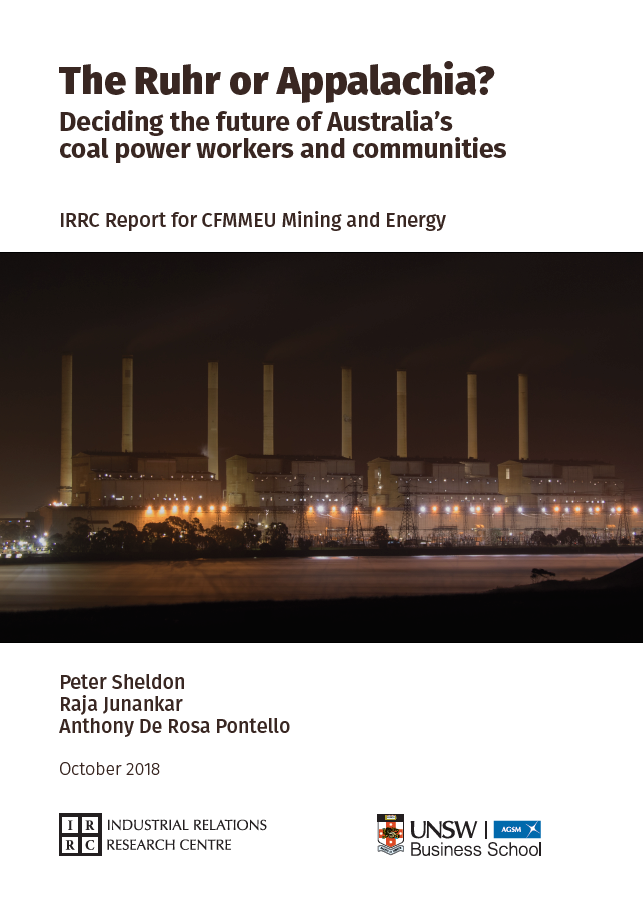
The Ruhr or Appalachia: Deciding the Future of Australia’s Coal Power Workers and Communities

By Peter Sheldon, Raja Junankar, and Anthony De Rosa Pontello - CFMMEU Mining and Energy, December 3, 2018

Australia’s coal-fired power stations will all close in the next two or three decades. We know this because the companies that operate the 23 power stations currently operating nation-wide have told us so.

Despite the empty rhetoric of some, it is unlikely that the economic case for investing in new coal-fired power stations in Australia will stack up. Those who currently own and operate coal power stations have no plans to build new ones.

The bad news is that the transition in how we produce power will bring great change to the workers and communities we have relied on to provide Australian homes and industry with reliable energy over many decades.

The good news is that we have the lead time to make smart decisions about what that change looks like—or at least, we now have the lead time after being caught unprepared by earlier closures, including Hazelwood in 2017.We have the choice to manage this structural economic change so that individuals, families and regions aren’t abandoned to unemployment, low-value jobs, poverty and associated health and social decline. Even better, we have the evidence about what works to deliver just transitions for coal power workers and communities, with skills, jobs, opportunities and hope for the future.

Communities grow around power stations and the mines that supply them. They are unique communities bonded in many cases by history, geography, difficult and dangerous working conditions and good unionised jobs. They are also uniquely vulnerable in their heavy dependence on the coal power industry.

This analysis of transitions in resource economies internationally and here in Australia provides valuable insights into the ingredients of success and the wide scope of outcomes.The Appalachian region in the United States is a heart-breaking story of industry transition characterised by short-term, reactive and fragmented responses to closures of coal mines, resulting in entrenched, intergenerational poverty and social dysfunction.

Compare this with the transition away from a heavy reliance on coal mining in Germany’s Ruhr region, where forward planning, investment in industry diversification, staggering of mine closures and a comprehensive package of just transition measures delivered a major reshaping of the regional economy with no forced job losses.

Central to these vastly different outcomes is the presence of a national, coordinated response. To this end, a major recommendation of this report is the establishment of a national, independent statutory authority to plan, coordinate and manage the transition.

In the energy debate to date, the impact of the transition on workers and communities has been almost completely ignored. This is an omission we can’t afford. After all, the costs of investing in a Just Transition need to be balanced against the costs of doing nothing and abandoning whole communities to a bleak future.

While global trends suggest that Australian export coal for steelmaking and energy production will be in demand for decades to come, coal-fired power generation in Australia is winding down. On the information available, there are no excuses for not taking action to protect the best interests of those affected.</p.

I thank Peter Sheldon and the team at UNSW Sydney’s Industrial Relations Research Centre for this important piece of work. I call on all power industry stakeholders to engage with its findings and consider how we can work together to deliver a Just Transition for coal power workers and communities.

Read the report (PDF).

Pages

The Fine Print I:

Disclaimer: The views expressed on this site are not the official position of the IWW (or even the IWW’s EUC) unless otherwise indicated and do not necessarily represent the views of anyone but the author’s, nor should it be assumed that any of these authors automatically support the IWW or endorse any of its positions.

Further: the inclusion of a link on our site (other than the link to the main IWW site) does not imply endorsement by or an alliance with the IWW. These sites have been chosen by our members due to their perceived relevance to the IWW EUC and are included here for informational purposes only. If you have any suggestions or comments on any of the links included (or not included) above, please contact us.

The Fine Print II:

Fair Use Notice: The material on this site is provided for educational and informational purposes. It may contain copyrighted material the use of which has not always been specifically authorized by the copyright owner. It is being made available in an effort to advance the understanding of scientific, environmental, economic, social justice and human rights issues etc.

It is believed that this constitutes a 'fair use' of any such copyrighted material as provided for in section 107 of the US Copyright Law. In accordance with Title 17 U.S.C. Section 107, the material on this site is distributed without profit to those who have an interest in using the included information for research and educational purposes. If you wish to use copyrighted material from this site for purposes of your own that go beyond 'fair use', you must obtain permission from the copyright owner. The information on this site does not constitute legal or technical advice.