You are here

green unionism

An Ecosocialist Path to Limiting Global Temperature Rise to 1.5°C

By Richard Smith - System Change not Climate Change, November 26, 2018

I. The IPCC Report “Global Warming of 1.5°C” and the imperative to immediately suppress fossil fuel production

The much-awaited report from the U.N.’s top climate science panel describes the enormous gap between where we are and where we need to be to prevent dangerous levels of global warming. The 2015 Paris climate accord committed industrial nations to reduce their emissions sufficiently to keep global temperatures within a 2°C rise over pre-industrial levels. In the final accord, highly vulnerable island nations and faith communities represented at the UN pressed the authors to include the 1.5°C limit as an aspirational target in the final draft of the accord with 2°C as the backup target.

Soaring GHG emissions over the past five years, rising atmospheric CO2 concentrations, ice-cap retreats, intensified storms, summer forest fires reaching even above the Arctic circle, and die-offs of the world’s coral reefs have all raised concerns about what even a little bit more warming would bring. Parts of the planet including the Arctic and many inland areas, have already warmed beyond 1.5°C. California is on fire most of the year. The worst hurricanes are twice as severe (more precipitation, slower passage, greater wind speeds) as they used to be. This is just a short start. Climate breakdown occurring much more quickly than expected is one reason why climate scientists now think that the goal just five years ago of limiting warming to 2°C  “increasingly seems disastrous in this context.”[2] The Paris pledges were never sufficient even to keep warming below 3°C let alone 2°C. Few of the signatories have even managed to meet the low bars they set for themselves and he world’s largest countries including China, the U.S., and Canada have us on track to a 4-5°C warming. As CO2 concentrations continue growing, preventing runaway warming is going to require ever deeper, truly draconian cuts in emissions, which will mean greater economic disruption. IPCC estimates already show us needing to achieve a near vertical drop in emissions in the early 2020s. Every day we delay getting off of fossil fuels increases the probability that we won’t be able to save ourselves.

The 2018 IPCC special report painted a stark portrait of how quickly the planet is heating up and called on governments to take immediate steps to suppress emissions:

If emissions continue at current rate, atmosphere will warm by as much as 2.7° Fahrenheit, or 1.5° Celsius, above preindustrial levels by between 2030 and 2052. Further, warming is more extreme further inland of large water bodies. [To keep temperatures from rising beyond 1.5° degrees] anthropogenic CO2 emissions [must] decline by about 45% worldwide from 2010 levels by 2030 . . . [This] would require rapid and far-reaching transitions in energy, land, urban and infrastructure (including transport and buildings), and industrial systems. . . . These systems transitions are unprecedented in terms of scale . . . and imply deep emissions reductions in all sectors, a wide portfolio of mitigation options and a significant upswing in those options.[3]

Preventing ecological collapse requires transforming the world economy at a speed and scale that “has no documented historic precedent.”[4] What would this take? Myles Allen, Oxford University climate scientist and an author of the report said, “It’s telling us we need to reverse emissions trends and turn the world economy on a dime.” To prevent 2.7 degrees of warming greenhouse emission must be reduced by 45 percent from 2010 levels by 2030, and by 100 percent by 2050. Use of coal as an electricity source would have to drop from 40 percent today to 1-7 percent by 2050.[5] Drew Shindell of Duke University, another author of the report said: “It would be an enormous challenge to keep warming below a threshold” of 1.5 degrees . . . What might that look like? In part, it would include things such as no more gas-powered vehicles, a phaseout of coal-fired power plants and airplanes running on biofuels,” he said. “It’s a drastic change,” he said. “These are huge, huge shifts . . . This would really be an unprecedented rate and magnitude of change.”[6] In response to the report, United Nations Secretary General António Guterres warned world leaders to “Do what the science demands before it’s too late.[7]

Protect the Sperrins From Pollution and Profit

By Derry IWW - (via facebook post), November 17, 2018

Earlier today members of the Industrial Workers of the World have taken a delegation of local activists to visit the Greencastle Peoples Office (GPO) in the heart of the Sperrin Mountains where the community continues to oppose the destruction of their environment by multinational Dalradian Gold Ltd.

Last week, several hundred people rallied at the site in solidarity and support with the ongoing campaign. The size of the demonstration clearly showed the extent of anger felt within the community and beyond at the activities of Dalradian Gold in the area. For the past number of years residents in the village of Greencastle, county Tyrone have continuously objected to any development of a gold-mining processing plant in the Sperrin Mountains due to the huge catastrophic impact which it will have on the environment and the health of people throughout the North West.

Following today’s visit, a spokesperson for the IWW said, “Today was a chance for activists to learn first-hand of what the Greencastle community are facing and have faced over the past number of years and the impact gold-mining will have on all of us. We wanted to show our solidarity with residents who have set up the GPO protest camp at the site of the proposed Dalradian Gold mine.

“Following on from today’s visit we would urge the wider trade union movement to acknowledge the destructive consequences of gold mining within a location such as the Sperrins, an area of outstanding natural beauty, as well as the impact it will have upon the lives and health of our communities throughout the entire North West for future generations.

(TUED Bulletin #78) Hothouse Politics? Struggles for Energy Democracy Heating Up

By staff - Trade Unions for Energy Democracy, October 2, 2018

Struggles around energy are proliferating globally. Working people, trade unions, communities and even some elected governments increasingly understand that the impacts of decisions about energy affect us all, and that there is an urgent need for bold, informed action to reclaim democratic control of energy resources, infrastructure and options.

Climate Action in a Climate of Job Insecurity

By Hazel Graham and Stephen Graham - The Ecologist, November 19, 2018

The seriousness of our environmental plight comes more clearly into view with each passing news cycle. The Canadian glaciers are melting faster than we forecast. Humanity has wiped out 60 percent of animal populations since 1970.
Only 12 years remain to act if we are to keep the global average temperature rise below 1.5C as required – yet global action on climate change consistently falls far short of what is needed. The ecological rifts opening up are legion.

From climate change to biodiversity loss, nitrogen cycle disruption to ocean acidification, the realisation that we are at – or will soon be reaching – points of no return has dominated headlines in recent months.

Capitalism is the Climate Crisis; Our Hope is Each Other

By Patrick O’Donoghue -  First of May Anarchist Alliance, November 6, 2018

The results are in: The planet is getting strangled and we’re running out of time.

The latest report of the Intergovernmental Panel on Climate Change, a normally conservative and cautious body, warns that on our current trajectory the world is set to warm by a global average of 1.5 degrees Celsius (2.7 Fahrenheit) by 2040, and that carbon emissions need to be cut in half by 2030 and go carbon neutral by 2050 if we want to avoid worse warming. Even with these changes, we are staring down the barrel of climate chaos– sea level rise, droughts, and severe weather are set to disrupt agriculture and the economy on a global scale, forcing the immense displacement of people and bringing with it conflict over resources and borders. These effects of warming are already hitting us, and are only set to get worse without a thorough restructuring not just of our energy system, but of our economy.  

From where we stand now, this seems almost impossible, after decades of inaction by politicians, financed by fossil fuel companies that knew full well the truth about climate change years before it became public knowledge. The 2015 Paris Climate Accords saw the world’s powers agree to reduce emissions enough to limit the warming to 2 degrees Celsius, none of the signatories of that treaty are currently on track to reduce their emissions to the agreed levels. Carbon in the atmosphere is over 400 parts per million, up from 280 parts per million at the dawn of the industrial revolution, and well over the 350 parts per million that NASA climatologist James Hansen has described as the safe upper operating limit for the climate.

The report confirms once more what we’ve known for decades– that our current relationship with the planet we live on is unsustainable, and that without an immense restructuring of society, we will see the unraveling and degradation of the ecosystems that sustain our life. We should be dead clear here that this is a political, economic issue, and not simply “humanity” or “civilization”. It’s capitalism.

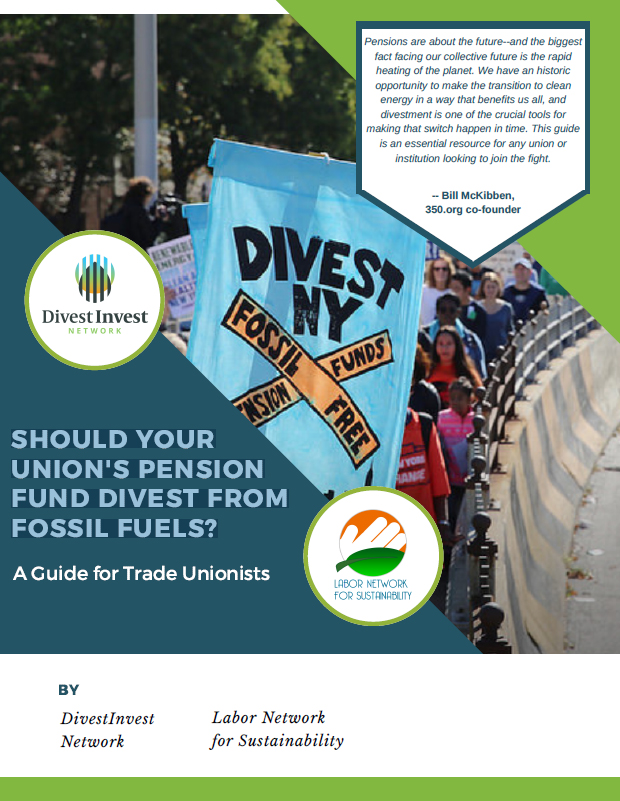
Should Your Union’s Pension Fund Divest from Fossil Fuels?

By staff - Labor Network for Sustainability, November 2018

This guide is designed to help you and your union consider whether you should divest from fossil fuels.
Working people collectively own an enormous amount of capital in our pensions. As a sector, pensions are the largest source of investment in financial holdings, even larger than standard investment houses and banks! Pensions constitute over $40 trillion! Our pension funds are invested in stocks and bonds that may not be serving our interests as working people and may be harming our families’ futures. Imagine what we might be able to support and build, imagine the great jobs we could create, if we use more of our pension funds to directly benefit our members and our families.

The Guide Contains:

  • An introduction to pension fund divestment and links to further information about it
  • Whether failure to divest can constitute a failure in fiduciary responsibility
  • How you can respond to divestment proposals and what questions need to be answered to reach a decision
  • How to start a divestment campaign yourself and answers to questions you may encounter from union members and divestment opponents

Download and Read the PDF Here.

Working Together for a Just Transition

By David Powell, Alfie Stirling and Sara Mahmoud - New Economics Foundation, November 2018

This short pamphlet has been produced to launch the New Economics Foundation’s new programme of work on the 'just transition'. Our interest is in the practicality of change: the policies, processes, narrative and investment needed to accelerate the UK’s progress on 'just transition', here and now. Over the coming months and years we will be working at local and national levels to explore what is needed to build common cause and provide the right mixture of incentives and critical challenge to all parties to help unlock a new momentum for a 'just transition' for the UK.

It has been produced in association with the Friedrich-Ebert-Stiftung’s London Office, part of the international network of FES. The London office was established in 1988 to promote better understanding of British- German relations. FES's work in the United Kingdom focuses in particular on the exchange of ideas and discussion on the following topics: common challenges facing Germany, the United Kingdom and the European Union; economic and social policy; experiences gained from differing regional and local policies and practices; and a continuing dialogue between politicians as well as between the trade unions in both countries.

Read the report (PDF).

Pages

The Fine Print I:

Disclaimer: The views expressed on this site are not the official position of the IWW (or even the IWW’s EUC) unless otherwise indicated and do not necessarily represent the views of anyone but the author’s, nor should it be assumed that any of these authors automatically support the IWW or endorse any of its positions.

Further: the inclusion of a link on our site (other than the link to the main IWW site) does not imply endorsement by or an alliance with the IWW. These sites have been chosen by our members due to their perceived relevance to the IWW EUC and are included here for informational purposes only. If you have any suggestions or comments on any of the links included (or not included) above, please contact us.

The Fine Print II:

Fair Use Notice: The material on this site is provided for educational and informational purposes. It may contain copyrighted material the use of which has not always been specifically authorized by the copyright owner. It is being made available in an effort to advance the understanding of scientific, environmental, economic, social justice and human rights issues etc.

It is believed that this constitutes a 'fair use' of any such copyrighted material as provided for in section 107 of the US Copyright Law. In accordance with Title 17 U.S.C. Section 107, the material on this site is distributed without profit to those who have an interest in using the included information for research and educational purposes. If you wish to use copyrighted material from this site for purposes of your own that go beyond 'fair use', you must obtain permission from the copyright owner. The information on this site does not constitute legal or technical advice.

