By Ella Gilbert MSc - Mashable, February 23, 2016
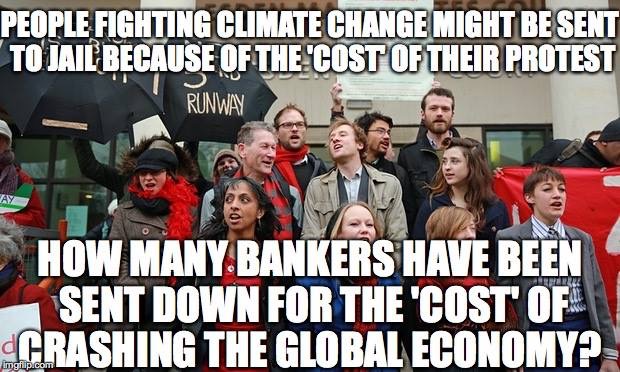 Editors Note: Ella Gilbert MSc (as well as several other members of the #Heathrow13) are dues paying members of the IWW. for more details about the struggle, please visit Plane Stupid.
Update from the Guardian:
Six women and seven men have avoided jail for trespassing at Heathrow, following a protest against the possible expansion of the airport.
The activists, dubbed the Heathrow 13, were given sentences of six weeks suspended for 12 months, meaning they would not have to go to prison immediately.
They had been found guilty in January of aggravated trespass and entering a security-restricted area of an aerodrome. They had been warned by district judge Deborah Wright to expect a custodial sentence.
Read more...
For more on the sentencing of the Heathrow 13, see also:
- Climate Protesters Avoid Jail - By Melanie Mattauch, Ecowatch, February 25, 2016
- #Heathrow13 to continue climate fight following court ruling - By Joanna Peasland, Climate Change News, February 25, 2016
- #Heathrow13: the systemic violence of climate change - By Ali Tamlit, The Ecologist, February 25, 2016
- Heathrow 13 avoid jail term following Plane Stupid runway climate change protest - By Ewan Palmer, International Business Times, February 24, 2016
- The noble cause of the Heathrow 13 - By John McDonnell MP, The Ecologist, February 24, 2016
- The Heathrow 13 are the only role models that count for my generation - By Anna Wild, New Internationalist, February 23, 2016
- Heathrow 13: The UK’s first climate prisoners? - By Melanie Mattauch, 350.org, February 23, 2016
- Jailing the #Heathrow13 for Protecting the Climate is a “Redline” - By Andy Rowell, Oil Change International, February 23, 2016
- The Heathrow 13: the resistance against a third runway - By Ali Tamlit, ROARmag, February 22, 2016
- 13 climate criminals who should be in jail - By Tom Walker, Red Pepper, February 23, 2016
LONDON — Today I’ve been packing my bag for prison.
That sentence never gets less weird. It’s a task that most people will never have to do, or even think about doing, so it’s been a learning curve. Take this for example: you can’t take black clothes into prison. This is a serious problem for someone whose entire wardrobe is black.
If you’re wondering why I’m having to do this, here’s why: on Wednesday, myself and 12 others from direct action network Plane Stupid will be sentenced to “almost inevitable” (in the words of the judge) custodial sentences for our part in a direct action that happened last year.
In July, the #Heathrow13 occupied one of Heathrow’s runways for six hours: the longest airport occupation in the UK to date, and the most high profile. We managed to stop 25 planes and in so doing prevented the emission of hundreds, if not thousands, of tonnes of greenhouse gases into the atmosphere.
Aircraft are hugely polluting machines. They spew out air pollutants like particulate matter and nitrogen oxides that cause serious health effects for wildlife and for people living in the local area, as well as climate-damaging greenhouse gases. I’m sure I don’t need to explain that greenhouse gases cause climate change by trapping heat in the atmosphere, causing temperatures to rise and altering the way the climate functions. Carbon dioxide is the most obvious of these warming gases, but many others are also emitted by plane exhausts, such as oxides of nitrogen, which trigger the formation of ozone when emitted at altitude, and water vapour. All of these have a significant warming effect, especially when emitted at aircraft cruising altitude, several kilometres above the ground.
One of the major problems with aviation is that it cannot really be decarbonised. It takes a lot of energy to fly a heavy metal object full of people at hundreds of miles an hour across the world. Unfortunately, the technology is not yet there to allow planes to fly using hydrogen or electric fuel cells, which means that for now at least, jet fuel is very much fossil fuel based. Although efficiency improvements can reduce some of its impact, demand for aviation is enormous and any efficiency improvements are vastly outstripped by the rapid growth in passenger volumes. Many airlines, incl. United, are experimenting with biofuel blends as a possible transition fuel of sorts. But most biofuels are no better for the climate than oil. It’s not a serious solution.
What this means is that aviation is still a heavily polluting industry and will probably continue to be so for many years to come. However, action needs to be taken to combat climate change – something recognised in law by the UK’s 2008 Climate Change Act. This stipulates that UK emissions must be reduced by 80% from 2005 levels before 2050. That’s a big cut, but it might be possible if every sector in the UK economy makes aggressive and sustained reductions in their emissions.
However, aviation is being given something of a free ride – a proposed third runway at Heathrow, which would emit another 9 million tonnes or so of CO2 per year (emissions on a par with the whole of Kenya). We cannot build new runways if we are to prevent climate change –- and doing so undermines all of our other efforts to reduce emissions across the board.






 Back in the fall of 2008, in the face of yet another horrendous and preventable catastrophic train wreck, the US Congress passed the Railroad Safety Improvement Act (RSIA). Among its many provisions, it mandated that the railroad carriers implement Positive Train Control (PTC), a technology that ensures train separation and can enforce safety despite possible mistakes and/or oversights by the train’s operating crew. The deadline for its installation was set for December 31, 2015, allowing the carriers more than seven years within which to comply. With that deadline looming, and most carriers not even close to implementation, on October 27th, 2015, Congress passed legislation that allows the railroads another three years (and now it looks more like five) to meet the new deadline.
 The transition from fossil fuels to sustainable energy sources is discussed primarily through an environmental lens--and for good reason. With the rapid depletion of planetary resources and the growing frequency of extreme weather events, it has become increasingly clear that capitalist forms of fossil-fuel extraction will continue to ignore the world's natural limits--even to the point of obliterating the possibility of life on earth.
 The following news items feature issues, discussions, campaigns, or information potentially relevant to green unionists:
 It is no secret that global trade is going through a major transformation. The EU-US TTIP agreement under consideration has been compared in scale by negotiators to the European internal market, while Hillary Clinton has
  Energy Justice Network is on the cutting edge of fighting fracking and related infrastructure in the northeast.
 A note from Jeanne Halpern, Louis Prisco’s long-time domestic partner: Louis and I met at the Hike Leaders’ Bash, the annual hike and potluck for hike leaders on Mt. Tam, in 1993. One thing people don’t realize is how much the Sierra Club brings people with like interests together. When we led the Valentine Lovers’ Hike the first time — which we’d expected would attract people who wanted to fall in love! — we stopped at the log where Louis and I had met. There we reenacted our meeting and then asked the thirty-one hikers to tell a little about themselves, maybe what attracted them to our hike. And we were amazed that almost all of them were couples who’d previously met on Sierra Club hikes! (The odd number was because Guy Mayes’ wife Nancy was home sick.) And I later learned that several couples had met on the Sierra Club hike I used to lead to movie filming sites in S.F. There, they had two things in common, a love of hiking AND of movies. The romance of the Sierra Club is not to be underestimated, but usually is.
 Oil production in North America has skyrocketed in the past five years, with industries using increasingly dangerous and desperate technologies to extract fossil fuels from the ground. Particularly in the Bakken Shale region of North Dakota, the cheapest way for companies to move oil to profitable markets is to load it onto trains and send it to the coast, where refineries and export terminals can transform it into fuel and transport it to wherever they can find the best price. With increasing oil production comes increasing oil train transport – and a mind-boggling increase in oil train accidents. When train cars carrying crude oil derail or hit something, they often puncture; when they do, a slight spark can set off a fiery explosion that turns the train car into a bomb.
 The following news items feature issues, discussions, campaigns, or information potentially relevant to green unionists:
 The #Heathrow13 will ‘almost inevitably’ be sent to prison on 24 February for occupying the northern runway of Heathrow airport. They took this action, which led to 25 flights being cancelled, to protest against the building of a third runway at Heathrow airport, as recommended by the Davis Commission less than a fortnight previously. The fact is, we can't build any new runways in the face of climate change. It's that simple.
 This site is not the official webpage of the Industrial Workers of the World.