

You are here

green unionism

Kill King Capital

By Paul Street - CounterPunch, February 9, 2016

“If you’re going to shoot the king, don’t miss,” Niccolò Machiavelli wrote in The Prince (1505). “The injury that is to be done,” Machiavelli added, “ought to be of such a kind that one does not stand in fear of revenge.”

Ralph Waldo Emerson wrote something similar in his journal in September of 1843: “Never strike a king unless you are sure you shall kill him.”

I first ran across a version of this sentiment many years ago (exactly where I do not recall) while I was researching some U.S. Black and labor history.[1] As I recall it was more class-specific, something along these lines: “if a peasant takes up arms against the king, he’d better well kill him.” The idea was that a high noble might be able to get away with challenging the king but a peasant certainly could not. If peasants and artisans were going to rebel, they’d better make a full revolution of it.

“No Desire to Get Rid of the Profit Motive”

Nowadays I think the aphorism applies to capital and the capitalist class. Take Bernie Sanders. He has called himself a “democratic socialist” and campaigns against “the billionaire class,” drawing large and approving crowds. He has taken more than a few at least rhetorical shots at the king, which in the U.S. is big capitalist and corporate-financial power – what Edward S. Herman and David Peterson have called the “the unelected dictatorship of money.”

In reality, however, Sanders, for all his sloganeering about “revolution,” has not remotely proposed that we figure out how to kill the king of capitalism. Sanders is at most a social democratically inclined New Deal liberal. His vision for America is one in which commanding heights economic decisions and ownership remain firmly in private, profit-taking hands while the government intervenes to a limited extent with the purpose of partially regulating some business activities and distributing income and wealth and social benefits in a more egalitarian and humane – less neoliberal – way. And as Bill Blum recently argued:

“Social democrats and democratic socialists [like Bernie Sanders] have no desire to get rid of the profit motive. Last November, Sanders gave a speech at Georgetown University in Washington about his positive view of democratic socialism, including its place in the policies of presidents Franklin D. Roosevelt and Lyndon B. Johnson. In defining what democratic socialism means to him, Sanders said: ‘I don’t believe government should take over the grocery store down the street or own the means of production.’”

“I personally could live with the neighborhood grocery store remaining in private hands, but larger institutions are always a threat; the larger and richer they are the more tempting and easier it is for them to put profit ahead of the public’s welfare, and to purchase politicians. The question of socialism is inseparable from the question of public ownership of the means of production. The question thus facing ‘socialists’ like Sanders is this: When all your idealistic visions for a more humane, more just, more equitable, and more rational society run head-first into the stone wall of the profit motive … which of the two gives way?” (William Blum, “Is Bernie Sanders a Socialist?”)

Answer: the profit motive. The “private sector” (I use quote markets because Big Business draws heavily on public subsidy and protection while wreaking monumental and multi-dimensional havoc on public experience) still rules under Bernie’s recommended “political revolution.” He can call himself a socialist but he says nothing about the need for a social revolution to expropriate the expropriators and remove the masters of wealth and property from the disastrous private ownership and control of economy, society, politics, and culture – from private/corporate ownership and control of the means of production, finance, distribution, and communication.

The vast global U.S. military Empire – intimately bound up with American capitalist class power at home and abroad – also continues under Sanders’ “revolution.” He doesn’t even take rhetorical shots at King Capital’s evil twin imperialism. Sanders is strikingly mute on the Pentagon system, no small silence given the devastatingly destructive impact of the nation’s giant military industrial complex on social and environmental well-being within and beyond the U.S. “homeland.”

BCGEU signs solidarity accord with First Nations against Northern Gateway pipeline

By Alyse Kotyk - Rabble.Ca, February 9, 2016

The B.C. Government and Service Employees' Union (BCGEU) has signed a solidarity accord with Indigenous nations opposing pipelines in their territories.

The accord affirms the Save the Fraser Declaration, an Indigenous law signed by representatives of over 100 First Nations that states it "will not allow the proposed Enbridge Northern Gateway Pipelines, or similar Tar Sands projects, to cross [Indigenous] lands, territories and watersheds, or the ocean migration routes of Fraser River salmon."

Last month, the B.C. Supreme Court ruled that the provincial government had failed in its duty to consult with Indigenous groups on the Northern Gateway pipeline.

"We agree with the recent ruling of the B.C. Supreme Court that the Province has not met its duty to consult with First Nations on Enbridge's Northern Gateway," said Paul Finch, BCGEU Treasurer in a statement. "We are proud to support the Save the Fraser Declaration, which demonstrates the resolve of First Nations in refusing consent for Northern Gateway."

The BCGEU has 65,000 members, many of whom work directly with the government. This significant number joins other labour unions including Unifor and the B.C. Teachers' Federation as well as businesses, environmental groups and community groups.

"BCGEU's endorsement of the Save the Fraser Declaration is indicative that more and more Canadians are committing to respect the laws and authority of First Nations and their efforts to protect the environment, fishers and the health and safety of all B.C. communities from Enbridge's Northern Gateway and other tar sands projects," said Grand Chief Stewart Phillip, President of the Union of B.C. Indian Chiefs.

The proposed Northern Gateway pipeline is a multi-billion dollar project that involves a new twin pipeline system for export of bitumen, running from near Edmonton, Alberta, to Kitimat B.C.

"Premier Clark and Prime Minister Trudeau be advised: the proposed Enbridge Northern Gateway is dead, dead, dead," said Phillip. "We call on you to stand with us, and to work with us to come up with alternatives for real change."

We have the power to change the history!

By the Organizing Committee of March 11 Anti-NPP Fukushima Action in 2016 - January 1, 2016

Doro-Chiba Union calls for endorsement of and participation in Anti-Nuclear Power Plant Fukushima Action on March 11, 2016:

We have the power to change the history! This is the slogan of the Anti-Nuclear Power Plant Fukushima Action on March 11, 2016.

Against the legislation to exercise the right to collective self-defense more than 100 thousand of people filled the square in front of the Diet day after day. Since this mass uprising last autumn a rising tide of the struggle by millions workers, students and other people, has broadened deeply all over the country and around the world.

The struggle of the fifth anniversary of the Earthquake and nuclear reactor meltdowns on March 11th in Fukushima will be fought headed by the unions which have been waging strikes, with Fukushima people’s widespread anger, calling “down with Abe administration which promotes war bills and wages restarting of nuclear power plants”.

Please endorse and participate in this action from all over the country and around the world.

Rebuilding Radical Unionism: An Organiser’s Notes

By an Anonymous Organiser - Novara, January 31, 2016

Britain is one of the wealthiest countries in the world. Still, a substantial minority of the workforce works for less than what it takes to get by. A much larger part of the workforce gets by in a haze of exhaustion, alienation and frustration, with little recourse. For the unemployed, disabled, ill or precariously employed, the sorrows of work are replaced or compounded by the malicious bureaucratic violence of the Department for Work and Pensions. For the retired, pensions are among the worst in the developed world and social care is a disgrace.

Chronic low expectations, low levels of worker solidarity and enfeebled official union structures – all the consequences of very deliberate legislative and executive action by successive governments – make it difficult to see a way out.

Still, a functional, scaleable, radical, rooted trade unionism capable of transcending bureaucratic hindrance and legal repression is a necessary starting point for a freer, more democratic, more equitable society.

With looming, sweeping automation threatening the movement’s last vestiges of strength in the industrial sectors – on the railways, and in some parts of distribution – the task of building this trade unionism is urgent.

Extensive automation achieved purely on the terms of capital will eradicate what’s left of the unionised working class, hastening the arrival of a purgatorial post-democracy. The absence of any industrial organisation with any means of obstructing the means of production and distribution in moments of conflict will lead to the total exclusion of the working class from civil society and political discourse. Protests and mobilisations are one thing – good unions secure and enforce the gains of the class in a permanent, scaleable way.

To unpack some of the obstacles to this work in the UK today, we need to approach this from the workplace and national level. We need to interrogate which demands, tactics and strategies could – just could – begin to rebuild the political and industrial power of workers and the economically excluded. And such interrogation is a matter of urgency: the Conservatives’ trade union bill – a bill that will make useful trade unionism close to impossible within the law – looks set to pass through parliament with little more than a whimper of labour movement opposition.

Inspiring Fossil Fuel Resistance Action In Northeast Pennsylvania

By Ted Glick - Ted Glick's Blog, February 8, 2016

Northeast PA – Very possibly as early as tomorrow, chain-saw-armed tree cutters hired by Williams Partners, a powerful pipeline-building corporation for the gas and oil industry, will try to cut down sugar maple trees on the property of Maryann Zeffer, Cathy and Megan Holleran and their family. For 65 years they have lived on this land, and for the last ten or so they have been producing delicious, pure, Pennsylvania maple syrup from those trees.

This destruction won’t happen without a big fight. Nine days ago as I write, after FERC gave approval to Williams’ request to start tree cutting in Pa. even though Williams does not have all of the necessary approvals to build their Pa. to NY Constitution pipeline, an encampment was set up on the Zeffer/Holleran land. Every day since people have been there.

The press has been there too. TV stations in Binghamton, NY and Scranton, Pa. have done stories on this epic David vs. Goliath battle, though this one is more like strong women Davidas vs. Goliath.

I spent a very cold but inspiring day yesterday with Maryann, Cathy and Megan and about 30 other people there for some part of the day, including fracktivist heroine Vera Scoggins, who I had never met before. One of the rewarding things about a life of for-the-people activism and organizing is the wonderful people you are always meeting and getting to know.

Yesterday it looked like Williams’ tree cutters might not be getting to the Zeffer/Holleran land for a while; they had started just the day before, a number of miles away. However, just today, another crew started cutting a little more than a mile away, and the locals sent out an alert calling upon as many people as possible to show up today if possible but tomorrow for sure. They expect the confrontation to take place within 48 hours at most.

People who can get to the site should do so right away. You don’t need to be prepared to risk arrest to do so; the more people there to watch and observe and take pictures and spread the word the better.

You do need a car. Here’s the information you need, from the “Stop the Constitution Pipeline in Pa” site on Facebook:
The Holleran property is located at 2131 Three Lakes Road, New Milford, PA, but use these coordinates to find where people are gathered to stop the tree cutting: 41.8272387, -75.7585062

Bridgeport Residents Release Balloon Banner at City Hall: “Fracked Gas is Environmental Racism”

By Dan Fischer, et. al. - Capitalism vs the Climate, February 2, 2016

Bridgeport, CT—PSEG expected to celebrate on Monday night as Bridgeport’s city council voted to endorse the company’s plan to replace its Bridgeport Harbor coal-fired power plant with a new fracked gas plant in 2021. Some environmentalists had even signed onto the agreement. To PSEG, it looked like local criticism would finally be silenced, that the company could maintain a “green” image while continuing to pollute one of Connecticut’s most vulnerable communities.

The corporate polluters must have been disappointed, then, when a group of Bridgeport residents and teachers, some of them members of Capitalism vs. the Climate, flooded a short public hearing preceding the city council session with a barrage of comments opposing the proposed fracked gas plant. As 10 year-old Jaysa Mellers spoke out against the proposal, with the words “no coal, no gas, go green!”, a Bridgeport-based member of Capitalism vs. the Climate released a banner tied to a bundle of balloons. The banner floated to the high ceiling, and city councillors and residents read its message: “Fracked gas is environmental racism! No coal, no gas!”

“Environmental racism is when an unfair share of pollution is placed on communities of color and low-income neighborhoods. That’s what is happening in Bridgeport. PSEG is making it worse by trying to open a new gas plant, which would continue to release pollution in the air for decades,” said Gabriela Rodriguez, a nineteen year-old Bridgeport resident and a member of Capitalism vs. the Climate.

If labour really wants to break the wealthy's grip on society, it should fight car culture

By Yves Engler - Rabble.Ca, February 4, 2016

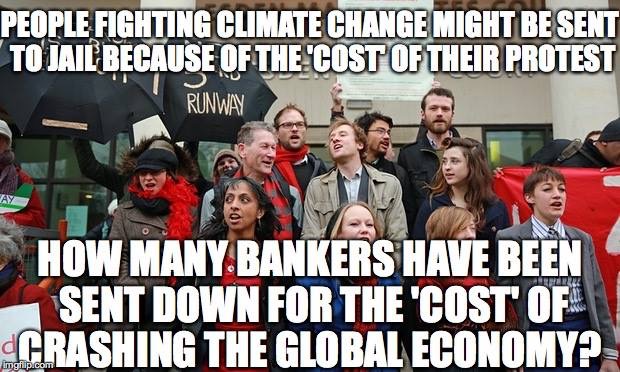
At their finest labour unions are class-conscious organizations that check the corporate elite's influence over public policy. But, even the best Canadian unions have largely failed to provide an alternative vision to the existing system and challenge the power of big business over important areas of our lives. 
Alongside collective-bargaining activities, unions have spearheaded efforts to expand the Canadian Pension Plan and Employment Insurance coverage, to raise minimum wages and to improve labour laws. While these campaigns have directly benefited all workers, unions have also been heavily involved in fights for Medicare and public daycare, programs that serve a wider interest than just people who work for a living.

Over the past few decades most unions have devoted resources to combating sexism, racism and homophobia. They have done so out of a sense of solidarity and an understanding, built upon internal union struggles, that these forms of oppression take their toll on many members and society in general.

But unfortunately unions have generally deferred to the business class regarding much of the social, cultural and even economic sphere. Advertising provides a striking example of this implicit class compromise. On a typical day most people come across hundreds of ads, which greatly influence their consumption habits and social outlook.

Additionally, a media sphere funded through advertising gives corporations significant leverage over the news agenda (companies regularly pull or threaten to pull ads when they are unhappy about a story and simply refuse to advertise in leftist media outlets). Yet most unions have little to say about this expression of capitalist power or the particularly acute psychological burden advertising places on low-income people.

Few (if any) unions have called for blanket restrictions on destructive corporate advertising. In fact, some unions representing media workers have called for more advertising. In response to layoffs at the Toronto Star two years ago, a union representative was quoted in a release saying, "Why cut ad staff when the thing we need most is more ads?"

In another example of how unions concede much of the social, cultural and economic arena to big business, they have given a free pass to the private automobile even though orienting our living spaces around cars is particularly damaging to working-class interests.

As the least accessible and most expensive form of land transportation, car-dominated transport eats up a disproportionate amount of working-class income. Rather than promoting cars, unions should be promoting access to employment, lodging and goods by foot, bike or mass transit as this would greatly benefit lower income people, as well as society in general.

But why not "cars for all" some might ask. One important answer is the environment. A transportation system based on the private automobile is simply not sustainable. Preventing global warming requires drastically reducing the number of cars.

But even aside from the critical environmental question cars are bad for ordinary people.

Why we need unions! #HeartUnions

By Admin - A Green Trade unionist in Bristol, February 3, 2016

We are often told that unions have become irrelevant to modern society, or worse that they are in some way negative.
No institution is perfect, but trade unions do amazing work standing up for their members in the workplace and increasingly in the community (see for example the role unions played locally in helping block the environmentally and medically damaging biomass facility in Avonmouth).  Many of us are given negative perceptions of trade unions because of how they are portrayed in the press (usually only ever mentioned if they’ve been forced into industrial action and then only described as militants needlessly causing trouble) and the legacy of the 1970s.

People who are against unions often argue that in the past ‘over mighty union barons’ ‘held the country to ransom’ and would strike ‘at the drop of a hat’. There may be some small germs of truth in this, but this is a gross exaggeration and is in part the result of attempts to undermine the legitimacy of unions and collective action.  Even if this had been the case the situation in modern Britain is so far removed it makes such comparison meaningless.

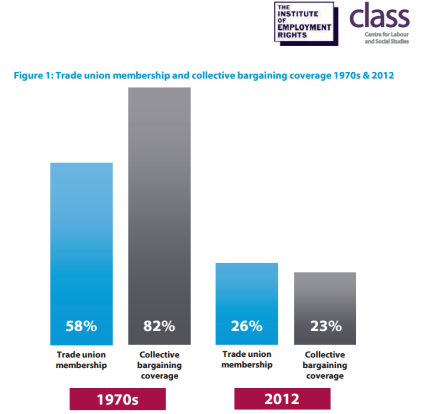
Today union membership is at a historic low (though it has moderately increased in recent years), as is the power and influence of unions in our society.  They’re even marginalised in the Labour party these days (though this could change under Corbyn).  We already have some of the most restrictive trade union laws in the ‘democratic’ world which are about to get even more restrictive with the governments draconian new strike legislation, making union action very difficult.  Furthermore, no worker ever takes the decision to strike and lose pay lightly (especially with the financial hardship of recent years), and with unions so comparatively weak and increasingly defensive the situation has to be pretty bad before they feel forced to resort to striking.

EcoUnionist News #90

Compiled by x344543 - IWW Environmental Unionism Caucus, February 9, 2016

The following news items feature issues, discussions, campaigns, or information potentially relevant to green unionists:

Lead Stories:

Ongoing Mobilizations:

The Thin Green Line:

Just Transition:

Bread and Roses:

An Injury to One is an Injury to All:

Greenwashers:

EcoUnionist News #89

Compiled by x344543 - IWW Environmental Unionism Caucus, February 2, 2016

The following news items feature issues, discussions, campaigns, or information potentially relevant to green unionists:

Lead Stories:

Ongoing Mobilizations:

The Thin Green Line:

Bread and Roses:

An Injury to One is an Injury to All:

Whistleblowers:

Greenwashers:

Pages

The Fine Print I:

Disclaimer: The views expressed on this site are not the official position of the IWW (or even the IWW’s EUC) unless otherwise indicated and do not necessarily represent the views of anyone but the author’s, nor should it be assumed that any of these authors automatically support the IWW or endorse any of its positions.

Further: the inclusion of a link on our site (other than the link to the main IWW site) does not imply endorsement by or an alliance with the IWW. These sites have been chosen by our members due to their perceived relevance to the IWW EUC and are included here for informational purposes only. If you have any suggestions or comments on any of the links included (or not included) above, please contact us.

The Fine Print II:

Fair Use Notice: The material on this site is provided for educational and informational purposes. It may contain copyrighted material the use of which has not always been specifically authorized by the copyright owner. It is being made available in an effort to advance the understanding of scientific, environmental, economic, social justice and human rights issues etc.

It is believed that this constitutes a 'fair use' of any such copyrighted material as provided for in section 107 of the US Copyright Law. In accordance with Title 17 U.S.C. Section 107, the material on this site is distributed without profit to those who have an interest in using the included information for research and educational purposes. If you wish to use copyrighted material from this site for purposes of your own that go beyond 'fair use', you must obtain permission from the copyright owner. The information on this site does not constitute legal or technical advice.
