You are here

green unionism

#ClimateChange and the fight for #ClimateJobs

By the Admin - A Green Trade Unionist in Bristol, December 1, 2015

Author's Note: This is a talk I prepared for a NEON (the New Economy Organising Network) event to prepare for Bristol Climate March:

Climate change as we know is the most serious long-term challenge facing both our society, and our planet in general.  We are on the verge of reaching the point of no return, the tipping point beyond which catastrophic warming of the planet will be unavoidable, and the habitability of our world serverely undermined.

But as well as a challenge of almost unimaginable horror, climate change is also an opportunity.  As Naomi Klein has recently persuasively argued Climate Change can provide movements for social and environmental justice with a ‘collective lens’, a shared conceptual framework, sense of purpose and set of arguments for moving beyond the extreme Free-Market Capitalism (conventionally labelled NeoLiberalism) that is so impoverishing both our planet and our communities.

For decades the arguments of the alter-globalisation movement – that Free Market fundamentalism was causing spiralling inequality and social stratification – have fallen on death ears.  We now know those exact same policies have greatly exacerbated our excessive consumption of resources and our output of greenhouse gases, endangering life as we know it.

It also presents an opportunity in terms practice solutions it requires.  I don’t want to understand the scale of the problem and the response it needs.  To do our part in preventing catastrophic climate change the few decades we have left to actually do something about it, we need to rapidly transition to a zero-carbon economy.  Tinkering around the edges with carbon trading, taxes and offsetting just won’t cut it.

The amount of carbon already in the atmosphere means that even if we stopped polluting tomorrow we’ve still locked in considerable warming, we have to act now to prevent temperature rises above 2 degrees (which would have extreme consequences across the world).

We need to cut CO2 emissions by around 75-80%.
We can achieve this if we cut our energy usage by half (very achievable with an aggressive program of energy efficiency and home insulation – Britain has the worst insulated homes in Europe, which contribute to an estimated 20,000 death every winter, as well as huge amounts of wasted energy) and supply at least half of that energy from renewable sources.

This will mean the end of many jobs in polluting and fossil fuel dependent industries (an estimated 350,000).  But it will also require millions of new jobs in building new infrastructure, renewable energy, home insulation, public transport and energy efficiency.  The Campaign Against Climate Change, have created a rough blueprint laying out how this might happen.  They estimate that nationally we need to create 1 Million Climate Jobs to do all this work.

What kind of "just transition"?

By Michael Ware - Socialist Worker, December 1, 2015

The climate justice movement knows what it is against, but what are we fighting for? Michael Ware, of System Change Not Climate Change, has some answers:

EVERYONE BUT a few Republican crackpots now acknowledge that the planet faces a climate emergency. But the bosses at ExxonMobil had a bit of a head start.

A company memo was unearthed this year showing that the oil giant knew since 1977 from its own scientists that burning fossil fuels contributed to global warming. But the findings were hidden, and Exxon continued to be climate change deniers for decades to come.

This revelation speaks volumes about how short-term profits trump everything under capitalism, even human survival. Exxon's research pointed toward what we are living through today: increased temperatures globally, drought, mass flooding, more intense hurricanes, crop failures, extinctions, melting polar regions, rising sea levels, ocean acidification, water scarcity, and on and on.

Already, climate change causes 300,000 to 400,000 deaths per year, mostly in the Global South, according to a study conducted on behalf of the UN several years ago.

In order to keep the increase in global temperatures under 1.5 degrees Celsius by mid-century and avoid catastrophic environmental changes, greenhouse gas emissions must be reduced by 5-10 percent each year. Already, the global temperature increase has been almost 1 degree Celsius.

The emergence of a green capitalism sector, increased energy efficiencies and limited expansion of renewable energy have done little to bring down the estimates of average temperature increases. Without a radical change of course, the increase will be between 4 and 6 degrees Celsius by the end of the century.

Clearly, just educating politicians and business leaders about the threat isn't enough. We need movements and protests strong enough to force big changes in the way humans produce and consume energy.

The urgency around halting climate change creates a unique political dynamic. The need for social change is always urgently felt by the oppressed, but for the first time, we have an environmental timer showing that the huge task of transitioning to a sustainable world must take place in this century, or humanity will face the consequences of an inhospitable planet.

Fighting for this kind of change will necessarily threaten capitalism. Yet it's hard for most people to envision a world without corporations, car culture, oil wars, oppression and a market for everything, including pollution.

Former inspectors allege safety issues with Spectra pipeline project

By Steve Ahlquist - RI Future, November 30, 2015

Two safety inspectors who worked on Spectra Energy’s proposed methane gas pipeline that will cut through Burrillville, RI, say the company cut corners when it came to project, worker and environmental safety.

“Right now, what they’re hoping to do, is they’re hoping to slam all this through, and then at the end ask for forgiveness,” said one of the former inspectors. “Oops, sorry about that, I didn’t know, let me write you a check. Because once this thing’s turning meter, they’re going to be making millions of dollars a day. It doesn’t matter what your problems are…”

The other added, “We were told to shut the fuck up or quit.”

Both men, who spoke on the condition of anonymity, were subcontracted by Spectra and both were terminated from the project this summer. I was introduced to them through FANG (Fighting Against Natural Gas), an environmental group that opposes the project, and have spent time talking with both men by phone as well as reviewing audio interviews and emails provided by FANG.

“Like every other company, Spectra gives a tremendous presentation about their commitment to safety, but their actions lack any kind of resolve. No one ever says, ‘Safety’s #2 here,’” said the first inspector. “At every turn when I made a safety suggestion, I was met with monumental resistance from the company on every level.”

Perhaps suspecting their days are numbered, fossil fuel companies are rushing to build the infrastructure required to keep us dependent on methane or “natural” gas for the next 50 years or more, even as evidence mounts that methane is a major contributor to climate change. This gives lie to the claim that methane will serve as a bridge fuel, something to ease the transition from fossil fuels to green energy sources, as the infrastructure investments being made are long term and permanent. Companies are investing billions laying pipelines, building compressor stations, and constructing energy plants and other infrastructure ahead of industry-wide extinction.

In their rush to build, safety and environmental concerns are being brushed aside, suspect many experts. A recent “Pipeline Safety Trust analysis of federal data,” shows that, “new pipelines are failing at a rate on par with gas transmission lines installed before the 1940s.”  Sarah Smith writes that Carl Weimer, director of the Pipeline Safety Trust, told attendees at a National Association of Pipeline Safety Representatives annual meeting in Tempe, AZ that, “The new pipelines are failing even worse than the oldest pipelines.”
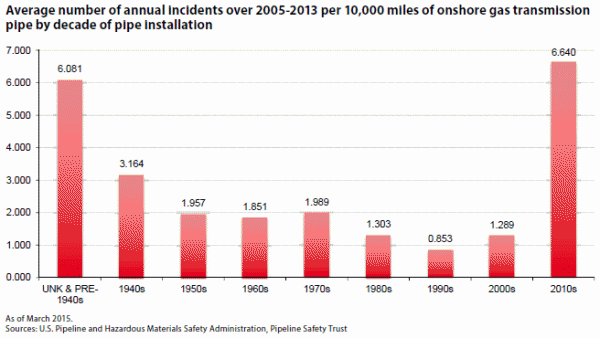
Pipeline Incidents

Though some of the problems may be related to workers learning how to implement the latest technologies, Weimar says, “there’s also some suggestions that we’re trying to put so many new miles of pipeline in the ground so fast that people aren’t doing construction … the way they ought to.”

In the same piece Smith quotes Robert Hall, of the National Transportation Safety Board Office of Railroad, Pipeline and Hazardous Materials Investigations, who agreed that, “the rapid construction of pipelines in the U.S. is likely a contributing factor to ‘people … out there possibly taking shortcuts or not being as diligent’ as they would be if the pace of construction were less fervent.”

Coming forward to confirm these observations are two former Spectra contractors I’m calling Inspector One and Inspector Two. Both wish to remain anonymous for this piece for personal and professional reasons, though they know that their former bosses may be able to identify them.

Paths Beyond Paris: Movements, Action and Solidarity Towards Climate Justice

By various - Carbon Trade Watch, December 2015

Over twenty years have passed since governments within the United Nations Framework Convention on Climate Change (UNFCCC) began to discuss the impending climate crisis. Year after year, we witness the talks moving further away from identifying the root causes of climate change while the increasing impacts affect even more peoples and regions. Every meeting has given more space for corporate involvement and less to the voices of those directly affected by these climate policies. Despite the promoters’ fancy “green” campaigns and videos, the main focus at the climate negotiations continues to be about saving the free-market economy for those who are holding the cards – the biggest transnational corporations and financial institutions. The same corporations that are largely behind the destruction of forests, rivers, diversity, territories – as well as the violation of human and collective rights and so on – are also the main polluters and plunderers of the Earth.

The climate crisis poses a real threat to the current economic model which is based on the continuous extraction and production of fossil fuels, hydrocarbons and “natural resources” such as land, minerals, wood and agriculture. If talks were to seriously address climate change, there would need to be a discussion on the many ways to support the hundreds of thousand of small-scale farmers, fishers, Indigenous Peoples, forest-dwelling communities and others whose territories and livelihoods are at risk from capital expansion, and how to transition to different economic systems where fossil fuels could be kept underground; where the consumption “mantra” would shift towards more local, diverse and collective discourses and practices. However, the hegemonic and colonial powers are once more violently closing doors, creating more “structural adjustments” and, ultimately, harming the people who are the least responsible for current and historical pollution levels suffering the most from the impacts.

The fallacy that we can continue with the same economic model is irremediably flawed, bankrolled by big polluters, and intrinsically linked to land and livelihoods grabbing, especially in the Global South. Nonetheless, mechanisms like carbon markets, which expand the extractivist and free-market logic, continue to be promoted as unilateral, program- matic “solutions” to mitigate climate change and address deforestation and biodiversity loss. From carbon trading to forests and biodiversity offsets, the climate crisis has been turned into a business opportunity, worsening the already felt impacts, especially for those who are the least responsible. Debates over molecules of carbon being accounted for and “moved” or “stored” from one location to the other detracts from the necessary debates on shifting away from extraction, unjust power structures and oppression. While being fully informed of the causes of climate change, international climate negotiations strive to ensure that the hegemonic economic model expands and rewards polluters.

The consequence is that “climate policies” (aka economic policies) finance the most destructive industries and polluters, often destroying genuinely effective actions that support community livelihoods and keep fossil fuels in the ground. Moreover, these policies further the “financialization of nature” process, which presupposes the separation and quantification of the Earth’s cycles and functions – such as carbon, water and biodiversity – in or-der to turn them into “units” or “titles” that can be sold in financial and speculative markets. With governments establishing legal frameworks to set these markets in place, they also have provided the financial “infrastructure” for negotiating financial “instruments”, by using derivatives, hedge funds and others. While financial markets have a growing influence over economic policies, the “financialization of nature” hands over the management to the financial markets, whose sole concern is to further accumulate capital.

Read the report (PDF).

EcoUnionist News #78

Compiled by x344543 - IWW Environmental Unionism Caucus, December 1, 2015

The following news items feature issues, discussions, campaigns, or information potentially relevant to green unionists:

Lead Stories:

Ongoing Mobilizations:

The Road to Paris:

Bread and Roses:

Unions to lobby for "energy democracy" at Paris climate talks

By Teresa Albano - People's World, November 27, 2015

Everybody likes to talk about the weather but nobody can do a damn thing about it. Or can they?
Severe weather events that have caused deaths and destruction are linked to climate change - like 2012's Hurricane Sandy that pummeled New York and New Jersey, or the drought in Syria that forced people off their lands and into the cities, helping to create, according to reports, conditions that caused the devastating civil war.

And there is something people can do about climate change.

Despite the billions that Big Oil companies like Exxon Mobil have poured into spreading all kinds of climate change denial narratives, the world's scientists agree overwhelmingly that the planet is warming and it's due to the unprecedented release of human-created greenhouse gases like carbon dioxide and methane into the atmosphere.

And this warming has a cascading effect that even scientists cannot forecast. For one thing, glaciers and gigantic ice floes are melting into the oceans causing sea levels to rise, which in turn, threatens island nations like Fiji or low-lying regions of the United States, like the Florida Everglades. It's changing ocean currents and atmospheric patterns, leading to extreme weather events of all kinds - yes, including more severe blizzards too.

And who are the biggest victims of climate change? Working people around the world - the poor, the underpaid, the jobless, the exploited.

Now, unions worldwide are preparing to make sure the voices and needs of working people are included in the final United Nations Climate Change Summit in Paris, Nov. 30 - Dec. 11. The International Trade Union Confederation (ITUC) plans to lobby negotiators and leaders of some 190 countries during the upcoming UN Climate Change Conference on three issues:

Raise the level of "ambition" in the emission targets and by doing so "realize" job creation potential in the greening of economies;

Guarantee the most vulnerable people and nations get the maximum financial help;

Commit to a "just transition" for workers and their communities involved in industries that rely on fossil fuels.

Among the U.S. union delegates will be Sean Sweeney, PhD, who is the coordinator of a global network called Trade Unions for Energy Democracy. He is also the director of the International Program for Labor, Climate and Environment, which is part of the City University of New York's Murphy Institute. Sweeney told People's World that there will be official union participation that focuses on the formal talks in Paris, but unions will also collaborate with other social movements in hosting discussions, debates and networking events outside of the official UN summit.

On Dec. 8, TUED and other union groups will host Naomi Klein, author of "This Changes Everything: Capitalism vs. the Climate," and British Labor Party leader Jeremy Corbyn in a conversation entitled, "Now Is Not the Time for Small Steps: Solutions to the Climate Crisis and the Role of Trade Unions."

Labor Rallies Against Fossil Fuel At Climate Rally In Oakland on November 21, 2015

By Steve Zeltser - Labor Video Project, November 21, 2015

Trade unionists from Northern California rallied and marched on November 21, 2015 against fossil fuel and further carbons in the planet. The march and rally was endorsed by the bay area labor councils. IBEW 595 officials also talk about the Zero Carbon building the union has built in San Leandro to train apprentices and their members on technology and energy efficiency.

EcoUnionist News #77

Compiled by x344543 - IWW Environmental Unionism Caucus, November 24, 2015

The following news items feature issues, discussions, campaigns, or information potentially relevant to green unionists:

Lead Stories:

Ongoing Mobilizations:

The Road to Paris:

Bread and Roses:

An Injury to One is an Injury to All:

Carbon Bubble:

Just Transition:

Other News:

For more green news, please visit our news feeds section on ecology.iww.org; Twitter #IWWEUC; Hashtags: #greenunionism #greensyndicalism #IWW. Please send suggested news items to include in this series to euc [at] iww.org.

ITUC calls on workers to join climate rallies in support of Paris climate justice

Press Release - International Trade Union Confederation, November 19, 2015

With the climate summit taking place in ten days in Paris, the ITUC issues a renewed call to all its members to take to the streets for climate justice in countries around the world.

“The cancelation of Paris marches and demonstrations based on security concerns adds one more reason for workers to show that no wall can be built between immediate problems and so-called long-term ones: climate change is already happening and destroying jobs and communities,” said Sharan Burrow, ITUC General Secretary.

The union movement is heavily involved in the organisation of the 28-29 November marches in Spain, the Netherlands, New Zealand and Australia, and dozens of national centres, sectoral federations and local unions are bringing workers together to show social justice is climate justice.

“Workers and their unions stand for decent jobs, social justice and prosperity for all, and the fight against climate change is about all those,” said Burrow.

Trade unions from around the world will still come to Paris and join its French counterparts as well as other social movements and organisations in the COP21 as well as for the Trade Union Climate Forum, part of which will be held in the Citizens’ Summit in Montreuil.

“Even without the Paris demonstrations, politicians will not be left off the hook. Our voices will be stronger than ever in calling for a climate deal that must protect people and the planet,” concluded Sharan Burrow.

Union members are asked to wear green hard hats in the rallies to show support for jobs and climate action. Hard hats can be personalised with stickers available from the ITUC.

Brazilian Petrobras Oil Workers Strike Against Privatization and Union Busting

By Steve Zeltser - Labor Video Project, November 14, 2015

Eighty thousand workers at the Brazilian Petrobras oil company are striking against further privatization and union busting. The strike started on September 24, 2015 and the PT Workers Party government is selling off shares of the companies to multi-national oil companies and the banks and outsourcing more and more of the work creating serious health and safety problems.

Striking Petrobras oil workers talk about their strike and the role of the Dilma Rousseff Workers Party government in dismembering the national oil company. They also discuss the role of the CUT union leaders who opposed the oil workers striking since they are supporting the Dilma government.

This interview was done on November 6, 2015 in Sao Paulo, Brazil at a meeting of the Conlutas union federation.

For more information on the strike visit this page.

Pages

The Fine Print I:

Disclaimer: The views expressed on this site are not the official position of the IWW (or even the IWW’s EUC) unless otherwise indicated and do not necessarily represent the views of anyone but the author’s, nor should it be assumed that any of these authors automatically support the IWW or endorse any of its positions.

Further: the inclusion of a link on our site (other than the link to the main IWW site) does not imply endorsement by or an alliance with the IWW. These sites have been chosen by our members due to their perceived relevance to the IWW EUC and are included here for informational purposes only. If you have any suggestions or comments on any of the links included (or not included) above, please contact us.

The Fine Print II:

Fair Use Notice: The material on this site is provided for educational and informational purposes. It may contain copyrighted material the use of which has not always been specifically authorized by the copyright owner. It is being made available in an effort to advance the understanding of scientific, environmental, economic, social justice and human rights issues etc.

It is believed that this constitutes a 'fair use' of any such copyrighted material as provided for in section 107 of the US Copyright Law. In accordance with Title 17 U.S.C. Section 107, the material on this site is distributed without profit to those who have an interest in using the included information for research and educational purposes. If you wish to use copyrighted material from this site for purposes of your own that go beyond 'fair use', you must obtain permission from the copyright owner. The information on this site does not constitute legal or technical advice.

