You are here

green unionism

Can Autoworkers Save the Climate?

By Lars Henriksson - Jacobin, October 2, 2015

Disclaimer: The views expressed here are not the official position of the IWW (or even the IWW’s EUC) and do not necessarily represent the views of anyone but the author’s.

At the COP 19, the even-more-depressing-than-usual climate summit that took place in Warsaw in 2013, one small ray of light made it through the dark corporate clouds that were otherwise suffocating even the slightest effort to address the ongoing environmental disaster.

On the last day of the conference, an unusual alliance was formed as environmental organizations and trade unions together walked out of the venue under the banner of “Enough Is Enough.” Sick of the meaningless talks, they stated:

We are now focusing on mobilizing people to push our governments to take leadership for serious climate action. We will work to transform our food and energy systems at a national and global level and rebuild a broken economic system to create a sustainable and low-carbon economy with decent jobs and livelihoods for all. And we will put pressure on everyone to do more to realize this vision.

If not entirely unique, this action nevertheless promised a new hope for a climate movement that never recovered after its (greatly exaggerated) expectations cruelly disappointed at the summit in Copenhagen four years earlier. The relationship between trade unions and environmentalists has often been strained, if there has been one at all. More often than not, those claiming to defend the earth and workers’ rights are operating at a crossroads, sometimes colliding in head-to-head confrontation — especially when jobs are pitted against environmental interests.

I found myself in that squeeze when the financial crisis hit the auto industry in 2008. The previous year, Al Gore and the Intergovernmental Panel on Climate Change (IPCC) were awarded the Nobel Peace Prize, and climate change topped worldwide headlines. But with the bankruptcy of Lehman Brothers and the auto industry in free fall, the climate crisis quickly disappeared from general discussion, even more so among auto-industry workers. Profits (disguised as “jobs”) were the main issue, not the complicated and distant phenomenon of global warming.

RailCon15: Chicagoland Conference Reflections

By Hieronymous - LibCom.Org, September 30, 2015

Disclaimer: The views expressed here are not the official position of the IWW (or even the IWW’s EUC) and do not necessarily represent the views of anyone but the author’s.

In his 1914 poem, “Chicago,” Carl Sandburg called the city a “Player with Railroads and the Nation's Freight Handler.” Others have called it the “Rome of Railroads,” as in all railroads lead to Chicago. It’s the biggest, busiest and most complex rail hub in the world, with at least 1,300 passengers and freight trains passing through it daily. It remains the central node of the North American rail transportation system. Despite the city’s vast size, you can’t visit a neighborhood without seeing traces of how railroads developed the city – in the process connected the eastern U.S. with all of the West through this major portal. And it’s not just railroads, as barges, tractor-trailers, and bellies of planes make Chicago a hub that ranks just behind Singapore and Hong Kong for the world’s highest intermodal volume – not to mention the pipelines that carry liquid commodities into the city.

So Chicago couldn’t have been more fitting for the third Railroad Safety Conference. I arrived the day before, Friday, September 18th to help prepare. From O’Hare Airport I took the CTA "L" Blue Line to the Loop downtown, strolled over to Millennium Park and immediately discovered it was built a decade ago on a steel superstructure over Illinois Central’s original Chicago rail yard. An RWU member met me at Union Station and gave me a tour of its once grand interior, detailing its demise. Until 1969 Chicago had six intercity passenger rail terminals; Union Station is the only one that is in any way close to its original form.

The conference location at the union hall of United Electrical, Radio and Machine Workers of America (UE) couldn’t have been more appropriate either. In response to McCarthyism inspired raids by competing unions, UE left the CIO in 1949. By 1950 eleven unions left or were expelled from the CIO; only two remain today, UE and the West Coast-based International Longshore and Warehouse Union (ILWU). Both remain strong unions, with democratic governance, and have led some of the most inspiring recent struggles. For the UE, it was the week-long occupation of the Republic Windows and Doors factory on Goose Island in Chicago in December 2008. For the ILWU it has been the willingness to take political stands, like the work stoppage on May Day 2008 when all 29 ports on the West Coast ceased operating for the day.

The conference, titled Railroad Safety: Workers, Community and the Environment, carried on the agenda of the previous two conferences in California and Washington State with around 80 in attendance. Carl Rosen, President of UE, gave us a warm welcome to the hall, then RWU General Secretary Ron Kaminkow gave a brief history of RWU and mentioned the recent defeat of a union proposal for single-person crews at BNSF. Conference attendees introduced themselves, showing how far some had traveled to attend, from as far as New York, Washington DC, Seattle, San Francisco and Quebec, Canada; in addition, each cluster of tables came up with their goals for the conference. Most concerned educating affected communities about the realities of fossil fuel transport, especially rail, as well as upholding the principle of keeping energy resources “in the ground.” Next RWU members gave two sessions about the safety concerns of railroad workers. Included in the first were Single Employee Train Crews, Teamwork, Chronic Fatigue and Scheduling. In the second they were Long & Heavy Trains, Track Maintenance, and Rail Safety Programs. A guest, Michael Termini from the Government Accountability Project, talked about legal protections for whistleblowers.

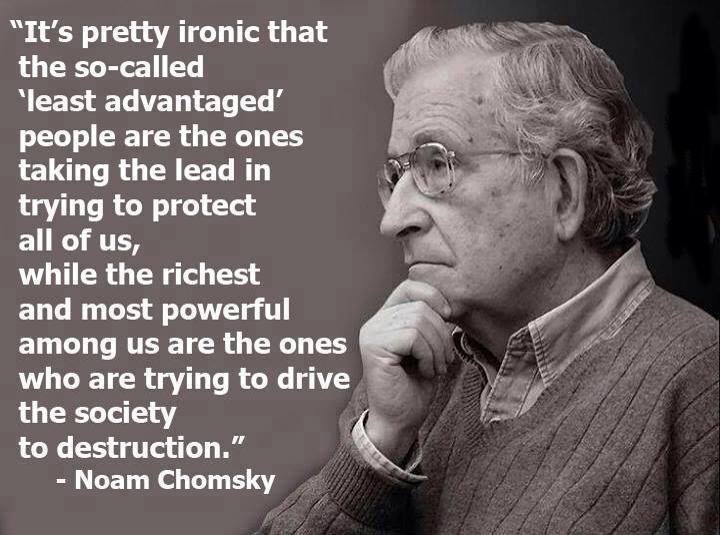
Chomsky: History Doesn’t Go In a Straight Line

Noam Chomsky interviewed by Tommaso Segantini - Jacobin, September 22, 2015

Disclaimer: The views expressed here are not the official position of the IWW (or even the IWW’s EUC) and do not necessarily represent the views of anyone but the author’s.

Throughout his illustrious career, one of Noam Chomsky’s chief preoccupations has been questioning — and urging us to question — the assumptions and norms that govern our society.

Following a talk on power, ideology, and US foreign policy last weekend at the New School in New York City, freelance Italian journalist Tommaso Segantini sat down with the eighty-six-year-old to discuss some of the same themes, including how they relate to processes of social change.

For radicals, progress requires puncturing the bubble of inevitability: austerity, for instance, “is a policy decision undertaken by the designers for their own purposes.” It is not implemented, Chomsky says, “because of any economic laws.” American capitalism also benefits from ideological obfuscation: despite its association with free markets, capitalism is shot through with subsidies for some of the most powerful private actors. This bubble needs popping too.

In addition to discussing the prospects for radical change, Chomsky comments on the eurozone crisis, whether Syriza could’ve avoided submitting to Greece’s creditors, and the significance of Jeremy Corbyn and Bernie Sanders.

And he remains soberly optimistic. “Over time there’s a kind of a general trajectory towards a more just society, with regressions and reversals of course.”

East Bay Unions Don't Want Your Coal

By S.E. Smith - Truthout, September 29, 2015

Disclaimer: The views expressed here are not the official position of the IWW (or even the IWW’s EUC) and do not necessarily represent the views of anyone but the author’s.

Coal is the energy source of the past, so what is it doing in plans for our future? It's a question that was asked by labor, environmental and community activists as they learned about plans for a new bulk commodities terminal proposed for Oakland's former army base by developer Terminal Logistics Solutions. The company is backed heavily by major coal producers in Utah looking for a way to get their product to U.S. ports for shipment, and while they thought they could sneak it by quietly, the ever-vigilant community in the Bay Area found out anyway, and the result was explosive. Opposition to the terminal is coming from a variety of angles, but one is particularly important: the labor community.

Oakland's workers, especially its dockworkers, have always been highly active in their community. Many live and work in and around West Oakland, near the city's port, and they have a vested interest in community health and welfare in addition to safe working conditions. They live in the awareness that the region has extremely high rates of respiratory disease and other pollution-related illnesses, something coal shipping would only exacerbate, and that working on a daily basis with the dusty and dangerous commodity would put their health at risk as well. So they had a personal interest in keeping coal out of Oakland, but it went deeper than that.

In a statement issued September 18—immediately before a city council meeting scheduled for the 21st—the Alameda Labor Council put forward a firm case against coal. "The Alameda Labor Council [expresses] opposition to the export of coal through Oakland and specifically the Oakland Global Trade and Logistics Center at the former Oakland Army Base," they explained, citing environmental and human health risks associated with coal exports. They also noted that the coal industry is notoriously anti-union, and that it doesn't offer as many jobs as work in other commodity industries. Moreover, union advocates argued, they welcomed development of other commodities shipping at the Port of Oakland, as long as it involved less toxic and environmentally harmful products.

There's No Jobs On A Dead Planet

By Joseph Scales - New Matilda, September 27, 2015

Disclaimer: The views expressed here are not the official position of the IWW (or even the IWW’s EUC) and do not necessarily represent the views of anyone but the author’s.

"We have a rendezvous with humanity." With that statement, the International Trade Union Confederation Climate Summit, ‘No Jobs on a Dead Planet!’ was opened in Paris, France last week. 

The Summit was the most significant trade union climate change meeting in history, held as a precursor to the COP21 Paris talks scheduled for December.

Climate Change is recognised and established. Even climate deniers like our former Prime Minister Tony Abbott are forced to at least publicly accept the legitimacy of the science.

The interconnected market pressures of a changing economy – particularly in a once manufacturing-intensive nation like Australia – means industrial change is coming, whether we like it or not.

What workers, unions and communities must decide is: are we part of that change or not? Business and capital will certainly be keeping their eye out for the best deal on their bottom line.

EcoUnionist News #68

Compiled by x344543 - IWW Environmental Unionism Caucus, September 29, 2015

Disclaimer: The views expressed here are not the official position of the IWW (or even the IWW’s EUC) and do not necessarily represent the views of anyone but the author’s.

The following news items feature issues, discussions, campaigns, or information potentially relevant to green unionists:

Lead Stories:

Ongoing Mobilizations:

Bread and Roses:

An Injury to One is an Injury to All:

Reversing Climate Change: What Will It Take?

By Jeremy Brecher - Labor Network for Sustainability, September 26, 2015

Disclaimer: The views expressed here are not the official position of the IWW (or even the IWW’s EUC) and do not necessarily represent the views of anyone but the author’s.

On the weekend of September 21, 2014, people in 162 countries joined 2,646 events to demand global reductions in the greenhouse gas (GHG) emissions that are generating climate catastrophe. An estimated forty thousand marched in London; thirty thousand in Melbourne; and twenty-five thousand in Paris. Some four hundred thousand joined the People's Climate March through the center of New York City. The climate protection movement had come a long way since 2006, when a march of one thousand through Burlington, Vermont proved to be the largest climate protest in American history. Yet, despite its exponential growth, whether and how the climate protection movement could realize its goals remained an open question.

The Failures of Climate Protection

Climate change poses an existential threat to our species, to every individual, and to all that any of us hold dear. Protecting the earth's climate is in the long-term interest of all humanity. Yet, efforts to cut carbon and other GHGs to a climate-safe level have been defeated for a quarter-century in arenas ranging from the United Nations to the US Congress.

Those failures are not what most climate protection advocates expected. From the scientific confirmation of global warming in the 1980s, they had laboriously built institutions like the United Nations Framework Convention on Climate Change and the Intergovernmental Panel on Climate Change and had painstakingly constructed a consensus among scientists,government leaders, and UN officials around the policies defined as necessary by the IPCC. The UN "framework agreement" was followed by the Kyoto Protocol and the Bali Road Map for the 2009 Copenhagen climate summit. The world seemed to be proceeding on a rational, if tardy, course to address climate change.

With the collapse of the Copenhagen climate summit in 2009, it became evident that the entire process had been little more than a charade in which world leaders, governments, and businesses pretended to address climate change while pursuing policies that pour ever more GHGs into the atmosphere. Copenhagen revealed a collection of greedy, advantage- seeking institutions whose leaders were unable to cooperate even for their own survival. The charade goes on: last November's extravagantly hailed US–China climate agreement, in the unlikely event that it is actually adhered to, will result in an estimated temperature rise of 3.8 degrees Celsius—nearly twice the 2-degree increase scientists say is the maximum compatible with human civilization as we know it. It is a suicide pact by the world's two leading polluters with the rest of the world as collateral damage.

In response to the failures of the official climate protection process, an independent climate protection movement has emerged. It is not controlled by any national or special interest. Instead, it has been organized globally and has demonstrated the capacity to act globally, exemplified by the actions in 162 countries for last year's People's Climate March. This movement has broken out of the constraints of lobbying and demonstrating within a legal framework set by governments by instead adopting civil disobedience as an important and legitimate part of its strategy. It has challenged the governments that permit climate destruction, the fossil fuel producing and using industries that conduct it, and the corporations and other institutions around the world that collude with it. In spite of its growth and commitment, the movement's ability to sharply reduce GHG emissions and establish climate-safe levels of carbon in the atmosphere has so far proven minuscule.

California climate activists set sights on COP21

By Nicholas Isaac - Socialist Action, September 21, 2015

Disclaimer: The views expressed here are not the official position of the IWW (or even the IWW’s EUC) and do not necessarily represent the views of anyone but the author’s.

As governments and some 40,000 corporate negotiators, scientists of different persuasions, and other mostly corporate-friendly parties prepare to attend the Nov. 30-Dec. 12 United Nations Conference of Parties (COP21) in Paris, environmental and climate-crisis organizations are preparing massive and perhaps unprecedented mobilizations around the world.

Fear is widespread that this 21st UN-sponsored climate meeting will propose nothing to stop the earth’s temperature from rising beyond the point of no return—the point where catastrophic and irreversible changes threaten all life on earth. Few, if any, environmental and related movement organizations believe that the world’s greatest polluters have any intention of subordinating their highly profitable fossil-fuel extraction to the interests of humanity. Indeed, the greatest of the polluters, the U.S. and China, have every intention of increasing their production and use of fossil fuels!

Activists from 350.org and a broad range of other concerned organizations on the East Coast are making preparations for a massive mobilization in Boston on Dec. 12, the last day of COP21. They chose the last day of COP21 to indicate their lack of confidence in any of the “solutions” proposed to date and to state unequivocally that only a massive international movement, a “movements of movements,” is capable of saving the earth and its inhabitants from the destructive forces of today’s profit-driven polluters.

In Northern California, a broad coalition of environmental groups, labor unions, social justice, antiwar, and human rights groups, and a number of socialist parties, has been meeting in Oakland union halls for the past two months to plan a mass march and rally through downtown Oakland on Nov. 21. Leading organizations include 350.org chapters in all Bay Area counties, the Sunflower Alliance—which focuses on defending frontline communities—System Change Not Climate Change, and a host of groups aimed at fighting California fracking, coal transport, explosive bomb trains, and environmental racism. Socialist Action, Solidarity, DSA, ISO, and CoC have also been actively building this effort.

EcoUnionist News #67

Compiled by x344543 - IWW Environmental Unionism Caucus, September 22, 2015

Disclaimer: The views expressed here are not the official position of the IWW (or even the IWW’s EUC) and do not necessarily represent the views of anyone but the author’s.

The following news items feature issues, discussions, campaigns, or information potentially relevant to green unionists:

Lead Stories:

Ongoing Mobilizations:

Bread and Roses:

An Injury to One is an Injury to All:

Carbon Bubble:

Just Transition:

Other News:

For more green news, please visit our news feeds section on ecology.iww.org; Twitter #IWWEUC; Hashtags: #greenunionism #greensyndicalism #IWW

Uruguay Shows the Way by Leaving Secret Trade Deal

By Viviana Barreto and Sam Cossar-Gilbert - Common Dreams, September 17, 2015

Disclaimer: The views expressed here are not the official position of the IWW (or even the IWW’s EUC) and do not necessarily represent the views of anyone but the author’s.

A strong coalition of trade unions, environmentalists and farmers working together on an effective public campaign were able to take on the interests of the world's biggest companies and win.

Last week the Uruguayan government decided to end its involvement in the secret negotiations of the Trade in Services Agreement TISA, signifying an important victory in the global fight against bad trade deals.

TISA is a radical new deal that aims to go far beyond current trade rules and force States to further open their markets to foreign corporations, privatize public services and reduce regulations. These measures often mean job losses, less environmental protection, and less accessible healthcare and education.

Uruguay has created a blueprint for how to stop this corporate-driven agreement.  It is time for  other countries to follow the lead and end TISA once and for all.

After months of intense pressure led by unions and other social movements—including a general strike on the issue—the Uruguayan President listened to public opinion and left the US-led trade agreement. The overwhelming majority of members of the ruling Frente Amplio party believe that the deal would undermine the government's national development strategy and therefore considered it “unadvisable to continue participating in the TISA negotiations”.

Pages

The Fine Print I:

Disclaimer: The views expressed on this site are not the official position of the IWW (or even the IWW’s EUC) unless otherwise indicated and do not necessarily represent the views of anyone but the author’s, nor should it be assumed that any of these authors automatically support the IWW or endorse any of its positions.

Further: the inclusion of a link on our site (other than the link to the main IWW site) does not imply endorsement by or an alliance with the IWW. These sites have been chosen by our members due to their perceived relevance to the IWW EUC and are included here for informational purposes only. If you have any suggestions or comments on any of the links included (or not included) above, please contact us.

The Fine Print II:

Fair Use Notice: The material on this site is provided for educational and informational purposes. It may contain copyrighted material the use of which has not always been specifically authorized by the copyright owner. It is being made available in an effort to advance the understanding of scientific, environmental, economic, social justice and human rights issues etc.

It is believed that this constitutes a 'fair use' of any such copyrighted material as provided for in section 107 of the US Copyright Law. In accordance with Title 17 U.S.C. Section 107, the material on this site is distributed without profit to those who have an interest in using the included information for research and educational purposes. If you wish to use copyrighted material from this site for purposes of your own that go beyond 'fair use', you must obtain permission from the copyright owner. The information on this site does not constitute legal or technical advice.