






You are here
shorter work hours
 Amidst the renewed rise of
 Unifor is Canada’s largest union in the private sector, representing 315,000 workers in every major area of the economy.
 The COVID-19 crisis poses a threat to people’s health, their jobs and their lives, and like all crises, exacerbates already existing inequalities. Trillions in public finance will be needed to get through the current pandemic. This briefing outlines why continuing to rely on fossil fuels, in particular oil and gas, is not compatible with long-term recovery. It does not make sense to use the COVID-19 stimulus packages to try to revive a sunsetting industry which will not deliver on economic recovery, only to shut it down a few years later to meet climate goals.
 Climate politics are today bursting to life like never before. For four decades, market fundamentalists in the United States and United Kingdom have blocked ambitious efforts to deal with the climate crisis. But now, the neoliberal hegemony is crumbling, while popular climate mobilisations grow stronger every month. There has never been a better moment to transform politics and attack the climate emergency.
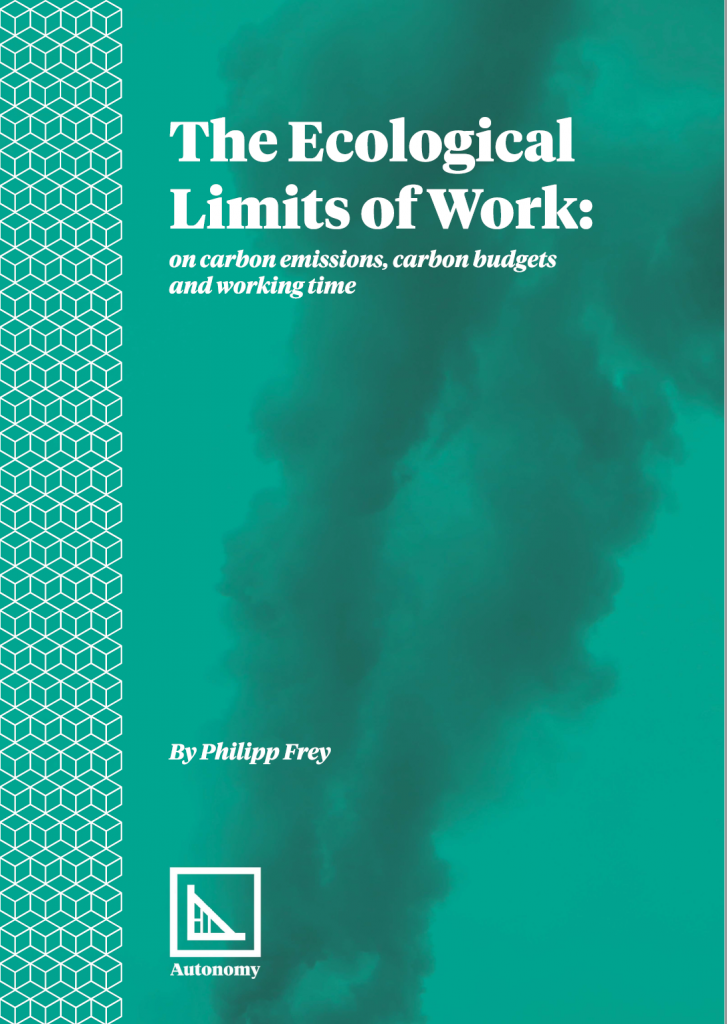 Faced with accelerating technological progress and a deepening ecological crisis, a growing discussion sees a reduction in working hours as a multiple dividend policy, increasing, among other things, individual wellbeing, productivity and gender equality whilst simultaneously potentially contributing to a reduction in unemployment and greenhouse gas (GHG) emissions. One cannot help but feel reminded of some earlier sociotechnical visions of a society in which productivity gains would be shared broadly to allow for radically shorter working hours and thus a qualitatively better life.
 Whenever the government fumbles around desperately for the story they can sell as success, they often reach for the following statistic: that since the Conservatives took power in 2010, unemployment has dropped, and more people than ever are in work. But this simple story conceals a much more worrying truth – that work simply doesn’t guarantee a decent standard of living any more. Official statistics gloss over the effects of semi-employment, self-employment, self-unemployment, zero-hours contracts and a shrinking in real wages, leaving four million people in in-work poverty. The sluggish growth of the apparent recovery is distorted by financial markets, and concentrated largely in the hands of the wealthy – particularly in the South of England. What growth does trickle down to the average worker is eaten up by inflation and falling wages. In other words, UK workers are in dire need of radical change to deliver a more just economy. And with automation promising to turf more jobs onto the scrapheap, maybe it’s time to stop thinking about how to “Get Britain working” – but how to share out labour more fairly across the workforce.
 Recently, It’s Going Down was asked by Kim Kelly (
The Fine Print I:
Disclaimer: The views expressed on this site are not the official position of the IWW (or even the IWW’s EUC) unless otherwise indicated and do not necessarily represent the views of anyone but the author’s, nor should it be assumed that any of these authors automatically support the IWW or endorse any of its positions.
Further: the inclusion of a link on our site (other than the link to the main IWW site) does not imply endorsement by or an alliance with the IWW. These sites have been chosen by our members due to their perceived relevance to the IWW EUC and are included here for informational purposes only. If you have any suggestions or comments on any of the links included (or not included) above, please contact us.
The Fine Print II:
Fair Use Notice: The material on this site is provided for educational and informational purposes. It may contain copyrighted material the use of which has not always been specifically authorized by the copyright owner. It is being made available in an effort to advance the understanding of scientific, environmental, economic, social justice and human rights issues etc.
It is believed that this constitutes a 'fair use' of any such copyrighted material as provided for in section 107 of the US Copyright Law. In accordance with Title 17 U.S.C. Section 107, the material on this site is distributed without profit to those who have an interest in using the included information for research and educational purposes. If you wish to use copyrighted material from this site for purposes of your own that go beyond 'fair use', you must obtain permission from the copyright owner. The information on this site does not constitute legal or technical advice.
 This site is not the official webpage of the Industrial Workers of the World.