You are here

reports

Addressing U.S. Manufacturing and Service Capacity/Gaps and Technical Standards

By David W. Cash - Labor Energy Partnership, June 2022

This paper attempts to analyze the existing offshore wind (OSW) supply chain and value chain capacity and gaps in U.S. manufacturing, vessels, ports, workforce development and standards. It further identifies opportunities and constraints in meeting goals of equity as the domestic OSW sector develops across all these dimensions. As the Biden administration notes, the development of the OSW sector offers the prospect not only to reduce emissions at scale, but also to seize the opportunity to create jobs along the value chain, create union and high-wage jobs, reduce U.S. sector uncertainties and drive equity, especially in overburdened and vulnerable communities.

Advancing Policy Measures to Drive Development of the Domestic Offshore Wind Supply Chain

By Liz Burdock, Ross Gould and Sam Salustro - Labor Energy Partnership, June 2022

Accelerating the growth of the U.S. offshore wind supply chain is critical to achieving national and state-level energy goals and will require a national strategy to succeed. This paper, titled Advancing Policy Measures to Drive Development of the Domestic Offshore Wind Supply Chain, assesses how current policies impact potential supply chain businesses and what is needed to help them retool or gain the capabilities needed to build out the U.S. offshore wind industry and compete in the global market. Secondary market forces, such as federal leasing processes and transmission capacities, play an important role in efforts to accelerate supply chain development and are discussed. This paper is informed by specific and general conversations with Network members actively working to build out a sustainable and competitive offshore wind supply chain. These insights are augmented by research into current global and European policies impacting the United States market and into comparable renewable energy technologies and their successes or failures in growing a domestic supply chain.

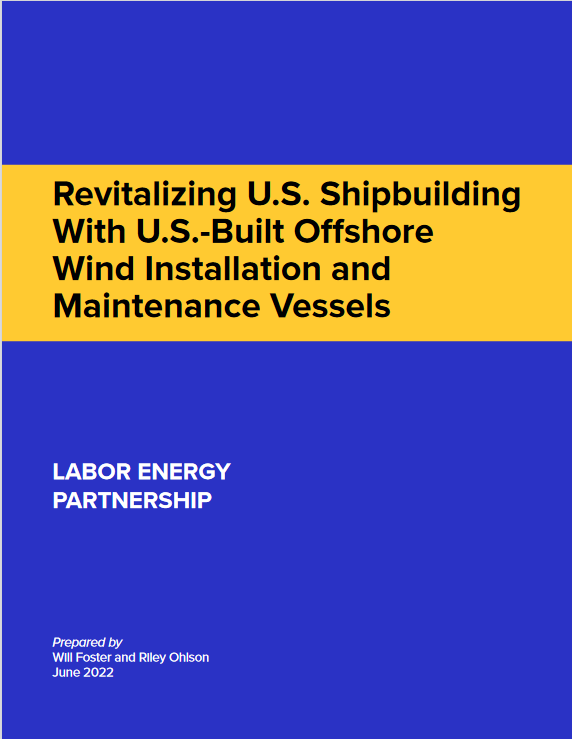
Revitalizing U.S. Shipbuilding With U.S.-Built Offshore Wind Installation and Maintenance Vessels

By Will Foster and Riley Ohlson - Labor Energy Partnership, June 2022

This paper assesses the opportunities and challenges for developing a fleet of Jones Act-compliant vessels for installation, maintenance and service of offshore wind infrastructure in the U.S., in consultation with shipbuilding unions.

Stimulating commercial shipbuilding activity is critical to facilitating OSW deployment while demonstrating the potential for this deployment to support and grow good manufacturing jobs.

Arguably, the greatest challenge facing sustained OSW development is neither technical nor financial but political. Many American workers, particularly those in industries tied to fossil fuels, are deeply skeptical of the prospects of a just transition and the fundamental ability for renewable energy production to support middle-class jobs.

The Power of Offshore Wind

By Sarah Clements and Angie Kaufman - Labor Energy Partnership, June 2022

The U.S. offshore wind energy industry is on the rise. As a climate solution with opportunities to create and support good-paying jobs, the offshore wind industry demonstrates the symbiosis between labor and the energy transition. 

This fact sheet was developed by EFI and AFL-CIO under the Labor Energy Partnership. It will help you understand the basics: what offshore wind energy is, why the East Coast has more potential, what the Biden Administration has pledged, and how to build the industry sustainably and equitably. 

Balancing objectives? Just transition in national recovery and resilience plans

By Sotiria Theodoropoulou, Mehtap Akgüç, and Jakob Wall - European Trade Union Institute, June 2022

This paper assesses how well national recovery and resilience plans (NRRPs) aim at jointly tackling the social and climate/environmental challenges of recovery from the crisis and the transition to a net zero carbon socioeconomic model. Drawing on the conceptual frameworks proposed by Mandelli (forthcoming) and by Sabato et al. (2021) on how economic, social and green objectives can be integrated in general, and more particularly in the EU Recovery Policy framework, this paper goes a step further and examines NRRP documents as well as secondary evidence from, among others, the assessments of the European Commission. We develop some indicators which operationalise, at ‘bird’s eye view’ level, the balance between policy interventions aiming at social and green objectives and which explore how well they promote the concept of ‘just transition’. Moreover, the paper looks in more detail at the plans of France, Greece and Germany to provide more qualitative evidence on how these countries have articulated their proposed policy interventions to have a joint impact(s) on both green and social objectives.

Our analysis suggests that planned spending from the Recovery and Resilience Facility (RRF) is tilted in favour of green transition objectives relative to social objectives. This might be a reason for concern about a new imbalance at the expense of the EU’s social dimension, beyond that already in existence with regard to the economic dimension; namely that there is an imbalance between the environmental/green dimension and the social one. Such a new imbalance, however, will also depend on a Member State’s capacity to cushion the impacts of the green transition beyond the use of RRF funds.

Decarbonized Electrification Would Generate Significant Job Gains

By Jim Stanford. - Center for Future Work, May 26, 2022

A new report from the David Suzuki Foundation takes a deep dive into the employment gains that could be achieved through the rapid electrification of Canada’s economy, driven by the expansion of sustainable power generation and infrastructure. The new report, “Shifting Power: Zero-Emissions Electricity Across Canada by 2035”, estimates that 75,000 net new jobs would be created by the expansion of clean electricity generation and use over a 15-year period. This would contribute substantially to the attainment of Canada’s net-zero objectives, as well as to strengthening employment outcomes for Canadian workers as the economy shifts toward sustainable energy sources.

Centre for Future Work Director Jim Stanford provided a supplementary analysis for the report, addressing the economic and employment opportunities associated with decarbonized electrification. He notes those benefits would occur through several complementary channels:

  • Jobs in developing and operating renewable generation systems (including solar, wind, geothermal and hydroelectric power). Construction of these projects will create hundreds of thousands of person-years, with thousands more ongoing jobs in operation and maintenance.
  • New work in expanding and upgrading the electric grid. Major investments will be required to upgrade transmission facilities, install modern control and regulating equipment and prepare the grid for the more complex and variable power distribution requirements associated with dispersed renewable generation.
  • Manufacturing of capital equipment and other material inputs to renewable generation projects. With appropriate value-added industrial strategies to enhance Canada’s industrial footprint in these growing industries, thousands of permanent jobs would be created manufacturing wind turbines, solar power equipment, transmission equipment and materials, and other capital inputs to electrification.
  • Installation and maintenance of new equipment that uses electricity in various industrial and consumer applications — everything from residential heating systems to electric vehicles to large industrial power systems.
  • Jobs in new industries attracted to Canada by the availability of clean, reliable and competitive electricity. Canada’s abundance of primary renewable electricity resources would position us at the forefront of the global transition to sustainable electric energy. That will stimulate interest and investment by industrial firms and financial investors from around the world.

Overstated and misleading warnings that shifting away from fossil fuel use will inevitably cause major job losses and dislocation have already been disproved by the progress in decarbonizing electricity that has already been made. Stanford notes that reliance on fossil fuels in electricity generation in Canada has already fallen by one-third since the turn of the century – yet the electricity generation and distribution industry has created 10,000 net new jobs over that same period. And since renewable energy sources, in general, are more labour-intensive than fossil fuels, this continuing shift can be expected to produce more net job gains in the years ahead.

Jim Stanford’s full commentary for the Shifting Power report is posted here. For more details, please see the Suzuki Foundation’s full report, “Shifting Power: Zero-Emissions Electricity Across Canada by 2035

REPORT: Canadian pension fund investment managers’ entanglement with fossil fuel industry raises conflict of interest concerns

By Adam Scott and Patrick DeRochie - Shift Network, May 5, 2022

New analysis finds 80 Canadian pension managers with 124 different roles at 76 fossil fuel companies, raising questions from beneficiaries about fiduciary duty and pension administrators’ potential conflicts of interest on climate-related investment decisions. 

Shift Action for Pension Wealth and Planet Health’s May 2022 report, Canada’s Climate-Conflicted Pension Managers: The Oil and Gas Insiders Overseeing Canadians’ Retirement Savings, reveals the deep entanglement between the fossil fuel industry and directors, trustees and investment managers at Canada’s largest public pension funds. 

The overlap raises serious questions from beneficiaries about their pension administrators’ ability to objectively manage climate-related financial risks and make critical climate-related investment decisions – when the pension administrators are so deeply entangled with an industry whose products are the primary cause of the climate crisis, whose bottom line depends on the continued production of climate-damaging products, and that has a long and ongoing legacy of obstructing efforts to cut carbon pollution.

The analysis finds that among Canada’s ten largest pension funds, which together manage more than $2 trillion in assets:

  • 80 different pension directors, trustees, executives and senior staff currently hold or previously held 124 different roles with 76 different fossil fuel companies. 

  • This includes nine current pension fund directors or trustees that currently hold 13 roles on the board of directors of 12 different fossil fuel companies, and 56 senior staff or investment managers at pension funds who hold 76 different corporate director roles at 39 different fossil fuel companies. 

  • Seven of the ten pension funds have at least one board member who simultaneously sits on the board of a fossil fuel company. 

  • In some cases, over a quarter of the pension fund’s board has direct connections to the oil and gas industry.

The best long-term interests of pension fund beneficiaries are not aligned with the financial interests of shareholders of fossil fuel companies. A pension director who is also a corporate director of a fossil fuel company could find themself with real or perceived conflicts of interest between their fiduciary duty to invest in the best long-term interests of pension beneficiaries, and their simultaneous legal obligation to act in the financial interests of the fossil fuel company on whose board they sit.

Press Release

Read the text (Link).

The ETUI's list of hazardous medicinal products (HMPs)

By Ian Lindsley and Tony Musu - European Trade Union Institute, May 2022

(Including cytotoxics and based on the EU CLP classification system of Carcinogenic, Mutagenic and Reprotoxic (CMR) substances)

Workers exposed to hazardous medicinal products (HMPs), or hazardous drugs, which are carcinogenic, mutagenic or reprotoxic substances (CMRs), within the meaning of the recently adopted Carcinogens, Mutagens and Reprotoxic Substances Directive (CMRD – Directive (EU) 2022/431), must be given specific training by their employers to prevent risks of adverse effects on their health.

In order to help employers meet their obligations, the European Commission has to publish European guidelines for the safe management of HMPs at work, including cytotoxics, by the end of 2022, and must draw up a definition and establish an indicative list of HMPs that are CMRs, no later than 5 April 2025.

The objective of this ETUI report and the list included is to identify which HMPs fall under the legislative scope of the CMRD in Europe, so that users of the European 2022 guidelines know which specific HMPs the guidelines now apply to, well ahead of the Commission’s indicative list, to be published by 2025.

Read the report (Link).

Warehouse Workers Call for Zero-Emission Trucks

By staff - Labor Network for Sustainability, May 2022

A growing convergence between climate protection and worker justice is embodied in a new report from Warehouse Workers for Justice titled “For Good Jobs and Clean Air: How a Just Transition to Zero Emission Vehicles Can Transform Warehousing.”

Warehouse Workers for Justice (WWJ) is a worker center founded in 2008 to win “stable, living wage jobs with dignity” for the hundreds of thousands of workers in Illinois’ logistics and distribution industry. WWJ “provides workshops about workplace rights, unites warehouse workers to defend their rights on the job, builds community support for the struggles of warehouse workers and fights for public and private policies that promote full-time work at decent wages in the warehouse industry.”

The new report, which includes both scientific information and vivid accounts by warehouse workers themselves, documents the toxic, diesel-driven air quality, public health, and labor impacts of warehousing at the nation’s largest inland port, Will County, IL. Its findings were generated by community-driven air quality monitoring, truck counting, and interviews.

The report finds that through environmental racism and poor labor standards, companies like Amazon put their predominantly Black and Latine workers at a “double jeopardy” of exploitation on the shop floor and toxic air pollution in the community.

The report shows that the transition to electric trucks creates an opportunity to uplift labor standards for warehouse workers and truckers while mitigating diesel-related public health crises — but only if the shift to EVs adequately prioritizes workers and residents.

Webinar: Investing in Workers for a World Beyond Fossil Fuels

Pages

The Fine Print I:

Disclaimer: The views expressed on this site are not the official position of the IWW (or even the IWW’s EUC) unless otherwise indicated and do not necessarily represent the views of anyone but the author’s, nor should it be assumed that any of these authors automatically support the IWW or endorse any of its positions.

Further: the inclusion of a link on our site (other than the link to the main IWW site) does not imply endorsement by or an alliance with the IWW. These sites have been chosen by our members due to their perceived relevance to the IWW EUC and are included here for informational purposes only. If you have any suggestions or comments on any of the links included (or not included) above, please contact us.

The Fine Print II:

Fair Use Notice: The material on this site is provided for educational and informational purposes. It may contain copyrighted material the use of which has not always been specifically authorized by the copyright owner. It is being made available in an effort to advance the understanding of scientific, environmental, economic, social justice and human rights issues etc.

It is believed that this constitutes a 'fair use' of any such copyrighted material as provided for in section 107 of the US Copyright Law. In accordance with Title 17 U.S.C. Section 107, the material on this site is distributed without profit to those who have an interest in using the included information for research and educational purposes. If you wish to use copyrighted material from this site for purposes of your own that go beyond 'fair use', you must obtain permission from the copyright owner. The information on this site does not constitute legal or technical advice.