






You are here
reports

 We are in the midst of a profound public health crisis. Rising temperatures fueled by climate change are contributing to more extreme weather events, spikes in air pollution, more frequent wildfires, and increases in tick- and mosquito-borne disease outbreaks. The resulting health harms fall more heavily on some populations than others, including workers. Workers face a range of climate-related hazards on the job, but one of the most pressing and well-understood hazards is extreme heat.
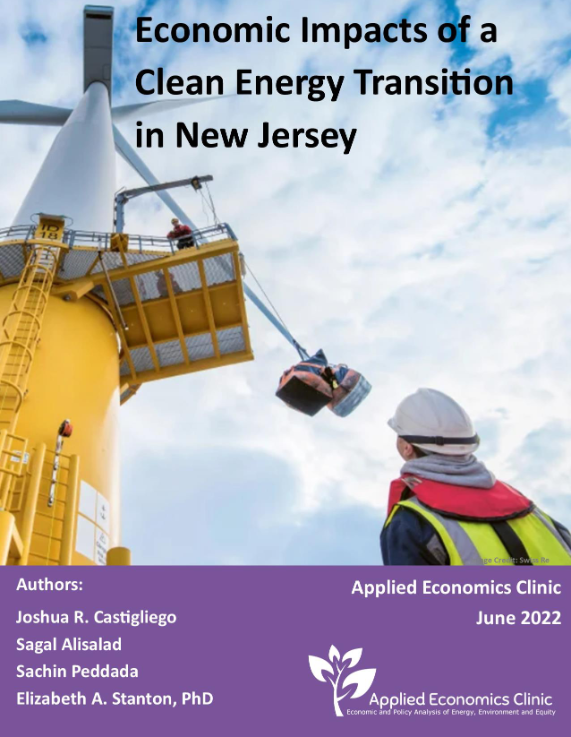 Researcher Joshua Castigliego, Assistant Researchers Sagal Alisalad and Sachin Peddada, and Senior Economist Liz Stanton, PhD prepared a report on the economic impacts associated with a clean energy transition in New Jersey that aims to achieve the State’s climate and energy goals in the coming decades. AEC staff find that adding in-state renewables and storage, and electrifying transportation and buildings creates additional job opportunities, while also bolstering the state’s economy. From 2025 to 2050, AEC estimates that New Jersey’s clean energy transition will result in almost 300,000 more “job-years” (an average of about 11,000 jobs per year) than would be created without it. AEC also identifies a variety of additional benefits of a clean energy transition, including several benefits that are conditional on the design and implementation of the transition.
 Senior Researcher Bryndis Woods, PhD, Researcher Joshua Castigliego, Assistant Researchers Elisabeth Seliga and Sachin Peddada, Researcher Tanya Stasio, PhD, and Senior Economist Liz Stanton, PhD prepared a report that assesses New Jersey’s current clean energy workforce, identifies barriers to green jobs that impede access to—and equitable representation within—the clean energy sector, and provides recommendations regarding how the State of New Jersey can shape policy and regulations to enhance the equity, diversity and inclusion of its clean energy jobs. AEC staff find that there are important barriers to green jobs that reinforce existing inequities in New Jersey’s clean energy workforce, including: educational/experience barriers, logistical barriers, equitable access barriers, and institutional barriers. Achieving a future of clean energy jobs in New Jersey that is diverse, equitable and inclusive will require overcoming barriers to green jobs with intentional efforts targeted at marginalized and underrepresented groups, such as racial/ethnic minorities, women, low-income households, and people with limited English proficiency.
 As the impacts of climate change begin to wreak havoc on our bisophere, the fossil fuel divestment movement has gained remarkable momentum. Globally, 1,500 institutions representing over $40 trillion in assets have already committed to some level of divestment from the fossil fuel industry.
 In March 2022, the LEP brought together an extraordinary group of leaders and experts for a private, virtual event on to workshop a series of four white papers related to building a robust domestic supply chain to support the emerging offshore wind (OSW) industry in the United States and abroad.
 How do we make offshore wind (OSW) power competitive? Systems need to be created and put into place. This means we need not only energy infrastructure but also specialized construction and supply infrastructure. The University of Delaware’s Special Initiative in Offshore Wind (SIOW) has calculated estimates of what such a system would result in for the United States, based upon 32,352 megawatts (MW) of installed capacity in the Northeast from 2021 through 2030.
The Fine Print I:
Disclaimer: The views expressed on this site are not the official position of the IWW (or even the IWW’s EUC) unless otherwise indicated and do not necessarily represent the views of anyone but the author’s, nor should it be assumed that any of these authors automatically support the IWW or endorse any of its positions.
Further: the inclusion of a link on our site (other than the link to the main IWW site) does not imply endorsement by or an alliance with the IWW. These sites have been chosen by our members due to their perceived relevance to the IWW EUC and are included here for informational purposes only. If you have any suggestions or comments on any of the links included (or not included) above, please contact us.
The Fine Print II:
Fair Use Notice: The material on this site is provided for educational and informational purposes. It may contain copyrighted material the use of which has not always been specifically authorized by the copyright owner. It is being made available in an effort to advance the understanding of scientific, environmental, economic, social justice and human rights issues etc.
It is believed that this constitutes a 'fair use' of any such copyrighted material as provided for in section 107 of the US Copyright Law. In accordance with Title 17 U.S.C. Section 107, the material on this site is distributed without profit to those who have an interest in using the included information for research and educational purposes. If you wish to use copyrighted material from this site for purposes of your own that go beyond 'fair use', you must obtain permission from the copyright owner. The information on this site does not constitute legal or technical advice.
 This site is not the official webpage of the Industrial Workers of the World.