You are here

reports

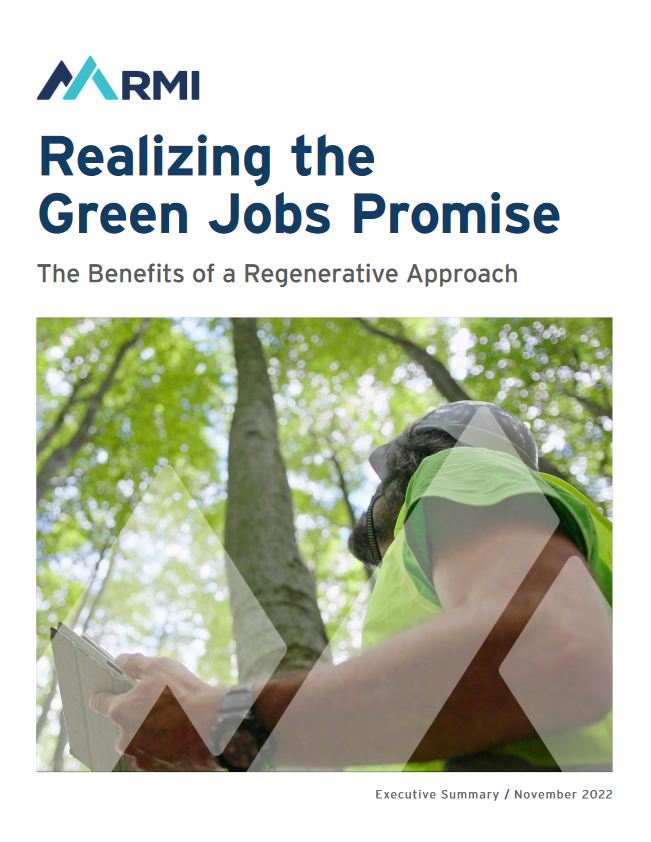
Realizing the Green Jobs Promise

By Raul Alfaro-Pelico, Charlie Bloch, Nick Pesta, and Madeline Tyson - Rocky Mountain Institute, November 2022

The switch to a carbon-free economy is the biggest economic opportunity of our era. The International Energy Agency and other analysts have predicted that this wave of market-driven innovation will create two to six “green jobs” for each fossil fuel job lost. The promised jobs are already arriving — the 2022 Annual Review by the International Labour Organization and the International Renewable Energy Agency reported that renewables alone had created more than 12 million jobs as of 2021.

But as well-researched and credible as such studies are, unfulfilled promises of prosperity have left many people skeptical about clean energy job claims, a skepticism that is commonly accompanied by the belief that the future holds less opportunity than the past. Even before COVID-19, two out of three people felt pessimistic that the gap between the rich and poor in their own country would ever improve. In fact, the U.N.’s World Social Report 2020 identifies four megatrends that are contributing to growing inequality for more than 70 percent of the global population: climate change, technological innovation, urbanization, and international migration. As a result, narrowly framing job numbers as a direct tradeoff between fossil fuel jobs lost and clean energy jobs gained risks undermining political and popular support for the clean energy transition.

A clean energy focus also misses the bigger picture of our rapidly changing global economy, obscuring the “hidden” costs and risks within our current economic system as well as the nascent opportunities embedded in a shift to a more sustainable economy. Compounding forces — pandemics and supply chain fragilities, new technologies and networked intelligence, and climate change and environmental degradation — are creating unprecedented rates of change in the global economy. Workers, communities, and companies cannot afford to ignore the big picture of what the future holds.

Read the report (Link).

The Dirty Truth About Utility Climate Pledges (Version 2)

By Cara Bottorff, Noah Ver Beek, and Leah Stokes - Sierra Club, October 2022

Rapidly cleaning up the electric sector is key to achieving our climate goals. We need electric utilities to retire coal plants, cancel plans to build new gas plants, and accelerate clean energy deployment to achieve 80 percent clean electricity by 2030 and 100 percent clean electricity by 2035. This is in line with the United States’ climate commitments and scientific consensus of what is needed for a livable planet.

Many utilities have pledged to clean up their electricity production, but our research shows these promises often amount to little more than greenwashing. In our 2021 report, released a year and a half ago, we analyzed the plans of 77 utilities owned by the 50 parent companies most invested in fossil fuel generation. We found that despite pledges to reduce emissions from many of these companies, most utilities did not have plans that would actually achieve the necessary emissions reductions by 2030.1, 2 This updated report investigates what progress, if any, these utilities made over the last year and a half to turn their pledges into real action. We want to know: have utilities stepped up to meet the challenge and make the changes needed to save lives, reduce costs, and address climate change by transforming our power system?

Download a copy of this publication here (PDF).

A Just Transition Primer from Global Climate Justice Leaders

By Molly Rosbach - Sunflower Alliance, October 1, 2022

A new report from leaders of the global climate justice movement argues that “a broad vision of Just Transition with social justice at its core is critical, especially as fossil fuel companies and defenders of ‘business as usual’ are adopting the language of climate action and just transition to thwart real solutions.”

The report, From Crisis to Transformation: A Just Transition Primer, released by Grassroots Global Justice and the Transnational Institute, “explores the root causes of the climate crisis . . . and argues that we need transformative and anti-capitalist visions to bring us “from crisis to transformation.” The report lays out the big picture of those causes, starting from colonialism, capitalism, and the industrial revolution, and traces the development of the current crisis. It outlines key elements of a true just transition:

  • Decolonization and restoration of indigenous sovereignty
  • Reparations and restitution
  • Ancestral and science-based solutions
  • Agroecology, food sovereignty, and agrarian reform
  • Recognition of rights to land, food, ecosystems, and territories
  • Cooperatives, social, and public production
  • Just distribution of reproductive labor
  • Going beyond endless economic growth

And provides case studies of communities putting visions of Just Transition into practice today:
* The Green New Deal
* Cooperation Jackson and the Jackson Just Transition Plan
* Just Transition in North Africa
* Movement of People Affected by Dams

Authors of the report include Jaron Brown of Grassroots Global Justice, Katie Sandwell and Lyda Fernanda Forero of the Transnational Institute, and Kali Akuno of Cooperation Jackson.

The report was released in Arabic, Spanish, and English, with plans to add translations in Bahasa, French, and Portuguese.

Grassroots Global Justice (GGJ) “is an alliance of over 60 US-based grassroots organizing (GRO) groups of working and poor people and communities of color,” including the Asian Pacific Environmental Network, Communities for a Better Environment, the Indigenous Environmental Network, Jobs with Justice, Cooperation Jackson and many more.

The Transnational Institute “is an international research and advocacy institute committed to building a just, democratic, and sustainable planet.”

They “offer this primer as a contribution to the broader ecosystem of Just Transition frameworks and articulations. In particular, we honor the work of the Just Transition Alliance, the Indigenous Environmental Network, the Climate Justice Alliance, Movement Generation, the Labor Network for Sustainability, and Trade Unions for Energy Democracy, among many others.”

OSU study finds higher rates of traumatic injuries for outdoor workers during hotter weather

By Molly Rosbach - Oregon State University, September 29, 2022

Rates of traumatic injury among workers in the Oregon agricultural and construction sectors are significantly higher during periods of high heat compared with periods of more moderate weather, a recent Oregon State University study found.

The results underscore the importance of providing robust safety protections for outdoor workers, especially as extreme heat events become more common with climate change, researchers said.

“The big take-home message I want people to get from this is that, if the temperature is high and you have workers out there, they’re more likely to be injured, whether it’s due to dehydration, reduction in mental capacity or exhaustion,” said Richie Evoy, lead author on the paper and a recent doctoral graduate from OSU’s College of Public Health and Human Sciences.

The study, published earlier this month, examined Oregon workers’ compensation data from 2009-2018. Researchers looked at nearly 92,000 injury claims in which workers suffered temporary disability, permanent disability or death. They focused on injuries that occurred in the months of April through October because the average heat index was above 55 degrees for that period.

In addition to heat, researchers also investigated the impact of wildfire smoke on worker injury rates.

They matched injury records with meteorological data to estimate heat exposure based on the heat index, which combines the effects of temperature and humidity in the air, along with environmental satellite data to estimate exposure to wildfire smoke.

They found that workers in agricultural and construction jobs were significantly more likely to suffer a traumatic injury on days when the heat index was above 75 degrees, compared with a baseline of 65 degrees or less.

The effect worsened when the heat index climbed to over 90 degrees, with an increased risk of 19-29% over baseline as the index ranged from 90-119 degrees.

“These results support the need for occupational safety practitioners to include protections for workers during extreme heat,” said Laurel Kincl, co-author on the study and an associate professor in OSU’s College of Public Health and Human Sciences. “While our study in based in Oregon, this is true in other states and regions since these conditions will likely become more frequent with climate change."

The impact of wildfire smoke was less clear. When researchers looked at smoke by itself, it was strongly associated with an increased risk of injury, but when they also incorporated heat index data into the analysis, the effect of wildfire smoke was no longer significant.

There are several potential reasons for this, researchers said. It could be that because wildfires happen more frequently in hot conditions, the smoke is coincidental to the heat; but smoke can sometimes also block the sun and reduce overall temperature.

Future studies should obtain more precise smoke exposure data to better understand the potential impact, researchers said. In using satellite imagery and data recorded from each day’s peak smoke exposure by zip code, Evoy said they couldn’t parse out exactly how much wildfire smoke individual workers were exposed to, or what was in that smoke, because of shifting winds and changes in what was burning at any given time.

“The way things stand now, wildfires are only going to increase in frequency and duration in Oregon and in the West, so the more we can do to understand the risks to our outdoor workers who are going to be experiencing these climate effects first, the better off those workers are going to be in protecting their health and staying productive,” Evoy said.

Just this summer, Oregon’s Occupational Safety and Health division adopted new standards regarding wildfire and excessive heat stress. Employers are now required by law to provide workers with shade areas when the heat index exceeds 80 degrees, along with access to drinking water, a specific work-rest schedule and several other safety measures. A coalition of Oregon business groups are suing the state over these new rules, which were praised by worker advocacy groups.

Other co-authors on the OSU study included Perry Hystad and Harold Bae, both in the College of Public Health and Human Sciences.

TUC welcomes Labour proposal for a new public energy champion (Public ownership of clean power: lower bills, climate action, decent jobs)

By staff - Trades Union Congress, September 27, 2022

Commenting on the announcement today (Tuesday) by Labour leader Keir Starmer of proposals for a new publicly owned energy champion called Great British Energy, TUC General Secretary Frances O’Grady said:

“This is a big, bold move that will cut bills and secure our energy future.

“This new national energy champion can provide high-quality jobs to every corner of the UK.

“And it’s about time the public shared in the profits of British energy.”

Editors note

- TUC report ‘Public ownership of clean power: lower bills, climate action, decent jobs’: A recently published TUC report set out an approach for the creation of a publicly owned national energy champion. The report is here: https://www.tuc.org.uk/research-analysis/reports/public-ownership-clean-power-lower-bills-climate-action-decent-jobs

New modelling finds Canada’s battery supply chain could be a boon for jobs and the economy, assuming Canada takes action

By staff - Clean Energy Canada, September 14, 2022

With the U.S.’s new electric vehicle tax credit requiring that EVs and their batteries be made in North America, Canada’s EV battery supply chain is in the spotlight. 

That spotlight is well warranted. If Canada plays its cards right, a domestic EV battery supply chain could support up to 250,000 jobs by 2030 and add $48 billion to the Canadian economy annually.

That’s according to modelling from Clean Energy Canada and the Trillium Network for Advanced Manufacturing, whose new report, Canada’s New Economic Engine, explores how Canada can successfully build an EV battery supply chain in order to become a North American battery powerhouse.

Recent months have seen a stream of new battery investments, from the $5 billion Stellantis and LG Energy Solution are investing in a Windsor battery factory to the $500 million General Motors and Posco are investing to bring battery material production to Bécancour, Quebec. 

But despite these encouraging investments, the success of Canada’s EV battery supply chain—and the hundreds of thousands of future jobs it could support—is still largely dependent on swift government action.

In a scenario where no additional government action is taken, Canada’s battery supply chain would create just 60,000 jobs and contribute only $12 billion in GDP—fulfilling only about a quarter of both its jobs and GDP potential.

Accordingly, the report identifies six ways in which Canada should focus its efforts to fulfill its battery-building potential. While Canada could do it all, a more effective strategy would double down on a few key stages, such as EV assembly, battery cell manufacturing, clean battery materials production.

In short, we have a once-in-a-generation opportunity to build a battery supply chain that will be the economic engine of tomorrow’s economy. 

A Low-Carbon Chemical Industry Could Create 29 Million Jobs, Study Finds

By Cristen Hemingway Jaynes - EcoWatch, September 13, 2022

While the chemical industry provides society with useful materials, it is also a heavy contributor to plastic waste being released into the planet’s oceans, greenhouse gas emissions, pollution, biodiversity loss and divergence from natural biogeochemical cycles, a press release from The University of Tokyo’s Center for Global Commons (CGC) said.

According to a new report from CGC and system change company Systemiq, 29 million new jobs could be created by the chemical industry embracing technology that is low-carbon and more efficient, The Guardian reported.

Around four percent of the planet’s greenhouse gas emissions come from the global chemical industry, reported The University of Tokyo.

The Planet Positive Chemicals report from Systemiq emphasized that the chemical industry must switch to a low emissions model that is more circular and end its reliance on fossil fuels in order to become a beneficial force for the planet.

Exposed and at Risk: Opportunities to Strengthen Enforcement of Pesticide Regulations for Farmworker Safety

By Olivia N. Guarna - Vermont Law & Graduate School Center for Agriculture & Food Systems and Farmworker Justice , September 2022

THE USE OF PESTICIDES IS UBIQUITOUS IN OUR FOOD SYSTEM. In the United States, approximately 1 billion pounds of pesticides are applied annually across sectors. Nearly 90 percent of conventional pesticides are applied in the agricultural sector. As a result, farmworkers are routinely exposed at unusually high rates to chemicals that pose substantial risk to human health and safety. These risks are exacerbated by insufficient worker training and frequent improper handling and application.

Vermont Law and Graduate School’s Center for Agriculture and Food Systems released a report in 2021 entitled Essentially Unprotected, which contains a detailed overview of the landscape of pesticide laws at the federal and state level. As demonstrated in the report, there are still key gaps in existing law to sufficiently protect farmworkers. Given these significant gaps, it is particularly alarming that compliance with current protections appears woefully low. The failure to adequately enforce pesticide laws leaves farmworkers unprotected and at continued risk of injury and illness.

The system of pesticide law enforcement is complex and varies widely between states. This report seeks to explain some of the nuance reflected in the regulatory structure of enforcement while highlighting recommendations for consistency and improved health and safety outcomes. However, it is essential to note that poor compliance and enforcement are symptomatic of other issues, many of which plague farmworkers beyond pesticide exposure. For example, enforcement is considerably affected by workers underreporting exposure incidents and suspected violations due to fear of retaliation by their employers.

Many farmworkers are undocumented or on an H-2A guestworker visa and thus face fears of deportation or blacklisting if they speak out against employer abuse. Additionally, farmworkers often do not have access or resources to seek out medical attention after exposure. If they do, doctors may not be aware that their symptoms indicate pesticide poisoning or may not know how and to whom to report the incident. Even when doctors can draw the connection, not all states require that doctors notify health authorities or the state agency responsible for enforcement.e, enforcement is considerably affected by workers underreporting exposure incidents and suspected violations due to fear of retaliation by their employers.

Download a copy of this publication here (PDF).

Landing Desirable Jobs

By staff - European Transport Workers Federation, September 2022

As it is now, the aviation sector needs a long-term sustainability perspective, both from the environmental and social points of view.

On the one hand, workers are leaving the industry due to a lack of decent jobs. On the other hand, the industry accounts for 4.8% of total CO2 emissions. While not the most polluting economic sector globally, aviation must do its part and put forward an ambitious decarbonisation plan.

So how can environmental and social sustainability go hand in hand? With a plan for decarbonisation with the heart of the industry at its core: its workers.

Fake My Catch: The Unreliable Traceability in our Tuna Cans

By staff - Greenpeace East Asia, September 2022

US seafood company Bumble Bee, one of the leading companies in the canned tuna market with nearly 90% consumer awareness levels,1 and its Taiwanese parent company Fong Chun Formosa Fishery Company (hereinafter referred to as FCF), one of the top three global tuna traders, play an important role in the global tuna industry, and thus hold responsibility over the health of our ocean, the treatment of those working in the tuna supply chain and consumer choices. Both companies have policies on sustainability and corporate social responsibility that are supposed to extend through their supply chain, but according to the analysis in this report, neither are meeting their responsibilities.

This report finds that the information on Bumble Bee’s “Trace My Catch” website, which enables consumers to track the source of their tuna product from catch to can, is insufficient and in some cases incorrect. In a number of cases Greenpeace East Asia's analysis found that the company was sourcing fish from vessels that had engaged in or were suspected of illegal, unreported and unregulated (IUU) fishing, forced labor, and/or human rights abuses. Therefore, Bumble Bee may not be fulfilling its responsibility and commitment to environmental sustainability and human rights, and without consumers’ knowledge seafood tainted with IUU and forced labor may have already entered the US market.

Based on 732 valid Bumble Bee tuna product codes, this report finds that Bumble Bee tuna was sourced from 290 different vessels, almost half of which are Taiwanese-flagged (119) or owned (22) distant water fishing vessels according to the information on Trace My Catch. In addition, some information on their Trace My Catch website contradicts official information from the Taiwan Fisheries Agency about where the supply vessel was authorized to fish. Verifying the vessel's location against a third data source- Automatic Identification System (AIS) data from Global Fishing Watch, revealed that 28 fishing vessels’ fishing area information provided by Bumble Bee’s traceability tool was incorrect. In addition, 13 fishing vessels that supplied tuna to Bumble Bee were listed on TFA’s website for IUU fishing.

Based on interviews with nine fishers on six Taiwanese vessels that supplied Bumble Bee, it was found that all nine fishers had experienced or observed at least one of the International Labor Organization (ILO) indicators of forced labor,3 and six out of those nine fishers had experienced or observed four or more of the 11 indicators. All of the fishers interviewed said they have experienced excessive overtime and retention of identity documents, and over two-thirds of them had their wages withheld.

Greenpeace East Asia research found that Bumble Bee canned tuna collected from Harris Teeter (a wholly owned subsidiary of Kroger Co.) in Arlington, Virginia on April 12, 2022 was sourced from DA WANG, a Taiwanese-owned vessel confirmed to use forced labor by US Customs and Border Protection.4 In April 2022, Taiwanese authorities indicted the vessel captain, first mate, and seven others for their involvement for forced labor and human trafficking. Bumble Bee's Trace My Catch website lists the source of this tuna as DA WANG on a trip in 2019, during which a fisher was reportedly beaten and died at sea. This leads to strong inference that seafood tainted with forced labor has already been sold in the US market.

On another Taiwanese fishing vessel, DE CHAN NO.116 evidence was revealed from Greenpeace East Asia interviews with fishers as well as Global Fishing Watch AIS data of suspected IUU fishing, including alleged shark finning and illegal transshipment at sea. The alleged illegal activities took place during a period when the ship was supplying tuna to Bumble Bee according to Trace My Catch.

Greenpeace East Asia urges immediate action from Bumble Bee and FCF, including issuing an apology to the exploited fishers, retailers and consumers, removing products suspected of IUU and forced labor-tainted tuna from the market, disclosure of their supplying vessels list, and establishment of an independent investigation committee for the flaw of Trace My Catch, to address issues of sustainability, legality and forced labor in their supply chain.

Read the text (Link).

Pages

The Fine Print I:

Disclaimer: The views expressed on this site are not the official position of the IWW (or even the IWW’s EUC) unless otherwise indicated and do not necessarily represent the views of anyone but the author’s, nor should it be assumed that any of these authors automatically support the IWW or endorse any of its positions.

Further: the inclusion of a link on our site (other than the link to the main IWW site) does not imply endorsement by or an alliance with the IWW. These sites have been chosen by our members due to their perceived relevance to the IWW EUC and are included here for informational purposes only. If you have any suggestions or comments on any of the links included (or not included) above, please contact us.

The Fine Print II:

Fair Use Notice: The material on this site is provided for educational and informational purposes. It may contain copyrighted material the use of which has not always been specifically authorized by the copyright owner. It is being made available in an effort to advance the understanding of scientific, environmental, economic, social justice and human rights issues etc.

It is believed that this constitutes a 'fair use' of any such copyrighted material as provided for in section 107 of the US Copyright Law. In accordance with Title 17 U.S.C. Section 107, the material on this site is distributed without profit to those who have an interest in using the included information for research and educational purposes. If you wish to use copyrighted material from this site for purposes of your own that go beyond 'fair use', you must obtain permission from the copyright owner. The information on this site does not constitute legal or technical advice.