You are here

green jobs

One Million Climate Jobs: Tackling the Environmental and Economic Crises

By Jonathan Neale, et. al. - Campaign against Climate Change, 2014

This booklet is about hope in the face of crisis. The economy is not working. Mass unemployment has lasted for years, and will last for many more. And at some point gradual climate change is going to turn into swift catastrophe. Dangerous climate change is a consequence of the work of the hands and brains of many men and women. It will take the hands and brains of many men and women to undo the damage. So many climate activists, and several trade unions, have decided to fight to make the government create one million climate jobs. This report sets out our case. To halt climate change we need drastic cuts in the amount of carbon dioxide and other greenhouse gases we put into the air. That means leaving most of the existing reserves of high carbon fuels – coal, oil and gas – in the ground. There are thousands of things we need to do to make that a reality. But three of them will make most of the difference.

We need workers to build enough wind power, solar power, wave power and tidal power to meet all our energy needs. We need workers to insulate and retrofit all our existing homes and buildings in order to conserve energy. And we need workers to run a massive public transport system powered by renewable electricity. We have people who need jobs, and jobs that must be done. So we want the government to hire a million people to do new climate jobs now in an integrated National Climate Service.Our estimate is that those workers could cut our CO2 emissions by 86% in twenty years. We can also create another half a million jobs in the supply line. And we can guarantee a new job to anyone who loses their job because of these changes.

This booklet explains how we can do all of this, and why we must. ‘Climate jobs’ are not the same as ‘green jobs’. Some green jobs help the climate, but ‘green jobs’ can mean anything – park rangers, bird wardens, pollution control, or refuse workers. All these jobs are necessary, but they do not stop climate change. Climate jobs are jobs that lead directly to cuts in emissions of greenhouse gases, and so slow down climate change. For instance, workers who build wind farms replace power stations that burn coal or oil. Workers who insulate buildings reduce the oil and gas we burn. Bus drivers reduce the amount of oil we burn in cars. We want a million new jobs. We don’t want to add up existing jobs and new jobs and say that now we have a million climate jobs. We don’t mean jobs that will be ‘created’ by some mysterious market process by 2030. We want the government to hire 90,000 new workers each month to do new climate jobs. In a year we will have a million new jobs.

Read the report (PDF).

BART Strike Facts – 1% vs. the 99% – Again

By Armineh Megroian - Solidarity in Motion, October 6, 2013

Disclaimer: The views expressed here are not the official position of the IWW (or even the IWW’s EUC) and do not necessarily represent the views of anyone but the author’s.

BART workers and their Unions are being forced into a strike which will begin on Thursday Oct. 11th.  This will cause congestion on roadways and bridges of Bay Area. But while you’re sitting in heavy traffic and stewing, don’t curse the so called overpaid, lazy Union workers. Acquaint yourself with a few facts first. Of course you know, that you will not get actual facts from the corporate media, only melodrama.

Fact: For BART workers, a strike is a last resort. They are more than willing to sit down and negotiate. It is the Board of Directors who refuses to negotiate.

Fact: BART’s General Manager Grace Crunican sits on the Board of directors of the “Bay Area Council”. A group of CEOs and managers dedicated to lowering wages and deteriorating working conditions for all workers. In short, to put profit before people.

Fact: The Board has spent $400,000 to hire a consultant turned negotiator from a private corporation named Veolia Transportation Services. Thomas Hock was brought in through the back door in an underhanded way. He has a reputation for Union-busting. His general strategy is to push Unions into a strike, provoke public anger and frustration against them, forcing them into taking concessions and pay cuts. That is 400K not spent on safety measures and upgrades for the paying public.

Fact:  Managements’ proposed “raise”, is actually a pay cut:

“According to BART’s analysis of its own proposal, utility workers, who currently take home $36,000 a year on average after taxes, would only see their pay increase to about $39,000 by 2017, after contributions to retirement and medical care are factored in. Train operators, who on average earn $44,000 a year after taxes, would only see their pay increase to $48,000 by 2017… That’s about an 8- to 9-percent increase in take-home pay for utility workers and train operators under the four-year BART contract proposal. But when you factor in an annual inflation rate of 2.5 percent, BART’s offer actually represents a pay cut of 1 to 2 percent over four years.” (Darwin BondGraham, “Why BART’s Wage Offer Doesn’t Include a Raise,East Bay Express.

Why Environmentalists Need to Support Transit Workers' Struggles - Solidarity With Bay Area Transit Workers!

By x344543 and x363464 - October 1, 2013

Disclaimer: The views expressed here are not the official position of the IWW (or even the IWW’s EUC) and do not necessarily represent the views of anyone but the author’s.

In the San Francisco Bay Area union workers at BART and AC Transit are embroiled in bitter contract fights with their bosses. Details on these struggles can be found at the Transport Workers Solidarity Committee (TWSC) site: transportworkers.org

Without going into a long analysis why we know this to be true (TWSC has already done that) we simply assert that the demands for concessions by the BART and AC Transit bosses is a result of the austerity measures being demanded of the 99% by the employing class in order for the latter to shore up their sinking capitalist ship.

Rank and file transit workers are organizing a militant response in the face of repression from their bosses (and the wider capitalist class in general) as well as the class collaborationist bureaucrats in their AFL-CIO unions, who simply cannot accept that this assault on the basic rights and livelihoods of trhese workers is happening.

Environmentalists should support the transit workers and oppose the bosses for the following reasons:

  • (1) Contrary to the information you might get from the capitalist media, these workers are not greedy and overpaid. In the Bay Area, an urban megalopolis with one of the highest costs of living in the US, these workers--on average--are barely making enough to survive.
  • (2) The bosses' latest contract offers are full of concessionary demands, and their wage offer amount to a pay cut.
  • (3) The transit bosses are following a pattern being followed by public agencies around the US of funding cuts, union busting, service cutbacks, outsourcing, and privatization.
  • (4) All of these are linked and are part of the systemic functions of capitalism which demands that wealth be continually transferred from the working class to the employing class.
  • (5) Capitalism cannot be reformed and cannot be effectively regulated. Even if temporarily constrained as it was in the Keynesian era, it ultimately seeks a way out of those constraints. Only working class solidarity and organization can effectively check and overcome the power of the employing class.
  • (6) Capitalism is inherently anti-ecological.
  • (7) Because an attack on the transit workers by the employing class enables the latter further, the bosses' actions are also an attack on the environment.
  • Negative consequences to the environment from the bosses actions have and will continue to manifest themselves thusly:

    • Cuts in service (resulting in lower ridership and increased use of personal automobile usage);
    • Cuts in maintenance which risks the safety of workers and commuters as well as causing increased long term wear and tear;
    • Less expansion of service to much needed areas;
    • Anti environmental practices within each agency.
  • (9) The arguments made by the bosses that the above conditions are caused by "workers' greed" are bogus. The bosses make far more by comparison and the real issue is one of allocation of adequate public funds.

Bay Area IWW Endorses August 3rd "Summer Heat" Action in Richmond, California!

At its July business meeting, the Bay Area General Membership Branch of the IWW endorsed the following event:

This May marked an ominous milestone on our rush past the safe upper limit of carbon dioxide in the atmosphere.  As CO2 exceeds 400 parts per million, the moment has come to do “hard, important, powerful things” to stop the large-scale burning of fossil fuels. These are the words of the organizers of 350.org’s national Summer Heat campaign—Naomi Klein, Bill McKibben, Winona LaDuke, Sandra Steingraber, and Rev. Lennox Yearwood, who are asking that we turn up the heat, show up and speak out “to the industry that’s wrecking our future.”

As part of Summer Heat events all across the country (see JoinSummerHeat.org), 350.org and its allies invite you to come together in a momentous West Coast mass action to declare our collective resistance to fossil fuels. We hope this will be one of the largest climate justice protests ever. Please join 350 Bay Area, the Richmond Progressive Alliance, Communities for a Better Environment, Asian Pacific Environmental Network, No Keystone Action Council, Idle No More, San Francisco Solidarity, Urban Tilth, and Gathering Tribes on August 3rd and 6th to stand with the people of Richmond, California who are in the frontlines in our common fight for the health and safety of our communities, and against accelerating climate change.

On August 3rd, three days before the one-year anniversary of the Chevron refinery explosion and fire, we will gather at 10am at the Richmond BART to march to a spirited rally with national and regional leaders in the fight against climate catastrophe.  (Full schedule is at JoinSummerHeat.org/bay; bus available for non-walkers.) The rally will be followed by a march to the gates of the Chevron refinery with the following demands:

  • NO KEYSTONE XL TAR SANDS PIPELINE.
  • NO MORE LIFE-THREATENING HAZARDS. Chevron and other Bay Area refineries shall prevent future spills, fires and explosions by retrofitting with the best and safest technology available.
  • NO REFINING OF DIRTY CRUDE.  Refining high-sulfur, low-quality tar sands and fracked oil increases greenhouse gas emissions and toxic air pollutants. It also seriously corrodes refinery machinery, which contributes to major industrial accidents.
  • NO MORE CORPORATE TAX EVASION.  Chevron shall pay its fair share of taxes to City, County, State and Federal agencies, and stop all frivolous litigation relating to these matters.
  • NO MORE POLLUTING OUR DEMOCRACY.  Chevron invests more in lobbying and manipulating elections with outrageous campaign contributions than it does in plant safety. Big Oil’s injection of mega-bucks into the political process ensures its continuing domination of energy policy.
  • A JUST TRANSITION FROM DIRTY FOSSIL FUELS TO UNION JOBS IN CLEAN ENERGY.              Government and Big Oil shall invest in high-quality union jobs in clean energy for local residents. Chevron needs to support Richmond’s long-term transition to a renewable energy-based economy that’s good for people and the planet.

Reinventing the Wheel - The REAL Green Jobs Story

By x356039 - May 2, 2013

Disclaimer: The views expressed here are not the official position of the IWW (or even the IWW’s EUC) and do not necessarily represent the views of anyone but the author’s.

In the accepted limits of debate in Washington and Wall Street the main argument by proponents of the fossil fuel industry is the same as its always been: do you want to protect the environment or create more jobs? They argue expanding fossil fuel exploitation, in spite of the proven risks to the environment and public health, is necessary for the sake of job creation. By building Keystone XL across the Great Plains, opening the Powder River Basin to coal interests, expanding offshore drilling, and opening up new lands to fracking the fossil fuel dinosaurs claim our economy will recover & energy independence will be achieved. When confronted with the facts on clean energy sources like wind and solar power fossil fuel proponents argue clean energy is too expensive. They claim it would not be cost-effective to build a green energy economy and that it would lead to a decline in standard of living.

Quite contrary to the boldest of claims made by those dinosaurs the facts show shifting to a clean energy economy would create more jobs, cost less money, and easily exceed all performance needs. Research by the Renewable & Appropriate Energy Laboratory at University of California, Berkeley shows the fossil fuel industry's claims of better job creation rates compared to green, clean energy are vastly overblown. As shown in this chart below renewable energy sources produce as many if not more jobs per megawatt of capacity as traditional dirty sources of electricity:

The Kochs and Clean Energy Jobs

By staff - International Forum on Globalization, October 2012

This IFG Special Report, “The Kochs and Clean Energy Jobs,” documents spending by the world’s two biggest billionaires intent on dealing a deathblow to green energy jobs and a low-carbon future.

IFG’s report reveals that the Kochs are today’s single largest funder of anti-environment and anti-worker activities, including:At least $643M in spending to block or rollback legal protections for the clean air, clean energy, clean water, and other environmental issues through sketchy scientific research, lobbying lawmakers, contributing to electoral candidates’ campaigns, media manipulation etc.At least $12M in spending to weaken the labor movement’s power through attacking collective bargaining rights, weakening worker protections, and stopping the financing for labor unions’ political activities.

Read the report (PDF).

Working towards sustainable development: Opportunities for decent work and social inclusion in a green economy (ILO)

International Labor Organization Press Release - May 31, 2012

GENEVA (ILO News) – The transformation to a greener economy could generate 15 to 60 million additional jobs globally over the next two decades and lift tens of millions of workers out of poverty, according to a new report led by the Green Jobs Initiative.

The study “Working towards sustainable development: Opportunities for decent work and social inclusion in a green economy ” says that these gains will depend on whether the right set of policies are put in place.

“The current development model has proven to be inefficient and unsustainable, not only for the environment, but for economies and societies as well”, said ILO Director-General Juan Somavia. “We urgently need to move to a sustainable development path with a coherent set of policies with people and the planet at the centre”.

“The forthcoming “Rio+20” United Nations conference will be a crucial moment to make sure decent work and social inclusion are integral parts of any future development strategy”, he added.

Achim Steiner, Executive Director of the UN Environment Programme (UNEP), said: “This report comes on the eve of World Environment Day on 5 June under the theme Green Economy: Does it Include You?”.

“The findings underline that it can include millions more people in terms of overcoming poverty and delivering improved livelihoods for this and future generations. It is a positive message of opportunity in a troubled world of challenges that we are relaying to capital cities across the globe as leaders prepare and plan for the Rio+20 Summit,” he added.

The report – published almost four years after the first study by the Green Jobs Initiative – looks at the impact that the greening of the economy can have on employment, incomes and sustainable development in general.

The Impact of Tar Sands Pipeline Spills on Employment and the Economy

By Lara Skinner and Sean Sweeney - Cornell University Global Labor Institute, March 2012
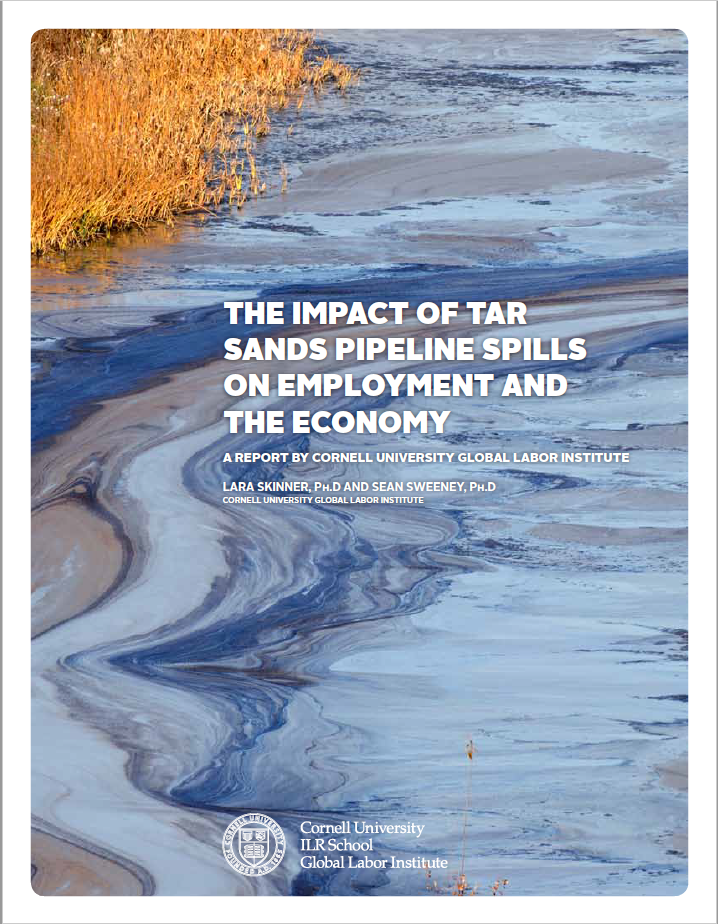
In debates over proposed tar sands pipelines such as the TransCanada corporation’s Keystone XL, little attention has been given to the potentially negative impacts of pipeline spills on employment and the economy. The proposed route for the 1,700-mile Keystone XL pipeline cuts through America’s agricultural heartland, where farming, ranching, and tourism are major employers and economic engines. Ground or surface water contamination from a tar sands oil spill in this region could inflict significant economic damage, causing workers to lose jobs, businesses to close, and residents to relocate. Such a spill could also negatively impact the health of residents and their communities.

A Closer Look at Keystone XL’s Threat to Existing Jobs and Economic Sectors:

» The negative impacts on employment and the economy of tar sands pipelines like the Keystone XL have largely been ignored. To date, a comprehensive risk assessment for the proposed Keystone XL pipeline oil spill has not been conducted. Such an assessment would provide an independent review of the risk of spills and their economic consequences. Since the first Keystone pipeline began operation in June 2010, at least 35 spills have occurred in the U.S. and Canada. In its first year, the spill frequency for Keystone’s U.S. segment was 100 times higher than TransCanada forecast.

» The Keystone XL pipeline would cut through America’s breadbasket. Agricultural land and rangeland comprise 79 percent of the land that would be affected by the proposed Keystone XL pipeline. It would cross more than 1,700 bodies of water, including the Missouri and Yellowstone rivers and the Ogallala and Carrizo-Wilcox aquifers. The Ogallala Aquifer alone supplies 30 percent of the groundwater used for irrigation in the U.S. It also supplies two million people with drinking water.

» Farming, ranching, and tourism are major sources of employment along the Keystone XL pipeline’s proposed route. Water contamination resulting from a Keystone XL spill, or the cumulative effect of spills over the lifetime of the pipeline, would have significant economic costs and could result in job loss in these sectors. Approximately 571,000 workers are directly employed in the agricultural sector in the six states along the Keystone XL corridor. Total agricultural output for these states is about $76 billion annually.

» Many of the land areas and bodies of water that Keystone XL will cross provide recreational opportunities vital to the tourism industry. Keystone XL would traverse 90.5 miles of recreation and special interest areas, including federal public lands, state
parks and forests, and national historic trails. About 780,000 workers are employed in the tourism sector in the states along the Keystone XL pipeline. Tourism spending in these states totaled more than $67 billion in 2009.

» Recent experience has demonstrated that tar sands spills pose additional dangers to the public and present special challenges in terms of clean up. There is strong evidence that tar sands pipeline spills occur more frequently than spills from pipelines carrying conventional crude oil because of the diluted bitumen’s toxic, corrosive, and heavy composition. Tar sands oil spills have the potential to be more damaging than conventional crude oil spills because they are more difficult and more costly to clean up, and because they have the potential to pose more serious health risks. Therefore both the frequency and particular nature of the spills have negative economic implications.

» The Kalamazoo River tar sands spill affected the health of hundreds of residents, displaced residents, hurt businesses, and caused a loss of jobs. The largest tar sands oil spill in the U.S. occurred on the Kalamazoo River in Michigan in 2010. This spill is the most expensive tar sands pipeline oil spill in U.S. history, with overall costs estimated at $725 million.

» The public debate around Keystone XL has focused almost exclusively on job creation from the project, yet existing jobs and economic sectors could suffer significantly from one or more spills from Keystone XL. According to the U.S. State Department, the six states along the pipeline route are expected to gain a total of 20 permanent pipeline operation jobs. Meanwhile, the agricultural and tourism sectors are already a major employer in these states. Potential job losses to these sectors resulting from one or more spills from Keystone XL could be considerable.

» Renewable energy provides a safer route to creating new jobs and a sustainable environment. The U.S. is leading the world in renewable energy investments, and employment in this sector has expanded in recent years. For every $1 million invested in renewable and clean energy, 16.7 jobs are created. By contrast, $1 million invested in fossil fuels generates 5.3 jobs.

Read the report (PDF).

Are “Green” Jobs Decent?

By Lene Olsen, et. al. - International Labour Organization, 2012

This issue of the Journal focuses on the question of whether the jobs that are emerging in the efforts to reach sustainable development can be described as “decent”.

A series of case studies is presented which demonstrates that this seems to be far from the case. While these results remain very partial, this should be seen as an important reminder that “green” employment is not decent by definition and that like in any other sector, green jobs require careful stewardship from public authorities to ensure that workers are able to exercise their rights. This is all the more the case given the central role government policy plays in creating the enabling conditions for these industries to emerge and thrive.

Read the report (Link).

Towards a Greener Economy: The Social Dimensions

By International Institute for Labour Studies - International Labour Organization, November 16, 2011

The European Commission and the International Labour Organization have combined efforts in reaction to the deep crisis that hit the global economy in 2008. The aim of this joint project is to examine policies that will lead not only to a quicker recovery but also to a more sustainable, environmentally friendly and equitable global economy. This is particularly relevant given the uneven and fragile nature of the recovery process across and within countries. These efforts have culminated in the publication of two Synthesis Reports. The first report examines the origins of the crisis and provides an overview of immediate policy responses across both developed and developing economies; the second discusses green policies and labour market issues related to this necessary long-term economic transformation. Both reports are based on a series of technical discussion papers.

This second report aims to promote a clearer understanding of the nature of the green economy and its implications for labour markets, especially the reallocation of jobs from high- to low-polluting sectors. It shows that a double dividend in terms of increased decent work opportunities and a greener economy is possible, provided that complementarities between environmental, economic and social policies are adequately exploited. The report discusses the green policy measures that EU countries are currently undertaking, with a view to identifying any gaps in the policy mix. It also presents model estimates on the likely transmission mechanisms arising from these measures.

Read the report (Link).

Pages

The Fine Print I:

Disclaimer: The views expressed on this site are not the official position of the IWW (or even the IWW’s EUC) unless otherwise indicated and do not necessarily represent the views of anyone but the author’s, nor should it be assumed that any of these authors automatically support the IWW or endorse any of its positions.

Further: the inclusion of a link on our site (other than the link to the main IWW site) does not imply endorsement by or an alliance with the IWW. These sites have been chosen by our members due to their perceived relevance to the IWW EUC and are included here for informational purposes only. If you have any suggestions or comments on any of the links included (or not included) above, please contact us.

The Fine Print II:

Fair Use Notice: The material on this site is provided for educational and informational purposes. It may contain copyrighted material the use of which has not always been specifically authorized by the copyright owner. It is being made available in an effort to advance the understanding of scientific, environmental, economic, social justice and human rights issues etc.

It is believed that this constitutes a 'fair use' of any such copyrighted material as provided for in section 107 of the US Copyright Law. In accordance with Title 17 U.S.C. Section 107, the material on this site is distributed without profit to those who have an interest in using the included information for research and educational purposes. If you wish to use copyrighted material from this site for purposes of your own that go beyond 'fair use', you must obtain permission from the copyright owner. The information on this site does not constitute legal or technical advice.