You are here

Environmental Protection Agency (EPA)

Environmental Justice Becoming Just a Platitude at EPA; New “Action Plan” Neuters Enforceable Protection for Overburdened Communities

By Kirsten Stade - Public Employees for Environmental Responsibility, July 14, 2015

Disclaimer: The views expressed here are not the official position of the IWW (or even the IWW’s EUC) and do not necessarily represent the views of anyone but the author’s.

Washington, DC — The proposed new U.S. Environmental Protection Agency “Action Agenda” for environmental justice contains precious little action and continues to marginalize disadvantaged communities beset by disproportionate pollution burdens, according to comments filed today by Public Employees for Environmental Responsibility (PEER). The EPA plan focuses on symbolic steps that will do little to lift the pollution burden off the poor.

Public comment closes today on EPA’s draft “EJ [Environmental Justice] 2020 Action Agenda framework” which would guide agency efforts over the next five years to make “a visible difference in environmentally overburdened, underserved, and economically distressed communities,” according to the agency website. PEER faults this new iteration for, among other reasons, its –

  • Divorce of environmental justice from its underlying basis in the Civil Rights Act of 1964. This separation has reduced environmental justice to a largely voluntary program;
  • Absence of any guidance for state and local recipients of EPA funds, leaving the program as an intellectual exercise for EPA staff with little practical consequence; and
  • Lack of any enforceable regulation or even a plan to promulgate any.

“At EPA, environmental justice has devolved into aspirational window-dressing,” stated PEER Executive Director Jeff Ruch, noting that the agency has yet to take promised steps to enable communities to defend themselves. “EPA’s ongoing failure to put some teeth into this program only perpetuates environmental injustice.”

The PEER comments urge EPA to adopt best practices from other agencies. For example, the Federal Highway Administration commits itself to “identify and address” undue pollution impacts in communities. By contrast, the EPA plan seeks to “build partnerships” to negotiate away problems.

“In the face of environmental racism, the EPA stance is that of a passive cheerleader,” added Ruch, pointing out that despite its muddled approach EPA is charged with coordinating environmental justice efforts among all federal agencies. “EPA has not even been able to develop guidance to implement the civil rights requirements underlying its environmental justice policies in the hundreds of state and local programs it funds, in the very communities bearing the brunt of pollution-driven insults to public health.”

The PEER comments also describe the fragmented and conflicted cross-currents within EPA that have caused various internal reform efforts to be stillborn. In addition, the agency has a history of civil rights complaints inside its own workforce. “Since EPA has not addressed the civil rights issues within its ranks, it is ill equipped to remedy those same problems outside its hallways,” Ruch concluded.

EcoUnionist News #52

Compiled by x344543 - IWW Environmental Unionism Caucus, June 16, 2015

Disclaimer: The views expressed here are not the official position of the IWW (or even the IWW’s EUC) and do not necessarily represent the views of anyone but the author’s.

The following news items feature issues, discussions, campaigns, or information potentially relevant to green unionists:

Lead Stories:

Fracking the EPA:

Bread and Roses:

An Injury to One is an Injury to All:

1267-Watch:

Carbon Bubble:

Just Transition:

Other News:

For more green news, please visit our news feeds section on ecology.iww.org; Twitter #IWWEUC; Hashtags: #greenunionism #greensyndicalism

EcoUnionist News #51

Compiled by x344543 - IWW Environmental Unionism Caucus, June 9, 2015

Disclaimer: The views expressed here are not the official position of the IWW (or even the IWW’s EUC) and do not necessarily represent the views of anyone but the author’s.

The following news items feature issues, discussions, campaigns, or information potentially relevant to green unionists:

Lead Story:

Fracking the EPA:

Bread and Roses:

An Injury to One is an Injury to All:

Carbon Bubble:

Just Transition:

Other News:

For more green news, please visit our news feeds section on ecology.iww.org; Twitter #IWWEUC

Two Years After West, Texas Fertilizer Plant Explosion, Are Workers Any Safer? New Report Says No

By Elizabeth Grossman - In These Times, April 17, 2015

Disclaimer: The views expressed here are not the official position of the IWW (or even the IWW’s EUC) and do not necessarily represent the views of anyone but the author’s.

On April 17, 2013, a massive fire and explosion tore through the West Fertilizer plant in West, Texas, killing 15 people—including 10 volunteer firefighters—and injuring more than 200. Fueled by the 30 or so tons of explosive ammonium nitrate on site, the blast ripped through the wooden building and its flammable contents, destroying three nearby schools, a nursing home and devastating 37 city blocks. A federal government investigation into the disaster found enormous gaps in information made available to first responders and the community about the plant’s highly hazardous materials – information that could have prevented or reduced the loss of life, injuries and damage.

Two years after this catastrophe, the Center for Effective Government has taken a look at the disclosure practices around such hazardous chemicals—and found what’s required of these facilities to still be “inadequate and insufficient.”

In a report released this week, the Center for Effective Government, a non-partisan government watchdog, examined emergency response planning and reporting on chemicals required of plants like West Fertilizer under the federal Emergency Planning and Community Right-to-Know Act of 1986 (EPCRA)—enacted in response to the 1984 release of deadly methylisocyanate gas from the Union Carbide plant in Bhopal, India that killed thousands and injured many more—and the Clean Air Act. Instead of comprehensive and coordinated reporting and planning that could help prevent the loss of life and injuries, CEG found “a patchwork of laws and regulations that cover chemicals and are supposed to be safeguarding the public,” says CEG Open Government Policy program director Sean Moulton.

“There are gaps between these programs, and West Texas, really highlighted this,” says Moulton. “It’s very hard to know what information is where and how planning is rolled out. It’s very clear that responders in West, Texas didn’t know how to respond,” he says.

Absent information about hazards at the plant, volunteer firefighters arriving on the scene were unaware of that ammonium nitrate might be in the process of exploding. There was—and still is—nothing that would have compelled anyone to alert community residents or local government that schools, healthcare facilities, homes or businesses were located near a plant housing massive quantities of explosive materials. And under current laws and regulations, nothing required the West Fertilizer company to report its use and storage of ammonium nitrate to the EPA or authorities with whom it might develop an emergency response plan...

Read the entire article here.

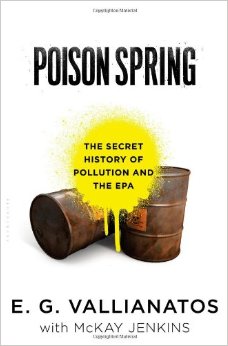
Poison Spring: The Secret History of Pollution and the EPA

Reviewed by Carol Van Strum - Independent Science News, February 23, 2015

Disclaimer: The views expressed here are not the official position of the IWW (or even the IWW’s EUC) and do not necessarily represent the views of anyone but the author’s.

“Science is the belief in the ignorance of experts,” Richard Feynman famously declared in 1966. Ever quick to challenge accepted wisdom, he distinguished the laudable ignorance of science, forever seeking unattainable certainties, from the dangerous ignorance of experts who professed such certainty.

Twenty years later, he would drop a rubber ring into a glass of ice water to show a panel of clueless rocket experts how willful ignorance of basic temperature effects likely caused the Challenger shuttle disaster (1).

Experts with delusions of certainty create imitative forms of science, he warned, producing “the kind of tyranny we have today in the many institutions that have come under the influence of pseudoscientific advisors.” (2)

Feynman’s warning against faith in the phony trappings of “cargo cult science” fell on deaf ears. Policies affecting every aspect of our lives are now based on dangerous forms of ignorance.

A prime case in point is the noble edifice of the U.S. Environmental Protection Agency, where a high-ranking EPA official was recently jailed and fined for collecting pay and bonuses for decades of non-existent work while he claimed to be working elsewhere for the CIA. Such long-standing fraud would hardly come as a surprise to Evaggelos Vallianatos, who toiled for a quarter of a century in the EPA’s Pesticide Division, ostensibly responsible for protecting human health and the environment from commercial poisons. His new book, Poison Spring: The Secret History of Pollution and the EPA, documents a culture of fraud and corruption infesting every corner and closet of the agency.

JUSTICE PUSHES WHISTLEBLOWER BOUNTIES AS EPA ABANDONS THEM - Declining EPA Prosecutions Reflect Low Priority for Corporate Pollution vs. Fraud

By Kirsten Stade - Public Employees for Environmental Responsibility, September 24, 2014

Disclaimer: The views expressed here are not the official position of the IWW (or even the IWW’s EUC) and do not necessarily represent the views of anyone but the author’s.

Washington, DC —As federal prosecutors promote substantial financial rewards for white collar crime whistleblowers, the U.S. Environmental Protection Agency cashiered its modest witness bounty program long ago, according to records released today by Public Employees for Environmental Responsibility (PEER). This may help explain the stagnancy of EPA’s anti-pollution criminal enforcement program.

In a September 17, 2014 speech at the New York University Law School, Attorney General Eric Holder advocated increasing the size of whistleblower awards under white collar crime bounty laws, saying it “could significantly improve the Justice Department’s ability to gather evidence of wrongdoing while complex financial crimes are still in progress – making it easier to complete investigations and to stop misconduct before it becomes so widespread that it foments the next crisis.”

By contrast, EPA has no interest in whistleblower bounties. In 1990, Congress authorized EPA to pay “an award, not to exceed $10,000, to any person who furnishes information or services which lead to a criminal conviction or a judicial or administrative civil penalty for any violation” of the Clean Air Act. In response to a Freedom of Information Act request from PEER about how this bounty authority had been utilized, the agency conceded that this provision had become a dead letter. EPA could find only one responsive document, a 1996 internal manual provision, because –

“Nearly all the records you requested were destroyed in 2012 because the retention schedule for those records had been met (10 years retention time).”

“The Justice Department now emphasizes the importance of whistleblowers to effective enforcement against corporate criminality while EPA remains clueless,” stated PEER Executive Director Jeff Ruch. “Corporate pollution violations are just as much a white collar crime as securities fraud.”

Reflecting persistent complaints about shortages of agents, lack of focus and low priority on complex pollution cases from within EPA’s own Criminal Investigation Division (CID), PEER points out that –

  • Criminal cases generated by EPA have been in overall decline over the last decade, with more than half of all its criminal referrals rejected for prosecution. During the first three-quarters of FY 2014, EPA generated only 207 new cases, putting it on track for the lowest number since 1992;
  • Despite policies requiring timely enforcement, EPA allows major wastewater dischargers to violate their permits for years without even a citation; and
  • EPA’s new five-year Strategic Plan deemphasizes traditional enforcement in favor of industry self-reporting of emissions and discharges.

“Agencies such as the Securities and Exchange Commission actively seek to verify corporate filings but when it comes to the environment EPA has no means for, or apparent interest in, checking whether industry pollution self-reporting is accurate,” added Ruch. “EPA hands out citizen awards for all sorts of volunteerism but not for helping catch polluters.”

Railroad Conductor: ‘Railroading Has Changed So Much’

Article and Photo by Steve Early - In These Times, September 8, 2014

Disclaimer: The views expressed here are not the official position of the IWW (or even the IWW’s EUC) and do not necessarily represent the views of anyone but the author’s.

For three years in the early 1970s, journalist Studs Terkel gathered stories from a variety of American workers. He then compiled them into Working, an oral-history collection that went on to become a classic. Four decades after its publication, Working is more relevant than ever. Terkel, who regularly contributed to In These Times, once wrote, “I know the good fight—the fight for democracy, for civil rights, for the rights of workers has a future, for these values will live on in the pages of In These Times.” In honor of that sentiment and of Working’s 40th anniversary, ITT writers have invited a broad range of American workers to describe what they do, in their own words. More "Working at 40" stories can be found here.

In Working, Terkel interviewed Bill Norworth, a railroad worker for fifty-three years who had recently retired as a locomotive engineer on the Chicago Northwestern Railroad. In 1970, he was still serving as president of his local of the Brotherhood of Railroad Engineers (which is now part of the Teamsters) in Working, Norworth described some of the changes in technology—including the transition from steam to diesel power—that affected working conditions, job skills and staffing levels during his career working on passenger and freight trains. Reflecting on the higher status of railroaders in the heyday of the industry, Norworth told Terkel: “They were the aristocrats at one time, but that time’s gone now…. The engineer was respected then, and now there’s no respect for him. He’s just a dummy….” As for deterioration of U.S. passenger train service, already evident four decades ago, he observed that, “If they had good trains again, people would ride. But they discourage you…”

Forty-two years later, Brian Lewis talked to In These Times about his job as a Union Pacific Railroad conductor, which he has just retired from after 36 years in the industry. He was long active in the United Transportation Union and also belongs to a cross-union reform group called Railroad Workers United (RWU). RWU has been fighting industry attempts to introduce single-employee train crews, which it believes are unsafe. RWU has also tried to warn regulators and the public about the dangers of longer and heavier trains, particularly those hauling hazardous materials like Bakken crude oil from North Dakota. Lewis talked to In These Times about how rail carriers have changed in the decades since Norworth’s long tour of duty and the challenges facing railroad workers today.

It was a childhood dream to become a railroad worker. Ever since I was a kid, I always loved trains. After graduating from UC-Berkeley and trying my hand at journalism for a few years in the early 1970s, I ended up at the Environmental Protection Agency (EPA) in San Francisco. I felt stuck in the office, doing intake on air quality complaints and setting up investigative interviews. Then, one day I saw a job advertisement—the Western Pacific Railroad was hiring “switchmen/brakemen” for its freight hauling operations between Salt Lake City and the Bay Area. I got my training and orientation in Portola, CA., a small railroad town north of Lake Tahoe, in the Sierras. The union was very involved in the whole process—job training, testing and helping to decide who made the grade and was ready to go. Half of my training class consisted of sons or daughters of existing railroaders.

Railroading has changed so much since then. In this day and age, they want you to have a college degree. But I didn’t dare tell them I had finished college because they would have figured I wouldn’t stick around and not hired me. I really thought I’d be coming back to the EPA so I took a 6-month leave of absence, just in case.  After two months on the railroad, I called and said I was never coming back. In my first six months, I made double and triple the money I was earning at the EPA. Of course, I was working a lot of hours. You used to be able to work 16-hours continuously before 12-hours on duty became the maximum.  It was a lot of very physical work, jumping on and off of moving equipment, throwing switches, with cars rolling in several different directions. They don’t let you climb on and off moving cars like that anymore. It was dangerous—and that’s why thousands of railroaders have been maimed or injured over the years.

Oil drilling in North Dakota raises concerns about radioactive waste

By Neela Banerjee - LA Times, July 26, 2014

Disclaimer: The views expressed here are not the official position of the IWW (or even the IWW’s EUC) and do not necessarily represent the views of anyone but the author’s.

very weekday, about a dozen large garbage trucks peel away from the oil boom that has spread through western North Dakota to bump along a gravel road to the McKenzie County landfill.

The trucks drive up to a scale flanked by something seldom found in rural dumps — two 8-foot-tall yellow panels that essentially form a giant Geiger counter.

Two or three times a day, the radiation detector blares like a squad car, because under tons of refuse someone has stashed yard-long filters clotted with radioactive dirt from drilling sites.

The "socks" are supposed to be shipped to out-of-state processing plants. But some oil field operators, hoping to save tens of thousands of dollars, dump the socks in fields, abandoned buildings and landfills.

"It's a game of cat-and-mouse now," said Rick Schreiber, the landfill's director. "They put the sock in a bag inside a bag inside a bag."

Nearly 1,000 radioactive filters were found last year at the landfill, part of a growing tide of often toxic waste produced by the state's oil and gas rush. Oil field waste includes drill cuttings — rock and earth that come up a well bore — along with drilling fluids and wastewater laced with chemicals used in fracking.

To many local and tribal officials, environmentalists and some industry managers in North Dakota, the dumping of the socks and the proliferation of other waste shows the government falling short in safeguarding the environment against oil field pollution.

The Environmental Protection Agency decided during the Reagan era to classify oil field waste as not hazardous, exempting it from tight controls and leaving it to be managed by widely varied state laws. Nationally, no one tracks how many millions of tons of waste the fossil fuel boom generates, or where it ends up.

The EPA exempts the waste, in part, because it considers state oversight adequate, despite what the agency calls "regulatory gaps in certain states."

Most oil companies dump drilling waste into thousands of pits by their wells, but North Dakota, the second-largest oil-producing state behind Texas, does not test the pits' contents or monitor nearby groundwater for contamination.

Read the rest of the article here.

IBEW, Fitters Locked Out by Construction Standards for the Milford and Easton Compressor Station Expansions

By Alex Lotorto - IWW Environmental Unionism Caucus, July 18, 2014

Disclaimer: The views expressed here are not the official position of the IWW (or even the IWW’s EUC) and do not necessarily represent the views of anyone but the author’s.

To: Executive Board, Officials, and Business Agents, et al.

  • United Association Local Union 524
  • IBEW Local 81
  • IUOE Local 542
  • Teamsters Local 229
  • LIUNA Local 130

From:  Alex Lotorto

Electrical Workers, Fitters are Locked Out By Construction Standards for the Milford and Easton Compressor Station Expansions

The proposed Milford and Easton Compressor Station expansions are part of Columbia Gas Transmission Co.’s (subsidiary of NiSource) East Side Expansion Project. Both proposed expansions do not utilize industry best practices to reduce or eliminate emissions that also require more manhours to install. This means that NiSource, which earned $5.7 billion in net revenue last year, is minimizing its costs, effectively swindling trade union members out of the best possible Project Labor Agreements. In this case, the cause of labor is also aligned with the cause of local environmentalists who seek to limit unnecessary harm to public health and air quality.

Specifically, it has been established by the gas industry associations and the Environmental Protection Agency’s Natural Gas Star program, that electric compressors, gas capture technology, and limiting production tank emissions are now the best practices for protecting air quality during transmission and distribution of natural gas. Columbia Gas is a partner in the EPA’s Natural Gas Star program and should be aware of their own recommendations.

In fact, technology like electric compressors and gas capture methods that eliminate blowdowns of methane during maintenance and inspections can pay for themselves as more methane is shipped to downstream customers. Methane that is now released into the atmosphere during blowdowns could be injected into the intersecting Tennessee and Transco pipelines at the Milford and Easton facilities, respectively, and sold to market. This would generate savings for NiSource within one to three years, depending on the price of methane. Above, you will find links to fact sheets for these technologies from the EPA, produced via industry partnerships.

Commonly, best practice recommendations become codified in EPA regulations once they have been shown to work in the field. This is the case for production tank rules limiting volatile organic compounds (VOCs) emissions to less than four tons per year, about to be enforced in January 2015 . Both Milford and Easton facilities will have waste liquid and condensate tanks that will be required to be fitted with VOC control technology next year. However, NiSource stated to Milford residents in pre-filing meetings that they will not be installing this technology, meaning lost work for union members and more exposure for neighboring families. In fact, there is nothing in their Resources Report submitted to the Federal Energy Regulatory Commission describing VOC controls. There is also nothing in the Resources Report describing how hazardous waste will be tended, removed, and disposed of from the facilities, a responsibility best handled by trained union labor.

Green Groups Endorse Empty EPA Carbon Emissions Regulation

By Ken Ward - TruthOut, June 17, 2014

Disclaimer: The views expressed here are not the official position of the IWW (or even the IWW’s EUC) and do not necessarily represent the views of anyone but the author’s.

For environmentalists, it turns out, climate truth is not merely inconvenient, it is incomprehensible. How else to explain the fawning response of major green groups to President Obama’s cynical carbon emissions scheme?

The Environmental Protection Agency’s (EPA) proposed coal plant emissions regulations are a trifecta of terrible: near to useless as emissions policy, effective in distracting attention from the administration’s overarching pro-fossil fuel plan, and a tragic obfuscation of the latest, deadly climate science reports.

The facts are not in dispute. Climate is in free fall, with recent definitive evidence that the first major geophysical system (the West Antarctic ice shelf) has passed its tipping point, guaranteeing 10 feet of sea level rise and providing irrefutable evidence that the entire, fragile system which has permitted civilization to develop is collapsing. The internationally agreed objective of limiting global temperature increase to 2 degrees Celsius is clearly way off base and all climate policy and strategy based on that target, which assumes a timeframe allowing for incremental response, is miscalculated.

In this context, President Obama unveiled an energy policy last month brazenly entitled “All of the Above,” which assumes a global temperature rise of 6 degrees Celsius, calls for an increase in oil and gas extraction and barely addresses climate change.(1) This pathway to doom was followed up last week with the EPA’s proposed emissions regulations for coal plants, which one business commentator described as a “big favor” to the power industry. The draft rules call for 30 percent emissions reduction from 2005 levels, half of which is already accomplished, and ignores the reality that coal being ripped from Appalachia and Western states will simply be shipped and burned elsewhere.

President Obama should have given the American people an honest explanation of the terrible predicament we now face and at least a sketch of the scale and timing of the global response now required – which must include new forestry and agricultural practices in addition to emissions cuts. What we got was a tepid description of the problem, weaker than past presidential statements, a flat lie (that natural gas has substantially less impact on climate than coal) and an understatement of risk so vast, in light of the most recent Antarctic news, as to arguably be considered misconduct.

Pages

The Fine Print I:

Disclaimer: The views expressed on this site are not the official position of the IWW (or even the IWW’s EUC) unless otherwise indicated and do not necessarily represent the views of anyone but the author’s, nor should it be assumed that any of these authors automatically support the IWW or endorse any of its positions.

Further: the inclusion of a link on our site (other than the link to the main IWW site) does not imply endorsement by or an alliance with the IWW. These sites have been chosen by our members due to their perceived relevance to the IWW EUC and are included here for informational purposes only. If you have any suggestions or comments on any of the links included (or not included) above, please contact us.

The Fine Print II:

Fair Use Notice: The material on this site is provided for educational and informational purposes. It may contain copyrighted material the use of which has not always been specifically authorized by the copyright owner. It is being made available in an effort to advance the understanding of scientific, environmental, economic, social justice and human rights issues etc.

It is believed that this constitutes a 'fair use' of any such copyrighted material as provided for in section 107 of the US Copyright Law. In accordance with Title 17 U.S.C. Section 107, the material on this site is distributed without profit to those who have an interest in using the included information for research and educational purposes. If you wish to use copyrighted material from this site for purposes of your own that go beyond 'fair use', you must obtain permission from the copyright owner. The information on this site does not constitute legal or technical advice.