

You are here

class struggle

Here’s How Rail Workers Are Fighting On After Biden Blocked a National Strike

By Jeff Schuhrke - In These Times, January 18, 2023

Politicians may have headed off their strike, but rail workers haven’t stopped organizing for paid sick leave and safe staffing.

While the high-stakes labor dispute on U.S. freight railroads has receded from headlines since President Joe Biden and Congress imposed a new contract last month, rail workers are continuing their fight for dignity and better conditions — albeit without the threat of a national strike on the table.

“The American people should know that while this round of collective bargaining is over, the underlying issues facing the workforce and rail customers remain,” the AFL-CIO Transportation Trades Department said in a statement.

The major underlying issue remains precision scheduled railroading (PSR), the business model adopted in recent years by Class I rail carriers like Union Pacific, BNSF, Norfolk Southern and CSX. Designed to maximize shareholder profits by cutting costs to the bone, PSR has been blamed for a dramatic reduction in the freight rail workforce, increased supply-chain congestion and deteriorating safety — all while investors rake in record profits.

As a potential railroad strike loomed late last year, the absence of guaranteed paid sick leave in the rail industry came to symbolize the immense strain PSR puts on workers. Without sick leave, and with the railroads implementing draconian attendance policies to deal with understaffing, workers face discipline for missing work due to illness and have to burn through their vacation time if they or their family members get sick. 

The tentative agreement between rail carriers and unions, brokered by Biden last September, did not include any guaranteed sick days — prompting a majority of the union rank and file to vote against ratifying the deal. 

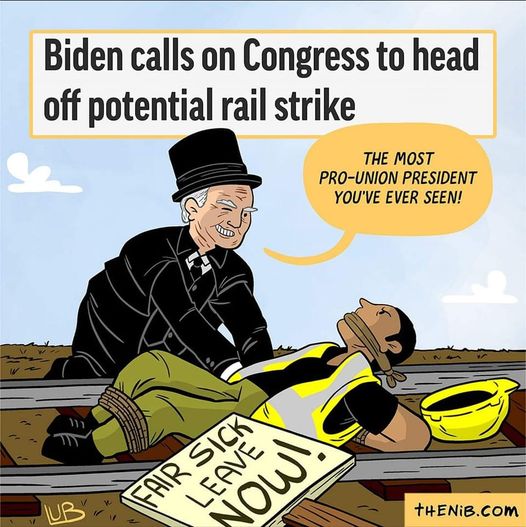
Late last year, when Biden called on Congress to override union democracy and impose the contract anyway, progressive Democrats attached a separate resolution mandating seven paid sick days, without the president’s public support. The measure passed in the House of Representatives, but failed in the Senate, where all but six Republicans voted against it. 

“President Biden campaigned on a week of paid sick leave for all working people, and then he had the opportunity right here but didn’t take action. He favored the corporations,” said Matt Weaver, a rail worker and member of the Brotherhood of Maintenance of Way Employes Division (BMWED) in Ohio. 

Sam Seder is RIGHT: Rail Workers DESERVE Support, Even If Some Are Conservative

Were Sick Days Not a Big Deal to Rail Workers?

#Insorgiamo: A Factory Occupation for the Climate

By Lukas Ferrari and Julia Kaiser - Rosa Luxemburg Stiftung, January 11, 2023

Over the last two years, Italian autoworkers have built a broad and inspiring alliance for ecological transformation:

Imagine a climate strike in which 40,000 industrial workers, climate activists, pacifists, and other non-politically active people are brought together. In their speeches, they denounce the shutdown of an automotive supply factory. They all agree that what is needed is a conversion of production instead of layoffs. The bloc right at the front of the demonstration is made up of workers from the affected factory, and behind them are masses of militant climate activists and spontaneous demonstrators.

The workers of the plant join forces with scientists to develop a conversion plan together and, based on their skills and the latest research in environmental sciences, a vision emerges of producing components for hydrogen-powered buses. More and more people agree: we need production centred on people instead of profits!

This vision — one that would not be at all out of place in an ecosocialist manifesto — became a reality in Tuscany, Italy. After the 422 employees and approximately 80 agency workers of the automotive supplier GKN Driveline received an email on 9 July 2021 informing them that they didn’t need to come to work next Monday, they occupied their plant in Campi Bisenzio, on the outskirts of Florence.

The strategic centre of the occupation and the wave of mobilization that developed around it came to be known collectively as the Collettivo di Fabbrica GKN, which operates autonomously from but closely with official trade union structures. The majority of the more than 500 workers, including the workers’ councils organized within the Federazione Impiegati Operai Metallurgici (FIOM), the Italian metalworkers’ union, identify as part of the collective, which meets outside of working hours.

GKN is an automotive supplier with more than 50 production plants worldwide. Up until the production halt in summer 2021 the plant in Campi Bisenzio mainly produced axle shafts for Fiat (Ducato), Maserati, and Ferrari. The plant has changed ownership many times over the last decades. Once under the property of Fiat, in 1994 it was bought by the company GKN, which in turn was bought by the British investment fund Melrose Industries in 2018 for 8 billion pounds. Only three years later management announced the shutdown of the plant in Campi Bisenzio and the layoff of all its employees, days after the Italian government lifted the ban on dismissals it imposed during the pandemic.

Statement of Solidarity with Railroad Workers

By Staff - Industrial Worker, December 23, 2022

The Industrial Workers of the World stands with U.S. rank-and-file railroad workers as owners and politicians collude to strip them of their most basic rights. The right to withhold our labor is inviolable and cannot be prohibited. Further, we believe that an injury to one is an injury to all. We are disgusted by the hypocrisy of so-called leaders in the U.S. government, who enjoy the luxury of virtually unlimited paid sick leave while legislating against any paid sick leave at all for railroad workers, and we are unsurprised when even the progressive wing of the Democratic Party ultimately aligns with their class over the workers. IWW members throughout the country are prepared to support railroad workers in every way possible as they lead this fight.
We hold that the failure to reach an agreement is undeniably the fault of the owners, who have enriched themselves and their shareholders at immediate cost to the workers generating the profits. One study of financial reports and internal communications for all the major rail carriers shows their unbridled avarice and total disregard for their workforce. They are well aware that wages have been stagnant for years. This was by design. They know that workers have fled the industry due to its destruction of workers’ quality of life and the carrot-and-stick system that prevents their use of promised benefits. They know that injuries on the job have reached record highs in recent years due to understaffing and impossible demands placed on workers.

The agreement being imposed by Congress is unacceptable. Wage increases to compensate for the lack thereof in years past, as well as skyrocketing inflation and cost of living more recently, are inadequate. Workers have univocally demanded more predictable scheduling and safer working conditions. Paid sick leave was a compromise many workers may have been willing to accept. It is the owners and their lackeys in government who refuse to compromise. It is despicable.

We in the IWW encourage workers from all industries to stand together with railroad workers. United we are strong. Together we can win.

For more information on Railroad Workers United, please contact RWU General Secretary Jason Doering, via email or at 202-480-0587.

For anyone who faces detainment for exercising their right to strike, or who knows someone who does, the IWW’s Incarcerated Workers Organizing Committee conducts public pressure campaigns and facilitates empowerment through solidarity. They can be contacted at IWOC@iww.org.

Additional statements of solidarity from members and local branches of the IWW throughout the U.S. are being prepared and issued even as mainstream media declares the “crisis averted.” For workers, the crisis only deepens. These conditions can be changed only when we stand together as one. Workers of the world: unite!

Workers Are Standing Up Against Railway Unions’ Raw Deal

By Shuvu Bhattarai - The Progressive, December 15, 2022

Biden forced railway workers to accept an agreement that lacked paid sick days; now rallies against the deal have spread across the country.

On December 7, outside of New York City’s Grand Central Terminal, a crowd of more than 100 Metro-North Railroad workers, airline pilots, construction workers, teachers, and activists held a solidarity rally in support of railway unions. 

The rally is the latest in a string of protests that have taken place across the country after President Joe Biden and the U.S. Congress imposed a tentative agreement on Class I freight rail workers, an agreement that had been voted down the membership of four rail unions representing a total of around 60,000 workers. The agreement grants only one additional day of paid sick leave, which was a major concern for the rail workers, many of whom are on call virtually 24/7. 

Five days before the Grand Central rally, on December 2, about 200 protesters held a demonstration outside of Boston’s JFK Museum, while Biden was visiting. They called the President a “scab” and a “strikebreaker,” chanting “striking is a human right,” and demanding sick leave for all. On December 5, around 30 people demonstrated outside of the Brooklyn home of Democratic Senator Chuck Schumer. Schumer had voted for the tentative agreement. 

On December 6, a small protest was held at the University of California, Berkeley, where striking UC Grad Workers spoke about how their struggle was connected to that of the rail workers. The next day, a group of twenty-five union members and activists in Baltimore, Maryland, gathered with similar demands.

At the Grand Central rally, which was partly coordinated by the December 12th Movement, a Black human rights organization based in New York City, organizer Omowale Clay echoed the feeling of betrayal by the Democratic establishment that’s been driving these outpourings of solidarity: “To take away the right of our brothers and sisters to strike is a violation of their human rights. To take away their right to be sick so that they can speed up and exploit us more is a violation of their human rights.” 

Justine Medina, a worker organizing with the Amazon Labor Union added, “We won our election on April 1, eight months ago, and the bosses refused to recognize Amazon Labor Union, refused to come to the table to negotiate a contract, just like the railroad workers.” 

Similar messages of support were echoed by teachers, construction workers, and others during the protest. A member of Railroad Workers United, a cross-union solidarity caucus of railroad workers, spoke of how the conditions in the job deteriorated especially over the past few years. 

Railroad and UC Workers Solidarity

By That Green Union Guy (with suggestions from Baltimore Red)- IWW Environmental Union Caucus, December 6, 2022

I gave the following speech at a rally on the UC Berkeley Campus (a video of the rally follows)

Fellow Workers, Comrades, and Friends:

I am a union mariner of over a quarter century (I am a member of the IBU, an ILWU affiliate, and the IWW); I grew up in a railroad family, and I graduated from UC Berkeley in 1994.

I am here today to deliver a message on behalf of Railroad Workers United (of which I am a solidarity member):

The Class One freight railroad bosses:

  • Have been reaping record profits for 25 years, and yet...
  • they are moving less freight than at any time since 2006;
  • they are swimming in money, while industry is contracting when it should be expanding due to its efficiency, and its potential as a major climate solution;
  • meanwhile, during that time, 30% of workforce has been lost in the last 4-5 years;
  • in spite of the potential for rail as a climate solution, the freight bosses are hostile to expansion of passenger trains;
  • in fact, the greed of the capitalist railroad bosses has grown so egregious, that the Class Ones have possessed off every major shipping group with their BS, thus even turning much of the capitalist class against them;

The "deal" brokered by Biden and rammed down the throats of the working class by the Republicans and Democrats alike won't solve the problem.

This is not only naked class war, it's a recipe for the complete implosion and meltdown of the nation's rail system.

Climate Change As Class War: A Review

By Tom Wetzel - Ideas and Action, December 6, 2022

As the burning of fossil fuels continues to pump up the size of the carbon dioxide layer in the atmosphere, the global warming crisis becomes ever more acute. In its “Code Red for Humanity” warning in 2021, the UN’s Intergovernmental Panel on Climate Change said: “The alarm bells are deafening, and the evidence is irrefutable: greenhouse gas emissions from fossil-fuel burning and deforestation are choking our planet and putting billions of people at immediate risk. Global heating is affecting every region on Earth…”

But we’re losing the climate battle thus far. In Climate Change as Class War, Marxist geographer Matthew Huber argues that the climate movement is losing because it is rooted in the “professional class.” He argues that this class lacks the power to defeat the powerful capitalist interests that drag their heals against the kind of drastic cutting back of fossil-fuel burning that is needed. For Huber, the climate movement needs to be rooted in the working class to have sufficient power to enact radical structural reforms needed to effectively fight global warming. 

Huber analyses the existing climate movement as consisting of three layers. First, there are the “science communicators” like James Hansen who try to do popular education about climate change science. A second group are “policy technocrats” with expertise in law or policy studies and work in think tanks, the university world, or non-profits. Their orientation is to craft “smart” policy solutions. A third group are the “anti-system radicals” whose exposure to the science of environmental devastation “leads to a kind of political radicalization.” Huber views these groups as part of the “professional class” and tries to use his theory of this class to explain the politics of the climate movement. Huber pinpoints two features of the climate movement that he sees as sources of weakness: (1) The emphasis on high levels of personal consumption as a factor in global warming, thus leading to a “politics of less” — especially a feature of “degrowth” politics; and (2) an emphasis on science education. “Making climate politics purely about science evades the question of power. It allows us to attribute…inaction on climate change as simply due to misinformation rather than a lack of power.”

Huber appeals to the theory of the “Professional-Managerial Class” (proposed by Barbara and John Ehrenreich) to try to explain the origin of these features of the “professional class” climate movement. Here he points to the centrality of credentials which mediates the access of the “professional class” to the labor market. This includes “the existence of a specialized body of knowledge, accessible only by lengthy training,” degree and licensing programs, professional associations, which he regards as “forms of class organization.” This tends to encourage acceptance of meritocratic ideology which favors decision-making power for managers and professionals. This emphasis on the importance of knowledge and the role of professionals tends to favor the science education emphasis of the climate movement, as Huber sees it.

In the Ehrenreichs’ theory of the PMC their class position is based on their control over cultural and social reproduction. This is how teachers and writers are included in the class. Among both Marxists and libertarian socialists, however, class has historically been seen as an institutional group-to-group power relation in social production, as in Marx’s concept of capital as a social power relation. Looking at it from this point of view, I think the PMC theory tends to paper over a distinction between two different class groups. First, there is a group I call the bureaucratic control class. This group’s class position is based on their relative monopoly of decision-making power, via bureaucratic hierarchies that exist to control labor and run corporations and government agencies day-to-day. This includes not only salaried managers but high-end professionals who work closely with management to control labor and defend corporate interests, such as corporate lawyers, HR experts, and industrial engineers who design jobs and work organization. This class power relation is the basis of the clear antagonism between this layer and the working class. 

It’s noteworthy that school teachers, newspaper reporters, script writers, and nurses all form unions and occasionally go on strike. These lower level professional employees are not usually part of the management apparatus, and don’t manage other workers. As such, they have a structural position like the core working class of manual workers, not the bureaucratic control class. The people in this lower professional layer often have college degrees, and sometimes do show elitism towards the core manual working class. They also tend to have more autonomy in their work. However, the “skilled trades” in the early 20th century often showed elitism towards less skilled manual workers and often had relative autonomy in their work. But we generally regard skilled blue collar workers (such as tool and die makers) as part of the working class. 

Lower level professional employees may be tempted to middle class meritocratic ideology. As such they will be in a conflicted position, as they also share the subordination of the working class position. This is why Erik Olin Wright’s phrase “contradictory class location” is appropriate for this group — a point that Huber concedes.

Railroad Workers’ Lives Revolve Entirely Around Their Jobs

By Andrew Perez - Jacobin, December 5, 2022

We spoke with a longtime BNSF conductor about the labor agreement recently imposed on railroad workers by President Biden. He says he feels betrayed by a president he thought was pro-labor and explains how his job has gotten worse over time.

Rob Kufalk is “always at the mercy of the railroad,” as his wife Mona puts it. “Our life only functions around the railroad.”

A longtime conductor for BNSF Railway, Kufalk is virtually always on call. He must be ready to get to work within ninety minutes from when the company says they need him — which can happen any time, day or night. The family lives forty-five minutes away from the terminal in La Crosse, Wisconsin, that serves as his home base. He spends a lot of time away in hotels in Chicago and Galesburg, Illinois.

Kufalk said the demands on his time have gotten worse over the years, with the industry shedding jobs to cut costs as part of its so-called “precision scheduled railroading” strategy. The situation, he said, has become unbearable since BNSF implemented a new points-based attendance policy, under which employees can be disciplined or fired for missing a call to come into work or taking an unplanned day off.

“They want us available for duty 95 percent of the time now — 24/7/365,” said Kufalk. “I try to plan for doctor’s appointments and other things and it’s almost impossible. Sometimes you just have to lay off and take the hit on the points.”

The lack of paid sick time afforded to workers was at the center of the high-stakes labor dispute between unions and giant railroad companies that came to a head last week. Through more than three years of contract negotiations, the railroads flatly refused to budge and give workers any paid sick days. The companies knew they didn’t really have to negotiate, because politicians in Washington wouldn’t risk allowing rail workers to strike and slow shipments — especially now during the holiday season — at an estimated cost to the economy of $2 billion per day.

The Case for Public Ownership of the Rails in the US

Pages

The Fine Print I:

Disclaimer: The views expressed on this site are not the official position of the IWW (or even the IWW’s EUC) unless otherwise indicated and do not necessarily represent the views of anyone but the author’s, nor should it be assumed that any of these authors automatically support the IWW or endorse any of its positions.

Further: the inclusion of a link on our site (other than the link to the main IWW site) does not imply endorsement by or an alliance with the IWW. These sites have been chosen by our members due to their perceived relevance to the IWW EUC and are included here for informational purposes only. If you have any suggestions or comments on any of the links included (or not included) above, please contact us.

The Fine Print II:

Fair Use Notice: The material on this site is provided for educational and informational purposes. It may contain copyrighted material the use of which has not always been specifically authorized by the copyright owner. It is being made available in an effort to advance the understanding of scientific, environmental, economic, social justice and human rights issues etc.

It is believed that this constitutes a 'fair use' of any such copyrighted material as provided for in section 107 of the US Copyright Law. In accordance with Title 17 U.S.C. Section 107, the material on this site is distributed without profit to those who have an interest in using the included information for research and educational purposes. If you wish to use copyrighted material from this site for purposes of your own that go beyond 'fair use', you must obtain permission from the copyright owner. The information on this site does not constitute legal or technical advice.
