By GAIA - Partnership for Working Families, MassCOSH, and the National Council for Occupational Safety and Health, June 23, 2015
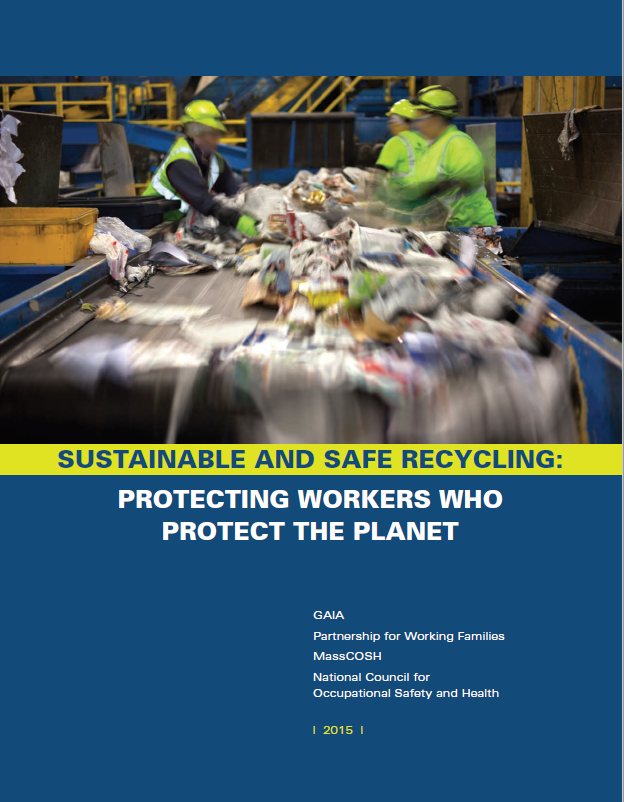 Zero waste is the future. Growth in the recycling economy has the potential to not only conserve the environment, but also create 1.5 million new jobs. But research indicates that recycling work can be dangerous, with injury rates more than double the national average. By addressing this problem, local governments have an opportunity to secure the sustainability and health of their cities while ensuring that recycling jobs are good jobs. Recyclers deserve safe working conditions, as they protect public health and the planet from waste, pollution, and resource depletion.
The environmental necessity of recycling is well-established: achieving a 75% recycling rate would yield greenhouse gas emission reductions equivalent to shutting down one-fifth of all U.S. coal power plants (Tellus 2011). A growing number of cities recognize recycling as a key component of their local climate action plans (West Coast Climate and Materials Management Forum 2012). In short, recycling provides proven benefits for clean air and waste reduction, and along with other zero waste strategies it can offer a critical pathway for municipalities to achieve sustainable growth.
Recycling can also play a key role in urban job creation strategies. At our current national recycling rate of 34.5%, the U.S. recycling industry employs nearly 1 million people and generates billions of dollars of economic activity annually (Tellus 2011, USEPA 2012).
Studies have shown that recycling creates at least 10 times as many jobs per ton of waste as disposal in either incinerators or landfills, and that investments in recycling, composting, and recycling reliant manufacturing could produce 1.5 million more jobs across the country.
But recycling workers face serious hazards on the job. In too many cities across the country, sorters work in loud and dusty facilities where they are often exposed to extreme temperatures. Working long hours, they lean over conveyor belts sorting materials – pulling out things that don’t belong, ensuring the best quality materials are bundled together for the highest value. They work with heavy equipment in dangerous situations – climbing onto and into massive conveyor belts and balers to clean them. They maneuver past huge front-end loaders and forklifts, and walk by heavy bales of material that, when unsafely managed, can fall on workers who are in the wrong place at the wrong time. Moreover, they deal with an array of inherently unsafe materials that should not be on the recycling line – used needles, chemicals, dead animals and broken glass. As a result of these unsafe conditions, recycling workers face above-average injury rates and are sometimes even killed on the job.
Many recycling sorters are employed by temp agencies, further increasing the likelihood that they won’t have the training or experience needed to do their job safely. But it doesn’t have to be this way. Occupational hazards can be mitigated, and in some cases eliminated, with a combination of engineering controls, improved safety systems, work practices, and extensive training.
There are important actions and best management practices that cities can and should take to improve recycling jobs. Cities that offer curbside recycling service generally contract with private companies to process recyclable materials collected from households. To ensure safe and dignified recycling jobs, municipal governments must require rigorous health and safety standards in recycling contracts.
This report offers a unique inside look at the working conditions faced by recycling workers across the United States, as well as a series of specific policy recommendations that municipal decision makers should follow to improve industry accountability and health and safety outcomes. It also includes practical recommendations for public education programs that can prevent dangerous materials from entering the recycling stream. Our analysis is based on occupational health studies, OSHA reports about health and safety violations, articles from news media and industry trade publications, interviews with recycling workers, and first-hand observation of recycling work.
Our findings underscore the need for urgent action to improve health and safety conditions for recycling workers. Improving the recycling sector overall is not only possible – it’s imperative for averting today’s ecological crises, and protecting the health and well-being of this important group of climate workers who protect us all.
Read the report (PDF).






 Desperate to avoid climate regulation that may affect profits, polluting corporations are working hand-in-hand with governments, presenting a dizzying array of false solutions that deepen inequalities in our societies. There is a clear agenda: Manage the climate crisis without compromising profits, the power structures or the economic system that got us here, even if that means exacerbating the problem. Wall Street financiers, the synthetic biology industry, “green” venture capitalists and a host of others are jumping on the “we care about the climate, too!” bandwagon.
 In this 34-page comic book for both youth and adults, 16-year-old Gabe Sanchez of East Oakland tells the story of how he and his grandfather time-travel 50 years into the future. His 60-year-old self tells him the story of how climate change has shaped his life: the superstorm that destroyed his home and livelihood, the collapse of California agriculture, and more. But 60-year-old Gabe also shows the many ways people today are fighting to stop fossil fuels and build a green economy. Gabe and Grandpa return to 2016 determined to join the movement for climate justice.
 Hazelwood Power Station (HPS) was built between 1964 and 1971, and comprises 1542 megawatt (MW) of capacity over eight generators. It was privatised by the Victorian Liberal Party Kennett government in 1996 for $2.35 billion.If HPS had stayed in public hands, it would likely have been decommissioned in 2005, but in 2004 the Bracks Labor government extended its operations till 2031, allowing Hazelwood to move a road and a river to access 43 million tonnes of brown coal deposits in a realignment of the mining licence boundaries. The owners have a 30-year mining licence due for renewal in 2026.HPS and the land on which it operates are owned by the Hazelwood Power Partnership. Since 7 June 2013, the four partners have been subsidiaries of International Power (Australia) Holdings Pty Ltd. This company is in turn jointly owned by subsidiaries of Engie (formerly GDF Suez SA) (72 per cent ownership) and Mitsui & Co Ltd (28 per cent ownership). Engie is a global energy company with corporate headquarters in France. Mitsui & Co Ltd is a global trading company with corporate headquarters in Japan.Currently HPS produces more than 10,000 gigawatt hours (GWh) of energy annually and is supplied with up to 18 million tonnes of coal each year from the adjacent Hazelwood mine, releasing around 16 million tonnes of greenhouse gases annually. Today HPS provides approximately 21 per cent of Victoria’s baseline electricity supply.
 This book is a collection of five essays that deal with the prime threat to human life on Earth: the tendency of global capitalist economic development to develop us to death, to drive us off the cliff to ecological collapse. It begins with a review of the origins of this economic dynamic in the transition to capitalism in England and Europe and with an analysis of the ecological implications of capitalist economics as revealed in the work of its founding theorist – Adam Smith. I argue that, once installed, the requirements of reproduction under capitalism – the pressure of competition, the imperative need to innovate and develop the forces of production to beat the competition, the need to constantly grow production and expand the market and so on, induced an expansive logic that has driven economic development and overdevelopment, down to the present day.
 Since the financial crisis of 2008 and the subsequent “Great Recession,” governments have mostly scaled back or deemphasized their climate protection and “green” commitments. Lack of public funds and concerns about growth, competitiveness, and unemployment are frequently cited as explanations for this apparent loss of both ambition and urgency. The “green growth” narrative that colored various countercyclical “stimulus” spending packages from 2009-10 has been largely abandoned.
 The global development of ‘unconventional’ fossil fuels (UFF) such as shale gas has provoked much debate involving scientists,industry, political decision-makers, environmental groups and civil society. More than a decade of large- scale development in North America has left a legacy of environmental damage, primarily resulting from the use of high- volume horizontal hydraulic-fracturing (also known as ‘fracking’) to extract the unconventional oil and gas. Despite the controversy surrounding this technique, the numerous unknowns and uncertainties concerning its impacts and the growing number of questions about the economic benefits of this industry, oil and gas operators are eager to identify new opportunities and so are engaged in a battle to make frackingpublicly and socially acceptable worldwide.
 This site is not the official webpage of the Industrial Workers of the World.