






You are here
publications
 This report documents massive exports of federally owned coal from 2000-15. The US Bureau of Land Management sold private companies the right to mine this coal for a pittance—in some cases, for less than 20 cents per ton. And when Asian demand was red-hot, these companies made massive profits selling millions of tons of federal coal overseas. Nonetheless, the Bureau of Land Management (BLM) has essentially ignored export economics when setting the “fair market value” that it will accept for federal coal leases. Now that the Department of Interior has placed a three-year moratorium on new coal leases pending a thorough review of federal coal policies, BLM has an ideal opportunity for a thorough review of the economics of exports. And our report points to evidence that by ignoring exports, the BLM has been selling many federal coal leases at just a fraction of their true economic value.
 California’s leadership role in climate policy has once again been confirmed by the passage of Senate Bill 32 (Pavley, 2016), which commits the state to the ambitious target of reducing greenhouse gas emissions to 40 percent below 1990 levels by 2030—staying the course to an 80-percent reduction by 2050. A central issue in the SB 32 political debate, as well as the many related policies that preceded it, is the impact of climate policy on equity: how to ensure that low-income and working-class Californians do not dis-proportionately bear the costs and are included in the benefits of California’s transition to a low-carbon economy. This report presents a Climate Policy Equity Framework to assist California decision-makers interested in reducing greenhouse gas emissions in ways that promote economic, social, and environmental equity. We suggest that policymakers, regulators, community groups, advocacy organizations, and business interests should develop a “social contract” to manage a transition to a low-carbon economy that both maximizes the benefits of low-carbon economic development and minimizes the risks to working people and disadvantaged communities. This social contract can strengthen the broad political coalition needed to stay the course on the state’s ambitious greenhouse gas reduction goals, particularly in the face of accelerating greenhouse gas emission reductions and a legal challenge to the constitutionality of California’s cap-and-trade system. The Climate Policy Equity Framework can then guide policy development and program implementation to reflect and support the social contract.
 This publication is intended to support the use of the Voluntary Guidelines on the Responsible Governance of Tenure of Land, Fisheries and Forests in the Context of National Food Security. It is not intended to contradict the language of the Guidelines as endorsed by the Committee on World Food Security on 11 May 2012 nor the role of states in their implementation.
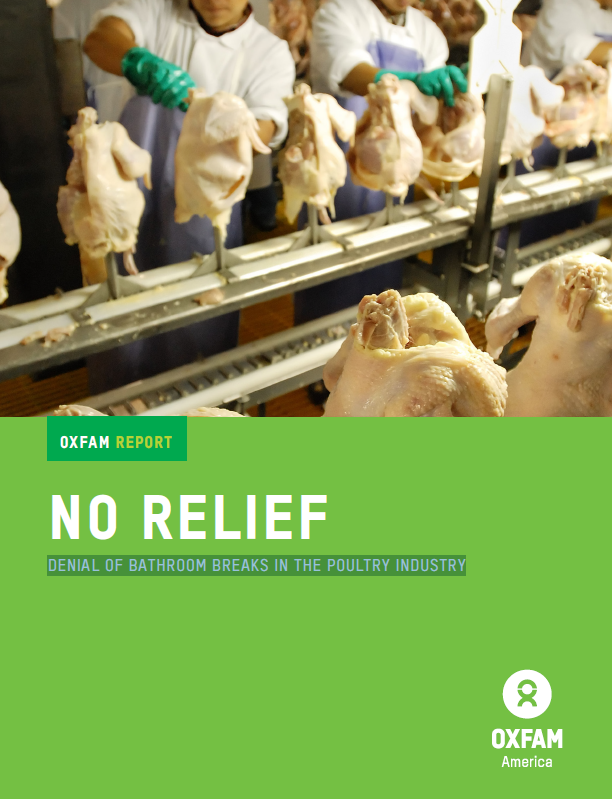 As poultry workers are routinely denied adequate bathroom breaks, they face dangers to their health and blows to their dignity.
 Today’s food and farming systems have succeeded in supplying large volumes of foods to global markets, but are generating negative outcomes on multiple fronts: widespread degradation of land, water and ecosystems; high GHG emissions; biodiversity losses; persistent hunger and micro-nutrient deficiencies alongside the rapid rise of obesity and diet-related diseases; and livelihood stresses for farmers around the world.
 The future of the major international oil companies (IOCs) – BP, Chevron, ExxonMobil, Shell and Total – is in doubt. The business model that sustained them during the 20th century is no longer fit for purpose. As a result, they are faced with the choice of managing a gentle decline by downsizing or risking a rapid collapse by trying to carry on business as usual.
The Fine Print I:
Disclaimer: The views expressed on this site are not the official position of the IWW (or even the IWW’s EUC) unless otherwise indicated and do not necessarily represent the views of anyone but the author’s, nor should it be assumed that any of these authors automatically support the IWW or endorse any of its positions.
Further: the inclusion of a link on our site (other than the link to the main IWW site) does not imply endorsement by or an alliance with the IWW. These sites have been chosen by our members due to their perceived relevance to the IWW EUC and are included here for informational purposes only. If you have any suggestions or comments on any of the links included (or not included) above, please contact us.
The Fine Print II:
Fair Use Notice: The material on this site is provided for educational and informational purposes. It may contain copyrighted material the use of which has not always been specifically authorized by the copyright owner. It is being made available in an effort to advance the understanding of scientific, environmental, economic, social justice and human rights issues etc.
It is believed that this constitutes a 'fair use' of any such copyrighted material as provided for in section 107 of the US Copyright Law. In accordance with Title 17 U.S.C. Section 107, the material on this site is distributed without profit to those who have an interest in using the included information for research and educational purposes. If you wish to use copyrighted material from this site for purposes of your own that go beyond 'fair use', you must obtain permission from the copyright owner. The information on this site does not constitute legal or technical advice.
 This site is not the official webpage of the Industrial Workers of the World.