

You are here

publications

(Working Paper #7) An Illness to One is the Concern of All: The Health Impacts of Rising Fossil Fuel Use

By Svati Shah and Sean Sweeney - Trade Unions for Energy Democracy, September 2016

This paper has been written to help unions representing workers in all sectors get a clear sense of what is presently happening in terms of the health impact of fossil fuel use and what could also happen if present patterns in energy use continue into the future. The data are presented in a way that unions can use to more effectively advocate both for their members and the broader public.

Unions in health care can play—indeed are playing—an important role in addressing both the climate-related and the pollution-related dimensions of the unfolding health crisis, as can health and safety personnel working with or for unions in different sectors. But the health-related impacts of rising pollution levels and climate change are expected to affect the lives of workers across a range of occupations. Unions representing workers in emergency services, workers in transport systems, or workers who must work outdoors in agriculture or construction also have a particularly important role to play. The situation requires as unified a response as possible.

One of the striking features of fossil fuel use today is how much it reflects and reinforces class inequalities. It is well known that rich countries consume far more energy per per-son than poorer ones, but within both rich and poor countries there is often a huge gulf between the energy consumed by the rich and the energy consumed by the poor and working class. The same is true of emissions. A December 2015 study released by Oxfam calculated that the poorest half of the global population are responsible for only around 10% of global emissions yet live overwhelmingly in the countries most vulnerable to climate change while the richest 10% of people in the world are responsible for around 50% of global emissions.

Trade unions with the capacity to play more of an active role in resisting the expansion of fossil fuel use can be confident of the fact that they will be intersecting with a rising global movement that is confronting fossil fuel extraction, including “unconventional fuels” like shale gas and shale oil. The concerns that drive this movement are numerous. Along with climate and air quality concerns, struggles have been built around questions of water scarcity and contamination and the fight to defend land and livelihoods from “extractivist” energy companies.

Read the report (PDF).

Life After Coal: Pathways to a Just and Sustainable Transition for the Latrobe Valley

By Anne Martinelli, et. al. - Environment Victoria - September 2016

The Latrobe Valley has a proud history of supplying the electricity that powers Victoria. But coal-burning power stations are ageing and –responding to climate change – the world is moving rapidly to cleaner energy sources. In this shifting context, the Latrobe Valley faces inevitable change. The question is: how will that change be managed?

With recent news that Hazelwood power station may close as early as in April 2017, there is a narrow window of opportunity to ensure that the Latrobe Valley prospers during the transition to a cleaner economy, rather than suffers as it did during previous economic changes.

A ‘just transition’ is a framework for managing the shift towards such new economies, with a focus on inclusive participation for those affected and a fair distribution of the costs and benefits of change.

This report explores what a just, and well-managed, transition process for the Latrobe Valley might look like. As experience from around the world has shown, when industrial change does arrive it can come very quickly, and being unprepared is costly.

In South Wales, UK, where there was little transition planning prior to the 1980s coal-mine closures, the damaging economic and social consequences have been profound and long-lasting. By contrast, Rochester, New York, which started planning its transition two decades before the city’s main employer – Kodak – collapsed, the situation has been more positive.

The first closure of one of the four large coal-burning power stations in the Latrobe Valley could be as early as 2017, and the rest could quickly follow. Tangible action and funding to develop an alternative economic future is required now.

For the Latrobe Valley to successfully achieve a just transition, two equally important processes must occur: (1) an orderly and planned transition away from coal; and (2) a collaborative and inclusive transition towards a sustainable local economy.

Read the Report (Link).

Smoke and Mirrors: Lonmin’s failure to address housing conditions at Marikana, South Africa

By staff - Amnesty International, August 16, 2016

Since 2012 Amnesty International has commented and campaigned on the serious policing failures that led to the deaths at Marikana, calling for full accountability and reparations for the victims and their families. That work continues.

This report examines abuses of the right to adequate housing of mine workers at Lonmin’s Marikana mine operation. Its primary focus is an examination of Lonmin’s response to the findings of the Farlam Commission.

In this regard it looks both at what Lonmin has done and what the company has said about the situation.

Read the text (PDF).

Critical Gulf: The Vital importance of ending new fossil fuel leases in the Gulf of Mexico

By various - Center for Biological Diversity, Friends of the Earth, Louisiana Bucket Brigade, Bold Louisiana, August 2016

As this report was going to press, a massive storm caused unprecedented flooding in Louisiana, destroying tens of thousands of homes and killing at least 11 people. Thousands of others were forced to evacuate. This is exactly the kind of extreme weather projected to become more severe on the Gulf Coast as the climate crisis intensifies.
And that’s what this report is about: the necessity of a rapid and just transition to clean energy to reduce this terrifying threat to the Gulf Coast. We must begin by stopping new fossil fuel leasing in the Gulf of Mexico to prevent offshore drilling and fracking that could ultimately contribute nearly 33 billion tons of carbon dioxide equivalent to global warming.

“Climate change is never going to announce itself by name. But this is what we should expect it to look like,” was the first line of a New York Times story about the flood. Indeed climate scientists and meteorologists are linking the Louisiana deluge to a series of extreme floods caused by climate change in the United States over the past two years.

The link between burning fossil fuels and heavy rains is clear and direct. Burning fossil fuels releases greenhouse gases, which warms our atmosphere. “As the atmosphere warms, so does the ocean,” climate scientist Katherine Hayhoe explained in a recent Facebook post about the Louisiana flooding. “Evaporation speeds up, making more water available for a storm to pick up and dump as it sweeps through.”

The National Weather Service in New Orleans measured record levels of moisture in the air during this storm. More than two feet of rain fell on Baton Rouge and southern Louisiana in under 48 hours, sending most of the region’s rivers over their banks on Aug. 17 and flooding thousands of homes. That deluge was the result of a low-pressure storm system that stalled off the coast and kept sucking more moisture from the unusually warm Gulf waters, which will only grow warmer over time.

It’s high time the communities of the Gulf Coast cease to be treated as sacrifice zones. They deserve environmental justice and a clean energy future. Turning away from fossil fuel extraction in the Gulf will allow them to weather future storms, help end our dangerous collective reliance on fossil fuels, and dramatically reduce hazards for future generations.

Read the report (PDF).

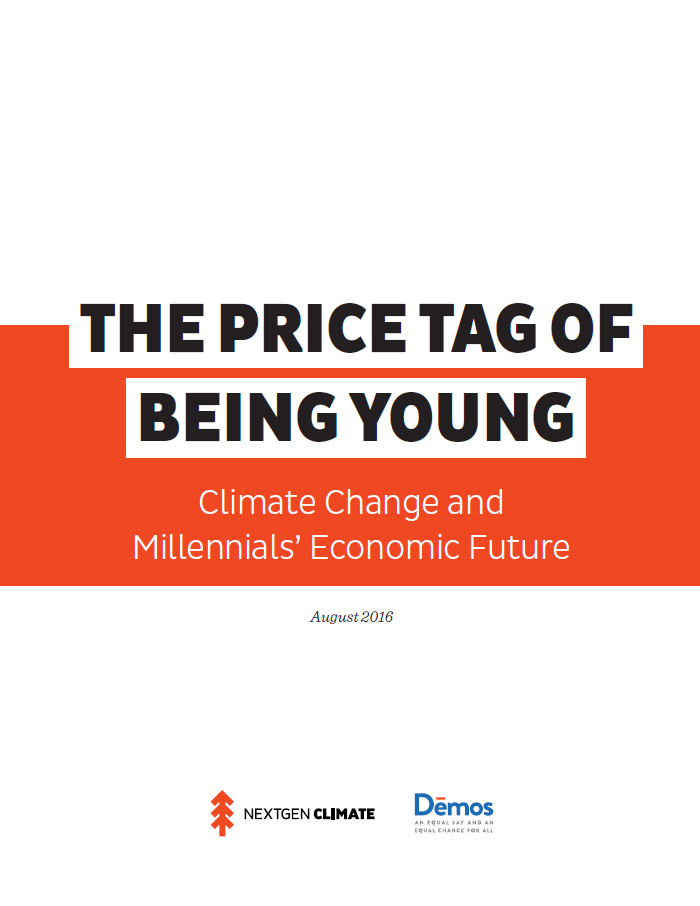
The Price Tag of Being Young: Climate Change and Millennials’ Economic Future

By Rachel Morello-Frosch, Manuel Pastor, James Sadd, Lara Cushing, Madeline Wander, and Allen Zhu - NextGen Climate and Demos, August 2016

This report quantifies the cost of climate change to millennials and their children, compared to a world without climate change. The climate change costs are compared to other significant economic burdens millennials will face over the course of their lifetime, including student debt, child care, stagnant wages, and the lack of good jobs. The key findings of this analysis include:

  • Without action on climate change, a 21-year-old in the class of 2015 earning a median income will lose $126,000 in lifetime income, and $187,000 in wealth.
  • Without action on climate change, a 21-year-old earning a median income will lose $100,000 in lifetime income, and $142,000 in wealth.
  • For the children of millennials, the losses from climate change will be drastically greater.
  • Without action on climate change, the millennial generation as a whole will lose nearly $8.8 trillion in lifetime income.
  • The economic losses caused by climate change are substantially greater than the damages of other economic challenges.
  • Student debt costs the median-earning college-educated individual approximately $113,000 in lost wealth over a lifetime, due to reduced savings for retirement and home ownership.
  • Losses from the Great Recession cost the median-earning college-educated household $112,000.

We must act quickly to address climate change because the impacts are occurring now faster and stronger than predicted:

  • July 2016 was the 15th straight month of record-breaking heat.
  • The 21st century has seen 15 of the 16 hottest years on record.
  • For the eighth consecutive year, extreme weather has cost U.S. taxpayers over $10 billion.
  • Sea levels are rising and in Miami, Norfolk, and other coastal cities, tidal flooding is becoming the norm – even on days without storms.
  • Drier and longer droughts are threatening our public health and crops.

We must transition to a 100 percent clean energy economy in order to avoid the devastating economic impacts of climate change detailed in this report.

Read the report (PDF).

Green Jobs for Tomorrow

By staff - Canadian Labour Congress, July 28, 2016

The biggest challenge of our generation could also be the biggest opportunity of the century for economic growth and job creation. The Canadian Labour Congress (CLC) rejects the notion that there is a fundamental conflict between the economy and jobs and environmental sustainability. Good economic and job creation policies must address all the indicators of a good quality of life — the economy, jobs, equality and the environment. Canada has an unprecedented opportunity to create new and better jobs as part of a planned transition to a much more energy efficient and environmentally sustainable economy. There is an urgent need for labour to address not only climate change with solutions which can be deployed quickly but also to seize the opportunity to create new and better jobs and ensure that climate change policies will not increase inequality in Canada.

The CLC supports a green jobs strategy and an environmental economic development strategy which places manufacturing and trade policies at the center of the climate change agenda. The CLC looks forward to any opportunity to work in collaboration with government to build support for effective and concrete measures to avert catastrophic climate change while ensuring that the path forward also builds a stronger economy with good jobs.

The CLC will work and collaborate with employers, educators and governments to minimize the costs of adjustment for workers, establish and collaborate on governance of Just Transition programs to support those workers who would be displaced by climate change or by climate change policies and mitigation measures. We believe the lynchpin of meaningful sustained climate action is retraining, re-employment and relocation for affected workers.

On behalf of the 3.3 million members of the CLC , we want to thank you for affording us the opportunity to present our views. The CLC brings together Canada’s national and international unions along with the provincial and territorial federations of labour and 130 district labour councils whose members work in virtually all sectors of the Canadian economy, in all occupations, in all parts of Canada.

Download PDF Here.

Going to Extremes: The Anti-Government Extremism Behind the Growing Movement to Seize America’s Public Lands

By staff - Center for Western Priorities, July 7, 2016

The 2016 armed standoff at the Malheur National Wildlife Refuge in Oregon provided the American public with a ringside seat to a disturbing trend on U.S. public lands: extremist and militia groups using America’s national forests, parks, monuments, and wildlife refuges to advance their anti-government beliefs.

But these far right-wing organizations are not operating in a vacuum. To the contrary, the armed insurrection in Oregon and Nevada before—led by Ammon Bundy and the Bundy family—share the same foundations as land transfer schemes promoted by some elected leaders in states throughout the West. Both rely upon a philosophy based in vehement anti-government ideologies, both have connections to organizations that espouse armed resistance, both employ pseudo-legal theories to justify their actions, and both use scholarly support from conspiracy theorists and discredited academics.

Our nation’s parks and network of public lands are one of our finest democratic achievements. Americans see management of public lands as one of the things our government does best. But over the last four years, politicians and special interest groups in 11 Western states and in Congress have tried to seize many of these places and turn them over to state and private control.

The elected officials supporting state seizure of U.S. public lands couch their arguments carefully, but our research shows their close associations to extreme individuals, groups, and ideology characterized by antigovernment paranoia and a pseudo-legal approach to the Constitution.

Since the beginning of 2015, 54 land seizure bills have been introduced into Western states, including Alaska, Arizona, Colorado, Idaho, Montana, Nevada, New Mexico, Oregon, Utah, Washington, and Wyoming. At least 22 state legislators with direct connections to anti-government ideologies or extremist groups were the primary sponsors on 29 of those bills.

Sitting at the hub of the movement and functioning as the bridge between extremism and the mainstream political debate are Utah Rep. Ken Ivory, Montana Sen. Jennifer Fielder, and their non-profit, the American Lands Council. A close analysis of Rep. Ivory and Sen. Fielder’s activities, and those of other active land seizure proponents at the state level, shows how these efforts are a functional part of an aggressive anti-government movement that will grow more potent if reasonable Americans don’t take action.

Read the report (PDF).

Atomic Depths: An assessment of freshwater and marine sediment contamination: The Fukushima Daiichi nuclear disaster—Five years later

By Hisayo Takada, Shaun Burnie, Kendra Ulrich, and Jan Vande Putte - Greenpeace, July 2016

The Fukushima Daiichi nuclear accident, which began on 11 March 2011, released large amounts of radioactivity into the Pacific Ocean. In fact, as calculated by the French Institute for Radiological Protection and Nuclear Safety (IRSN), “this is the largest one-off injection of artificial radionuclides into the marine environment ever observed.”

This report is based on a review of the extensive scientific research that has been conducted since 2011 on radiocesium in seabed sediments in the Pacific Ocean along the Fukushima coast and in river systems and lakes. It also includes the results of Greenpeace radiation surveys conducted in the coastal waters, estuaries, and rivers of Fukushima prefecture in early 2016, as well as in Lake Biwa, Shiga prefecture.

Read the report (PDF).

A Deadly Shade of Green: Threats to Environmental Human Rights Defenders in Latin America

By staff - Center for International Environmental Law, et. al., Summer 2016

On 3 March 2016, a wave of indignation and repudiation swept the world, condemning the brutal and cowardly assassination of Berta Cáceres, a Honduran environmental activist and community leader who inspired thousands of people through her work promoting the rights of the Lenca people.

Her death came amid a growing number of attacks against human rights defenders, particularly campaigners peacefully defending the environment, the right to land and the rights of indigenous peoples. This situation is not limited to Honduras, but can be seen throughout the continent, in Colombia, Brazil, Peru, Mexico, Guatemala, and Ecuador. This long list is being added to by an increasing number of countries that seem willing to put economic interests before those of people and territories. Reports from numerous organizations confirm a steady deterioration of the situation, highlighting the fact that Latin America has become the most dangerous region in the world for environmental activists.

Various types of attack have been committed against campaigners and their organizations. They range from surveillance campaigns, harassment, and being discredited in the media and social networks, to physical assaults, acts of torture, enforced disappearances and assassinations. In addition, there is widespread corruption and impunity in many countries where relations between state and non-state actors are often ambiguous. We should note, in particular, the attacks against female human rights defenders, who face threats of sexual violence and smear campaigns based on their gender. All of this is exacerbated by the context of increasing criminalization of social protest, and use of the law to suppress dissent in Latin American and Caribbean societies.

Despite the grim outlook, there are reasons to remain optimistic. Civil society has never looked so strong, organized and determined. International solidarity strengthened by the globalization of exchanges between people and organizations makes it possible to bring these struggles out of isolation, and demand accountability to ensure the effective implementation of human rights commitments.

Read the report (EN PDF) | (ES PDF).

Divestment Done! and Divestment To Do: the Norwegian Government Pension Fund and Coal

By Heffa Schücking - Urgewald, Future in our hands, and Greenpeace Norway, Summer 2016

(in 2015), the Norwegian Parliament took a historic decision to move the Government Pension Fund Global (GPFG) out of thermal coal. The Parliament determined that companies should be excluded if they “base 30% or more of their activities on coal, and/or derive 30% of their revenues from coal.”1Thiswas an important break-through as the 30% threshold established a new benchmark for divestment actions of large investors. Only months after the Norwegian decision, the world’s largest insurance company, Allianz, undertook a coal divestment action of its own based on the GPFG’s 30% threshold.2And other investors such as KLP and Storebrand, which had already undertaken divestment actions, have now tightened their thresholds to keep up with the trail blazed by the Norwegian Parliament.

This briefing provides a “snapshot” of how the world’s largest coal divestment action (was progressing by 2016). To this end, we have analyzed the GPFG’s holdings list from December 31st 2015 as well as the implementation guidelines laid out by Norway’s Finance Ministry. Although the divestment action is not due to be completed until the end of 2016, we wish to draw attention to some weaknesses that could diminish the scope and impact of the Storting’s decision if they are not addressed.

Read the text (PDF).

Pages

The Fine Print I:

Disclaimer: The views expressed on this site are not the official position of the IWW (or even the IWW’s EUC) unless otherwise indicated and do not necessarily represent the views of anyone but the author’s, nor should it be assumed that any of these authors automatically support the IWW or endorse any of its positions.

Further: the inclusion of a link on our site (other than the link to the main IWW site) does not imply endorsement by or an alliance with the IWW. These sites have been chosen by our members due to their perceived relevance to the IWW EUC and are included here for informational purposes only. If you have any suggestions or comments on any of the links included (or not included) above, please contact us.

The Fine Print II:

Fair Use Notice: The material on this site is provided for educational and informational purposes. It may contain copyrighted material the use of which has not always been specifically authorized by the copyright owner. It is being made available in an effort to advance the understanding of scientific, environmental, economic, social justice and human rights issues etc.

It is believed that this constitutes a 'fair use' of any such copyrighted material as provided for in section 107 of the US Copyright Law. In accordance with Title 17 U.S.C. Section 107, the material on this site is distributed without profit to those who have an interest in using the included information for research and educational purposes. If you wish to use copyrighted material from this site for purposes of your own that go beyond 'fair use', you must obtain permission from the copyright owner. The information on this site does not constitute legal or technical advice.
