You are here

United Kingdom (UK)

On Inflation and Working Class Struggle

By anonymous - angryworkers.org, June 17, 2022

On Saturday 18th of June, (there was) a national TUC demo in London, and as part of the build up, we were invited to sit on a panel hosted by the People’s Assembly called ‘Wages Up, Bills Down, Tories Out’. We were joined by six other panelists from the RMT, Bristol Co-operative Alliance and the Tribune, Bristol Trades Council and the NEU, the TUC and PCS, the Green and Labour Councillors for Ashley Ward, and the Secretary for Unite South West, who chaired the meeting.

Below is the transcript of the input from one AngryWorkers comrade about the current crisis, followed by a report from a comrade on the meeting in general.

I work as a housekeeper at Southmead hospital and I am a GMB rep there. I previously worked for several years in warehouses and food factories. I can see every day how people who earn around the minimum wage are struggling more.

I think we’re in a crisis in more ways than one. It’s a cost of living crisis, yes. It’s also coinciding with a long-running crisis of working class organisation and militancy (e.g. the fact that NHS workers can’t even enforce an actual pay rise, despite all the public support and the fact that we slogged our guts out in the pandemic, says a lot). And it’s also a crisis of the system where there aren’t any obvious answers.

Good jobs and a Just Transition into wind technology

By staff - IndustriALL, June 16, 2022

On 7 June, the International Trade Union Confederation (ITUC), LO Norway and IndustriALL held a second workshop on wind technology as part of the Just Transition and the energy sector initiative. The initiative provides a platform for unions around the world to exchange information on energy transition technologies and the jobs, skills, markets, investments, and emissions related to them.

Workers want good jobs and just transition in the energy sector. This workshop looked at offshore and onshore wind technology, which employers and government see as a potential pathway for oil and gas companies to diversify their assets and bring down emissions. The information is not always easy to get but unions want to see how many jobs there are, when they will come, what kind of jobs they will be, what kinds of skills workers will need for these jobs, and the transition that workers will be faced with.

To get a better view of what the future holds, participants looked at the value chains of oil and gas, and onshore and offshore wind, breaking both value chains down to production, processing, distribution, and end-use (upstream, midstream, downstream).

Egypt can't deliver a just transition at COP27 while workers' rights are on the line

By Anna Markova - Trades Union Caucus, June 10, 2022

As Egypt prepares to take over the COP27 presidency and countries gather for the Bonn Climate Conference, trade unions are calling for Egypt to end its repression of workers, trade unions and activists.

How is a just transition or safe climate future to be agreed in Sharm El-Sheikh in November while the Egyptian government imprisons thousands of trade unionists, journalists and civil society organisers? 

The TUC is calling on the UK government and specifically the outgoing COP26 President Alok Sharma to use his influence to seek assurances for the freedom and safety of Egyptian trade unionists and human rights activists prior to COP27. This should involve immediate action to secure the release of British-Egyptian writer Alaa Abd el-Fattah, currently on hunger strike

Egypt has regularly ranked in the lowest categories of the ITUC’s Global Rights Index when it comes to trade union rights and freedoms. In the ITUC’s 2021 Global Rights Index Egypt was listed in the worst ten countries for workers.

TUC Cost of Living Demo: Nationalise to De-Carbonise Energy and Transport

By various - London Green Left Blog and Red Green Labor, June 10, 2022

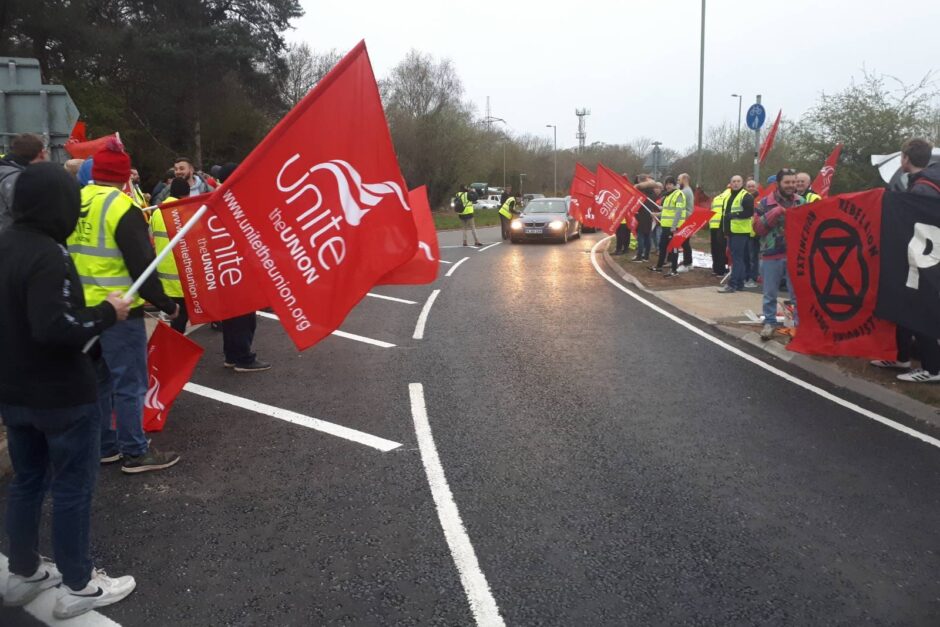
This is the text of Ecosocialist Alliance leaflet which will be circulated on the TUC demo on Saturday18 June, 11am start, Portland Place, London, W1. Come along and support us if you can, look out for the banner pictured above. Ecosocialism not Extinction!

The media is full of headlines about crises: cost of living, energy prices, health and social care, pandemics - and, less frequently, climate collapse. Mainstream politicians see these as separate crises, while ecosocialists recognise these are interrelated crises of the capitalist system itself.

Insulate Britain activists have been jailed for trying to get the Westminster government to begin a massive programme to insulate homes and Just Stop Oil activists also face jail for their protests outside the Kingsbury oil depot.

Simple measures like insulation and renewable energy would take millions of people out of fuel poverty and would greatly reduce the numbers dying each year because they cannot afford to heat their homes. Britain has the worst record in Europe for this: in 2020, fuel poverty charities estimated such deaths as around 10,000 a year.

Government funded insulation programmes, combined with putting taxpayers' money into renewable energy, would greatly reduce our carbon emissions as well as create thousands of good green jobs.. In addition, our reliance on the profiteering and polluting fossilfuel giants – posting record profits, while continuing to drive the climate and ecological crises – would be massively reduced.

The Tories' record is appalling with millions of working families living below the poverty line. The hike in energy prices will see well over 25% of UK households – 15m people – in fuel poverty. Johnson and Sunak’s subsidies and rebates barely touch the sides.

The British government gives the fossil fuel industry £10 billion a year in tax breaks and subsidies.

The Tories finally bowed to pressure for a windfall tax on dirty fuel producers but we would go much further. All subsidies to oil and gas companies must end now and be switched to renewables. We must take energy companies and road and rail infrastructure into public ownership and rapidly de-carbonise the whole economy. We stand for a rapid ecosocialist transition led by, and in the interests of, working people.

Ecosocialist Alliance is a network of organisations and individuals. We campaign for ecosocialist and ecofeminist solutions to the multiple crises of the system. We are internationalist: the climate crisis will not be solved by any one country, but by collective global action.

We stand firmly with the global south in seeking ecological and social justice.

We reject green capitalist “solutions”, which are unworkable under a capitalist system of infinite growth and accumulation. The planet will only be saved by disposing of this system and replacing it with ecosocialism.

“We Want Everything”: A Four-Day Work Week

By Samantha O’Brien - Rupture, June 9, 2022

“It’s not fair, living this shitty life, the workers said in meetings, in groups at the gates. All the stuff, all the wealth that we make is ours. Enough. We can’t stand it any more, we can’t just be stuff too, goods to be sold. Vogliamo tutto - We want everything”

- Nanni Balestrin

Labour Power

The four-day work week has captivated media headlines internationally, with different countries piloting programmes in the Global North. Seventeen companies have signed up to commit to a pilot programme in Ireland. Thirty companies in the UK are taking part in a new pilot. Workers will maintain one-hundred per cent productivity for eighty per cent of their time.[1] Belgium has given workers the right to request a four-day work week with no loss of pay, effectively condensing their five day work week into four days. This has rightfully attracted criticism, as working time has not reduced, but workers get to maximise their stress levels by working nine and a half hours per day.[2] The central theme of many global campaigns is that the implementation will look different in varying sectors, rosters and working arrangements. The campaign’s main aim is for a shorter working week with no loss of pay and challenging the dominant narrative that long hours equate with greater productivity.[3]

The key demand of socialists has long been a shorter working week with no loss of pay. Karl Marx in Capital describes how the hours that make up the working day mean different things to employees and employers. Workers put in their time to afford the basic necessities in life. Employers buy labour-power, and the value is determined by working time. Any labour-power beyond what is required to produce the necessities of life is surplus-value that employers get for free. It is not necessary for us to work long hours to produce what is needed, but instead employers maximise their profits by taking our surplus value. Marx notes that “the history of capitalist production, the determination of what is a working-day, presents itself as the result of a struggle, a struggle between collective capital, i.e., the class of capitalists, and collective labour, i.e., working-class.”[4]

There are many examples of struggles over shorter working hours throughout history. The eight-hour working day in the Global North was not granted because of benevolent employers or lobbying politicians, but fought for and won through struggle. In 1856, Australian Stonemasons who were working harsh ten hours days walked off their job and eventually won an eight-hour day.[5] The same story was echoed in struggles internationally, with workers taking a collective stand for their pay and conditions. Eleanor Marx, who was a founder of the GMB Union in 1889, fought and won an eight hour workday for gas workers. On May Day in 1890, she also played a crucial role in organising the Hyde Park protest in London. This protest gathered hundreds of thousands of people with the key demand of an eight-hour workday.[6]

Two enemies, one fight: climate disaster and frightful energy bills

By Simon Pirani - People and Nature, May 16, 2022

Two clouds darken the sky. A close-up one: gas and electricity bills have shot up since the Russian invasion of Ukraine, and millions of families are struggling to pay. And a bigger, darker, higher one: the climate disaster, and politicians’ refusal to tackle it.

Ultimately, both these threats have a single cause: fossil fuels and the systems of wealth and power that depend on them. We need social movements to link the fight to protect families from unaffordable bills with the fight to move beyond fossil fuels, and in that way turn back global warming.

Here I suggest ways to develop such a movement in the UK, starting by demanding action on home heating.

Oil and Gas Price Rises Fuel the Case for a Just Transition Now

By staff - Just Transition Partnership, April 22, 2022

The dramatic rise in the prices of oil and gas, compounded by the reductions in supplies as a result of the war in Ukraine, have demonstrated the failings of our broken energy system. The social and environmental damage it causes have underlined the case for a just transition to renewable sources of energy, giving people power over the energy system. This must be planned to create good and secure new jobs and to protect the living standards of the poorest, the wellbeing of all and the health of the planet.

Consequences of fuel price rises for citizens and corporations

Wholesale gas prices quadrupled in the last year, according to Ofgem’s statement1 made on 3 February when it announced that the energy price cap (the maximum prices which energy retailers can charge) would rise by 54%. Further rises are anticipated in September.

On the same day , Shell announced profits of $19.3bn for 2021. In the last few months profits made by oil corporations have soared. “The largest oil and gas companies made a combined $174bn in profits in the first nine months of the year” reported the Guardian2.

National Energy Action said that in the UK the number of households in fuel poverty is expected to go up from four million in October 2021, to 6.5 million after April’s price rise3. That would go up again to 8.5 million in October this year, if the typical bill increases to £3,000.

As Unite general secretary Sharon Graham said on 3 February:The energy price cap rise will turn the cost-of-living crisis into a catastrophe for millions of people. This will plunge at least one in four families in Britain into fuel poverty”.4 With rates of inflation higher than wage increases and benefit upgrade, living standards are under threat.

The consequences for employment of rising prices and falling incomes have been predicted to be negative across the economy as a whole. In the energy sector there may be some stronger recruitment where production can be increased in the short-term in response to higher wholesale prices but in a volatile market the longer-term consequences are probably going to be determined mainly by the direction of government policies on both energy efficiency and fossil fuel licensing , with the prospect of largest employment rises in energy efficiency.

Extinction Rebellion Trade Unionists: a Timely Initiative

By Rob Marsden - Red-Green Labour, April 19, 2022

The incredibly clumsy, tone deaf and downright offensive tweeting by the official Labour party twitter account of a link to The Sun attacking environmental protesters shows the absolute need to build much better grassroots links between the labour movement and activist environmental campaigns, writes Rob Marsden

Recently relaunched, Extinction Rebellion Trade Unionists exists to further such a dialogue.

Building on the success of self-organised groups such as XR Scientists and XR Doctors it aims to assist Extinction Rebellion in getting its key message across to workers whose jobs are in the direct line of the necessary rapid transition away from fossil fuels.

The founding ‘mandate’ of Extinction Rebellion Trade Unionists includes the following ideas:

  • Promote XR members to join a union.
  • Promote concerns about the climate crisis and XR within our trade unions and the trade union movement.
  • To ensure that the withdrawal from fossil fuels includes a just transition for workers.
  • Lobby for XR actions to include consultation, and link actions with trade unions,
  • To support trade union and workers strikes.
  • Promote strike action as an effective form of NVDA, in the fight for climate justice.

XR recently issued a statement in support of Fawley oil refinery workers:

“On the 8th April members of XR Trade Unionists will visit the workers on their picket line in order to show support and solidarity. The dots are being joined for us all in the current context, from the wars fuelled by fossil fuel money, the exacerbating inequalities in the cost of living crisis, and energy companies shamelessly making record profits from the plight of the ordinary person and leaving workers behind. It is now clear in the UK that we’re being ripped off, our future is being burned, sold, decimated and all the while companies and the government sit back and support corporate interest over people’s live and livelihoods. Enough of the lies, deceit and deadly political failure. Unite workers are taking disruptive nonviolent action just as we are, and we wish them luck in their endeavours.”

Solidarity with the sacked P&O seafarers

By collective - Earth Strike UK, April 10, 2022

Recently, P&O Ferries laid off 800 members of staff without a moment’s notice over a video call. While this has been widely condemned as both immoral and illegal, P&O have continued to refuse to reinstate the sacked workers. This is the latest in a string of brutal mass sackings and fire and rehire schemes, which will become increasingly common unless organised labour are able to resist it here and now.

For a company that saw its revenue reach more than $10 billion in 2021, there is no reason why 800 members of staff should be cast aside only to be replaced by contract workers who will be paid next to nothing. Capitalists don’t see ferries as an essential public service but as a means to accumulate profit. They don’t see workers as people who deserve dignity, respect and the means to live a good life, but as parts in a profit making machine. It is this same philosophy that is driving the destruction of the environment. Companies like DP World (P&O’s parent company) are among the richest in the world, incorporating ever-larger supply chains and workforces, while at the same time causing more and more damage to the environment (while shareholders receive greater and greater profits).

The way forward is for workers to utilise our power through collective action. Corporations will try relentlessly to divide us, to undermine our unions, to cut our pay and worsen our working conditions, all in the pursuit of power and profit. But workers are the ones with real power. We keep the wheels of industry turning and we can pull the brakes. This is especially the case for seafarers and dockworkers who can shut down world trade, hitting the capitalists where it really hurts.

We have already seen powerful acts of solidarity in support of the P&O seafarers: dockworkers in the UK and the Netherlands refusing to handle P&O ships stopping them from sailing, agency workers refusing to replace their fellow workers, and thousands of supporters protesting at the ports and corporate offices. We have also seen brave acts of defiance from the seafarers themselves – who initially refused to leave their ships when instructed by handcuff equipped security. Some were forcefully removed.

Earth Strike UK extends our solidarity to the P&O workers. We support the P&O boycott and call on all workers to continue to support the struggle however they can. Join the pickets, join the protests, join the boycott. Justice for the P&O seafarers!

Extinction Rebellion UK statement on strike at Fawley Oil Refinery

By staff - Extinction Rebellion, April 8, 2022

Extinction Rebellion UK stands in solidarity with the 100 or more workers at Fawley Oil Refinery who will be taking strike action on 8th April. The strike is in response to the offer of a “pathetic” 2.5 per cent pay offer and a lack of company sick pay, despite Exxon’s profits in 2021 topping an eye-watering £6.75 billion.

Exxon’s business model is not built to benefit the workers who without which, they wouldn’t be able to make record profits. XR UK recognises that Exxon’s business practices not only destroy the planet but oppress and marginalize the workers that enable their activities. They choose to underpay workers and maintain the fossil fuel economy, rather than seeking to facilitate a just transition, which our own Office for Budget Responsibility says is affordable and would create thousands of jobs and save billions of pounds for the UK public.

Pages

The Fine Print I:

Disclaimer: The views expressed on this site are not the official position of the IWW (or even the IWW’s EUC) unless otherwise indicated and do not necessarily represent the views of anyone but the author’s, nor should it be assumed that any of these authors automatically support the IWW or endorse any of its positions.

Further: the inclusion of a link on our site (other than the link to the main IWW site) does not imply endorsement by or an alliance with the IWW. These sites have been chosen by our members due to their perceived relevance to the IWW EUC and are included here for informational purposes only. If you have any suggestions or comments on any of the links included (or not included) above, please contact us.

The Fine Print II:

Fair Use Notice: The material on this site is provided for educational and informational purposes. It may contain copyrighted material the use of which has not always been specifically authorized by the copyright owner. It is being made available in an effort to advance the understanding of scientific, environmental, economic, social justice and human rights issues etc.

It is believed that this constitutes a 'fair use' of any such copyrighted material as provided for in section 107 of the US Copyright Law. In accordance with Title 17 U.S.C. Section 107, the material on this site is distributed without profit to those who have an interest in using the included information for research and educational purposes. If you wish to use copyrighted material from this site for purposes of your own that go beyond 'fair use', you must obtain permission from the copyright owner. The information on this site does not constitute legal or technical advice.