You are here

United Kingdom (UK)

Firefighters on the front line of the climate emergency

By Denise Christie - Morning Star, November 19, 2021

From flooding to forest blazes, firefighters all over Britain are already engaged with the practical battle against the climate crisis – but our services are not yet fully prepared for the enormous implications of the emergency, writes DENISE CHRISTIE of the Fire Brigades Union.

COP26 is an opportunity for our movement to demonstrate our solidarity with working people and their communities around the world and to organise together to create the just and green world we want and need, to allow us to live safely and fairly.

We must also be fully active in the campaign that Cop26 must be a focus to organise against the climate emergency in solidarity with all working people.

The climate crisis is a crisis of social justice, with those who have done least to cause the crisis and who are least able to address it facing the worst effects.

What’s it got to do with firefighters and the FBU?

Firefighters are on the front line of tackling the climate emergency. Climate change is increasing the risk of wildfires, such as grassland and forest fires and floods, including from surface water, rivers and the sea.

It will also affect the supply and availability of water and may give rise to more extreme weather events.

These hazards will have implications for the working conditions of firefighters. The climate emergency will require significant changes to appliances, to the equipment available to firefighters, and to training.

We will also need greater awareness of firefighters’ health implications, greater pumping capability and water use and increased capacity within our operational fire control rooms.

The fire and rescue service needs the staff, resources and equipment to tackle the impact of this climate emergency. There is no logic to job cuts and shutting fire stations and control rooms when these risks are likely to increase in the years ahead.

Phased down and out at COP26

By Stephen Smellie - Unison, November 15, 2021

As proceedings ended at COP26 late on Saturday night, the Glasgow Climate Pact joined a long list of previous agreements, arrived at by world leaders, that have failed to ensure global temperatures stop rising.

The sum of all the commitments given before and during the two-week jamboree is that the Earth is heading for a 2.4 degree increase rather than being held back to 1.5 degrees. This, according to the prime minister of Barbados, will be a death sentence for many small island communities.

COP president Alok Sharma claims that the 1.5 target is still alive; but as many people have said, it is on life support and slipping away.

The hopes for COP26 were high. The stakes were even higher. The science is clear – if we do not cut the emission of greenhouse gases such as CO2 and methane by significant amounts by 2030 we will not meet the target of being net zero by 2050 and the planet will overshoot 1.5 by some way.

As an official observer at COP26 with the International Trade Union Confederation (ITUC), I was privileged to spend the second week in the COP26 blue zone, working with a team of trade unionists from across the globe.

The ITUC’s aims were to lobby the government representatives to ensure that the historic commitment in the Paris Agreement to “ensure Just Transitions that promote sustainable development and eradication of poverty, and the creation of decent work and quality jobs” was retained in the final Glasgow agreement. That was achieved.

However, the lobbying of the ITUC, along with other NGOs and many Global South countries, to secure the $100 billion for mitigation and adaptation in the developing countries by 2020, a mechanism for paying for loss and damage for the impact of climate change that is already happening, and a clear intention to reduce emissions, was not successful.

It is true that the Glasgow Climate Pact recognises, for the first time, the need to address the use of fossil fuels, but it does not set any targets, relying on countries to improve on their existing plans to reduce the burning of climate changing fossil fuels. However, in the final hours, even the limited commitment to “phase-out the use of unabated coal” was watered down by an amendment from China and India to change “phase out” to “phase down”.

Climate talks are leaving workers ‘out in the cold’ warn unions

By staff - Unison, November 10, 2021

UNISON adds its voice to concerns that the UK’s own COP president is ignoring ‘just transition’ in the COP26 negotiations.

UNISON has joined the TUC and others in warning COP26 president Alok Sharma that he is “putting progress at risk” during this month’s climate talks by neglecting international commitments to a just transition in the move towards low-carbon economies.

The Paris Agreement in 2015 committed nations to taking account of “the imperatives of a just transition of the workforce and the creation of decent work and quality jobs in accordance with nationally defined development priorities”.

However, trade union delegates within the climate conference, including UNISON’s Stephen Smellie, fear that just transition is being sidelined in the negotiations.

Reflecting their concerns, the TUC, Scottish TUC and Wales TUC, with support from affiliated unions, have made a joint statement calling on the UK Presidency to build on the commitment made in Paris.

Their statement says: “The UK COP pPresident Alok Sharma MP has repeatedly committed to just transition as an essential component in rapidly moving the world away from fossil fuels.

“But so far, the UK presidency has invested little political capital in including just transition in the climate agreement negotiations – leaving workers around the globe out in the cold.”

The statement applauded the presidency’s role in preparing last week’s conference declaration supporting just transition, but added that this was separate to any binding agreements currently being discussed.

“Similar efforts need to be made to incorporate just transition and labour rights into the official COP26 negotiations,” it says.

Policy recommendations re Green jobs and Green skills in U.K. and the EU

By Elizabeth Perry - Work and Climate Change Report, November 10, 2021

An October publication by researchers at the Grantham Research Institute on Climate Change in the U.K. revisits the issue of green jobs: how to define them, where they are, and the labour market policy challenges of educating and training the workforce to prepare for them. Are ‘green’ jobs good jobs? How lessons from the experience to-date can inform labour market transitions of the future focuses on U.K. data, but also compares it to EU data and discusses the different labour market methodologies for measuring and tracking green jobs. The authors conclude that more information and deeper analysis is needed , especially regarding the educational needs of specific regions and occupations. An 8-page Policy Brief distills the policy applications of the analysis, concluding that green jobs provide good quality employment in Europe and in the UK, where they pay higher wages and are at lower risk of automation than non-green jobs, especially for middle- and low-skilled workers. The Brief notes that some groups, especially women and young people, are underrepresented. It concludes that policymakers need to focus on building the skills needed in the net-zero transition, and target transition policies to address regional and demographic imbalances.

This research comes as the government has a stated goal to reach 2 million green jobs by 2030, and to do so, has initiated a Green Jobs Task Force, and a multitude of studies, plans and consultations. Some sense and summary of all these comes in the Green Jobs Report released by the U.K. Parliamentary Environmental Audit Committee on October 25. It is the result of a consultation process which received 65 submissions. Amongst the recommendations: based on the recent failure of the government’s Green Homes Grant voucher scheme, it is clear that the Government urgently needs to set out a retrofit skills strategy.

COP26: We Only Want the Earth

By IWW Ireland - IWW UK, November 7, 2021

World leaders gathering in Glasgow for COP26 are more concerned with the theatrics of playing to the media than the climate catastrophe.

The vocal pledges and emotive speeches hold little weight against the refusal to hold large corporations to account. Despite a planet which is slowly eating itself alive, world leaders repeatedly hold back when it comes to holding their profit driven capitalist projects to account. Instead, they are opting for wishful thinking as exemplified by the Trevi fountain stunt.

As members of the Industrial Workers of the World gather to protest in support of our earth, we do so knowingly that what is actually called for is the immediate end of capitalism and that of the power structures which keep it intact. Nothing short of the complete destruction of global capitalism, here and now, will prevent us from free-falling into an irreversible environmental catastrophe for the world and all its inhabitants.

Due to the unjust structures in our world, it is those at the lower ends of capitalist hierarchies that are most affected by climate distress. Those in lower-profit countries, people of colour, women, the trans community, those who are disabled and the working class have an increased chance of experiencing the negative impact of climate change.

Simultaneously, it is those least affected who cause the most damage to our planet. During the first lockdown, when everyone stopped, carbon emissions only decreased by 3%. 71% of global emissions are produced by 100 companies including Amazon and the US Military.

For ourselves, as revolutionary syndicalists, it is our belief that the working class ultimately has the power and strength to end this nightmare for all. From the outset as a revolutionary union, our principles and vision refuses to compromise.

“The working class and the employing class have nothing in common. There can be no peace so long as hunger and want are found among millions of the working people and the few, who make up the employing class, have all the good things of life.

“Between these two classes a struggle must go on until the workers of the world organise as a class, take possession of the means of production, abolish the wage system, and live in harmony with the Earth.”

COP26 is a piece of theatre. As members mobilise on the streets of Glasgow, in Ireland, Wales, Scotland, England, and across the world, we do so without hesitation at the importance of the challenges that lay ahead of our earth. There must be no ceasefire in the class war as our mission remains as important as it was back in 1905. Only organising industrially, within the workplace, within our communities, our streets and home can begin to form the structure of the new society within the shell of the old.

You can play your part by joining the IWW today where you work or live and encourage others to do likewise.

From the words of James Connolly, founding member of the Industrial Workers of the World, we echo today, “Our demands are most moderate, We only want the earth!

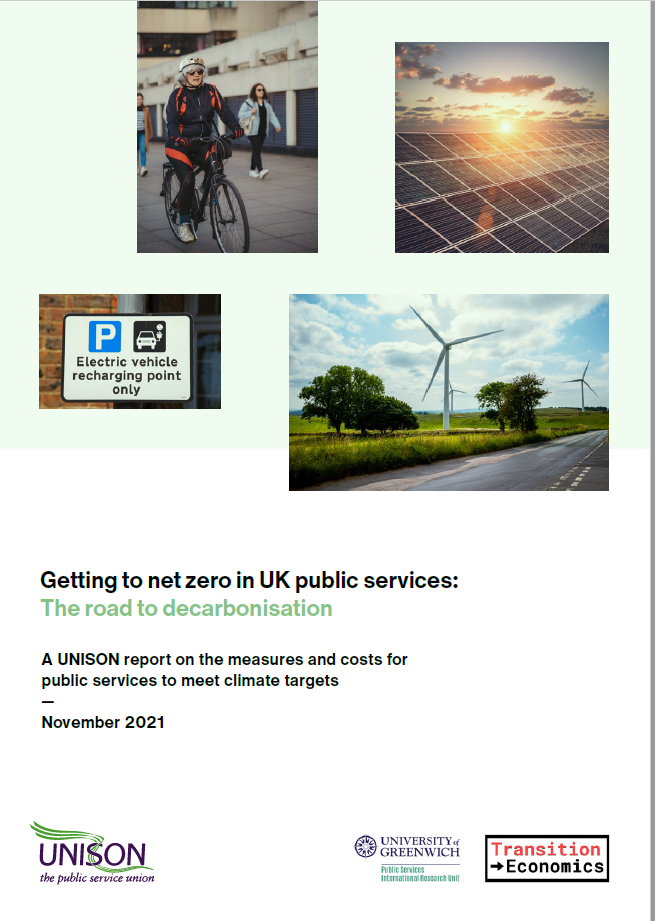
Getting to Net Zero in UK Public Services: The Road to Decarbonisation

By Dr. Vera Weghmann, et. al. - Unison, November 2021

Public services as a whole (excluding transport) represent about 8% of the UK’s direct greenhouse gas emissions. The NHS alone represents about 4% of the UK’s emissions. When procurement, construction, and social housing are taken into account, public services’ impacts are much greater.

Different sectors within the overall framework of public services have declared their decarbonisation plans. Some are ahead of the national targets. The NHS has declared that it will reach net zero by 2040, with an ambition to reach an 80% reduction by 2028 to 2032. More than one-third of local authorities (single- and upper-tier) committed themselves to decarbonise their local area by or before 2030.

The government aims to reduce direct emissions from public sector buildings by 75% against a 2017 baseline by the end of the Sixth Carbon Budget.

This report identified 21 different measures that should be taken across buildings, transport, electricity generation, waste, procurement and land use along with costed measures for each of nine different public services.

In our analysis, the UK’s public services need a capital investment injection of over £140 billion to 2035 to meet their Net Zero obligations. This will set the public sector on track to meet their climate targets and contribute to the UK’s overall carbon reduction aims. The analysis also identified measures that required annual operational expenditures of £1 billion to hit net zero targets. UNISON fully advocates that quality public services are best delivered by public ownership of public services and utilities rather than privatisation, outsourcing or PFI contracting of public services.

As well as improving the quality of life for service users, workers and the wider community, a number of the measures will also result in significant savings to public services’ budgets, through lower energy bills, cheaper to run fleets, and procurement savings. UNISON fully advocates that quality public services are best delivered by public ownership of public services and utilities rather than privatisation, outsourcing or PFI contracting of public services.

Read the text (PDF).

Climate Jobs: Building a Workforce for the Climate Emergency

By Suzanne Jeffery, editor, et. al - Campaign Against Climate Change, November 2021

This report was written by the Campaign Against Climate Change Trade Union Group (CACCTU). It builds on and develops the earlier work produced by CACCTU, One Million Climate Jobs (2014). The editorial group and contributors to this report are trade unionists, environmental activists and campaigners and academics who have collaborated to update and expand the previous work. Most importantly, this updated report is a response to the urgency of the climate crisis and the type and scale of the transition needed to match it.

This report shows how we can cut UK emissions of greenhouse gases to help prevent catastrophic climate change. We explain how this transformation could create millions of climate jobs in the coming years and that the public sector must take a leading role. Climate jobs are those which directly contribute to reducing emissions. This investment will give us better public transport, warmer homes, clean air in our cities and community renewal in parts of the country which have long been neglected. Most importantly, it will give us a chance for the future, avoiding the existential threat of climate breakdown.

Read the text (Link).

Worker’s events at COP26: virtual and in-person

By Elizabeth Perry - Work and Climate Change Report, October 26, 2021

Web editor's note: Although these events have all passed, we include this as a record of the union efforts surrounding COP26.

The UN Conference of the Parties (COP26) in Glasgow begins on October 31 and runs until November 12, with the world’s media in attendance to chronicle if the high expectations are being met. A good source of news from a Canadian perspective is Canada’s National Observer, which will send reporters to Glasgow, and whose coverage has already begun, here .

Some news from a worker’s point of view:

Climate Jobs: Building a workforce for the climate emergency will be released to coincide with COP26, by the Campaign against Climate Change, a coalition of U.K. unions . As of October 26, two chapters of the new report are available for free download: Warm homes, healthy workplaces: climate jobs in buildings and Creating a green, affordable and accessible network for all: climate jobs in transport. The new report updates their 2014 report, One Million Climate Jobs.

Another U.K. organization, the COP26 Coalition, is a broader, civil society coalition which includes environment and development NGOs, labour unions, grassroots community campaigns, faith groups, youth groups, migrant and racial justice networks. Their statement of demands is here . The Coalition is organizing a Global Day of Climate Justice on November 6 – with events in Canada happening in Toronto and in Quebec City , along with a related event in Sherbrooke Quebec on Nov. 5th .

In addition, COP26 Coalition has organized a People’s Climate Justice Summit  in Glasgow, composed of 150 sessions which will focus on indigenous struggles, racial justice, youth issues, and worker and labour union perspectives. Many, but not all, worker-related sessions will be held on November 8 as a “Just Transition Hub” – a full day of sessions hosted by the Friends of the Earth Scotland, Just Transition Partnership, Platform, STUC, TUC and War on Want. The full program, with the ability to register is here : those unable to travel to Glasgow can register as “Online- only” to receive a Zoom link for a livestream of some of the sessions. The online program includes the opening panel for the Just Transition Hub: “Here and Everywhere: Building our Power”, to be led by Asad Rehman, (War on Want), Sean Sweeney,(TUED), Roz Foyer, (STUC), and Denise Christie, (FBU). Other sessions available online include “UK climate jobs rooted in global solidarity and climate justice” and “Just Transition in Latin America, from Decarbonization to Transformation”.

In-person only sessions, which tend to have a U.K. focus, include: “Lessons from the Frontline: Climate crisis resistance from around the world”; “Are green jobs great jobs, or are green jobs rubbish jobs?”; “The Lucas Plan for Climate? How workers are fighting to future-proof industry”; “Geared Up: Campaigns for Greener Transport”; “Air tight: Campaigns for home retrofits”; “Organising the unorganised: tactics and strategies for power in new industries”; and “Changing workplaces, changing jobs: organising for power in unionised workplaces” – a training session led by Prospect union. Other sessions, outside of the Just Transition Hub, ( in-person only), include “Trade Unions and Climate Action”, a training session led by the Ella Baker School of Organizing and “International Trade Union Forum on Social and Ecological Transitions: what’s next?”, reporting on the International Trade Union Forum on Ecological and Social Transitions which took place for 6 days during June 2021, with more than 140 organizations from about 60 countries.

Do trade unions have energy for change?

By Bert Schouwenburg - MorningStar, October 2021

AGAINST a backdrop of floods and heatwaves of unprecedented magnitude and frequency all over the world, the latest report from the UN International Panel on Climate Change (IPCC) issues a stark warning that immediate action must be taken on emissions to prevent global warming exceeding 1.5°C above pre-industrial levels, if a global catastrophe is to be averted.

Its sobering assessment will set the scene at the forthcoming Cop26 climate change conference in Glasgow, scheduled to commence at the end of October after being postponed from last year because of the Covid pandemic, where representatives of the international trade union movement will be in attendance.

Many of those unions are affiliated to Trade Unions for Energy Democracy (TUED), established in 2012 and based in New York City.

TUED describes itself as a global multi-sector initiative to advance democratic direction and control of energy in a way that promotes solutions to the climate crisis, energy poverty, the degradation of land and people and responds to attacks on workers’ rights and protections.

It promotes an equitable energy system that can only occur if there is a decisive shift in power towards workers, communities and the public.

In order to achieve that goal, TUED advocates resistance to the agenda of the fossil fuel corporations, reclaiming privatised energy for the public ownership and restructuring it to a renewable, sustainable model.

Six of the 88 organisations belonging to TUED are the British trade unions — Unite, GMB, Unison, PCS, NEU and UCU. While they have all participated in TUED’s activities at one time or another and there is a general consensus on the call for public ownership, there are differences between them on matters of future energy policy in Britain and elsewhere.

Broadly speaking, the political debate about how best to avoid climate disaster has centred on whether the dominant neoliberal order can be adapted to provide market-based solutions to the crisis or whether a system based on perpetual growth and capital accumulation is completely at odds with the need to curb emissions.

It goes without saying that political elites in the richer countries of the global north, including Britain, subscribe to the former in their belief that some kind of green capitalism is both possible and desirable.

In this they are supported by the energy companies, whose principal concern is their bottom line.

TUED, on the other hand, is promoting the concept of a Just Transition from an economy based on fossil fuel consumption to one that largely relies on renewable energy.

Technological advances make that transition a realistic proposition but in order for it to be “just” it must take into consideration the livelihoods of energy workers who would see their jobs disappear.

This presents an enormous challenge to the governments of the day but were there to be a strategically planned conversion to a publicly owned green economy, there would undoubtedly be a huge demand in everything from retrofitting home insulation to the manufacturing of wind turbines that could more than absorb work lost in the transition.

The theory of a Just Transition within the framework of an oft-quoted Green New Deal is certainly plausible, but for British trade unions there is, justifiably, little faith in a right-wing Conservative regime doing the right thing by their members, many of whom currently enjoy relatively stable and well-paid employment in parts of the energy sector that would disappear.

A Vision for Scotland’s Railways

By staff - Unity Consulting, ASLEF, RMT, TSSA, and Unite the Union, October 29, 2021

Scotland cannot meet its environmental obligations without a world-class rail service that shifts people and goods from cars and lorries onto trains.

This requires a service that is fully staffed, with affordable fares, stations that are accessible and trains that are clean, green and attractive.

What is needed is an ambition for Scotland’s railways that is expansive, that encourages people to make rail their first travel choice and increases freight capacity.

Our long-term vision for Scotland's railways:

  • It should be a publicly operated and governed system run as public service and not for private profit
  • A system that helps Scotland meet its wider environmental and public policy ambitions
  • A railway that is supported by public subsidy
  • Is fully staffed
  • That reinvests in rail infrastructure, to help grow the economy.
  • Takes ScotRail (and the Serco operated Caledonian Sleeper) back under public ownership permanently
  • A railway that is part of a wider integrated public transport system with through ticketing
  • Is part of an industrial strategy that recognises rail services are a vital part of Scotland’s economy helping create jobs and growth
  • Has a democratic regulatory and governance structure
  • Has a cross representation of Scottish society and rail interests at the heart of decision making
  • Has representation from all four trade unions on the board of the new operator
  • Has local political representatives on the board
  • Has passenger representatives on the board

Read the text (PDF).

Pages

The Fine Print I:

Disclaimer: The views expressed on this site are not the official position of the IWW (or even the IWW’s EUC) unless otherwise indicated and do not necessarily represent the views of anyone but the author’s, nor should it be assumed that any of these authors automatically support the IWW or endorse any of its positions.

Further: the inclusion of a link on our site (other than the link to the main IWW site) does not imply endorsement by or an alliance with the IWW. These sites have been chosen by our members due to their perceived relevance to the IWW EUC and are included here for informational purposes only. If you have any suggestions or comments on any of the links included (or not included) above, please contact us.

The Fine Print II:

Fair Use Notice: The material on this site is provided for educational and informational purposes. It may contain copyrighted material the use of which has not always been specifically authorized by the copyright owner. It is being made available in an effort to advance the understanding of scientific, environmental, economic, social justice and human rights issues etc.

It is believed that this constitutes a 'fair use' of any such copyrighted material as provided for in section 107 of the US Copyright Law. In accordance with Title 17 U.S.C. Section 107, the material on this site is distributed without profit to those who have an interest in using the included information for research and educational purposes. If you wish to use copyrighted material from this site for purposes of your own that go beyond 'fair use', you must obtain permission from the copyright owner. The information on this site does not constitute legal or technical advice.