You are here

green industrial unionism

Environmentalism as if Winning Mattered: A Self-Organization Strategy

By Stephen D’Arcy - The Public Autonomy Project, September 17, 2014

Disclaimer: The views expressed here are not the official position of the IWW (or even the IWW’s EUC) and do not necessarily represent the views of anyone but the author’s.

[Note: This article was first published on the internet as a contribution to the Reimagining Society Project hosted by ZCommunications in 2009, where it seems no longer to be available. This version is substantially revised.]

Many people doubt that the environmental movement can actually defeat its adversaries and achieve its key aims. After all, it seems clear that winning would mean introducing sweeping social change and a new kind of sustainable and socially just economy. But the forces arrayed against this kind of change – including corporations, governments, and many affluent consumers hoping to raise their consumption levels – seem to represent too powerful a force to be overcome by a relatively small and seemingly powerless group of environmental activists.

These doubts about the capacity of environmentalists to win are confined neither to the movement’s self-serving and greed-motivated adversaries in business and government, nor to the many indifferent bystanders who cast an equally skeptical eye on all attempts to transform society by means of popular mobilization from below. As it happens, many environmental activists themselves are no less convinced that failure is all but inevitable.

When this sort of pessimism overtakes environmentalists, they tend to adopt one of several familiar responses. First, there is the response of those who retreat from the movement altogether in favor of “lifestyle” environmentalism, replacing their former activism with “conscious” shopping. Second, there are those who reject activism as naïve compared to their own approach of apocalyptic “survivalism” which leads them to prepare for the day when “civilization” collapses, such as by stockpiling food or learning how to hunt and gather. A third group responds to the apparently bleak outlook for environmental activism not by leaving the movement, but by remaining active while seeking to cultivate “friends in high places,” linking arms with Big Business or the capitalist state in a mode of “mainstream” environmentalism that tries to promote “environmentally friendly” capitalism and “socially responsible” corporations. A fourth group also remains active, but replaces the aim of winning with the more readily attainable aim of making a moral statement, by serving as a “moral witness” or by “speaking truth to power.” Finally, a fifth group also accepts the inevitability of failure but tries to seize every opportunity to put on public display the purity of their own uncompromising and self-righteous (albeit relentlessly impotent) radicalism, as a form of self-congratulatory “posturing.”

There is nothing to be gained by adopting a judgmental or holier-than-thou attitude toward people who adopt such responses. Why condemn such choices, which are all more or less understandable adaptations to the admittedly distressing predicament of contemporary environmentalism?

Nevertheless, we do need to see these stances for what they undoubtedly are: failures (in some cases) or refusals (in others) to develop a strategy for winning. Yet a strategy for winning is precisely what we need. The scale of the general environmental crisis is well known, and needs no special emphasis here: we are only too well-informed about the potentially catastrophic impact of plutogenic (caused-by-the-rich) climate change, the degradation of air quality, the erosion and poisoning of soil, the disappearance of forests and spreading of deserts, the despoliation of both fresh water sources and oceans, the historically unprecedented rates of species extinction, and so on. If nothing is done about any of this, it is not because there is any uncertainty about the gravity of these threats (notwithstanding cynical attempts by Big Business to fund “denial” research from “free market think tanks,” as a transparent ploy to muddy the waters of public discussion).

Something must be done, clearly. And most people certainly want more to be done. Globally, according to a survey of world opinion in 2010, “84 percent of those polled globally said the problem was serious, with 52 percent saying it was very serious. The number of people saying that it was not a problem averaged just 4 percent.” Even in the United States, where public awareness about environmental issues is lower than anywhere else on earth, “in 2010, 70 percent of US respondents described the problem as serious and 37 percent described it as very serious.” According to Steven Kull, director of WorldPublicOpinion.org (which conducted the poll), “most people around the world appear to be impatient that their government is not doing enough to address the problem of climate change.” Indeed, “on average across all nations polled, 60 percent want climate change to get a higher priority, 12 percent want a lower priority.”

Evidently, inaction on the part of governments does not reflect any pressing need to “change attitudes” or “educate the public.” If governments and corporations were even modestly responsive to public opinion, the prospects for implementing real change would be much more favorable for our side than they actually are at present.

The widespread pessimism about the movement’s prospects for success is impossible to explain without relating it to a widely understood insight registered in another recent opinion poll. According to a 2012 Harris Poll, 86% of Americans believe that “Big companies” have “too much power and influence in Washington.” An even higher percentage, 88% of Americans, believe that “political action committees that give money to political candidates” also have too much power and influence. Conversely, a full 78% of Americans believe that “public opinion” has “too little power and influence in Washington.” Americans, it seems, understand the workings of their political process rather better than many people give them credit for.

It should be clear, therefore, that we need a strategy for winning, and we need to develop it sooner rather than later. The approach that I pursue in this article will be to identify strategic objectives for weakening and ultimately defeating the adversaries that stand in the way of doing what science, morality, and good sense dictate must be done: transforming our destructive, unjust and unsustainable social order into a democratic, egalitarian and sustainable one.

Jobs and the Planet: is it Really Either/or?

By Jean Parrey and Carole Ramsden - Socialist Worker, September 18, 2014

Disclaimer: The views expressed here are not the official position of the IWW (or even the IWW’s EUC) and do not necessarily represent the views of anyone but the author’s.

WHO HAS the power to stop climate change?
Demonstrations like the People's Climate March in New York City on September 21 are important in showing the determined and growing opposition to a system that is driving the planet toward ecological devastation. But protests--while they can bring together and galvanize a growing movement--aren't enough by themselves.

One group in society with more potential leverage is workers in the energy and transportation industries, and those employed in sectors (like health care, for instance) directly impacted by climate change. Especially if they are members of unions, these workers can affect the operations of the fossil fuel industry by taking actions related to their work.

If this power were utilized, even if only partially, such actions could dramatically increase the pressure on the political and business establishment to do something to stop the carbon industry.

Yet organized labor has a notorious reputation for opposing measures to reduce greenhouse gas emissions and pollution. Union leaders insist these initiatives will cost union jobs--that it is a zero-sum game between jobs and the environment.

Therefore, the role of labor in the People's Climate March is a particularly important question.

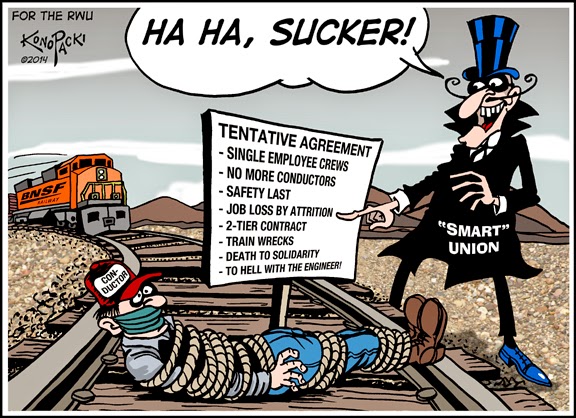
The BNSF Single Crew Initiative Defeated!

By J.P. Wright - Railroad Workers United Blog, September 11, 2014

Disclaimer: The views expressed here are not the official position of the IWW (or even the IWW’s EUC) and do not necessarily represent the views of anyone but the author’s.

The members of the International Association of Sheet Metal, Air, Rail & Transportation Workers (SMART) General Committee GO—001 have spoken. In a loud and clear mandate, they have told the BNSF railway, their union leaders, and the world, that they do not support single employee train crews. By 2-to-1, the rank and file voted down a tentative agreement, that – had it been ratified – would have resulted in conductorless train operations over more than half of the Burlington Northern Santa Fe Railway (BNSF), the second largest rail carrier in the U.S.

The major rail carriers have been seeking to run trains with a single employee for nearly a decade now. This latest attempt was by far the most blatant and confrontational effort to date. Railroad workers know that there are grave dangers and inefficiencies should such practice be implemented. According to Railroad Workers United General Secretary Ron Kaminkow, “Single employee train operations – with or without Positive Train Control (PTC) – would compromise the safety and security of train crews, motorists, pedestrians, trackside communities, the environment and the general public. Railroad workers are ready, willing and able to fight this concept with everything we have.”

In voting down this contract, the SMART GO-001 rank and file have won a decisive victory, not just for the trainmen and engineers on the BNSF, but for every railroad worker in North America. While the victory belongs to them, it is of course shared by all those who assisted – engineers (both UTU and BLET); union brothers and sisters from other crafts and carriers who rose to the occasion and helped out; family members who took part in pickets, rallies and demonstrations; fellow unionists and citizens who grasped the importance of the struggle and pitched in to help.

An Open Letter to my Fellow Railroad Workers

By Jen Wallis - Railroad Workers United, September 4, 2014

Disclaimer: The views expressed here are not the official position of the IWW (or even the IWW’s EUC) and do not necessarily represent the views of anyone but the author’s. The author wants to make it clear that her views are not necessarily those of her union, Railroad Workers United, or the members of either.

Dear fellow rails:

On Tuesday, September 2, 2014, five residents of Seattle and Everett working with Rising Tide Seattle, stopped work at a Burlington Northern Santa-Fe Rail Yard in Everett by erecting a tripod-structure on the outbound railroad tracks, directly in front of a mile-long oil train.

Just to be clear, I had nothing to do with the action. Direct actions are the result of affinity groups, who plan these things completely amongst themselves within their own organizations. All I did was share the message of how dangerous one-person crews would be. I'm thrilled that they listened, but I'm actually opposed to most formal coalitions. All of the ones I've been involved with have ended by either imploding because of the hostile factions they inevitably splintered into, or became appropriated by the bureaucrats. I'm more inclined to simply keep lines of communication open between our respective movements, but personally it goes much deeper than that.

Every age has their growing pains. Growing as a society means that those who advocate social or economic change are invariably encumbered with a lot of “isms” or “ists” for their beliefs. More than 100 years ago, and for centuries before that, it was not universally accepted that slavery was wrong. If you believed that it was, you were labelled a “abolitionist”, along with the other colorful labels that went with it. If you helped slaves gain their freedom, you went to jail. Now it is universally accepted that enslaving people is wrong.

100 years ago, it was not universally accepted that women should have the right to vote. If you believed that women had the right to vote, you were called a “suffragist”, along with all of the labels and misconceptions that went along with it. Believing in it often landed you in jail. It was a controversial opinion to be held in that era, but in America, it is now universally accepted.

Just 50 years ago, if you believed that Jim Crow laws were wrong, you were called a “civil rights activist”, along with all of the horrible names that went along with that. If you believed that segregation was wrong, you often went to jail. Now at least it is not directly advocated, though we still have a ways to go.

All of these changes, which are now universally accepted as truths, came about as the result of numerous acts of non-violent civil disobedience and direct actions. The actual legislation came about much later as the result of public pressure.

Climate change is not a myth. It is scientifically proven, and many of the effects of the causes we have made in the last 30 years are irreversible. We have the opportunity to stop the destruction, but we are well past the time to act on it. It’s upon us right now. It is our obligation to our children and their children’s children to stand up and say, “Enough! This is no longer sustainable for our planet!”.

IWW United Campaign Workers Demand: "Do the Right Thing, Nature Conservancy!"

By the United Campaign Workers of the IWW - September 8, 2014

IWW members and supporters handed out the following leaflet today at a rally in support of IWW Canvassers Union (for more details see IWW Canvassers Strike Over Unpaid Wages):

Dorset Group of the IWW and IWW EUC Launched at Poole Community Green Fair

By x375261 - IWW Environmental Unionism Caucus, September 3, 2014

Disclaimer: The views expressed here are not the official position of the IWW (or even the IWW’s EUC) and do not necessarily represent the views of anyone but the author’s.

Dorset Green Community Fair took place over the weekend and provided a welcome alternative to the war junkie attraction of the annual Bournemouth air show, where, a source reported there was a large military presence engaging in a dubious attempt to convince Joe Public that state terrorism is a good thing and it may be worth their while packing their kids off to some remote foreign field just to get them back in bits in the state approved body bag(s).

The usual suspects from the reformist tendency were in attendance pushing yet more discredited ideas to persuade visitors that you can reform capitalism and deal effectively with the ecological crisis. Can't be done.

After the shambles in Brighton http://www.bbc.co.uk/news/uk-england-sussex-25976843 we now know the Green Party are no better than any other political party when it comes to any idea of a radical solution to the ecological nightmare about to befall us all. The bottom line is they are just tories on bikes (Boris Johnson x many by any other name).

Probably the stall that had the most impact was the launch of the newly formed Dorset Group of The Industrial Workers of the World and their Environmental Unionist Caucus (http://ecology.iww.org/).

Ten Ways We Can Build A Better Economic System

By Gary Engler - rabble.ca, August 25, 2014

Disclaimer: The views expressed here are not the official position of the IWW (or even the IWW’s EUC) and do not necessarily represent the views of anyone but the author’s.

For the numerous readers who asked: “But what can we do?” after reading my “10 reasons to smash capitalism,” here are ten ways we can build a better economic system:
10. We can elect governments that represent people rather than corporations. This will require serious electoral reform and include laws to make it clear corporations are not people and therefore cannot participate in the political process. A government representing all the people would regulate corporations to ensure socially responsible behaviour and transform psychopathic capitalist monstrosities into democratic, social enterprises that benefit all.

9. We can build communities and organizations that encourage solidarity, compassion and altruism. These will include worker, consumer, housing and producer cooperatives, as well as institutions of government. People must always remain vigilant, especially while capitalism continues to exist, about the pervasive power of greed to destroy these communities and organizations.

8. We can promote and build a democratic economy in which social ownership replaces private ownership of communities’ means of livelihood. The people who work in them and the communities in which they are located should control economic enterprises.

7. Since authentic freedom for any of us can only come when all of us are free we must create enterprises, communities, forms of governance and institutions that respect the rights of everyone and encourage the creativity of all. Socially useful individual enterprise should be encouraged but everywhere people work together we must create effective forms of democratic decision-making to promote creative input from all involved.

6. Everywhere we work we can organize in ways that become the building blocks of a new, democratic economy. Sometimes this will be through existing unions but often we will create new organizations that defend our day-to-day interests while self-consciously preparing to replace capitalist minority rule with democratic social control of all enterprises.

Bay Area IWW General Membership Branch Resolution in Opposition to Single Employee Train Crews

Passed Unanimously on Thursday, August 7, 2014

Whereas, the BLET and the SMART have joined forces and have been working hand in hand to outlaw Single Employee Train Crews; and

Whereas, railroad workers universally support a minimum of two crew members on every train, an engineer and a conductor; and

Whereas, in the wake of the Lac Megantic tragedy and numerous other train wrecks in the last year, we have an historic opportunity to build alliances with community and environmental groups to outlaw single employee train crews;

Whereas, a rogue general committee of the SMART TD has recently announced an tentative agreement, that would, if implemented, eliminate the road conductor on through freight and allow single employee crews;

Therefore, be it resolved, that the Bay Area General Membership Branch of the IWW affirms our opposition to single employee train operations and that we support an engineer and a conductor on every train; and

Be it further resolved, that we condemn the backroom deal recently made between the SMART TD and the BNSF as it would undermine the national union strategy to outlaw single employee operations; and

Be it further resolved, that the Bay Area General Membership Branch of the IWW urge all rail, transportation, and other union members to actively oppose contracts that would allow single employee operations of trains; and

Be it finally resolved, that Local the Bay Area General Membership Branch of the IWW urge trainmen on the BNSF GC-001 in the strongest possible terms to stand up and fight back standing shoulder to shoulder with the rest of labor and to vote NO on this tentativeagreement. 

Adopted by the members of the Bay Area General Membership Branch of the IWW on August 7, 2014

Bay Area IWW Endorses the WEST COAST PEOPLE'S CLIMATE RALLY

At its August 2014 General Membership Branch Meeting, held Thursday, August 7, 2014, the Bay Area IWW endorsed this event:

West Coast People's Climate Rally in solidarity with the historic September 21 NYC event called by 350.org and hundreds of local and national environmental, trade union and social justice organizations across the country.

All Out for Sun., September 21, 12 Noon – 5 PM at Oakland's Lake Merritt Park Amphitheater

The Amphitheater is at the end of Lake Merritt near 12th Street &, Lake Merritt Blvd, Laney College, and the Lake Merritt BART Station.

This historic Sept. 21 NYC protest will lead up to the UN Climate Summit of world leaders. Tragically, more inaction or inadequate action can be expected. We want to show the world that the climate crisis can no longer be ignored, that the planet earth is burning, that massive & unprecedented measures must be taken now to assure humanity’s future.

The People’s Climate March is shaping up to be one of the largest climate justice mobilizations in history, with organizers of the march setting a goal of getting a half million people to demonstrate in NYC. For additional information visit peoplesclimatemarch.org

While people all over the country are mobilizing for New York, a multitude of activists will undoubtedly be available to join us in Oakland. Let's make the  West Coast Solidarity action a great success...

  • For a world with an economy that works for people and the planet
  • For a world safe from the ravages of climate change
  • For a world with good jobs, clean air, water and healthy communities

To endorse this event, visit endorse@BayAreaSept21.org

Who Stole the Four-Hour Workday?

By Nathan Schneider - Vice, August 5, 2014

Disclaimer: The views expressed here are not the official position of the IWW (or even the IWW’s EUC) and do not necessarily represent the views of anyone but the author’s.

Alex is a busy man. The 36-year-old husband and father of three commutes each day to his full-time job at a large telecom company in Denver, the city he moved to from his native Peru in 2003. At night, he has classes or homework for the bachelor’s in social science he is pursuing at a nearby university. With or without an alarm, he wakes up at 5 AM every day, and it’s only then, after eating breakfast and glancing at the newspaper, that he has a chance to serve in his capacity as the sole US organizer and webmaster of the Global Campaign for the 4 Hour Work-Day.

“I’ve been trying to contact other organizations,” he says, “though, ironically, I don’t have time.”

But Alex has big plans. By the end of the decade he envisions “a really crazy movement” with chapters around the world orchestrating the requisite work stoppage.

A century ago, such an undertaking would have seemed less obviously doomed. For decades the US labor movement had already been filling the streets with hundreds of thousands of workers demanding an eight-hour workday. This was just one more step in the gradual reduction of working hours that was expected to continue forever. Before the Civil War, workers like the factory women of Lowell, Massachusetts, had fought for a reduction to ten hours from 12 or more. Later, when the Great Depression hit, unions called for shorter hours to spread out the reduced workload and prevent layoffs; big companies like Kellogg’s followed suit voluntarily. But in the wake of World War II, the eight-hour grind stuck, and today most workers end up doing more than that.

The United States now leads the pack of the wealthiest countries in annual working hours. US workers put in as many as 300 more hours a year than their counterparts in Western Europe, largely thanks to the lack of paid leave. (The Germans work far less than we do, while the Greeks work considerably more.) Average worker productivity has doubled a couple of times since 1950, but income has stagnated—unless you’re just looking at the rich, who’ve become a great deal richer. The value from that extra productivity, after all, has to go somewhere.

It used to be common sense that advances in technology would bring more leisure time. “If every man and woman would work for four hours each day on something useful,” Benjamin Franklin assumed, “that labor would produce sufficient to procure all the necessaries and comforts of life.” Science fiction has tended to consider a future with shorter hours to be all but an axiom. Edward Bellamy’s 1888 best seller Looking Backward describes a year 2000 in which people do their jobs for about four to eight hours, with less attractive tasks requiring less time. In the universe of Star Trek, work is done for personal development, not material necessity. In Wall-E, robots do everything, and humans have become inert blobs lying on levitating sofas.

During the heat of the fight for the eight-hour day in the 1930s, the Industrial Workers of the World were already making cartoon handbills for what they considered the next great horizon: a four-hour day, a four-day week, and a wage people can live on. “Why not?” the IWW propaganda asked.

Pages

The Fine Print I:

Disclaimer: The views expressed on this site are not the official position of the IWW (or even the IWW’s EUC) unless otherwise indicated and do not necessarily represent the views of anyone but the author’s, nor should it be assumed that any of these authors automatically support the IWW or endorse any of its positions.

Further: the inclusion of a link on our site (other than the link to the main IWW site) does not imply endorsement by or an alliance with the IWW. These sites have been chosen by our members due to their perceived relevance to the IWW EUC and are included here for informational purposes only. If you have any suggestions or comments on any of the links included (or not included) above, please contact us.

The Fine Print II:

Fair Use Notice: The material on this site is provided for educational and informational purposes. It may contain copyrighted material the use of which has not always been specifically authorized by the copyright owner. It is being made available in an effort to advance the understanding of scientific, environmental, economic, social justice and human rights issues etc.

It is believed that this constitutes a 'fair use' of any such copyrighted material as provided for in section 107 of the US Copyright Law. In accordance with Title 17 U.S.C. Section 107, the material on this site is distributed without profit to those who have an interest in using the included information for research and educational purposes. If you wish to use copyrighted material from this site for purposes of your own that go beyond 'fair use', you must obtain permission from the copyright owner. The information on this site does not constitute legal or technical advice.