You are here

green industrial unionism

Chapter 13 : They’re Closing Down the Mill in Potter Valley

By Steve Ongerth - From the book, Redwood Uprising: Book 1

Download a free PDF version of this chapter.

“A year before (the closure) was announced, they told us we’d work ten more years…if they hadn’t gone to two shifts five years ago, we could’ve gone twice as long.”

—Ray Smith, 14 year L-P employee commenting on the closing of the Potter Valley Mill.

“Harry Merlo, L-P’s president, makes a million dollars a year in salary and fringes. Forty-five Potter Valley mill jobs at $20,000 per year out of Merlo’s annual booty would still leave Harry a hundred grand a year.

—Bruce Anderson, Anderson Valley Advertiser, December 28, 1989

“Now Ray says there’s timber back there, They’ll haul it right past town,
Sam says the only way they’ll reopen, Is if another mill burns down,
The company says it’s environmentalists, Crampin’ up their style,
But as I look out on the Mendocino Forest, I can’t see a tree for miles…”

—Potter Valley Mill, lyrics by Darryl Cherney and Judi Bari, January 1989.

The ideological battle being waged between Corporate Timber and the environmentalists continued. Although the Louisiana Pacific workers had been largely silent since the unions had been busted three years previously, they were about to be shocked out of their malaise. Despite announcing record company quarterly earnings of $51.5 million at $1.34 per share (in contrast with $36.8 million at $0.97 the previous year) [1] L-P announced, on November 28, 1988, that they would be clos­ing their lumber mill in Potter Valley in Mendocino County, which had been in operation for fifty years and employed 132 full-time employees, the following spring. L-P’s Western Division manager, Joe Wheeler admitted that the timing of the announcements, just before the Christmas holiday season, was “especially difficult”, but felt it was necessary so the workers would not “extend themselves financially through the holiday season.” [2]

Rumors of the closing had been circulating for some time. The company confirmed them in their usual fashion. As they had prior to the temporary mill closures in the earlier part of the decade, L-P management bought the workers donuts. “For the past 15 years it was the same rumor. ‘Here come the donuts,’ the workers would say, expecting the worst, but it was usually a (temporary) layoff,” declared Linda Smith, whose husband, Ray, worked as a saw-filer in the mill. Indeed, many initially thought that the latest layoff would be no different, but this time they were mistaken.

Urban Ore Ore Workers Win Union Certification Election With IWW

By Comms Officer - Bay Area IWW, April 10, 2023

Urban Ore workers join IWW to build more sustainable working conditions as business booms.

(Berkeley, CA, April 7, 2023) Workers at Urban Ore, a 3-acre salvage operation in Berkeley, have successfully won their organizing campaign with the Industrial Workers of the World's (IWW), San Francisco Bay Area Branch. The victory comes after more than a year of organizing and building solidarity within the workplace, community outreach and a delayed election, culminating in a successful union election on April 7, 2023.

"I'm incredibly proud of my coworkers and the hard work we ve done to reach this moment," said Receiving Department worker Benno Giammarinaro. "It's been a tiring year and a half of planning and supporting each other, but achieving union certification makes me excited to continue building a collective voice in our workplace." AJ Abrams, a worker in Urban Ore's General Store, is ready to carry the momentum of the election to the bargaining table. "The solidarity and resolve of our workforce as represented by these election results is definitely worth celebrating. But, we have a lot more work ahead in our efforts to bargain for a fair contract."

"I'm confident that we can make Urban Ore a more sustainable place for everyone. not just the owners. I am thrilled that we now have a seat at the bargaining table where the voices of the workers can finally be heard" said Receiving Department worker Sarah Mossier.

Workers began organizing amidst the COVlD-19 pandemic in a push to implement better safety and health protocols, win more stable wages and correct chronic understaffing. Since the onset of the pandemic, the company has experienced both unprecedented turnover and unprecedented profit.

Workers announced their union campaign on February 1, 2023 and have received overwhelming support from the community. Tati, one of the clothing specialists, attended a majority of the customer support days that took place after the vote was announced. "I loved talking with our patrons about what's going on at Urban Ore. Hearing their questions and doing my best to answer. One of the top questions was 'Isn't Urban re a co-op?'. No, not yet. But the union may help us finally make that transition after twenty years of talking about it!"

The victory at Urban Ore is another example of the power of worker solidarity and the strength of the labor movement in fighting back against corporate greed and exploitation. The IWW remains committed to supporting workers in their struggles for better working conditions, higher wages, and greater dignity on the job.

The workers of Urban Ore join a long tradition of labor organizing with the IWW, a union founded on the principles of industrial democracy and direct action. The IWW has a proud history of successful campaigns in industries ranging from agriculture to entertainment.

The victory at Urban Ore is another example of the power of worker solidarity and the strength of the labor movement in fighting back against corporate greed and exploitation. The IWW remains committed to supporting workers in their struggles for better working conditions, higher wages, and great dignity on the job.

Chapter 11 : I Knew Nothin’ Till I Met Judi

By Steve Ongerth - From the book, Redwood Uprising: Book 1

Download a free PDF version of this chapter.

Now there’s one thing she really did for me, (did for me),
Was teach me all ‘bout labor history, (history)
So now I can relate to the workin’ slob, (workin’ slob),
Even though I never had a job.

—Lyrics excerpted from “I Knew Nothin’ Till I Met Judi”, by Darryl Cherney, ca. 1990.

Judi Bari (ne Barisciano), the second of three daughters, was born on November 7, 1949 in a working class neighborhood in a suburb of Baltimore, Maryland, where most of the nearby families were employed in the local steel mills. Bari’s mother Ruth, however, had made history by earning the first PhD ever awarded to a woman studying mathematics at Johns Hopkins University. Bari’s father, Arthur, was a diamond setter, and from him, Bari developed extremely steady hands, which later became a boon to her considerable artistic skills. Bari’s older sister, none other than Gina Kolata, became a famous science writer for the New York Times and Science (although many Earth First!ers, including Bari herself, would argue that Bari’s older sister’s “science” is distorted by corporate lenses), while her younger sister, Martha, was, by Bari’s description, “a perpetual student”. Judi Bari’s upbringing may have been “Middle Class” by most definitions, but her parents, survivors of the McCarthy era in the 1950s, passed on their closet radicalism to their receptive middle daughter, including teaching Bari old IWW songs (and admonishing Bari not to reveal her source) and lecturing all of their daughters against racial and ethnic prejudice. From the get-go, Bari had radical roots.[1]

Judi Bari, in spite of her background as a “red diaper baby”, became politically radicalized on her own accord, having at first been apolitical, even into her first years at the University of Maryland, choosing at first to follow the high school football team, even seeking dates from some of the players as her primary social activity. However, Bari soon became disillusioned with the sexist and racist culture of high school football, having been told not to date an African American player by some of the white ones, who threatened to ostracize her socially if she did. Bari gave in to this threat, an act she later regretted, though this was her first and only capitulation to the status quo. From that point onward, Bari grew increasingly radical. [2]

Why are Urban Ore Workers Trying to Unionize?

By Zack Haber - Medium, February 15, 2023

Workers say they want higher wages, scheduling reform, a just cause clause for terminations, and a say in how the company is run.

Workers at Berkeley’s popular salvaged goods store, Urban Ore, filed a petition to the National Labor Relations Board (NLRB) stating their intention to form a union through the Industrial Workers of the World on February 2.

That same day, an instagram account associated with the union drive posted a statement voicing support for the store and its mission of stopping waste while also pushing for higher wages and scheduling reform for workers.

“We are proud to work at Urban Ore, and we want to make it even better,” reads the statement. “Urban Ore allows its customers a more sustainable alternative for shopping, and we want it to provide more sustainable jobs.”

On February 5, workers held a rally to support their union drive outside of the store. Members of East Bay DSA and several unions, such as ILWU, Bay Area TANC, and the National Union of Health Care Workers, accompanied the workers.

The NLRB will soon hold a secret ballot election for the store’s 25 union eligible employees. If a majority votes to approve the union, it will be officially recognized.

Benno Giammarinaro, who works in Urban Ore’s merchandise receiving department, said he’s “definitely optimistic” employees will secure enough yes votes to unionize. As part of their union petition filing, a majority of the store’s employees have already submitted signed cards indicating a desire to form a union.

Mary Van Deventer told this reporter that her and fellow Urban Ore co-owner Dan Knapp would not do an interview. She did, however, email a written statement from the store saying it “respects the rights of its employees to unionize if that is what a majority desire.”

Workers want higher wages, which they say Urban Ore can afford to pay

Van Deventer’s statement also said the company offers “very competitive pay.” Urban Ore pays its non-managerial staff a base wage of $13.60 an hour, which is less than Berkeley’s minimum wage of $16.99. But these employees also get fluctuating additional wages as a portion of the store’s gross income goes to them. In January, this proportion was raised from 10% to 15%. This year the owners estimate the income share to provide a $9.25 boost to the base wage, meaning that, in total, they expect workers to make around $22.85 per hour.

Urban Ore worker Sarah Mossler said that she’s not against income sharing, but that the current model often leaves her worried about whether or not she can pay her bills.

Workers at Urban Ore, Berkeley’s last salvage store, announce union drive

By Iris Kwok - Berkeleyside, February 2, 2023

Workers at Urban Ore announced Wednesday that they intend to unionize.

The workers at Berkeley’s last architectural salvage store are hoping to join the Industrial Workers of the World Union 670 and have filed a petition for a union election with the National Labor Relations Board. 

Organizers said they’re hoping to address understaffing, high turnover rates, and change the business’ wage structure through unionization. The store’s current wage structure, which fluctuates based on store profit and hours worked, exacerbates understaffing because it pads paychecks, said Urban Ore employee and organizing committee member Sarah Mossler. 

“It’s dangerous, quite frankly, the work that we do when we don’t have sufficient staffing,” Mossler said. “We’re lifting huge things. I’ve definitely been in situations before where I’m helping a customer lift a stove out of the truck, and we’ve been understaffed, and there’s no one who can help me.”

Business unexpectedly boomed at Urban Ore during the pandemic amid a spike in demand for secondhand clothes. Revenue has climbed 35% since 2019, according to the business’ organizing workers.

Union organizers are confident that they have support from the majority of workers, and intend to proceed with an official vote within the next four to six weeks, depending on whether the NLRB approves their petition. (As organizers felt the union would not be received well by the store’s owners, they opted not to seek voluntary recognition and instead file directly for recognition from the National Labor Relations Board.) 

Green Unionism and Human Rights: Imaginings Beyond the Green New Deal

By Chaumtoli Huq - Pace Environmental Law Review, January 2023

Web Editor's Note: This publication contains an error, identifying the International Woodworkers of America (IWA), a CIO union, as an IWW affiliate. This is inaccurate. The IWA was cofounded by many radical workers, including (but not limited to) members of the IWW, but it was never an IWW union itself.

The Green New Deal harkens us back to the nostalgia of the New Deal era when a diverse and comprehensive set of federal legislation, agencies, programs, public work projects and financial reforms were implemented between 1933 and 1939 by President Franklin D. Roosevelt to promote economic recovery. Among them, relevant to this essay’s focus on labor, was the passage of the National Labor Relations Act (NLRA) which provided legal protection to organizing, and supporting unionization and collective bargaining. However, due to political compromises, categories of workers including domestic workers and agricultural workers, who were mostly Black and immigrants were excluded from the NLRA’s coverage. Despite these exclusions, it was a time when the New Deal state seemed to be a strong ally of workers and the labor movement. Industrial peace and security were dominant narratives fueling much of the New Deal legislation. This industrial peace and security rhetoric suppressed the radicalization and rising militancy of the labor movement of the time such as the Industrial Workers of the World (IWW). Moreover, the law was actively used to prosecute criminally radical unionists and through other extra-judicial means.

New Deal policies solidified one form of unionism, referred to as business or contract unionism which is based on the idea that the union or labor movement brokers wages, benefits from its members, through collective bargaining agreements, and unions become servicers or administrators of those benefits. Such an approach heavily defers to law, state and legislative spaces as the protector of labor rights; thereby, ceding power away from worker or community control. In contrast, social unionism espoused the view that the role of the labor movement was to build worker power which gives them greater control over their livelihood, workplaces and environment. This view encompassed a wide spectrum of political ideologies and strategies. Social unionism broadly advanced that unions should address the economic interests of its members, encourage them to be active on broader issues of social justice and engage with the state to pass protective worker legislation.18 Under the social unionism view, syndicalists like IWW were skeptical or at most contemptuous of the legal system and emphasized the direct role of the union as agents of social change and governance.

Read the report (PDF).

Remembering Civil Rights Attorney Dennis Cunningham and Judi Bari bombing with Karen Pickett

By Karen Pickett and Steve Taylor - Breaking Green, March 25, 2022

On March 6th, Famed Civil Rights Lawyer, Dennis Cunningham died of cancer. He was 86.

In his long and varied career Cunningham successfully represented Attica Prison Inmates, members of the Black Panthers. He also represented Earth First! organizers Judi Bari and Darryl Cherney in a case they won against the FBI and Oakland police for violation of their civil rights when they were arrested after a car they were traveling in had a bomb detonate under the passenger seat nearly killing Bari.

Despite having numerous death threats against them Bari and Cherney were named as suspects in their own bombing. They were never charged, and a jury awarded them 4.4 million dollars in a 2002 for the violation of their civil rights.

On this episode of Breaking Green we will talk with Karen Pickett.

Pickett has been a grassroots activist for over 40 years. She has focused on forest and habitat preservation as well as environmental justice, protecting the civil rights of activists, and alliance building with Indigenous campaigns and the labor movement.

She is a founder and Director of the Bay Area Coalition for Headwaters, Biocentric Media Inc, as well as earlier organizations, including the Alliance for Sustainable Jobs and the Environment. She is a Board member of the Global Justice Ecology Project and has a decades-long affiliation with Earth First!.

Pickett worked closely with Mr. Cunningham on the trial against the FBI and Oakland police and was a close personal friend of Judi Bari.

The Interview may be heard on Breaking Green, a podcast by Global Justice Ecology Project

On Green Socialism and Working Class Politics

By Staff - Pittsburgh Green Left, February 8, 2021

Green Socialism is inspired partly by traditional worker-oriented socialist views, but attempts to transcend class struggle by organizing popular struggle for true democracy, ecology, and freedom.

As we enter the second decade of the 21st century, ecological and social crisis exist simultaneously in multiple forms within the US and across the world. Global neoliberal capitalism has captured the world’s economic and political structures, and we feel the growing pressures of poverty and climate change under the threat of a pervasive police state.

These deteriorating conditions imply that historical socialist revolutionary movements have largely failed to produce the widespread change they described in their visions. There’s an increasing feeling, particularly by the youth, that the “old ways” are insufficient to confront 21st century capitalism and win — particularly with the climate change clock running out — and that a new form of social movement and politics is necessary to directly confront capitalism and broader ecological and social issues.

I believe the new model for the 21st century must be Green Politics, or what I will call “Green Socialism” here to distinguish from other tendencies that lay claim to the more broad term “eco-socialism”. Green Politics is today largely associated with the Green Party, however anyone can practice Green Politics in or outside of the Green Party.

A simplistic description of Green Politics might be to list the 4 pillars — grassroots democracy, peace, social justice, and ecological wisdom — and the 10 Key Values of the movement, but to create a deeper discussion of what Green Politics and Green Socialism really means, a good place to start might be to address some complaints and criticisms of the Green Party and Green Socialism that you have no doubt already heard, particularly from other socialists.

Left Voice for example ran an opinion piece by author Ezra Brain making “a socialist case against” the Green Party and Howie Hawkins, the party’s 2020 presidential candidate, which echoes a number of common leftist complaints against Green Politics. 

However these complaints often ring hollow, either as grave misunderstandings of the Green platform that betray a lack of deeper research and knowledge about the subject — ironically often appropriating bourgeois neoliberal talking points against Green Politics — or as legitimate complaints that have a feel of “stones thrown from glass houses” as those same complaints often apply to other socialist and leftist organizations in the US and simply illustrate the challenge of organizing against global neoliberal capitalism in the 21st century.

Reinvent Transport for Reduced Emissions and More Jobs

Disclaimer: The views expressed here are not the official position of the IWW (or even the IWW’s EUC) and do not necessarily represent the views of anyone but the author’s.

By Ian Angus - Climate and Capitalism, February 16, 2014 (used by permission)

Cutting greenhouse gas emissions will throw millions of people out of work! That claim has made many working people reluctant to support action to slow climate change. But is it true?

Our Jobs, Our Planet, a report written in 2011 by Jonathan Neale for the European Transport Workers Federation, argues the opposite, that changing the ways that goods and people are moved can reduce emissions from the transport sector by 80% while creating over 12 million new jobs – 7 million in transportation and 5 million in renewable energy.

The author of Stop Global Warming, Change the World writes that such a program will be a big win for workers and for the planet: “there are more than 40 million people out of work in Europe now. The planet needs help. They need work. If we succeed, we can solve both problems at once.”

Richmond IWW May Day Platform

By Joe Sabo - Richmond IWW, April 25, 2018
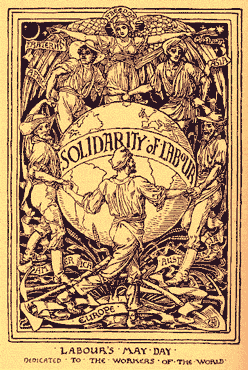
May Day in Richmond this year has been organized as a celebration of working people and worker’s power. We will meet at Abner Clay park in Richmond at 5pm for a people’s banquet, music, comradery and other awesome events! This celebration has been collectively organized by the Richmond chapters or Organizing for a Free Society, Democratic Socialists of America, and the Richmond IWW General membership branch.

The following platform was penned collectively by the various representatives of each of the aforementioned groups and has been approved via consensus:

May 1st is International Workers’ Day. Unlike other holidays, it is not a day to commemorate bloody wars for empire. It is not a day for shopping. May Day is a day for the vast majority of us who must labor for the profit of a tiny minority. May Day is a day without borders, where workers of all countries unite in celebration of our collective potential and power, recognizing the capitalist bosses and their state as our common enemy, and liberation as our common goal. May Day is a day to reconnect with a more sustainable form of existence, for workers to share in the abundant harvest that is the product of our collective social labor.

May Day is widely celebrated throughout the world with protests, boycotts, sabotage, and strikes against a system of exploitation: it is a day without work. May Day is not recognized as a holiday by the rulers of the USA, though it originates in our country. However, despite this lack of “official” recognition, working people have always celebrated May Day. Before the capitalists kicked the peasantry off the land and privatized every aspect of our lives, May Day was a day to celebrate the fertility and abundance of the earth with communal singing, dancing, loving, eating, and drinking.

After capitalism began to spread its reach throughout the world, May Day became a day of working class resistance: on May 4, 1886, immigrant workers in Chicago went on strike for the eight-hour day, better working conditions, and higher pay. In response, the government arrested and executed 7 working class activists – the Haymarket Martyrs – in 1887. Since then, anti-capitalist workers have chosen the 1st of May to commemorate and continue their struggle for liberation. On May Day 2006, when millions of immigrant workers went on strike against workplace injustice and racist immigration policies in the USA, we were once again reminded of the real spirit of May Day.

May Day 2018 is a day of struggle against fascism and imperialism, and a day of celebration to affirm the value of life against the killers of the earth. We mobilize on May Day against white supremacy and in defense of Black Lives, Muslims, immigrants, and all indigenous people and people of color. We mobilize on May Day against mass incarceration and in defense of prison abolition. We mobilize on May Day against heteropatriarchy and in defense of queer and trans lives and reproductive freedom. We mobilize on May Day against the capitalist exploitation of the working class, against slavery and unpaid labor, and against the destruction of our environment. We mobilize on May Day because another world is possible.

Our goal is to foster collaboration among the multiple autonomous organizations and projects operating in the city of Richmond, Virginia. We hope that May Day can be an opportunity for horizontal exchange of diverse ideas and experiences, and to form bonds based on common affinities and commitment to revolutionary struggle.

Pages

The Fine Print I:

Disclaimer: The views expressed on this site are not the official position of the IWW (or even the IWW’s EUC) unless otherwise indicated and do not necessarily represent the views of anyone but the author’s, nor should it be assumed that any of these authors automatically support the IWW or endorse any of its positions.

Further: the inclusion of a link on our site (other than the link to the main IWW site) does not imply endorsement by or an alliance with the IWW. These sites have been chosen by our members due to their perceived relevance to the IWW EUC and are included here for informational purposes only. If you have any suggestions or comments on any of the links included (or not included) above, please contact us.

The Fine Print II:

Fair Use Notice: The material on this site is provided for educational and informational purposes. It may contain copyrighted material the use of which has not always been specifically authorized by the copyright owner. It is being made available in an effort to advance the understanding of scientific, environmental, economic, social justice and human rights issues etc.

It is believed that this constitutes a 'fair use' of any such copyrighted material as provided for in section 107 of the US Copyright Law. In accordance with Title 17 U.S.C. Section 107, the material on this site is distributed without profit to those who have an interest in using the included information for research and educational purposes. If you wish to use copyrighted material from this site for purposes of your own that go beyond 'fair use', you must obtain permission from the copyright owner. The information on this site does not constitute legal or technical advice.


