You are here

mining

Defend Our Sperrins Not Toxic Gold Mining

By staff - IWW Ireland, May 11. 2019

The Industrial Workers of the World (IWW) have issued a call for support and solidarity with communities in the heart of the Sperrin Mountains who continue object to the poisoning of our environment by Canadian based multinationals, Dalradian Gold Ltd.

A spokesperson for the IWW General Members Branch in Ireland said in a statement: “At a time when communities in lockdown are dealing with the Covid 19 crisis, some will intend to use such a period of uncertainty to deflect attention away from events happening elsewhere to shamelessly promote themselves and their own agenda.

"To date we have witnessed the behaviour of multinationals such as Dalradian Gold Limited attempting to use such a climate to befriend local community organisations with financial incentives and windfalls as advertised in the press. This is yet another under hand attempt by a tarnished company to embellish themselves as a type of 'saviours of the community' at a time of increasing hardship.

"Again for anyone approached by or offered to be garnished by financial rewards from multinational companies with an atrocious environmental legacy, we would urge them to firstly question their own conscious and of course their own ethical policies of the organisations to which they belong. Recent moves should be viewed as nothing shy of a community grooming exercise.

"Let's be clear, this is an attempt to sow seeds of division within and around the north west which will ultimately fail, like their ongoing plans to mine and destroy our environment in the pursuit of profit will fail.

"As an international union we would urge community and environmental groups both locally and internationally, as well as the wider trade union movement to acknowledge the many groups challenging the destructive consequences of gold mining within a location such as the Sperrins. An area of outstanding natural beauty.

"Any attempt to view Dalradian Gold Limited as a some type of 'financial saviour' much be challenged. A multinational gold company who plan to create a toxic gold mining plant, an act that will impact upon all our lives throughout the entire North West for future generations to come.

“It is vital at this time we remain vigilant and vocal about what is actually happening. We believe that it is up to all of us to protect and defend our environment and our rights as workers. The right to live in an environment free from toxic pollution and environmental destruction. Free from the greed of scrupulous multinational corporations who try to divide communities.

"Our message today as all ways remains, an injury to one is an injury to all!"

Does the transition to the Circular Economy on a global scale enhance mechanisms of intragenerational inequality?

By Sara Huier - International Development Studies and Global Studies, Roskilde University, April 2019

The study argues that the Circular Economy (CE) model often privileges the Global North economies’ standpoint, revealing a significant inadequacy. Therefore, the present research investigates the extent of the disparities in closed-loop strategies between developed and developing countries. The objective of the analysis is to understand whether these contingencies are relevant and whether they are the display of global economy dynamics that reinforce mechanisms of inequality, conflicting with the Sustainable Development rationale.

It is found that the analysis corroborates the existence of imbalanced drivers, opportunities, barriers and drawbacks between the Global North and the Global South, although potential benefits for the South are entailed. However, it also emerges the existence of critical transnational dynamics which may prevent the achievement of CE objectives globally. The existence of these overlooked and unaddressed global forces is identified as the actual problem of the CE model. Indeed, the narrow focus of the CE on production processes and local, national and regional dynamics diverts the attention from the Global Value Chains. Thus, it is recommended to analyse the global CE structure by applying the Global Value Chain framework, in order to investigate if it is possible to overcome the exposed CE’s limits.

Read the Report (PDF).

Just Transition for the coal industry is expensive – but cheaper than failure to address the needs

By Elizabeth Perry - Work and Climate Change Report, September 5, 2017

July 2017 saw the release of  Lessons from Previous Coal Transitions:  High-level Summary for Decision-makers , a synthesis report of case studies of past coal mining transitions in Spain, U.K., the Netherlands, Poland, U.S., and the Czech Republic – some as far back as the 1970’s.  Some key take-aways from the report:  “Because of the large scale and complexity of the challenges to be addressed, the earlier that actors (i.e. workers, companies and regions) anticipated, accepted and began to implement steps to prepare and cushion the shock of the transition, the better the results”; “the aggregate social costs to the state of a failure to invest in the transition of workers and regions are often much higher that the costs of not investing from an overall societal perspective.” While the level of cost details varies in the case studies, it is clear that costs are significant.  For example, the case study of Limburg, Netherlands states that the national government spent approximately 11.6 billion Euros (in today’s prices) on national subsidies to support coal prices and regional reconversion, in addition to  several 100 million per year in EU funds. “One estimate also suggested that in the Dutch case, all told, regional reinvestment in new economic activities also cost about 300 to 400 000€/per long-term job created.”  Limburg is also cited as “remarkable for the relatively consensual nature of the transition between unions, company and government.”  (see page 10).

The Synthesis report and individual case study reports of the six countries are available here . These are the work of the Research and Dialogue on Coal Transitions project, a large-scale research project led by Climate Strategies and the Institute for Sustainable Development and International Relations (IDDRI) , which also sponsors the Deep Decarbonization Pathways Project.  Future reports scheduled for 2018: a Global report, and a Round Table on the Future of Coal.

Just Transition — Part 1: The Kingdom of Coal

By Chris Silver - DeSmog UK, October 30, 2018

In this first of our new series 'Just Transition, from Fossil Fuels to Environmental Justice', we look at the history of energy in Fife, and begin to mine the prospects for a more sustainable future to meet our climate crisis.

Towards a just transition: coal, cars and the world of work

By Béla Galgóczi - European Trade Union Institute, 2019

The role of trade unions and social dialogue is key in demonstrating the major differences between coal-based energy generation and the automobile industry. This book presents two faces of a just transition towards a net-zero carbon economy by drawing lessons from these two carbon-intensive sectors. The authors regard just transition not as an abstract concept, but as a real practice in real workplaces. While decarbonisation itself is a common objective, particular transitions take place in work environments that are themselves determined by the state of the capital-labour relationship, with inherent conflicts of interest, during the transition process.

The case studies presented in this book highlight the major differences between these two sectors in the nature and magnitude of the challenge, how transition practices are applied and what role the actors play.

Read the report (Link).

Banking on Climate Change: Fossil Fuel Finance Report 2020

By Alison Kirsch, et. al. - Rainforest Action Network, et. al., January 2019

Financial companies are increasingly being recognized — by their clients, shareholders, regulators, and the general public — as climate actors, with a responsibility to mitigate their climate impact. For the banks highlighted in this report, the last year has brought a groundswell of activism demanding banks cut their fossil fuel financing, at the same time that increasingly extreme weather events have further underscored the urgency of the climate crisis.

This report maps out case studies where bank financing for fossil fuels has real impact on communities — from a planned coal mine expansion in Poland, to fracking in Argentina, to LNG terminals proposed for South Texas. Short essays throughout highlight additional key topics, such as the need for banks to measure and phase out their climate impact (not just risk) and what Paris alignment means for banks. Traditional Indigenous knowledge is presented as an alternative paradigm for a world increasingly beset with climate chaos. November’s U.N. climate conference in Glasgow, on the fifth anniversary of the adoption of the landmark Paris climate agreement, will be a crucial deadline for banks to align their policies and practices with a 1.5° Celsius world in which human rights are fully respected. The urgency of that task is underlined by this report’s findings that major global banks’ fossil financing has increased each year since Paris, and that even the best future-facing policies leave huge gaps.

Read the report (PDF).

A New Horizon: Innovative Reclamation for a Just Transition

By various - Reclaiming Appalachia Coalition, 2019

The certainty of an Appalachian transition has become self-evident. The questions that remain are “What shape will that transition take?” and “Will our region seize the opportunity to establish just and sustainable economic models that invest in our strengths and set the region up for meaningful and healthy participation in the new economy?” Foundational to our coalition’s work is the understanding that specific, targeted intervention is necessary to ensure that an equitable vision becomes reality.

Appalachia is at the threshold of a paradigm shift into the new economy, ushered in by communities that are taking their futures into their own hands like never before and implementing innovative ways to address long-standing economic issues with degraded lands. The table on page 6 shows funded projects illustrating this shift that have been supported by our coalition, ranging from ecotourism, renewable energy, arts and culture, and creative waste recycling.

This report highlights the successes achieved in 2019 from previously submitted projects and showcases a brand new round of innovative projects. We’re very excited about both the successes that have already been funded and implemented, as well as the new opportunities that are currently being considered for Abandoned Mine Lands (AML) Pilot funding.

Read the report (Link).

A New Circular Vision for Electronics - Time for a Global Reboot

By staff - Platform for Accelerating the Circular Economy (PACE) and E-waste Coalition, January 2019

The global consumption of smart phones and other electronic devices is increasing, and bringing benefits to many people in areas as wide- ranging as health, education, finance and commerce. But there is a downside: the world is now seeing a growing tsunami of e-waste.

A new report launched by the United Nations E-waste Coalition indicates that the global economy generates approximately 50 million tonnes of e-waste every year. This is a huge amount, representing the mass of all the commercial aircraft ever produced.

Unfortunately, less than 20% of this is waste formally recycled. This results in global health and environmental risks, as well as the unnecessary loss of scarce and valuable natural materials.

But businesses, policy makers, and the public can turn this global challenge around. And the rewards will be significant. Indeed, the proper management of e-waste yields not just one, but multiple gains for development.

The new report calls for a systematic collaboration with major brands, small and medium-sized enterprises (SMEs), academia, trade unions, civil society and associations in a deliberative process to reorient the system and reduce the waste of resources each year with a value greater than the GDP of most countries.

Read the report (PDF).

Responsible Minerals Sourcing for Renewable Energy

By Elsa Dominish, Sven Teske, and Nick Florin - Institute for Sustainable Futures, 2019

The transition to a 100% renewable energy system is urgently needed to meet the goals of the Paris Climate Agreement and increase the chance of keeping global temperature rise below 1.5 degrees. Renewable energy technologies are now the most cost competitive technologies for new installations – and recent investment in new renewable energy infrastructure globally has been double that of new energy investment in fossil fuels and nuclear.

Renewable energy technologies, electric vehicles and battery storage require high volumes of environmentally sensitive materials. The supply chains for these materials and technologies need to be appropriately managed, to avoid creating new adverse social and environmental impacts along the supply chain.

This report presents the findings of an assessment of the projected mineral demand for fourteen metals used in renewable energy and storage technologies, the potential to reduce demand through efficiency and recycling, and the associated supply risks and impacts. Solar photovoltaic (PV) and wind power have been chosen for this assessment because these two technologies make up the majority of new global renewable electricity installations. Batteries have been assessed because of their importance for use in electric vehicles (EVs) and energy storage systems.

This research aims to identify the main ‘hotspots’ or areas of concern in the supply chain, including technologies, metals and locations, where opportunities to reduce demand and influence responsible sourcing initiatives will be most needed.

Read the report (PDF).

The Ruhr or Appalachia: Deciding the Future of Australia’s Coal Power Workers and Communities

By Peter Sheldon, Raja Junankar, and Anthony De Rosa Pontello - CFMMEU Mining and Energy, December 3, 2018
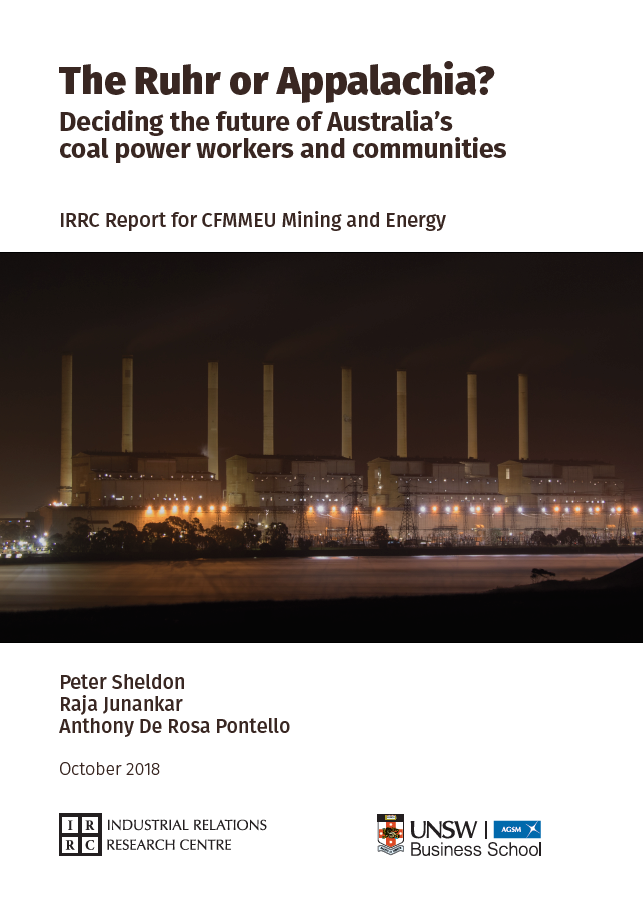
Australia’s coal-fired power stations will all close in the next two or three decades. We know this because the companies that operate the 23 power stations currently operating nation-wide have told us so.

Despite the empty rhetoric of some, it is unlikely that the economic case for investing in new coal-fired power stations in Australia will stack up. Those who currently own and operate coal power stations have no plans to build new ones.

The bad news is that the transition in how we produce power will bring great change to the workers and communities we have relied on to provide Australian homes and industry with reliable energy over many decades.

The good news is that we have the lead time to make smart decisions about what that change looks like—or at least, we now have the lead time after being caught unprepared by earlier closures, including Hazelwood in 2017.We have the choice to manage this structural economic change so that individuals, families and regions aren’t abandoned to unemployment, low-value jobs, poverty and associated health and social decline. Even better, we have the evidence about what works to deliver just transitions for coal power workers and communities, with skills, jobs, opportunities and hope for the future.

Communities grow around power stations and the mines that supply them. They are unique communities bonded in many cases by history, geography, difficult and dangerous working conditions and good unionised jobs. They are also uniquely vulnerable in their heavy dependence on the coal power industry.

This analysis of transitions in resource economies internationally and here in Australia provides valuable insights into the ingredients of success and the wide scope of outcomes.The Appalachian region in the United States is a heart-breaking story of industry transition characterised by short-term, reactive and fragmented responses to closures of coal mines, resulting in entrenched, intergenerational poverty and social dysfunction.

Compare this with the transition away from a heavy reliance on coal mining in Germany’s Ruhr region, where forward planning, investment in industry diversification, staggering of mine closures and a comprehensive package of just transition measures delivered a major reshaping of the regional economy with no forced job losses.

Central to these vastly different outcomes is the presence of a national, coordinated response. To this end, a major recommendation of this report is the establishment of a national, independent statutory authority to plan, coordinate and manage the transition.

In the energy debate to date, the impact of the transition on workers and communities has been almost completely ignored. This is an omission we can’t afford. After all, the costs of investing in a Just Transition need to be balanced against the costs of doing nothing and abandoning whole communities to a bleak future.

While global trends suggest that Australian export coal for steelmaking and energy production will be in demand for decades to come, coal-fired power generation in Australia is winding down. On the information available, there are no excuses for not taking action to protect the best interests of those affected.</p.

I thank Peter Sheldon and the team at UNSW Sydney’s Industrial Relations Research Centre for this important piece of work. I call on all power industry stakeholders to engage with its findings and consider how we can work together to deliver a Just Transition for coal power workers and communities.

Read the report (PDF).

Pages

The Fine Print I:

Disclaimer: The views expressed on this site are not the official position of the IWW (or even the IWW’s EUC) unless otherwise indicated and do not necessarily represent the views of anyone but the author’s, nor should it be assumed that any of these authors automatically support the IWW or endorse any of its positions.

Further: the inclusion of a link on our site (other than the link to the main IWW site) does not imply endorsement by or an alliance with the IWW. These sites have been chosen by our members due to their perceived relevance to the IWW EUC and are included here for informational purposes only. If you have any suggestions or comments on any of the links included (or not included) above, please contact us.

The Fine Print II:

Fair Use Notice: The material on this site is provided for educational and informational purposes. It may contain copyrighted material the use of which has not always been specifically authorized by the copyright owner. It is being made available in an effort to advance the understanding of scientific, environmental, economic, social justice and human rights issues etc.

It is believed that this constitutes a 'fair use' of any such copyrighted material as provided for in section 107 of the US Copyright Law. In accordance with Title 17 U.S.C. Section 107, the material on this site is distributed without profit to those who have an interest in using the included information for research and educational purposes. If you wish to use copyrighted material from this site for purposes of your own that go beyond 'fair use', you must obtain permission from the copyright owner. The information on this site does not constitute legal or technical advice.


