






You are here
mining

 It has been 55 years since the social ecologist Murray Bookchin
  THE WORLD’S LARGEST PENSION FUNDS comprise over half of global investment capital. The Canada Pension Plan Investment Board (CPPIB) manages one of the country’s largest pools of investments, at $400 billion. How pension funds choose to invest has significant bearing on how we collectively address the climate emergency and the needed energy transition away from fossil fuels. In this report we ask: Is the CPPIB investing with the 1.5-degree Celsius limit on global average temperature rise in mind?
 This report explains that Alberta will have little coal-fired electricity left by the end of 2023, six years ahead of the federally mandated coal phaseout deadline of December 31, 2029. This relatively rapid transition away from coal power is the result of numerous decisions made since 2007 by various provincial and federal governments, a few arms-length agencies of the Alberta government, and several large publicly traded corporations that produce electricity for the Alberta market. Our report aims to evaluate Alberta’s electricity transition to date against principles and lessons gleaned from the just transition literature.
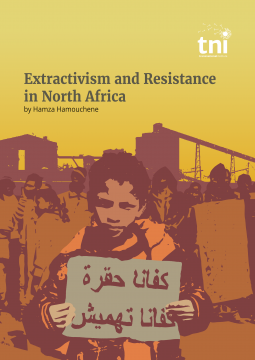 Extractivism as a mode of accumulation and appropriation in North Africa was structured through colonialism in the 19th century to respond to the demands of the metropolitan centres. This accumulation and appropriation pattern is based on commodification of nature and privatisation of natural resources, which resulted in serious environmental depredation. Accumulation by dispossession has reaffirmed the role of Northern African countries as exporters of nature and suppliers of natural resources – such as oil and gas- and primary commodities heavily dependent on water and land, such as agricultural commodities. This role entrenches North Africa’s subordinate insertion into the global capitalist economy, maintaining relations of imperialist domination and neo-colonial hierarchies.
 The idea of just transition first emerged in the 1970s, when US union leader Tony Mazzocchi1 proposed that people whose jobs were threatened by nuclear disarmament should be compensated for the loss. In the 1990s Mazzocchi broadened the argument to refer to workers in environmentally damaging jobs, whose employment is affected by new policies aiming to reduce pollution.
 While the global majority disproportionately suffer the impacts of the climate crisis and the extractivist model, theGlobal North’s legacy of colonialism, the excess of the world’s wealthiest, and the power of large corporations are responsible for these interrelated crises.
 Climate politics are today bursting to life like never before. For four decades, market fundamentalists in the United States and United Kingdom have blocked ambitious efforts to deal with the climate crisis. But now, the neoliberal hegemony is crumbling, while popular climate mobilisations grow stronger every month. There has never been a better moment to transform politics and attack the climate emergency.
The Fine Print I:
Disclaimer: The views expressed on this site are not the official position of the IWW (or even the IWW’s EUC) unless otherwise indicated and do not necessarily represent the views of anyone but the author’s, nor should it be assumed that any of these authors automatically support the IWW or endorse any of its positions.
Further: the inclusion of a link on our site (other than the link to the main IWW site) does not imply endorsement by or an alliance with the IWW. These sites have been chosen by our members due to their perceived relevance to the IWW EUC and are included here for informational purposes only. If you have any suggestions or comments on any of the links included (or not included) above, please contact us.
The Fine Print II:
Fair Use Notice: The material on this site is provided for educational and informational purposes. It may contain copyrighted material the use of which has not always been specifically authorized by the copyright owner. It is being made available in an effort to advance the understanding of scientific, environmental, economic, social justice and human rights issues etc.
It is believed that this constitutes a 'fair use' of any such copyrighted material as provided for in section 107 of the US Copyright Law. In accordance with Title 17 U.S.C. Section 107, the material on this site is distributed without profit to those who have an interest in using the included information for research and educational purposes. If you wish to use copyrighted material from this site for purposes of your own that go beyond 'fair use', you must obtain permission from the copyright owner. The information on this site does not constitute legal or technical advice.
 This site is not the official webpage of the Industrial Workers of the World.