You are here

Industrial Workers of the World (IWW)

Mapping Climate Justice

By Dr Joanna "Jody" Boehnert - EcoLabs, October 16, 2014

Disclaimer: The views expressed here are not the official position of the IWW (or even the IWW’s EUC) and do not necessarily represent the views of anyone but the author’s.

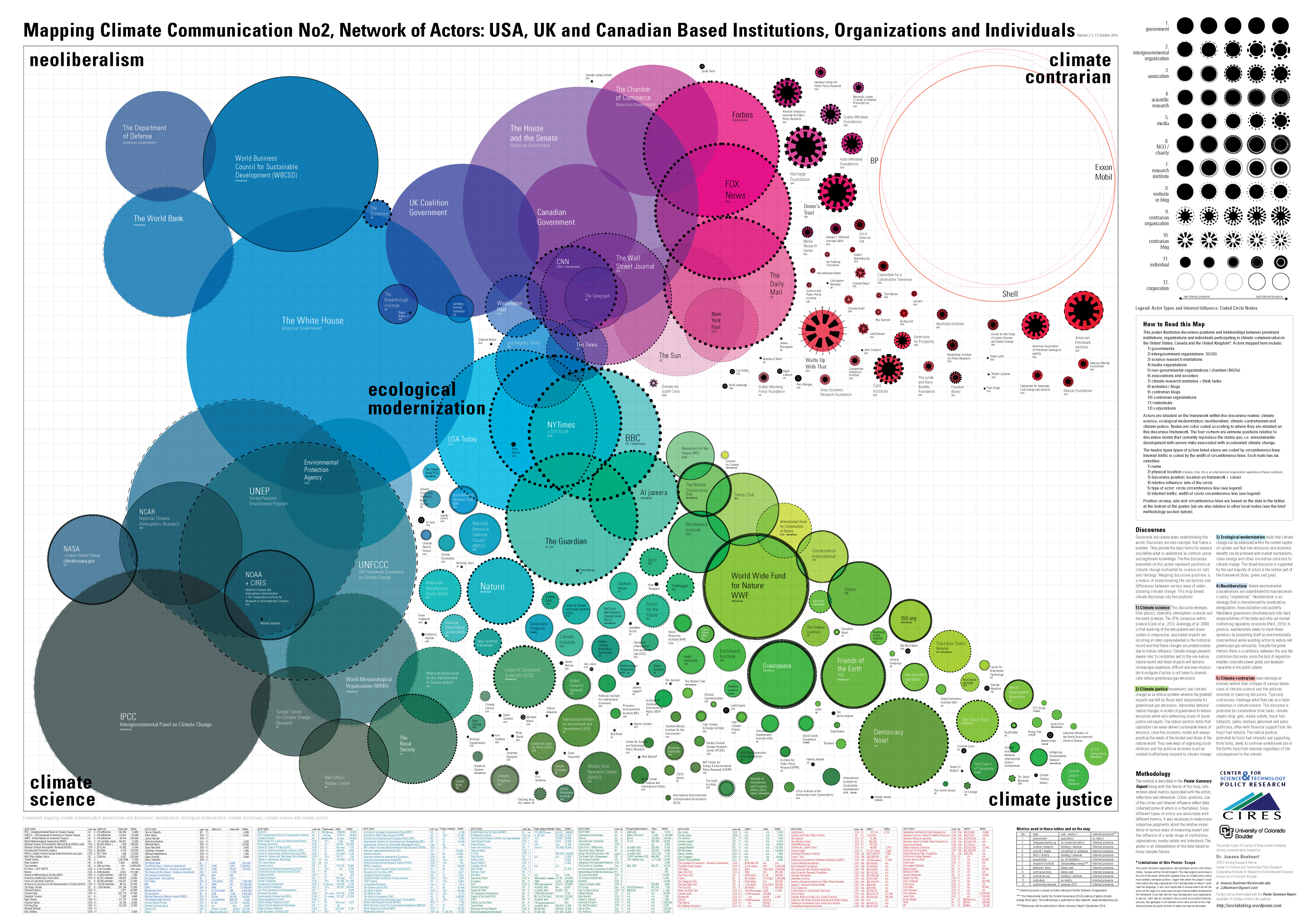
Web Editor's Note: The IWW Environmental Unionism Caucus is featured on the climate map as one of the "climate justice" organizations.

The Mapping Climate Communication Project illustrates key events, participants and strategies in climate communication.

1) Climate Timeline visualizes the historical processes and events that have lead to various ways of communicating climate change. Key scientific, political and cultural events are plotted on a timeline that contextualizes this information within five climate discourses. These reveal very different ideological, political and scientific assumptions on climate change.

2) Network of Actors displays relationships between 237 individuals, organizations and institutions participating in climate communication in Canada, United States and the United Kingdom.

Details about this project can be found in the Mapping Climate Communication: PosterSummary Report. This report can be downloaded here:


The maps reveal how specific details in climate communication are contextualized within complex debates. For example:

  • How does a climate march impact the volume of media coverage of climate change?
  • How does the work of the climate denial industry potentially impact climate policy?
  • Do popular movies and books on climate result in activity in the climate movement?
  • What are the relationships between organizations active in climate communication?

By illustrating key events and actors over time and within five discourses this work makes links between disparate factors and reveals dynamics that contribute to public understanding of climate change.

The project also explores politicised issues in climate communication by using a discourse approach to analyse the various strategies and ideologies held by those organizations, institutions and individuals participating in climate communication in the public realm. This report describes the impact of neoliberal dogma and modes of governance on climate communication as one of the central problems preventing a global response to climate change. Theorizing the impact of neoliberalism on climate change communication and policy is key to an understanding of why emissions continue to rise despite the significant work by the climate science community and the environmental movement over the past four decades.

Green Unionism and the IWW

By Martin Zehr - IWW Environmental Unionism Caucus, October 14, 2014

Disclaimer: The views expressed here are not the official position of the IWW (or even the IWW’s EUC) and do not necessarily represent the views of anyone but the author’s.

“Every union should have a vision of the future,” stated Jock Yablonski as he announced his candidacy for the UMWA presidency. “What good is a union that reduces coal dust in the mines only to have miners and their families breathe pollutants in the air, drink pollutants in the water, and eat contaminated commodities?”  

This presentation by Jock Yablonski presents a concise analysis of the relationship between the working class and the environment. Because the environmental issue has been dominated for so many years by NGOs and advocacy groups, there remains a fundamental schism in substance and politics between the working class and sound environmental and resource planning advocates. The much celebrated blue-green unity of Seattle is a fading memory. In the age of the increasing role of the AFL-CIO in promoting corporate profits for jobs, we have seen how unions like the Mineworkers, Boilermakers, Steelworkers and others have adopted a pro-corporate militarization stance. This significance of this collaboration goes beyond simply environmental issues. In fact, it threatens an independent class role for all unions, whether it's quality of life issues or shop floor issues.  

To date, the IWW’s reputation remains in geographical locales and in small retail or commercial local unions. Our presence within the labor movement remains marginal. The re-emergence of an active IWW presents a new stage for workers in the class stage. More than a revival of the sixties mass struggles and beyond the single issue advocacies of the late 20th century, the IWW can play an leadership role given our willingness to consciously analyze our role, our strategies  and our tactics. For example, the drive to organize in basic industry is a task that remains ahead of the IWW. The service economy will provide certain in-roads needed to establish our validity and are important in establishing real credentials that workers can see. But, the task ahead remains in steel, electrical, maritime, auto and other industries that have become open shops, or even non-union (such as auto). Likewise, organizers and political education of organizers need to be developed to a generation that has minimal experiences in the class struggle.  

Syndicalism: An International and Historical Perspective (Dek Keenan)

By Dek Keenan - Zabalaza Books, October 12, 2014

This paper will introduce syndicalism both as an historical international phenomenon and as a contemporary international model and movement. It presupposes very little knowledge of, but hopefully some substantial interest in, the subject on the part of the reader.

What does Syndicalism mean to us as labour movement activists? It may mean the million workers in the Spanish CNT fighting with a new world in their hearts during the Spanish Civil War. It may mean the legendary Industrial Workers of the World organising the One Big Union across craft and trade, race and gender lines. It may mean a vast movement of workers across Latin America during the first half of the 20th Century. It may mean Starbucks baristas fighting today to build unions in coffee houses in New York and Santiago. But it very possibly means none of these things.

Because syndicalism constitutes one of the least understood currents in the workers movement. And yet syndicalism was the driving force of immense and powerful labour movements across the globe in the first decades of the 20th Century; from Argentina to Japan and from Australia to Portugal workers gathered under its flag. And today it represents a small, but growing, part of the international labour movement; albeit one that remains unduly obscure and marginal.

Of course, for speakers of a Romance language syndicalism will be recognised as simply the word for ‘unionism’. So, when we talk of syndicalism in the context of this paper we are actually talking about revolutionary syndicalism and, later on, anarcho-syndicalism. Revolutionary syndicalism or revolutionary unionism (I will for brevity use the term syndicalism to indicate revolutionary syndicalism throughout this paper) emerged in the latter part of the 19th century as an alternative vision to the dominant unionism which had developed and which were aligned with social democratic political parties or which simply followed a class collaborationist line. Syndicalists, aware of the failure of this form of unionism to defend the interests of workers and generally informed by socialist ideas, of both anarchist and Marxist origin (Darlington, 2013), looked to establishing workers’ organisations that would provide both day to day resistance to the bosses and a structure able to establish a new society based on a collectivised system of worker-managed production and distribution. In the United States and Canada this vision tended to be described as Revolutionary Industrial Unionism rather than syndicalism, but this can be understood as a ‘local’ variant of syndicalism re-named to reflect a notion of advanced industrial development (Dubofsky, 1969).

Syndicalists took diverse routes in building such organisations, sometimes based upon federations of small trade and even craft unions, sometimes upon national industry-wide unions and sometimes co-ordinated in one big union (e.g. Industrial Workers of the World (IWW) in the United States and globally). What they shared, however, were the following common characteristics.

Progressive Union Busting

By The Angry Syndicalist - October 9, 2014

Disclaimer: The views expressed here are not the official position of the IWW (or even the IWW’s EUC) and do not necessarily represent the views of anyone but the author’s.

Grassroots Campaigns Inc is in the process of being unionized by the newly formed United Campaign Workers who have canvassed for the progressive non-profit organization. The canvassers have been denied paychecks owed by the organization and have been running a campaign for the regulation and restoration of hemp. Apparently these progressives have bounced checks before as well, since management wasn't willing to discuss these problems, the workers walked off the job.

The UCW was formed in concert with the help of the IWW. A phone blast was the first response to the liberal organization, with supporters calling in for the UCW. The demands were simple, $15.00 an hour and the overtime pay they were owed. When these were handed in to the director, he apparently thought the word grassroots and the IWW were strangers, naivety abound.

The campaign has been gathering signatures for I-21, the Oregon Cannabis Amendment, which would end all legal penalties for marijuana products and extend growing permissions to Oregonians. It’s paired with the Oregon Cannabis Tax Act, I-22, which would override existing laws to create a new regulatory framework and funnel money from marijuana sales into state programs.

The crew pulls 600 signatures a day and it would make sense since they are in favor of the campaign they'd be brought back to work? No. The canvassers have support in the community in the form of Jobs for Justice and other union members.

Nonprofits have been using methods normally reserved for the conservative wing of liberal politics to bust unions i.e. Sisters Camelot, which has left a sour taste in many Wobblies mouths. Who resorted to a lawyer whose goal was to destroy the union, despite the fact the NLRB recognized them as workers.

I do not put it past progressives to have the not in my backyard mentality if it affects them. So much so, they hired scabs who ironically were offered $15.00 an hour. Since then the workers have done what they can to get management back to the bargaining table, including demanding enough dignity from the work they perform in the payment of bonuses so they can feed their children.

A confused liberal called this heteronormative, however I question if this liberal has ever had to starve before.

Part II: Boston Wobblies in Solidarity.

GCI has had their reputation for union busting spread throughout the local community in Boston(where their HQ is). Their quotas were unrealistic and union busting isn't a thing a labor democrat would do would they? Anyways, they resorted to hiring private security who were too cowardly to show their faces to the world.

Grassroots Campaigns was founded in December 2003. By April 2004 Grassroots Campaigns had opened offices in 40 cities throughout the country. By July 2004 they had over 2,000 staff knocking on doors and fund raising on behalf of the  Democratic National Committee With continued work on behalf of MoveOn PAC to run "Leave No Voter Behind," (LNVB). This was a "get out the vote" (GOTV) program intended to give Democratic candidate John Kerry an edge in the swing states. 

Grassroots Campaigns, Inc clients are a who's who for those who like to name drop, from the ACLU to the SPLC to the Sierra Club. It's one big club and the canvassers aren't in it. Praise be to the liberal elite with college degrees and Starbucks addictions.

Why Is The World Ignoring The Revolutionary Kurds in Syria?

By David Graeber - Boston IWW, October 8, 2014

Disclaimer: The views expressed here are not the official position of the IWW (or even the IWW’s EUC) and do not necessarily represent the views of anyone but the author’s.

In 1937, my father volunteered to fight in the International Brigades in defence of the Spanish Republic. A would-be fascist coup had been temporarily halted by a worker’s uprising, spearheaded by anarchists and socialists, and in much of Spain a genuine social revolution ensued, leading to whole cities under directly democratic management, industries under worker control, and the radical empowerment of women.

Spanish revolutionaries hoped to create a vision of a free society that the entire world might follow. Instead, world powers declared a policy of “non-intervention” and maintained a rigorous blockade on the republic, even after Hitler and Mussolini, ostensible signatories, began pouring in troops and weapons to reinforce the fascist side. The result was years of civil war that ended with the suppression of the revolution and some of a bloody century’s bloodiest massacres.

I never thought I would, in my own lifetime, see the same thing happen again. Obviously, no historical event ever really happens twice. There are a thousand differences between what happened in Spain in 1936 and what is happening in Rojava, the three largely Kurdish provinces of northern Syria, today. But some of the similarities are so striking, and so distressing, that I feel it’s incumbent on me, as someone who grew up in a family whose politics were in many ways defined by the Spanish revolution, to say: we cannot let it end the same way again.

Boston IWW’S to Grassroots Campaigns Inc (GCI): F U!

By 6eoff - Boston IWW, October 2, 2014

Disclaimer: The views expressed here are not the official position of the IWW (or even the IWW’s EUC) and do not necessarily represent the views of anyone but the author’s.

Today Wobblies from Boston took to the street to support Portland OR canvassers, employed by Grassroots Campaigns Inc (GCI), who formed the United Campaign Workers* union in response to poverty pay, impossible quotas, meager training, and blatant disrespect. Canvassers’ demands included $15/hr, overtime pay, and sick leave. The company retaliated by shutting down its Portland operation, laying off employees with no notice and just two days’ wages!

GCI has its headquarters here in Boston at 186 Lincoln Street. Today local IWW’s leafleted to expose GCI’s union-busting and exploitation. We sent the message to GCI and the neighborhood: there is nothing progressive about terminating canvassers for not meeting unreachable quotas, or for banding together to negotiate better terms and conditions. GCI apparently heard we were coming, and had to arrange for special security goons, who however were camera-shy and hid demurely inside the building when we attempted to preserve their images for posterity. It was a great time & we’ll be back!

*Affiliated with the Industrial Workers of the World

Help IWW General Headquarters Recycle!

Official IWW Bulletin - October 2, 2014

Chicago does not provide a public recycling scheme, but we can recycle for about $400 per year, working with a non-profit environmental education organization. Help General Headquarters "recycle as feasible," as our constitution suggests for all IWW shops. Click here to donate!

ecology.iww.org editor's note: this is true in many large cities. Curbside recycling pick-up was more or less invented by the Ecology Center in Berkeley, California, in the early 1980s (by a group that included some of the founders of the Bay Area chapter of Earth First!, and who helped Earth First! and IWW organizer Judi Bari organize IWW Local #1 in Mendocino County. They later organized Redwood Summer together. Coincidental with that, the curbside recyler drivers joined the IWW and became one of the first unionzed curbside reclycing pick-up crews in the world. That shop is still organized under an IWW contract to this date.

For Oil and Gas Companies, Rigging Seems to Involve Wages, Too

By Naveena Sadasivam; image by Matt Nager - ProPublica, September 25, 2014

Disclaimer: The views expressed here are not the official position of the IWW (or even the IWW’s EUC) and do not necessarily represent the views of anyone but the author’s.

A ProPublica review of U.S. Department of Labor investigations shows that oil and gas workers – men and women often performing high-risk jobs – are routinely being underpaid, and the companies hiring them often are using accounting techniques to deny workers benefits such as medical leave or unemployment insurance.

The DOL investigations have centered on what is known as worker "misclassification," an accounting gambit whereby companies treat full time employees as independent contractors paid hourly wages, and then fail to make good on their obligations. The technique, investigators and experts say, has become ever more common as small companies seek to gain contracts in an intensely competitive market by holding labor costs down.

In the complex, rapidly expanding oil and gas industry, much of the day to day work done on oil rigs and gas wells is sub-contracted out to smaller companies. For instance, on one gas rig alone, the operator might hire one company to construct the well pad, another to drill the well, a third company to provide hydraulic fracking services and yet another to truck water and chemicals for disposal.

But for the thousands of workers in the hundreds of different companies, a single standard is supposed to apply: by law, they must be paid more than minimum wage and they must be fairly compensated for any overtime accrued.

In 2012, the DOL began a special enforcement initiative in its Northeast and Southwest regional offices targeting the fracking industry and its supporting industries. As of August this year, the agency has conducted 435 investigations resulting in over $13 million in back wages found due for more than 9,100 workers. ProPublica obtained data for 350 of those cases from the agency. In over a fifth of the investigations, companies in violation paid more than $10,000 in back wages.

One of those companies was Morco Geological Services, a company providing mud logging services for other oil and gas drilling companies. In 2013, the DOL found that Morco was paying some workers $75 daily for working virtually round-the-clock shifts. The company eventually agreed to pay $595,737 in back wages to 121 workers following the DOL's investigation. In another significant case, Hutco, a company providing labor services to the oil and gas industry, ended up paying $1.9 million to 2,267 employees assigned to work in Louisiana, Mississippi and Texas.

"The problem of misclassification has become pervasive," said Dr. David Weil, a former economics professor at Boston University who today heads the DOL's Wage and Hour Division.  "Employers are looking for opportunities in a changing business landscape at the employee's expenses to cut corners as much as possible, leaving room for wage and hour violations."

Over the last decade, the oil and gas industry has seen tremendous growth. Between 2007 and 2012, when average employment in all U.S. industries fell by 2.7 percent, employment in the oil and gas industry increased by over 30 percent. According to research conducted by Annette Bernhardt, a scholar on low-wage work, 84 percent of workers in the oil, gas and mining industry were employed by contractors in 2012.

At the same time, the industry has also seen an increase in fatalities and injuries on the job. There is, so far, no evidence to suggest that these accidents are a result of inadequate training or overworked laborers. But accounts from other industries that heavily outsource work suggest those risks could be present.

Wall Street is Fertile Ground for a Movement

By Dave Lindorf - CounterPunch, September 24, 2014

Disclaimer: The views expressed here are not the official position of the IWW (or even the IWW’s EUC) and do not necessarily represent the views of anyone but the author’s.

There were many extraordinary moments during both Sunday’s huge climate march through mid-Manhattan and Monday’s more militant protest in Lower Manhattan’s financial district, from the little boy marching with a tambourine that had “This Machine Kills Fascists” written around its edge to the bored policeman along the march route blowing a huge bubble from the gum he was chewing, but perhaps the most telling occurred in the early afternoon on Monday, when, as several thousand climate action protesters sat or milled around, penned into several blocks of Broadway by hundreds of linked-together metal police barricades, (MH) astride a pair of telephone booths began an impromptu IWW rant.

The day before, during the big march down Central Park West, Sixth Avenue and across 42nd Street, those phone booths had been favored vantage points for photographers, dancing young women and people just trying to get a better view of the march. Bored cops standing along the parade route would chat and joke with those perched above. But this time (MH), dressed in black and standing in sight of the big bronze Wall Street Bull sculpture, and just several blocks down Broadway from Wall Street and the New York Stock Exchange building, was shouting out a call for workers to unite, rise up and overthrow the capitalist system. It was just too much for the police who were guarding the barricades to segregate people so those on the street couldn’t leave and so supporters on the sidewalk couldn’t join the protest.

A dozen of the cops came over to the nine-foot-tall phone booths, surrounding them, and demanded that the (MH) come down. He ignored them, realizing that they couldn’t reach him, and went on to finish his speech, which was relayed phrase by phrase via the “human mic” technique perfected three years earlier by the Occupy Wall Street movement. When he was done, he paced around on his perch like a rooster, looking down at the surrounding cops, and then suddenly made his break.

Leaping over the cops and some of the surrounding protest supporters, he managed to land on his feet on the sidewalk and started running. Protesters closed ranks behind him, slowing down the cops who all began chasing after him.

At that point, all the police guarding the metal barriers took off after the young man too. Eventually this police horde caught up with (MH), and leapt on him like a rugby scrum. I don’t know what happened to him in the end. He was probably arrested and charged tautologically with resisting arrest, but for what violation I don’t know since, as the events of the day before proved that just standing on a phone booth was not illegal or cause for arrest; apparently only making a leftist speech from one is a “crime.”

But this anonymous orator’s escape attempt turned out to be an unintended act of liberation. As soon as the majority of police lit out after him, abandoning their posts for the opportunity to finally pummel someone, people on the sidewalk and in the street spontaneously, with no organized encouragement, began unhooking the gates separating them. On the west side of Broadway, people carried the gate segments around a corner and down a side street out of sight. On the east side of the street, the sections were piled in a heap on top of each other, after which protesters scaled them and sat down. The gates were never replaced by police, and the attempt to fence in the protest collapsed.

Food Justice and Worker Organization: An Interview with Luigi Rinaldi, Industrial Workers of the World

Interview with Luigi Rinaldi - Theory in Action, Vol. 7, No. 4, October 2014, reposted by Providence IWW

Disclaimer: The views expressed here are not the official position of the IWW (or even the IWW’s EUC) and do not necessarily represent the views of anyone but the author’s.

Q: First off, thanks so much for taking the time to do this interview, Luigi. This issue of Theory in Action is centered on food justice and sustainability. For a lot of people, food justice cannot be coherently separated from the experiences of workers in the food industry and, I think, if we mean the term “sustainability” in its most widely applicable way, that also means looking at how people’s lives and livelihoods are made unsustainable by our dominant institutions. I know your union, the Industrial Workers of the World, over the last few years has had various campaigns in food service. Can you start by briefly outlining the economic situation of workers in the food industry? Why should people be concerned with the plight of food industry workers?

Luigi Rinaldi (LR): Thank you for the opportunity to talk about these issues! I would say that it is impossible to talk about food justice without touching on capitalism and, therefore, the class relation. Workers in the food industry, throughout the whole process – from farm to restaurant – are in a situation that leaves them extremely precarious. Now, I’m primarily going to focus on the food service end of things, because that’s the part of the industry I’ve worked in, but there’s a lot to be said for the production side and the supply chain as well. The work isn’t the same, but the conditions that it creates are similar.

What you have is a very precarious and low wage industry. You can expect to hold a job for less than a year and to earn less than ten dollars an hour. My previous workplace, a café and bakery, had about 90% turnover in a year… I would say that is low for most of the industry, especially when you get into fast food. Contrary to the popular image, most of these workers are not teenagers, but adults trying to eke out a living. They are fathers and mothers who often have to work two or three jobs, because in the food industry full time employment is rare, and even with full time employment the wages are too low to get by on. The work conditions are often unsanitary and you are subject to harsh and arbitrary discipline. There should be concern about this industry because it’s one of the fastest growing, at least here in the United States. It’s already one of the largest private sector employers and while job growth for the rest of the economy is around 1.5 or 2%, food service is growing at a rate nearly double that. The industry is expected to add 1.3 million jobs to the economy over the next decade. With the decline of many manufacturing and even professional jobs from our economy in the United States, look at where there’s job growth: that’s where you’ll be applying.

Pages

The Fine Print I:

Disclaimer: The views expressed on this site are not the official position of the IWW (or even the IWW’s EUC) unless otherwise indicated and do not necessarily represent the views of anyone but the author’s, nor should it be assumed that any of these authors automatically support the IWW or endorse any of its positions.

Further: the inclusion of a link on our site (other than the link to the main IWW site) does not imply endorsement by or an alliance with the IWW. These sites have been chosen by our members due to their perceived relevance to the IWW EUC and are included here for informational purposes only. If you have any suggestions or comments on any of the links included (or not included) above, please contact us.

The Fine Print II:

Fair Use Notice: The material on this site is provided for educational and informational purposes. It may contain copyrighted material the use of which has not always been specifically authorized by the copyright owner. It is being made available in an effort to advance the understanding of scientific, environmental, economic, social justice and human rights issues etc.

It is believed that this constitutes a 'fair use' of any such copyrighted material as provided for in section 107 of the US Copyright Law. In accordance with Title 17 U.S.C. Section 107, the material on this site is distributed without profit to those who have an interest in using the included information for research and educational purposes. If you wish to use copyrighted material from this site for purposes of your own that go beyond 'fair use', you must obtain permission from the copyright owner. The information on this site does not constitute legal or technical advice.