

You are here

green syndicalism

Arriving at May Day: Lockdowns, Throwdowns, and Direct Action

By the Earth First! Journal Staff - Earth First! Journal, May 1, 2014

Disclaimer: The views expressed here are not the official position of the IWW (or even the IWW’s EUC) and do not necessarily represent the views of anyone but the author’s.

When the Global Climate Convergence announced the Earth Day to May Day series of events and actions, it revealed a gap between daily reality and Hallmark posturing. More than 100 actions—such as the occupation of the DEQ in Portland, Oregon, by Rising Tide—have taken place in dozens of cities as part of the Climate Convergence.

Over the last few days, IWW fellow workers in California have protested the Koch Bros PetCoke Facility in Pittsburg, the Chevron Refinery in Richmond, and Crude by Rail at the Union Pacific’s Ozal Train Yard in Martinez.

One Wob organizer named Elliot Hughes U-locked himself to the gate of the Koch Brothers facility to halt business as usual. “Our goal is the liberation of the people on the planet that is our home. With the increasing amount of industrial disasters, we cannot wait any longer because the health and safety of all workers of the world is on the line.”

EF! shares numerous crucial membranes with the IWW and the labor movement, dating back to Judi Bari’s founding of the IWW timber workers local #1 in Northern California in the late 1980s. The goal of uniting loggers against Maxxam’s junk bond dealing, land grabbing, and clear cutting was to restore timber lands to the public interest. While some hardcore EF!ers were repulsed by the notion of chatting up loggers, let alone working to move timber lands into the hands of communities that would take part in “sustainable logging,” most agreed that the terms were vastly superior to clear cutting old growth.

Indeed, growth from the Redwood Summer movement at the turn of the 1990s fed the entire radical movement, developing critical understandings that would be cultivated and emerge in Seattle 1999 and again during Occupy. According to stories passed down to us over the years, activists being shot at in Northern California’s redwood forest by the same loggers they were trying to organize later on that night in the barroom would, ten years down the line, take part in the free states of Cascadia, and the No Borders Camp of the Sonoran desert five years later.

In the words of Buenaventura Durutti, “The bourgeoisie might blast and ruin its own world before it leaves the stage of history. We carry a new world here, in our hearts. That world is growing in this minute.” The inter-generational movement of Earth First! grows in the interstices of stories and ideologies, yet we often lag behind when it comes to social analysis.

May Day 2014: Reviving The General Strike

By Staughton Lynd
This article originally appeared in the May 2014 Industrial Worker

On May 1, 1886, the first general strike in U.S. history brought workers into the streets on behalf of one simple demand: an eight-hour working day. Their anthem was:
“We want to feel the sunshine;
We want to smell the flowers;
We’re sure (that) God has willed it
And we mean to have eight hours.

We’re summoning our forces from
Shipyard, shop and mill;
Eight hours for work, eight hours for rest,
Eight hours for what we will.”

As is the case in the movement of low-wage workers today, the movement for eight hours was characterized by skilled and less-skilled workers, and workers in different trades, making common cause.

On May 3, 1886, union members at the McCormick Reaper Works in Chicago, who had been locked out, confronted strikebreakers as they left the plant. A firefight broke out involving the police, and strikers were killed. In response a protest rally was called at a downtown open area called The Haymarket. The rally was peaceful, but as the meeting was coming to an end someone threw a bomb and seven policemen died. After a dramatic trial and unsuccessful appeals, four so-called “anarchists” were hanged.

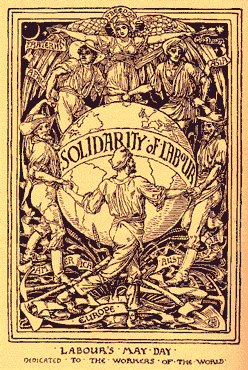
This story became familiar to working-class movements all over the world. May 1 became international May Day. In Mexico City, it has been a tradition that every May Day translated excerpts from the last words of two of the executed men, Albert Parsons and August Spies, are read aloud to huge crowds in the central public square, or zocalo.

Climate Change and Human Alienation

By Javier Sethness - Dissident Voice, April 26, 2014

Disclaimer: The views expressed here are not the official position of the IWW (or even the IWW’s EUC) and do not necessarily represent the views of anyone but the author’s.

[The] self-alienation [of humanity] has reached such a degree that it can experience its own destruction as an aesthetic pleasure of the first order.
– Walter Benjamin1

At the end of last year, the Humanist Workers for Revolutionary Socialism (HWRS) published a provocative position paper which presents their analysis of the climate crisis: “Alienation, Climate Change, and the Future of Humanity.” Aside from discussing the very real threat which anthropogenic climate disruption poses to humanity and terrestrial nature generally considered, the HWRS in this essay develop a theory of human alienation based on the thought of Karl Marx and Erich Fromm and posit such alienation as the main obstacle for the emergence today of radical mass-movements from below that would check the increasingly fatal trends toward unprecedented levels of suffering and death and global ecocide promised by climate catastrophe. Being Leninists, however, the HWRS recommend “revolutionary” party leadership as a means of directing the alienated masses toward the enacting of anti-capitalist social transformation and the rational mitigation of climate destruction. Clearly, such a recommended solution is highly problematic—yet the HWRS paper presents enough critical points for reflection and contemplation to merit a brief discussion of it here.

Get Intersectional! (Or, Why Your Movement Can't Go It Alone)

By Kristin Moe - Yes Magazine, April 4, 2014

Disclaimer: The views expressed here are not the official position of the IWW (or even the IWW’s EUC) and do not necessarily represent the views of anyone but the author’s.

"Intersectionality" has evolved from a theory of how oppression works to a notion of how people can fight it.

"There is no such thing as a single-issue struggle because we do not live single-issue lives." –Audre Lorde

Here’s the scenario: This year’s epic drought devastates agriculture in California. Water use is rationed, so the cost of grain goes up, and, because cattle eat grain, the cost of beef goes up too. To cut expenses, the owners of a fast food restaurant cut a worker's wages and benefits by a couple bucks an hour. Next month he won’t be able to send money to his wife and kids back in Mexico, where the same drought is also decimating farms—and may be contributing to even more northward migration.

What’s the origin of the restaurant worker’s predicament?

Is it climate change, which makes droughts more severe and more likely to persist? Is it the labor policies that allowed the worker's wages to be cut? Or is it that NAFTA has flooded the Mexican market with cheap, U.S.-grown corn since 1996, forcing him to leave his family’s farm and migrate to California in the first place?

The likely answer is that it’s a little bit of everything. “People don’t have one dimensional identities as human beings,” says Brooke Anderson—a Labor Fellow at the Oakland-based nonprofit, the Movement Generation Justice and Ecology Project—and the issues that affect them aren’t one-dimensional, either.

There’s a word for this kind of thinking: "intersectionality." And while the word has been around for more than 25 years, it’s being used more and more frequently all over in social justice movements today, from climate to reproductive rights to immigration. It’s a way of thinking holistically about how different forms of oppression interact in people’s lives. More recently, it's also led to a more collaborative form of organizing that reflects that, rather than taking on one issue at a time.

Our Plan for May Day — All out to fight for the working class!

Statement by United Rank and File in San Francisco - April 30, 2014

Disclaimer: The views expressed here are not the official position of the IWW (or even the IWW’s EUC) and do not necessarily represent the views of anyone but the author’s.

On International Workers’ Day, Thursday, May 1 (yes in two days) join us as we take our fight to “Smash the 2 Gate System” directly to those who profit from it.

If it is at all possible for you to be there at 5am, please do! We will need numbers in the beginning for the action to last and be successful.

If you cannot be there at 5am, get there as early as you can. Use this rough schedule to find us, and follow @UnitedRnF on Twitter to get updates. Obviously, some of this may require adjustment due to circumstances that morning but generally you should be able to meet up with us along the way.

Here is the plan:

5am – Meet at 16th and Mission

We will have United Rank and File T-Shirts and picket signs for folks, donations accepted but not required. Otherwise, wear work attire but comfortable walking shoes. Please, do not wear construction union specific (shirts/hats with bugs, etc.) apparel so as not to give the implication that this was organized by any construction union officialdom but by rank and file workers ourselves.

5:30am – March to 2 Gate Jobs

If you are not able to make there before we leave 16th and Mission, walk to Market and Guerrero. Cross Market onto Laguna. Walk a few blocks up Guerrero. Turn right, walk one block to Octavia. Walk back toward Market on Octavia. If you walk this route, you should see and/or hear us someplace nearby. There are a handful of 2 Gate jobs in that area and we will be at one or more of them.

6am – Set up pickets at 2 gate job(s)

We will have a flag at each location that we need to be at. We plan to have well organized pickets. Please know that we have a process for making decisions at this action should we need to adjust our actions. We will stay at any given location until an outcome has been determined.

10:40am – March to the War Memorial Performing Arts Center

201 Van Ness Ave. The Herbst building is currently undergoing a complete remodel. They are using the 2Gate System. A nonunion subcontractor is doing around 10 million dollars in work. This is unheard of in downtown San Francisco.

11am – Rally at the War Memorial Performing Arts Center

We will have a short speakout against the 2Gate System and building a sustained and united fight for the working class.

11:30 – March to City Hall to meet up with the Building Trades Council’s rally.

END – After this there are other rallies in the Bay Area that people should consider attending. If you are hosting or know of one, please comment with the information. 

As construction workers, are directly affected by the 2Gate system and so we strive to collectively lead this effort as organized rank and file workers. This is one part a larger struggle that affects all working people and for that reason we call on all members of the working class to come out and join us.

We also realize that solidarity goes both ways. Members of United Rank and File have gone to many other actions in solidarity and plan to continue in the future as an organization.

At this action, we ask that everyone comes in true solidarity. We ask that you be as militant as we are. We are respectful of everyone’s choice to protest in the ways that they feel are necessary at times but we ask that everyone coming to this action help make it a success in the using the tactics and strategies that we have worked very hard to organize.

We look forward to building United Rank and File and class solidarity with everyone!

See you on May Day!
Call to Action – May 1, International Workers Day

Statement by United Rank and File in San Francisco - April 2014

Disclaimer: The views expressed here are not the official position of the IWW (or even the IWW’s EUC) and do not necessarily represent the views of anyone but the author’s.

United Rank & File Construction Workers Take A Stand on May Day

Join us as we return to a proud history of direct action to fight to protect our own livelihoods, to raise up and organize all workers and against laws that restrict us. 

On May 1, International Workers Day, we will be gathering at 16th and Mission at 5am to protest the 2 Gate System. This is a system that contractors and developers have created in order to impose the restrictive, discriminatory and repressive anti-worker laws of the Taft-Hartley act on construction unions.

San Francisco appears, on the surface, to be recovering from the economic disasters of recent years. There are cranes all over town and buildings are popping up everywhere. The people building these buildings are unable to afford the luxuries that many supposedly offer. We are also growing further and further from the chance of ever living a reasonable distance from the city in which we work. Most of us have long been unable to afford to live within the limits of the city we built. We see new wealth coming into SF all the time and yet we have gotten modest or no raises.

Many of us are lucky to have collective bargaining. We look forward to contracts coming up during this building boom. It seems the time has finally come for us to get the raises that we have lacked in the last few years while the cost of living has skyrocketed. We are looking forward to the opportunity to dig out of the financial holes we are in after years of unemployment, losing insurance for our families, losing houses and having to raid our retirement accounts to make ends meet. Now, contractors and developers need us badly and will have to give us a decent raise next contract, right? Maybe not…

Historically in San Francisco a vast majority of building has been done by workers who together, through their unions, bargain with all of their employers for a fair and equal wage rate for all of the labor done by their craft. This is still the case but we see other employers winning work contracts in SF at an alarming rate. Building has increased suddenly in San Francisco but it has disproportionately increased for the non-signatory contractors. There is an unprecedented amount of building being done by contractors who do not agree to the standards of pay and conditions that workers have fought for.

This gives signatory employers (those who employ workers under collective agreements) a powerful bargaining chip as we go into negotiations during this boom. They will argue that they need to stay competitive or the “union contractors” (and therefore workers) will all lose jobs. “Staying competitive” they argue, means that they cannot give raises, may even need some back, in order to compete. Suddenly, the snowball that has killed all the reasonably livable jobs across the country is being rolled around in San Francisco, the last bastion of hope for a decent living for those of us with blue collars.

The Brief Origins of May Day

By Eric Chase - Published on IWW.ORG, written ca.1993.

Most people living in the United States know little about the International Workers' Day of May Day. For many others there is an assumption that it is a holiday celebrated in state communist countries like Cuba or the former Soviet Union. Most Americans don't realize that May Day has its origins here in this country and is as "American" as baseball and apple pie, and stemmed from the pre-Christian holiday of Beltane, a celebration of rebirth and fertility.

In the late nineteenth century, the working class was in constant struggle to gain the 8-hour work day. Working conditions were severe and it was quite common to work 10 to 16 hour days in unsafe conditions. Death and injury were commonplace at many work places and inspired such books as Upton Sinclair's The Jungle and Jack London's The Iron Heel. As early as the 1860's, working people agitated to shorten the workday without a cut in pay, but it wasn't until the late 1880's that organized labor was able to garner enough strength to declare the 8-hour workday. This proclamation was without consent of employers, yet demanded by many of the working class.

At this time, socialism was a new and attractive idea to working people, many of whom were drawn to its ideology of working class control over the production and distribution of all goods and services. Workers had seen first-hand that Capitalism benefited only their bosses, trading workers' lives for profit. Thousands of men, women and children were dying needlessly every year in the workplace, with life expectancy as low as their early twenties in some industries, and little hope but death of rising out of their destitution. Socialism offered another option.

A variety of socialist organizations sprung up throughout the later half of the 19th century, ranging from political parties to choir groups. In fact, many socialists were elected into governmental office by their constituency. But again, many of these socialists were ham-strung by the political process which was so evidently controlled by big business and the bi-partisan political machine. Tens of thousands of socialists broke ranks from their parties, rebuffed the entire political process, which was seen as nothing more than protection for the wealthy, and created anarchist groups throughout the country. Literally thousands of working people embraced the ideals of anarchism, which sought to put an end to all hierarchical structures (including government), emphasized worker controlled industry, and valued direct action over the bureaucratic political process. It is inaccurate to say that labor unions were "taken over" by anarchists and socialists, but rather anarchists and socialist made up the labor unions.

Green Unionism Strategy and Tactics - Railroad Workers and Crude by Rail Trains

By x344543, x356039, and x363464 - April 29, 2014

Disclaimer: The views expressed here are not the official position of the IWW (or even the IWW’s EUC) and do not necessarily represent the views of anyone but the author’s. This is not an official statement of either Forest Ethics or Railroad Workers United, and neither organization has vetted this article.

As many of you may be aware, there has been a growing uproar against crude-by-rail, which is one of the major components of the current fossil fuel capitalist driven extreme energy boom. This is due in large part to the fact that there were more derailments involving crude-by-rail trains in 2013 alone than the previous four decades combined. In some cases, like Lac Megantic, whole towns have been nearly wiped off of the map.

This is particularly true in the San Francisco Bay Area where residents in five different communities dominated by oil refineries are organizing to prevent increased transportation of crude-by-rail into their homes. The organizers have built coalitions with local environmental and social justice groups as well as called upon the support of environmental NGOs. Their efforts have included speaking out at public forums, attending public hearings, watch-dogging the regulatory process (such as it is), participation in in electoral campaigns, producing alternative media, rallies, marches, and even nonviolent civil disobedience.

These community activists have even cultivated relationships with rank and file workers employed by the refineries--at least those not buying the company line. Still, there's another group of workers that these coalitions could approach, and that is the railroad workers themselves, but how to do it?

Many of our fellow workers who are union railroad workers are quick to point out that in spite of all of the recent derailments, rail is nevertheless the safest mode of transportation of crude, even the heavy and dirty crude resulting from the extreme energy extraction of tar sands and shale, relative to all of the others. This, of course, is a matter of degrees.

Transportation of heavy crude by any means is a risky business. In addition to derailments, there have been oil spills by ship and pipeline breakages. As the folks at Forest Ethics have pointed out, there is really no completely safe way to transport this stuff.

And the railroad workers to which we have spoken have hinted that they're entirely supportive of the efforts to transition away from fossil fuels to greener, non-polluting alternatives. It's just that of all of the cargoes they transport, crude-by-rail is but one of many dangerous examples.

So, can there be any common ground between the community organizers and railroad workers? The answer is, "yes" (according to those very same railroad workers).

(Members of the) IWW Environmental Unionist Caucus protests Koch Bros, Chevron, and Crude by Rail

By Karen Hansen - SF Environmental News Examiner, April 28, 2014

Disclaimer: The views expressed here are not the official position of the IWW (or even the IWW’s EUC) and do not necessarily represent the views of anyone but the author’s.

The Environmental Unionist Caucus announced they will protest the Koch Bros PetCoke Facility today Monday, April 28 in Pittsburg; the Chevron Refinery tomorrow Tuesday, April 29 in Richmond; and Crude by Rail at the Union Pacific’s Ozal Train Yard in St. April 30 Martinez, Calif.

Union organizer and environmental activist Elliot Hughes released a statement this morning that his organization would be taking several direct actions over the next 3 days to orchestrate a general strike of the poor, the unemployed, and the working class. “Our goal is the liberation of the people on the planet that is our home. With the increasing amount of industrial disasters, we cannot wait any longer because the health and safety of all workers of the world is on the line.”

Anarchist Materialism: Can We Start Having a Revolutionary Labor Strategy?

IWW Disclaimer: The views expressed here are not the official position of the IWW (or even the IWW’s EUC) and do not necessarily represent the views of anyone but the author’s.

Authors' Disclaimer: This piece is designed to challenge some prevailing attitudes of Class Struggle Anarchists in the US.  The arguments should not be seen as a critique of individual behavior but rather of structural tendencies which hopefully will produce a constructive discussion. 

It should be apparent to anyone viewing the labor movement in the US that it has arrived at a turning point.  Despite economic stagnation and a reduction in comparative household wages, business unions are in a weaker position than they have been in almost 100 years.  Meanwhile there seems to be a lack of discussion about how radical labor militants can seize this opportunity to become relevant… much less win.  If we want a revolutionary change in economic and social structures, then it is necessary to build the power and capacity that can actually achieve it.

However, in order to build power, we must first determine where power lies.  One such way is to map out economic and community structures and find out where anarchist militants can be the most useful.  In labor organizing it is vital to understand the demographics and profit generation of specific industries, capital investment, percentage of GDP, modes of production (the manner and relationships of production), transportation choke points, and important utilities (such as power companies) just to name a few.

From there it is important to develop and prioritize a strategic orientation.  What are the stages that the US needs to go through in order to actually overthrow the system?  First the current period should be thought out.  What are the current realities both in terms of where our strengths are and that of the rest of the left and working class, as well as our opponents?  Is capital in advance or retreat?  Are we in a moment of structural reorganization and if so, where in the country?  Manufacturing may be shrinking in the Midwest but retooling in the Southwest and growing in the Southeast.  There could be increasing mechanization in the ports, but also expansion to keep up with growing population demand.  Food production may be shifting in scale, labor, and products as it becomes industrialized or shifts to accommodate trade agreements.  But this must be researched to determine the exact material conditions that exist.  Only then can we decide how to begin social insertion and develop mature national strategies.

Pages

The Fine Print I:

Disclaimer: The views expressed on this site are not the official position of the IWW (or even the IWW’s EUC) unless otherwise indicated and do not necessarily represent the views of anyone but the author’s, nor should it be assumed that any of these authors automatically support the IWW or endorse any of its positions.

Further: the inclusion of a link on our site (other than the link to the main IWW site) does not imply endorsement by or an alliance with the IWW. These sites have been chosen by our members due to their perceived relevance to the IWW EUC and are included here for informational purposes only. If you have any suggestions or comments on any of the links included (or not included) above, please contact us.

The Fine Print II:

Fair Use Notice: The material on this site is provided for educational and informational purposes. It may contain copyrighted material the use of which has not always been specifically authorized by the copyright owner. It is being made available in an effort to advance the understanding of scientific, environmental, economic, social justice and human rights issues etc.

It is believed that this constitutes a 'fair use' of any such copyrighted material as provided for in section 107 of the US Copyright Law. In accordance with Title 17 U.S.C. Section 107, the material on this site is distributed without profit to those who have an interest in using the included information for research and educational purposes. If you wish to use copyrighted material from this site for purposes of your own that go beyond 'fair use', you must obtain permission from the copyright owner. The information on this site does not constitute legal or technical advice.