You are here

green syndicalism

Climate Politics Must be as Radical as the Climate Crisis

If the climate action movement allows its goals to be shaped by what is permissible in a capitalist economy then it has already failed.

By Simon Butler - Climate and Capitalism, December 8, 2013; used by permission

Disclaimer: The views expressed here are not the official position of the IWW (or even the IWW’s EUC) and do not necessarily represent the views of anyone but the author’s.

It’s wrong to think that we can campaign to stop climate change in the same way we might campaign to end a war. All the evidence says we are well past that stage now. That is, even if by some impossible, magical course of events all carbon pollution on Earth was stopped tomorrow, we’d still be in really, really deep trouble.

So many greenhouse gases have been pumped into the Earth’s atmosphere that we have rushed far past the safe upper limit — the famous 350 parts per million of CO2, the number that climate action group 350.org took for its name.

Today’s level of 400ppm has been enough to trigger the“death spiral” in Arctic sea ice. More than three-quarters of the ice cap’s volume has melted away in the past 30 years.

Along with wrecking the Arctic region’s fragile ecosystem, scientists predict the loss of the ice cap will trigger other events that throw global warming into overdrive. The two biggest of these are the melting of the huge Greenland ice sheet and the release of immense stores of methane gas frozen inside ice-like crystals on the seafloor.

There is alarming evidence that both disastrous events may already be underway.

Capital Blight: a Green-Syndicalist Responds to David Walters "Socialist" Defense of Nuclear Energy

By x344543 - November 22, 2013

Disclaimer: The views expressed here are not the official position of the IWW (or even the IWW’s EUC) and do not necessarily represent the views of anyone but the author’s.

I read with interest David Walters's recent article, "A Socialist Defends Nuclear Energy, wondering what I would find. I soon discovered there was very little credible "defense" and for that matter, not much "socialism" (other than the citation of various Marxist quotations that Marx and Engels would have bristled at given their context here) in it. In fact, it read to me as a typical capitalist defense of its standard operations wrapped in a rather threadbare and tattered red flag.

Michael Friedman has thoroughly debunked Walters's claims about the "safety" of (conventional) nuclear (fission) energy and the "ease" at dealing with the nuclear waste in his own piece so there is no utility in elaborating further on that matter. It is my intention to address the issues that Friedman didn't cover.

To begin with, if David Walters is so willing to overlook peer reviewed science and factual evidence that clearly shows that conventional nuclear fission energy is unsafe and the problem of nuclear waste not easily handled, he may as well also argue in favor of thorium based breeder reactors, nuclear fusion power, fracking, tar sands, "clean" coal, or even hydrogen fuel cells which are equally questionable technologies (and please note that I am not arguing in favor of any of these things here, though I think hydrogen fuel cells are worth a look at least).

Additionally, Walters lumps in all greens into a single, monolithic group, dominated by primitivism and Malthusianism. This is as inaccurate as arguing that all communists take their marching orders from Stalin. This is the rhetoric one expects to hear from the most reactionary elements of the capitalist class's punditocracy rather than an informed anti-capitalist. To me this is a clear indication that his entire argument is mere propaganda and has very little substance.

Warsaw Climate Talks Go Up in Smoke

By Chris Williams - reprinted by permission from Truthout, November 21, 2013

Disclaimer: The views expressed here are not the official position of the IWW (or even the IWW’s EUC) and do not necessarily represent the views of anyone but the author’s.

"The smell of inaction" is how Dipti Bhatnagar, Friends of the Earth Mozambique's international program director for climate justice and energy, summed up the atmosphere inside the giant Narodowy Stadium after the first week of the latest round of international climate negotiations, Conference of the Parties, otherwise known as COP 19, taking place Nov 11-22, 2013, in Warsaw.

Given that this is the 19th consecutive year of annual negotiations and with a meaningful global treaty more distant now than it was almost two decades ago, Bhatnagar's olfactory deduction seems likely to be highly accurate.

As the pervasive smell of inaction seeped like a suffocating gas throughout the inside of the conference, outside, the choking effects of coal smoke waft from all corners of a country that obtains 90 percent of its electricity from coal and whose government has pledged to keep it that way until 2060.

As if to emphasize the point, just on the other side of the banks of the Vistula River, a stone's throw from the international climate negotiations, another conference is being held at the Polish Ministry of the Economy. Intent on sending a none-too-subtle message to government negotiators at COP 19, coal industry executives have gathered at the International Coal and Climate Conference, November 18-19, to discuss the future of coal in light of climate change.

If this were a rational system set up to benefit humanity, one might think that, as coal burning releases more carbon than other fossil fuels in addition to small particulates that infiltrate and cause chronic lung damage as well as other toxic chemicals that increase the risk of cancer and cause acid rain - coal industry leaders might be discussing how to shift their investments, to phase out coal and transition to alternative energy production methods that don't rely on burning such a noxious substance.

In reality, the conference was put on for precisely the opposite reasons. Attendees, with the blessing of the Polish government, were there to argue for the future of "clean coal." This technology is known as CCS (carbon capture and storage). And although it seeks to trap and bury carbon emissions from coal plants, it doesn't exist in any meaningful commercial form. Even some supporters harbor increasing doubts that it ever will be made to work on the scale necessary. But, nevertheless, it is being touted as the way to "safely" continue burning coal.

Who Gets Paid When Machines Do the Work? A Look Back at the Luddites, and Why Capitalism and High Technology Are Incompatible

By members of the Southern Maine IWW - November 13, 2013

Disclaimer: The views expressed here are not the official position of the IWW (or even the IWW’s EUC) and do not necessarily represent the views of anyone but the author’s.

200 years ago in England, artisan cloth workers launched what became known as the Luddite uprising, smashing machines which were “destroying their trades, undercutting wages and forcing them into unemployment and destitution.” Although their legacy has been distorted over time, the original Luddites were primarily concerned about the introduction of technology into their field which was “hurtful to commonality,” or the common good. A thoughtful web site celebrating their intent is here: http://www.luddites200.org.uk/

Although labor-saving technologies definitely have their advantages for those who own them, as long as economies are governed by the principle that social members’ access to the commodified essentials of life — food, shelter, medical care, etc. — is regulated by one’s access to money (which typically comes in the form of wages), there is a limit to how helpful these technologies actually are to workers. For example, since the 1970s, the introduction of computers into the workplace has exponentially increased workers’ productivity per hour, increasing company profits likewise, yet the capitalists who own the workplaces (and the technologies) have refused to share the wealth. Rather, workers’ wages have stagnated over the last 40 years, and layoffs have abounded — because we do not control the technology, also known as the means of production.

For workers to be able to embrace labor-saving technology, which could afford us all a four-hour workday (or less) at the same rate of pay or better than we had forty years ago if it were distributed properly, we must unionize and put massive pressure on the capitalists who own our workplaces to do so. Ultimately, we must also change the social norms which state that it’s permissible for a handful of 1%er fat-cats to own and operate productive industrial infrastructure on which the common good depends according to their whims, for their own private profit, and often without regard to natural resource limitations and pollution. After all, what good is high technology when all it does is make your boss’s situation more stable and enriched, and yours more precarious and disposable?

Save the machines; ditch the 1%. Join the IWW and help to abolish wage slavery worldwide.

Capitalism Must Die (Stephanie McMillan)

By Stephanie McMillan - Open Source, November 16, 2013

The purpose of this project is to contribute to a collective process of analyzing our objective conditions and clarifying concepts in service to the struggle to defeat capitalism. It rests on, and elaborates, several basic premises. Premises:

  • The capitalist system is evil and omnicidal. It needs to stop.
  • It will not disappear or collapse by itself. If allowed to continue, it will devour all life on Earth.
  • Capitalism can only be eliminated by overthrowing it in a collective revolutionary process. It can not be reformed out of existence, escaped, or replaced from within.
  • Capitalism is a continuously expanding mode of production. Capital struggles for its own self-reproduction. Capitalists accumulate surplus value, which is converted into more capital, through the exploitation of workers as they convert the natural world into commodities.
  • The fundamental contradiction of capitalism is capital vs. labor. Its manifestation is the social relationship of domination of one class (workers) by another (capitalists). Its expression is class struggle.
  • The working class, or proletariat, is in an antagonistic and strategic position in relation to capital. In liberating itself, it liberates all the dominated classes.
  • The proletariat is the only class able to offer an alternative to capitalism. All other classes will tend to reproduce it or some other form of class society.
  • In the current crisis of global capitalism, objective conditions are ripening for revolution, but subjectivity (ideology, or consciousness) is lagging, weakening popular mass struggles.
  • In order to fulfill its historical mission, the proletariat must become class conscious and appropriate its own theory, which is the synthesized knowledge gained from its own struggles.
  • Theory is collectively constructed in the process of class struggle. It can’t develop separate from practice. In the dialectical relationship between theory and practice, practice is primary and determinate. Theory is for the purpose of practice, to transform social relations.

PDF File

Ecosocialism in a Nutshell

Arranged by Stan Rosenthal (Socialist Environment and Resources Association) - Writers and Reader Cooperative, 1980; (republished by Ian Angus - Climate and Capitalism, November 13, 2013

This booklet outlines in cartoon form perhaps one of the most significant developments in contemporary politics--the blending of the traditional concerns of the Labour Movement with those of the fast growing rcological lobby into a new concept: Eco-Socialism.

It has been compiled from the relevant parts of Nuclear Power for Beginners since this was considered to be the best material available for publicizing the new ideas in the most concise and effective manner.

Not only does the booklet trace the coming together of the Greens and the Reds, but it shows how you can help turn their vision into reality.

Read the report (PDF).

The Anti-Democratic Nature Of Big Unions

By Burkely Herrman - Industrial Worker, November 2013

Disclaimer: The views expressed here are not the official position of the IWW (or even the IWW’s EUC) and do not necessarily represent the views of anyone but the author’s.

Ten thousand times has the labor movement stumbled and fallen and bruised itself, and risen again; been seized by the throat and choked and clubbed into insensibility; enjoined by courts, assaulted by thugs, charged by the militia, shot down by regulars, traduced by the press,  frowned upon by public opinion, deceived by politicians, threatened by priests, repudiated by renegades, preyed upon by grafters, infested by spies, deserted by cowards, betrayed by traitors, bled by leeches, and sold out by leaders, but notwithstanding all this, and all these, it is today the most vital and potential power this planet has ever known.”  – American union leader and socialist Eugene Debs, 1904

In the age of Obama, unions have had an even more diminished role than before. Despite this, a recent poll from the Pew Research Center for the People and the Press has shown that a slim majority, or 51 percent, approves of “organized labor…up a full 10 percentage points from two  years ago” and also “labor unions had the highest approval ratings among women, people of color, and young people between the ages of 18 and 29 [but not] whites and retirees.” The right-wing has launched a massive attack on unions as can be seen in the “right-to-work” bills in recent  years and other measures. As a result, the  big unions, part of the labor aristocracy, like the AFL-CIO and the Change to Win Federation have backed the Democratic Party, the second-most capitalistic party in American politics. In electoral battles  with the Republicans, the unions fund ads to help out their favored candidates: big business Democrats. Along with the agents of oligarchy, these unions applauded when the Wall Street marketing creation named Barack Obama was elected as U.S. President in 2008, and continued to support him throughout his presidency. Some of the only sticking points have been the protectionist multinational-empowering investor-rights agreements that promote “trade” like the North American Free Trade Agreement (NAFTA), the United States-Dominican Republic-Central  America Free Trade Agreement (CAFTA), the United States–Republic of Korea Free Trade Agreement (KORUS FTA), the Panama–United States Trade Promotion Agreement (TLC), the upcoming Trans-Pacific Partnership (TPP) and the Transatlantic Free Trade Area (TAFTA), among many others. At the same time, these unions have not tried very hard to reverse trends that have caused unionization in the American economy to be on the decline. From here, it is important to discuss what the subservience of the labor aristocracy means to working-class and middle-class Americans.

Recall the Wisconsin uprising of 2011.  According to his website, Governor Scott  Walker wanted to “create an atmosphere  where business can thrive and success  will follow” and the unions were in his  way. One of the state’s biggest unions decided to back some of the cuts sought  by anti-union stalwart Governor Walker, in the infamous 2011 Wisconsin Act 10, also known as the Wisconsin Budget Repair Bill, at first, only opposing a provision limiting collective bargaining of public employees. Later, they changed their position after Walker rejected their compromise, as reported in the Milwalkee Journal Sentinel. Numerous protesters demonstrated a different view by calling for the defeat of the whole bill, not just one provision. Once Act 10 had passed, the unions pushed the next step: recalling Governor Walker. Almost a million signed a petition to recall him. However in the primaries, big labor’s favorite candidate Kathleen Falk was defeated by Tom Barrett. Barrett was a Democratic machine politician who Walker had defeated in 2010, but the unions backed him anyway along with corporatists like Barack Obama and Bill Clinton. The website watchdog.org reported that Barrett was “sticking  by a plan that could mean up to $14,000 in compensation cuts for state workers…[and] ‘rightsize’…state government and put public-worker pay and benefits more in line with private-sector compensation.” This follows what Barrett planned to do in 2010, as outlined in his report, “Tom Barrett’s Plan to Create Wisconsin Jobs”: “simplify[ing] regulations and streamline the regulatory process to lighten the burden on business.” Additionally, the report “Tom Barrett’s Plan to Put Madison on a Diet” was slated to “introduc[e]…technologies and revising processes to lessen the need for replacement employees…[and] keep…compensation and sick/leave accrual for state employees in line  with the private sector, including wages, health care, pension, retirement age, job security, and overtime pay.” Due to this, he only gave lip service to the unions, making protesters disenchanted along  with conducting a horrible campaign that didn’t mention Act 10. As a result, the propaganda machine, in part funded by the Koch Brothers, propelled Scott Walker to victory. The concentration of capital had sadly won against people power.

Earth First! and the IWW, Part 4 - I Knew Nothin' Till I Met Judi

By x344543 - Industrial Worker, November 2013

"Every once in a while a new radical movement arises and illustrates the social firmament so suddenly and so dazzlingly that many people are caught off guard and wonder: “What’s going on here? Who are these new radicals, and what do they want?...

"This new movement...starts delivering real blows to the power and prestige of the ruling exploiters and their governmental stooges. This in turn inevitably arouses the hostility of the guardians of the status quo...who raise a hue and cry for the punishment and suppression of the trouble making upstarts...

"The new movement, with wild songs and high humor, captures the imagination of masses of young rebels, spreads like wildfire, turns up everywhere, gets blamed for everything interesting that happens, and all the while writes page after page in the annals of freedom and justice for all..."

These words were written by IWW member Franklin Rosemont in one of his four articles about Earth First! In the May 1988 edition of the Industrial Worker. In doing so, he brought the IWW squarely into the middle of a firestorm of controversy, and not just on the left, but in timber dependent rural communities as well.

On the left, Earth First! had been (with some justification) excoriated for the reactionary sounding positions taken by Dave Foreman, Ed Abbey, and Chris Manes on starvation among Africans, limiting immigration, and AIDS being "nature's" remedy for excess population, all of which were based on the wrongheaded notion that Thomas Malthus's views on population and starvation had any merit or any relevance to the environment (they don't).

Timber dependent communities lambasted Earth First! for entirely different reasons. Obviously, the bosses hated Earth First! because the latter threatened their profits. Timber workers--many of whom suffered from a sort of capitalist induced "Stockholm Syndrome", not the least of which was made worse by collaborationist business unions (where they existed at all)--echoed the bosses rhetoric, particularly when the capitalists used the word "jobs" when they actually meant profits. Earth First!'s association with tree spiking, and their stubborn refusal to jettison the tactic didn't help matters much.

Ironically, few on the left, and practically nobody in the corporate media paid any attention to what was going on in "ground zero" for the timber wars, California's northwestern redwood coast. Earth First! there had never used tree spiking, and they had gone to great lengths to express their sympathy for the timber workers' plight-identifying capitalist timber harvesting practices as the actual threat to the workers' livelihoods.

How Science is Telling us All to Revolt: Is our relentless quest for economic growth killing the planet? Climate scientists have seen the data; and they are coming to some incendiary conclusions

By Naomi Klein - New Statesman, October 29, 2013

In December 2012, a pink-haired complex systems researcher named Brad Werner made his way through the throng of 24,000 earth and space scientists at the Fall Meeting of the American Geophysical Union, held annually in San Francisco. This year’s conference had some big-name participants, from Ed Stone of Nasa’s Voyager project, explaining a new milestone on the path to interstellar space, to the film-maker James Cameron, discussing his adventures in deep-sea submersibles.
But it was Werner’s own session that was attracting much of the buzz. It was titled “Is Earth F**ked?” (full title: “Is Earth F**ked? Dynamical Futility of Global Environmental Management and Possibilities for Sustainability via Direct Action Activism”).

Standing at the front of the conference room, the geophysicist from the University of California, San Diego walked the crowd through the advanced computer model he was using to answer that question. He talked about system boundaries, perturbations, dissipation, attractors, bifurcations and a whole bunch of other stuff largely incomprehensible to those of us uninitiated in complex systems theory. But the bottom line was clear enough: global capitalism has made the depletion of resources so rapid, convenient and barrier-free that “earth-human systems” are becoming dangerously unstable in response. When pressed by a journalist for a clear answer on the “are we f**ked” question, Werner set the jargon aside and replied, “More or less.”

There was one dynamic in the model, however, that offered some hope. Werner termed it “resistance” – movements of “people or groups of people” who “adopt a certain set of dynamics that does not fit within the capitalist culture”. According to the abstract for his presentation, this includes “environmental direct action, resistance taken from outside the dominant culture, as in protests, blockades and sabotage by indigenous peoples, workers, anarchists and other activist groups”.

Serious scientific gatherings don’t usually feature calls for mass political resistance, much less direct action and sabotage. But then again, Werner wasn’t exactly calling for those things. He was merely observing that mass uprisings of people – along the lines of the abolition movement, the civil rights movement or Occupy Wall Street – represent the likeliest source of “friction” to slow down an economic machine that is careening out of control. We know that past social movements have “had tremendous influence on . . . how the dominant culture evolved”, he pointed out. So it stands to reason that, “if we’re thinking about the future of the earth, and the future of our coupling to the environment, we have to include resistance as part of that dynamics”. And that, Werner argued, is not a matter of opinion, but “really a geophysics problem”.

Plenty of scientists have been moved by their research findings to take action in the streets. Physicists, astronomers, medical doctors and biologists have been at the forefront of movements against nuclear weapons, nuclear power, war, chemical contamination and creationism. And in November 2012, Nature published a commentary by the financier and environmental philanthropist Jeremy Grantham urging scientists to join this tradition and “be arrested if necessary”, because climate change “is not only the crisis of your lives – it is also the crisis of our species’ existence”.

How to Deflate the Carbon Bubble

By Truls Gulowsen - Originally published at OpenDemocracy.net, September 29, 2013

Disclaimer: The views expressed here are not the official position of the IWW (or even the IWW’s EUC) and do not necessarily represent the views of anyone but the author’s.

Last Friday, the Intergovernmental Panel on Climate Change went public with their Fifth Assessment report in Stockholm. The report supplied us with more reasons to dread the coming effects of global warming, and even more reasons to urge politicians to act.

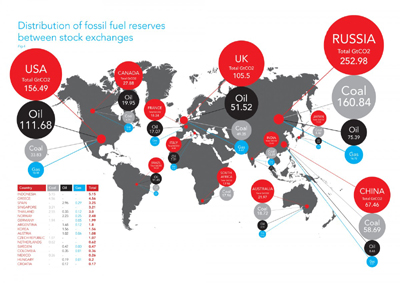
One of the key new features in the IPCC report is the global accumulative “carbon budget”. The IPCC confirms earlier findings that there is an allowence for less than 1000 gigatons of CO2 in the atmosphere for the rest of the century, if we are to avoid dangerous climate change above two degrees warming. This is less than a third of proven fossil reserves, and will be consumed in less than 30 years at current emission levels.

In neighbouring Norway, often described as a “world-leader in the combat against climate change”, a population of just over 5 million reap the profits in being the world's second largest gas exporter and the sixth largest oil exporter. The investments in the sector are growing year by year.


Along with the rest of the world, we are debating how to manage a limited resource and how to achieve the necessary emission cuts to avoid disastrous global warming. 


Along with the rest of the world, we live in a carbon bubble, in which, despite increasingly urgent warnings from scientists and environmentalists, we keep pumping up fossil fuels at record speed, pushing greener industry aside as we do so. In Norway the fossil fuels industry is by far the country's largest, and our reliance on this industry is not just a threat to the green industry, but to our entire economy, as has lately been pointed out by various individuals and organizations, including the IMF.


Our goal is not to get rid of the oil industry tomorrow. Nor is it to set a date for when the last oil worker will be out of a job. On the contrary, we want to keep the industry going for generations, but at a significantly lower level than we see today. To achieve this in a way that does not lead to mass unemployment (an estimated 250,000 people - or one in twenty Norwegians - are involved in the fossil fuel industry) we need a plan that combines both environmental policy and the oil workers' interests. That was the starting point when labour unions and environmental NGOs sat down to draft a plan on how we might realistically deflate Norway's inflated oil industry in a way that also retains the interests of the industry's employees.

Pages

The Fine Print I:

Disclaimer: The views expressed on this site are not the official position of the IWW (or even the IWW’s EUC) unless otherwise indicated and do not necessarily represent the views of anyone but the author’s, nor should it be assumed that any of these authors automatically support the IWW or endorse any of its positions.

Further: the inclusion of a link on our site (other than the link to the main IWW site) does not imply endorsement by or an alliance with the IWW. These sites have been chosen by our members due to their perceived relevance to the IWW EUC and are included here for informational purposes only. If you have any suggestions or comments on any of the links included (or not included) above, please contact us.

The Fine Print II:

Fair Use Notice: The material on this site is provided for educational and informational purposes. It may contain copyrighted material the use of which has not always been specifically authorized by the copyright owner. It is being made available in an effort to advance the understanding of scientific, environmental, economic, social justice and human rights issues etc.

It is believed that this constitutes a 'fair use' of any such copyrighted material as provided for in section 107 of the US Copyright Law. In accordance with Title 17 U.S.C. Section 107, the material on this site is distributed without profit to those who have an interest in using the included information for research and educational purposes. If you wish to use copyrighted material from this site for purposes of your own that go beyond 'fair use', you must obtain permission from the copyright owner. The information on this site does not constitute legal or technical advice.

