You are here

NGO-industrial complex

WWF’s REDD project in Mai Ndombe, Democratic Republic of Congo: No consultation, no transparency, and communities paid less than DRC’s minimum wage

By Chris Lang - REDD Monitor, November 1, 2017

WWF’s largest REDD project in Africa is in Mai Ndombe province, in the Democratic Republic of Congo. According to WWF, the results so far are “very encouraging”. On its website, WWF states that, “The participatory approach through local development committees has proven to be a success with effective achievements.”

But a recent report by the Congolese NGO, Ligue Congolaise de Lutte Contre la Corruption (LICOCO), challenges these claims. LICOCO’s report is based on an independent observation mission to the territory of Mushie in Mai Ndombe.

The report looks into whether WWF is implementing the governance tools developed by DRC’s National REDD+ Commission.

WWF was hired by the Ministry of Environment, Conservation of Nature and Sustainable Development to run the REDD project in four territories: Bolobo, Kwamouth, Mushie, and Yumbi. The project is part of a Forest Investment Program project titled Improved Forested Landscape Management Project (PGAPF), which has US$37.7 million funding from the World Bank.

Where Non-Profits Fear to Go: Report From Florida

By Mutual Aid Disaster Relief - It's Going Down, September 25, 2017

The following is a report back for a relief trip to the Florida Keys made possible by the work of numerous folks involved with Mutual Aid Disaster Relief (MADR). The immense amount of support and solidarity provided for those in need exists through the collaboration of various communities to come together in times of crisis. This represents the perspective and response of anarchist comrades, yet there are a number of different political orientations for those involved with MADR. As the predatory nature of the State continues to benefit from disasters such as these, we feel it is crucial to give space to anti-state and anti-authoritarian voices in order to continue to remind us in the storm after the storm, who the true enemy is.

On 9/18 Monday morning at 3 AM a group of 9 folks left “The Hub” (5107 N. Central Ave.) in Tampa to drive to the Florida Keys with a 12 ft truck loaded with food, water, and other necessities, as the U.S. Highway 1 checkpoint established in Florida City after Hurricane Irma, was to be terminated Tuesday at 7:30 AM. Although police stated that only residents, business owners, disaster workers and supply vehicles with proper identification would be allowed to enter until further notice.

It had been a week since residents who were able to leave had evacuated and they were just now returning to their homes, or what was left of them. The hurricane’s last minute shift to the western coast of Florida put the Florida Keys (especially the Middle Keys such as Marathon, and Lower Keys; Big Key Pine, Little Torch Key, and Key West) directly in the storm’s path, as it made landfall on Sunday, September 10th.

In order to provide much needed aid to those neglected by the Red Cross and FEMA, we drove with a van full of medical supplies and a 12 ft moving truck filled with food, water, and other necessities to the poorest areas. Yet, before we even entered, there were a number of other obstacles in our way constructed by the State and the non-profit industrial complex looking to take advantage of successes in autonomous organizing and the opportunities that disaster provides. The immense amount of supplies that have been collected at “The Hub” in the past couple weeks was made possible through the long-standing connections between various radical communities and the donation of the space from the St. Paul Lutheran Church.

Our activism will be intersectional, or it will be bullshit…

By Ali Tamlit - Red Pepper, April 23, 2017

To begin this story, cast your mind back a few months…

It’s May 2016. My facebook feed (the ultimate source of truth in our post-truth world) seems to be schizophrenic, or at least representing two entirely different worlds.

One world is the ‘green’ activists, who are in the middle of two weeks of global actions against fossil fuels. The spectacular actions in the US, Australia, the UK and most notably Ende Galende in Germany, have led some of my comrades to claim: “WE ARE WINNING!”

The other world is that of Monique Tilman, the young Black girl assaulted by an off duty police officer as she rode her bike in a car park. It is the world of police brutality, the world of indigenous people being dispossessed of their lands for tourism or ‘conservation’.

Surely, the ‘we’ that is winning can’t claim to include these people?

The green movement, under NGO leadership, seems to be content with shallow demands of CO2 reduction. Whilst the inextricable links between capitalism, ecological destruction, colonialism, white supremacy and hetero-patriarchy lie just below the surface, yet no one, within the nonprofit-industrial complex at least, seems to want to join the dots.

Why the NGOs won't lead the revolution

By Leela Yellesetty - Socialist Worker, March 29, 2017

FOR MANY who are outraged and want to do something about the human suffering and environmental devastation wrought by capitalism, volunteering or working for a nonprofit or non-governmental organization (NGO) is a natural place to turn. So why do socialists think this isn't the best way to address the problem?

There is no shortage of such organizations today. Most of them are engaged primarily in direct service work, providing a whole spectrum of needed resources such as housing, food, health care, child care, legal defense and so on. Often, these services fill the gap left by cuts in government funding and are a lifeline for those who otherwise couldn't afford or wouldn't have access to a basic necessity.

There are, of course, problems with some of these organizations: Many overwork and underpay their employees while executives award themselves fat paychecks. Unlike governmental agencies, they are free of any democratic accountability and can choose to impose their religious or political views on those they serve or employ.

But even for organizations which do good, needed work and genuinely attempt to be responsible and accountable to the communities they serve and the people who labor for them, there is a built-in limitation: They are only addressing the symptoms and not the cause of the problems.

Reflections on Angry Inuk: White Animal Saviour (Industrial) Complex* and the Perpetuation of Colonial Domination

By Darren Chang - PPEH Lab, March 18, 2017

Inuk filmmaker Alethea Arnaquq-Baril’s 2016 documentary, Angry Inuk, is a story about the erasure and domination of Indigenous peoples by colonial powers. The film impassionedly defends the seal hunt industry by revealing how Western environmental and animal advocacy NGOs (e.g., Greenpeace, International Fund for Animal Welfare, Humane Society International), have devastated the livelihoods of Inuit communities that rely on the industry for subsistence. The NGOs have destroyed the Inuit seal trade economy by successfully campaigning the European Union to ban products made from seals, despite allowing an exception for the trading of Inuit seal products. This reflection examines how the strategies carried out by Western NGOs to achieve their “victory” are rooted in colonial-capitalism, white supremacy and Eurocentrism, and therefore reinforces colonial domination. Below, I focus on a few strategies employed by the NGOs, as highlighted in the film.

One strategy is that the NGOs deliberately mislead the public with select imagery of seals. For example, one segment shows how the NGOs continue to use images of white-coated seal pups in their campaign advertising, even though the slaughter of white-coated seal pups has been banned in Canada for over thirty years. Another segment shows how images of seals “crying” have been heavily used in advertising by the NGOs to pull on the public’s heartstrings for effective fundraising. However, tearing has no known relation to cognitive or emotional response in seals, and serves only to protect their corneas from salt. Arnaquq-Baril also plays a 1978 interview in which Paul Watson admits that targeting the seal hunt and exploiting images of harp seals have always been the easiest way for NGOs such as Greenpeace to raise funds. At the time of the interview, Watson had left Greenpeace and founded his own Sea Shepherd Conservation Society. Years later, Watson and Sea Shepherd have gone on to raise money using the exact same strategies targeting the seal hunt. This manipulative profit-driven fundraising and advocacy strategy fits into the existing nonprofit industrial complex, where the growth of NGO organizational capacities is prioritized and pursued by appealing to the sentiments of the settler-colonial population and the state.

Other parts of the film illustrate how NGOs invoke nationalist and colonial discourses by shaming the government of Canada for allowing the seal hunt, and appealing to European sensibilities in lobbying the EU for the ban. These strategies rest on the Western civilizational binary logic that defines accepted Western practices as “civilized” and non-Western practices as “savage” or “barbaric”. Tracing the NGOs’ actions along this logic illuminates why the mostly-white Western animal advocacy NGOs tend to exert a disproportionate level of aggression to end culturally-specific animal exploitations and killings practiced by people of color. Meanwhile, campaigns to challenge the infinitely more destructive and violent animal exploitation industries founded, upheld and propagated by their fellow whites (e.g. industrial animal agriculture that brutally slaughters billions of animals yearly) are carried out with less intensity and far more civility.

More importantly, if we interpret the exception in the EU ban allowing Inuit seal products to continue being traded through the civilized/savage binary logic, we see how the Inuit exception could have led more Members of the European Parliament to support the overall ban. That is, the MEPs did not vote to ban seal products because they thought killing seals was immoral or unethical; instead, the MEPs banned seal products because seal hunting was associated with the “barbaric” Inuit, who the “civilized” Europeans preferred to distance themselves from. Moreover, to uphold this European self-aggrandizing fantasy, it was important to deny the Inuit their voice and presence. Therefore, in all the NGO campaigns against the seal hunt industry, the commercial seal hunt has been whitewashed, or portrayed as predominantly white. Simultaneously, Indigenous seal hunters who depend every bit as much on the commercial industry to maintain the price of seal products, were completely erased as members of the commercial seal hunt. Effectively, the Inuit exception fixes the Inuit seal hunters and their cultures and ways of life in the past. The underlying message of the Inuit exception is that while the EU allows the Inuit seal hunters to continue their way of life, they could never expect to be part of a modern industry, because there is no place for the Inuit way of life in modernity.

In emphasizing these racist NGO strategies, Angry Inuk reveals the ways in which colonizers disintegrate Indigenous sovereignty through their good intentions to “save” others. This time, however, unlike the earlier colonizers who tried to save Indigenous peoples from so-called savagery through genocide and assimilation, the white animal saviours reproduce this colonial process (regardless of their intentions) by attempting to save animals. What many white animal saviours need to confront is a problematic drive to save every individual animal in denial of ecological realities and the necessity for some Indigenous peoples to kill other species for subsistence. White animal saviours should also own up to their unethical, institutionally racist practices of NGO campaigning.

Not-for-Profit, Open for Business

By Sophia Burns - The North Star, December 15, 2016

One summer in college, I got a job canvassing for Greenpeace. We spent the morning getting pumped up by our supervisor about how we were really going to make a difference, then spent the afternoon on the sidewalk downtown asking passers-by for donations. As new hires, we had three probationary days to “make staff”: anyone who didn’t meet the quota would not be kept on, and those who did would be fired if they didn’t continue to deliver.

Every Monday, a new crop of fifteen or so recruits showed up. A week later, all but two or three would be gone. Almost nobody lasted more than a month. There was no union, the training wage was lower than the advertised staff wage, and the large bulk of the money we raised was brought in by trainees who never made staff.

While few nonprofit workplaces have conditions quite so extreme, low pay and long hours are par for the course at most NGOs. Union density in the field is quite low, and many nonprofits expect their employees to accept the conditions they impose in the name of “the mission” and a “nonprofit ethic” of selfless service. Often, members of the activist community see nonprofit jobs as very desirable – a chance to make a living by living their values and to do progressive organizing full-time. And, indeed, on-the-ground progressive politics frequently depends on the resources NGOs offer, including funding, legal infrastructure, and staffers’ time and labor. Certainly, when I worked for Greenpeace, few canvassers complained about the draconian quotas or extreme precarity – at any given time, any given worker would more likely than not be fired within a week, but we were “doing something real.” In comparison, retail didn’t seem to cut it.

Our jobs may have been precarious, but Greenpeace’s funding was not. While Greenpeace does not accept government or corporate contributions, most NGOs do, as well as foundation grants and individual “membership” donations. “Member,” of course, is an ambiguous word. A member of a book club will generally get to help choose the next book, and a member of a labor union will (in theory, at least) get to vote in internal elections and on contracts. However, a “member” of an advocacy group like Greenpeace donates money and doesn’t do a whole lot else. As a canvasser, I certainly wasn’t voting for candidates for the Board of Directors. Neither were the “members” I was signing up. And while Greenpeace is typical of policy-focused nonprofits in that it claims to speak for a broad constituency, it’s also typical in that those constituents don’t really get a say in the organizational and political decisions that determine the group’s activities. For most nonprofits, “joining” means donating (and occasionally receiving a mailer asking for even more donations).

Community-Driven Social Change in the Age of the Non-Profit Industrial Complex

By staff - Murphy Institute, November 22, 2016

How can we make sense of the organizing coming out of today’s social change and resistance movements?

In a new article coming out in the Fordham Urban Law Journal, Professor Michael Haber connects many of today’s most important movements—from post-Occupy community organizing to the rise of the worker co-op movement to parts of the Movement for Black Lives—by looking at how activists’ growing understanding of the non-profit industrial complex has led to the creation of a new framework for social change practice, what he calls the community counter-institution.

Community counter-institutions have grown out of a decades-long tradition of anti-authoritarian activism, one with roots in women-of-color feminism and the service models of the Black Panther Party of the late 1960s and early 1970s, growing through the radical pacifist, anti-nuclear, LGBTQIA, and environmental movements of the 1970s and 1980s, continuing through the anti-globalization movement of the late 1990s and early 2000s, and getting perhaps its greatest boost through the Occupy Movement in the early 2010s. The article traces this history, focusing on how activists in recent years have come to develop an alternative model for community-driven activism, one that breaks from the dominant non-profit forms of community organizing, service provision, and community economic development.

The article, CED After #OWS: From Community Economic Development to Anti-Authoritarian Community Counter-Institutions, describes how community counter-institutions have grown out of this tradition of anti-authoritarian activism, making three shifts away from conventional non-profit practices:

  1. From hierarchy to horizontalism and intersectionality. Community counter-institutions move away from hierarchically-structured non-profit forms toward horizontalism and intersectionality, shifting away from conventional non-profits to new ways of structuring our group relationships that strive to overcome all forms of domination, including those that have led once-activist groups to embrace certain structural traits of the business world.
  2. From community economic development to prefigurative politics. Community counter-institutions move away from traditional, market-based community economic development projects toward an embrace of prefigurativism, the use of processes in organizing and building a social change movement that are themselves already constructing the world we want to see.
  3. From empowerment to autonomy. Community counter-institutions move away from a focus on empowerment, in which community dialogue, group cohesion, and compromise are top priorities, and instead they prioritize autonomism, organizing and taking action toward shared goals through small groups connected with one another through decentralized networks.

In these bleak times, clear visions for community-driven social change activism, and thoughtful analyses of our current models are essential. Haber spells out challenges that activists and organizers to overcome, analyzing a wide range of projects including the Common Ground Collective, Hands Up United, Mayday Space, Occupy Sandy, and the Sylvia Rivera Law Project, and is full of hundreds of footnotes for further reading.

EcoDefense Radio: Alex Lotorto on Supporting Frontline Communities

By Ryan Clover - Eco Defense Radio, September 8, 2016

Audio File

Bio:

Alex has been the Shale Gas Program Coordinator for Energy Justice Network since 2011. Outside of his professional capacity, he has worked extensively as a volunteer organizer fighting for environmental justice in communities facing rural poverty.

Alex also has a labor union background and has been a union activist in both the private and public sectors, is a union delegate for the Industrial Workers of the World, and represents workers in unemployment compensation appeal hearings on a volunteer basis.

Main Message :

Foundations and major environmental groups (Big Greens) aren’t situated to help the people most in need and Organizers need to build their own support network if the most difficult and important work is going to get done.

What we talked about :

In this conversation Alex shares his experience working with his friends in Northeastern Pennsylvania. From working in rural communities, and with a history in labor organizing, Alex understands the importance of building support networks of our own – and not relying on large foundations or major environmental groups (Big Greens).

At first I was uncomfortable when Alex started sharing examples of how organizations like the Sierra Club can actually perpetuate the problems of fracking – I didn’t want this episode to come across as cynical. But Alex’s message isn’t cynical, it’s critically important – it’s empowering. He shares some concrete examples about how we can build support networks of our own, and has suggestions for how people working within large environmental organizations can help steer them toward supporting the front lines.

Links to stuff we talked about:

Cultural shifts in the climate justice movement

Kevin Buckland - ROARMag, March 22, 2016

hundred days on, as the climate justice movement looks back to the COP21 Climate Summit to see what may be learned, we reflect on the context of the violent attacks of November 13, 2015 that foreshadowed the unstable and volatile world we will all inhabit for the rest of our lives.

The ensuing crackdown on climate protesters sent shock waves through the Climate Coalition’s (CC21) plans for a series of mass climate mobilizations around the COP21 UN climate summit. This opened fissures at every weak point, revealing the political values dormant beneath and bringing to the front cultures of resistance that had the structural integrity and coherence to be able to thrive under the Parisian “State of Emergency”.

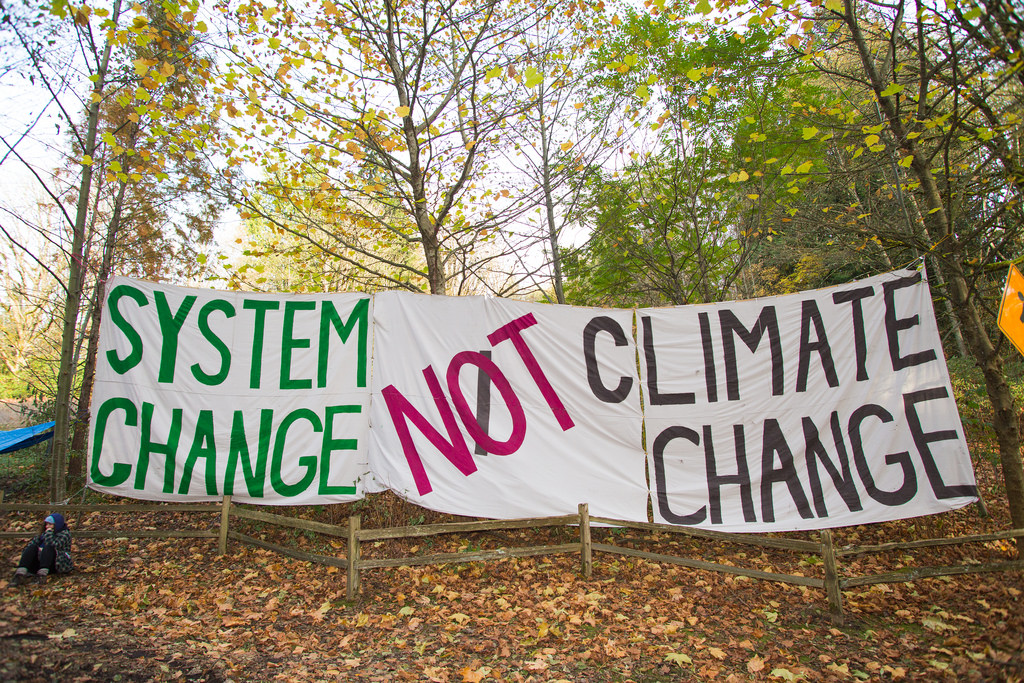
Several underlying trends that characterized successful activism during COP21 indicate an emerging cultural shift in climate activism, especially in places where the call for “system change” was not just being demanded, but enacted by the movements themselves. Three trends in particular can be identified:

  1. The spread and increased role of creativity in activism;
  2. The deepened commitment to indigenous leadership; and
  3. The evolving tensions between rhetoric and form among different organizational models.

What these trends may portend for the future of this growing movement as it begins to inhabit its politics, is that it is tilting from a protest movement towards being a truly revolutionary force.

Paris deal: Epic fail on a planetary scale

By Danny Chivers and Jess Worth - New Internationalist, December 12, 2015

Image, right: 'D12' day of action in Paris, France, 12 December 2015. by Allan Lisner, Indigenous Environment Network

Today, after two weeks of tortuous negotiations – well, 21 years, really – governments announced the Paris Agreement. This brand new climate deal will kick in in 2020. But is it really as ‘ambitious’ as the French government is claiming?

Before the talks began, social movements, environmental groups, and trade unions around the world came together and agreed on a set of criteria that the Paris deal would need to meet in order to be effective and fair. This ‘People’s Test’ is based on climate science and the needs of communities affected by climate change and other injustices across the globe.

To meet the People’s Test, the Paris deal would need to do the following four things:

  • 1. Catalyze immediate, urgent and drastic emission reductions;
  • 2. Provide adequate support for transformation;
  • 3. Deliver justice for impacted people;
  • 4. Focus on genuine, effective action rather than false solutions;

Does the deal pass the test? The 15,000 people who took to the Paris streets today to condemn the agreement clearly didn’t think so. Here’s New Internationalist’s (NI) assessment.

Pages

The Fine Print I:

Disclaimer: The views expressed on this site are not the official position of the IWW (or even the IWW’s EUC) unless otherwise indicated and do not necessarily represent the views of anyone but the author’s, nor should it be assumed that any of these authors automatically support the IWW or endorse any of its positions.

Further: the inclusion of a link on our site (other than the link to the main IWW site) does not imply endorsement by or an alliance with the IWW. These sites have been chosen by our members due to their perceived relevance to the IWW EUC and are included here for informational purposes only. If you have any suggestions or comments on any of the links included (or not included) above, please contact us.

The Fine Print II:

Fair Use Notice: The material on this site is provided for educational and informational purposes. It may contain copyrighted material the use of which has not always been specifically authorized by the copyright owner. It is being made available in an effort to advance the understanding of scientific, environmental, economic, social justice and human rights issues etc.

It is believed that this constitutes a 'fair use' of any such copyrighted material as provided for in section 107 of the US Copyright Law. In accordance with Title 17 U.S.C. Section 107, the material on this site is distributed without profit to those who have an interest in using the included information for research and educational purposes. If you wish to use copyrighted material from this site for purposes of your own that go beyond 'fair use', you must obtain permission from the copyright owner. The information on this site does not constitute legal or technical advice.