You are here

coal

Worker Wisdom in a Changing Climate: Al Marshall - SEIU 1021, Oakland Chapter President

Interview and Image by Brooke Anderson - Climate Workers, November 13, 2015, reprinted by permission.

On September 21st, hundreds of people packed the Oakland City Hall to oppose developer Phil Tagami’s proposal to build a coal export terminal in Oakland. Among them were dozens of union members whose locals were opposing coal as anti-union, a major source of carbon emissions, and a risk to public health in working class neighborhoods through which coal trains would pass and deposit toxic coal dust. One of those union members was Al Marshall, SEIU 1021 City of Oakland Chapter President, who told the council that coal dust would only exacerbate his son’s asthma. We later interviewed Al. Here’s his story.

Brooke Anderson, Climate Workers: Thanks for talking to me, Al. You’re a union member. How did you get involved in the union?

Al Marshall, SEIU 1021: I’ve worked as a construction inspector for the City of Oakland for 15 years, and a city employee for 26 years total. One day I showed up to a union meeting, learned that our contract was being violated and that other people were frustrated too. I’ve been involved in the union ever since. I was elected City of Oakland Chapter President two years ago.

BA: So you live in Oakland then?

AM: I used to live in Oakland. But I lost my family home as a result of the furloughs during the financial crisis. My wife was laid off with reinstatement rights up to three years. She was called back with 45 days left, but by that time, the damage had been done. We now live on the other side of the tube in Alameda.

BA: You recently spoke against coal at Oakland City Council. Why do you oppose coal?

AM: My son DeVon is 7. He’s had asthma since he was 1.5 years old. He also has bad allergies. Most nights we have to hook him up to a ventilator to breathe. It’s a 20 minute process, and I lay there with him to help him find a breathing pattern that will calm his cough. As a parent, having a child with asthma is hell. It means many sleepless nights.

Depending on how hot it is and which way the wind is blowing, what’s in the atmosphere triggers my son’s allergies and asthma. So to me, it doesn’t make any sense to transport coal through Oakland. And if we know coal will cause health problems here, why we would send it elsewhere? We are the gatekeeper to the planet. What we do has impacts on the other side of the planet and vice versa. We are all responsible.

BA: At the hearing, we heard the coal lobbyists say we need coal because it will bring jobs.

AM: I find it interesting that all these people are coming out of the woodwork now to say how it important it is to have coal in Oakland to bring jobs. There is enough other things to put on that Army Base to bring good paying jobs to those who need them. We don’t need coal for that. It’s the people who are financially well off who have the money to push coal on the less fortunate neighborhoods. They don’t have to worry about it because they don’t live here. But if they did, they would oppose coal too.

BA: Any last words for the coal industry?

AM: We all have a duty here while we are here on earth. We need to recognize what our calling is and do our best to serve whatever that calling is in the amount of time that we have here. We need to preserve something for those who come after us. It’s called passing the baton, and we have to make sure the baton doesn’t get dropped.

Unprecedented? Unions and community unite to halt plans to build coal export terminal in Oakland, California

By Elena Mora - Trade Unions for Energy Democracy, October 9, 2015

A short but well-organized campaign to stop plans to build a coal export terminal in the Oakland Port resulted in a packed Oakland City Council meeting on September 21, and a vote requiring a public health impact study to guide the Council’s action, up to and including a moratorium on coal.

Screenshot 2015-09-26 10.47.56The campaign, “Coal Free Oakland,” led by the Sierra Club and others, brought together a very broad coalition (more than 80 organizations), with significant union participation, including the Alameda Labor Council, which passed a resolution calling on the city to reject the coal export plan.

Among those coordinating the labor outreach was Climate Workers, a project of Movement Generation Justice & Ecology Project.

Labor and climate justice organizer Brooke Anderson, who heads up Climate Workers, called it “hugely significant — precedent setting — that labor came out in this way and opposed coal coming through the neighborhoods where their members live.” Unions signing on to the petition against the coal facility include the California Nurses Association; SEIU 1021 and United Service Workers West; the American Postal Workers Union (Oakland’s largest post office is next to the port); ILWU Local 10, Local 6 and Northern California District Council; UniteHERE Local 2850; the Peralta Federation of Teachers; the Oakland Education Association; UAW Local 2865; the Amalgamated Transit Union Local 192; and AFSCME District Council 57.

Korean Unions Call for a “Just Energy Transition” to Move Away From Coal and Nuclear

By Staff - Trade Unions for Energy Democracy, August 4, 2017

In a series of landmark statements following the May 2017 election of the pro-reform President Moon Jae-in, Korean energy, transport and public service workers have called for “a just energy transition” allowing the sector to “function as a public asset under public control.”  Unions support the new government’s decision to close the country’s aging coal-fired and nuclear power stations, and its planned reconsideration of two new nuclear facilities, Kori 5 and Kori 6. In a statement issued in late July, the Korean Public Service and Transport Workers’ Union (KPTU) and the Korean Labour and Social Network on Energy (KLSNE), a coalition of unions and civil society organization, said, “We actively support the policy of phasing out coal and nuclear and expanding clean renewable energy.” The statement urged the development of, “A roadmap for energy transition that ensures public accountability and strengthens democratic control of the energy industry.” KPTU and KLSNE also committed  “to work together with the public and civil society to achieve a just transition.”

The Korean Labour and Social Network on Energy (KLSNE) and the Korean Public Service and Transport Workers’ Union (KPTU) Support the Government’s Policy of a Transition towards a Coal-free, Nuclear-free Energy System

The Moon Jae-in government, which was elected on a pledge to phase out coal and nuclear generation and scale up clean renewables, is now moving quickly to enact these promises. Following a temporary shutdown of old coal-fired power plants, the Kori 1 nuclear reactor was permanently closed down on June 19. The government is now reconsidering plans to build new nuclear reactors Kori 5 and 6. The KLSNE and KPTU declare our support for these policies and our intentions to play a leading role in bring about a just energy transition.

The government’s establishment of a commission to assess public opinion on the plans to build Kori reactors 5 and 6 on July 24 sparked immediate outcry from nuclear power business interests and pro-nuclear power scholars. The press has exacerbated this conflict with sensational reporting. It is deeply regrettable that those who oppose the government’s policies are speaking only from their individual self-interest without putting forth viable alternatives.

It is even more regrettable that the voices of workers at the Korean Hyro & Nuclear Power Corporation and other nuclear-power related companies who support a just transition are being stifled in the process. We stress the importance of recognising the difference between nuclear power business interests and the nuclear power workers. These workers are the people most easily exposed to radiation and at the most risk in the case of accidents. Electricity and gas workers, who have been discussing paths for a just transition for many years now, are sure that nuclear power workers will soon join us in this effort.

During the last nine years of conservative rule, South Korea’s energy policy has been focused on restructuring aimed only at meeting the interest of corporations (i.e. privatisation). The result has been the expansion of nuclear power and private coal and LNG generation and massive profits for corporations. Energy policy has been consistently undemocratic and anti-climate.

With South Korea now facing the threat of earthquakes and air contaminated with fine dust it is only natural that we energy workers, who have fought for almost two decades to stop privatisation and protect our public energy system, would take a leading role in the fight for a just energy transition.

The Ruhr or Appalachia: Deciding the Future of Australia’s Coal Power Workers and Communities

By Peter Sheldon, Raja Junankar, and Anthony De Rosa Pontello - CFMMEU Mining and Energy, December 3, 2018
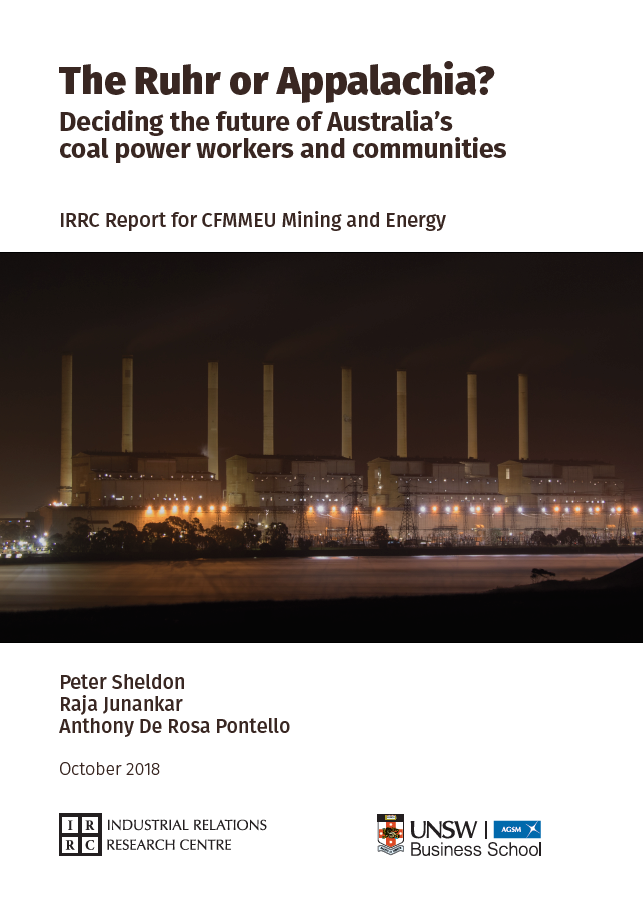
Australia’s coal-fired power stations will all close in the next two or three decades. We know this because the companies that operate the 23 power stations currently operating nation-wide have told us so.

Despite the empty rhetoric of some, it is unlikely that the economic case for investing in new coal-fired power stations in Australia will stack up. Those who currently own and operate coal power stations have no plans to build new ones.

The bad news is that the transition in how we produce power will bring great change to the workers and communities we have relied on to provide Australian homes and industry with reliable energy over many decades.

The good news is that we have the lead time to make smart decisions about what that change looks like—or at least, we now have the lead time after being caught unprepared by earlier closures, including Hazelwood in 2017.We have the choice to manage this structural economic change so that individuals, families and regions aren’t abandoned to unemployment, low-value jobs, poverty and associated health and social decline. Even better, we have the evidence about what works to deliver just transitions for coal power workers and communities, with skills, jobs, opportunities and hope for the future.

Communities grow around power stations and the mines that supply them. They are unique communities bonded in many cases by history, geography, difficult and dangerous working conditions and good unionised jobs. They are also uniquely vulnerable in their heavy dependence on the coal power industry.

This analysis of transitions in resource economies internationally and here in Australia provides valuable insights into the ingredients of success and the wide scope of outcomes.The Appalachian region in the United States is a heart-breaking story of industry transition characterised by short-term, reactive and fragmented responses to closures of coal mines, resulting in entrenched, intergenerational poverty and social dysfunction.

Compare this with the transition away from a heavy reliance on coal mining in Germany’s Ruhr region, where forward planning, investment in industry diversification, staggering of mine closures and a comprehensive package of just transition measures delivered a major reshaping of the regional economy with no forced job losses.

Central to these vastly different outcomes is the presence of a national, coordinated response. To this end, a major recommendation of this report is the establishment of a national, independent statutory authority to plan, coordinate and manage the transition.

In the energy debate to date, the impact of the transition on workers and communities has been almost completely ignored. This is an omission we can’t afford. After all, the costs of investing in a Just Transition need to be balanced against the costs of doing nothing and abandoning whole communities to a bleak future.

While global trends suggest that Australian export coal for steelmaking and energy production will be in demand for decades to come, coal-fired power generation in Australia is winding down. On the information available, there are no excuses for not taking action to protect the best interests of those affected.</p.

I thank Peter Sheldon and the team at UNSW Sydney’s Industrial Relations Research Centre for this important piece of work. I call on all power industry stakeholders to engage with its findings and consider how we can work together to deliver a Just Transition for coal power workers and communities.

Read the report (PDF).

Beyond Coal by 2030

By Florent Marcellesi and Joanna Flisowska - Green European Journal, November 29, 2018

The COP24 climate talks in Katowice, Poland are set to start on December 2. This year, the negotiations follow a clear warning from the global climate science community, which highlighted in the recent IPCC report that urgent steps are needed to slow global warming. Without action, the world faces the grim prospect of extreme weather events and a massive loss of species. Florent Marcellesi, Green MEP, and Joanna Flisowska, coal policy coordinator at Climate Action Network Europe, discuss COP, the energy global transition, and the gender dimension of climate change.

Green European Journal: In a matter of days, almost 200 countries will meet in Katowice, a city at the heart of a Polish coal mining region, to try and finalise the details of how the Paris Agreement will be put into force. Increasingly, the main timeline for taking steps to keep the global temperature rise well below 2 degrees, preferably to 1.5, now seems impossible. Where are we going into the talks?

Joanna Flisowska: The objective of limiting temperature rise to 1.5 degrees was in the Paris agreement from the very beginning. But with the latest Intergovernmental Panel on Climate Change (IPCC) report, we found out just how urgent it has become to act on climate change. The report brings the impact of climate change beyond the 1.5-degree mark to light and shows how disastrous and far-reaching it will be.

Florent Marcellesi: The IPCC report is a tipping point. We can now clearly say that we have to go faster and act with greater ambition for two main reasons. First, the drastic consequences if we do not. In Spain, from now to the end of the century the soil could become a desert and Spanish people could end up as climate refugees. Second, the opportunities. Achieving the 1.5-degrees limit means people living healthier lives and the creation of new and better jobs. Climate change will have negative consequences for the economy and for identity, traditions, and culture too as it disrupts ways of life. But we must turn it into an opportunity and act with commitment to achieve the goals of the Paris agreement.

The IPCC report sets out some potential pathways for the world to stabilise global warming at 1.5 degrees. These depend on an unprecedented effort to cut fossil-fuel use, among which coal is a particularly high source of carbon emissions. How can we transition from coal to clean energy sources?

Joanna Flisowska: The way forward is somewhat different depending on whether we look at the global perspective or the EU one. The EU has to consider its historical contribution to today’s climate change and must therefore reduce emissions even faster than the rest of world. According to many scientific studies, the fastest and most effective way to stay on the path to 1.5 degrees is to phase out coal by 2030 at the latest. This assessment is certainly true and is why environmentalists are emphasising that coal has to be phased out in order for the EU to reduce its emissions in a timely and cost-effective manner. Today’s reliance on coal can be overcome through renewables, investments in energy efficiency, storage, and with better management of electricity networks.

Florent Marcellesi: We are phasing out of coal for two reasons. The first is economic: coal is not profitable right now. Many plants are closing simply because it cannot compete with renewables. But second, we need to phase out coal well before 2040 for ecological reasons. The IPCC was very clear on that point and, for Europe, a coal phase-out has to mean 2030 at the latest. In some countries like Spain, coal plants must be closed even earlier by 2025.

Working Together for a Just Transition

By David Powell, Alfie Stirling and Sara Mahmoud - New Economics Foundation, November 2018

This short pamphlet has been produced to launch the New Economics Foundation’s new programme of work on the 'just transition'. Our interest is in the practicality of change: the policies, processes, narrative and investment needed to accelerate the UK’s progress on 'just transition', here and now. Over the coming months and years we will be working at local and national levels to explore what is needed to build common cause and provide the right mixture of incentives and critical challenge to all parties to help unlock a new momentum for a 'just transition' for the UK.

It has been produced in association with the Friedrich-Ebert-Stiftung’s London Office, part of the international network of FES. The London office was established in 1988 to promote better understanding of British- German relations. FES's work in the United Kingdom focuses in particular on the exchange of ideas and discussion on the following topics: common challenges facing Germany, the United Kingdom and the European Union; economic and social policy; experiences gained from differing regional and local policies and practices; and a continuing dialogue between politicians as well as between the trade unions in both countries.

Read the report (PDF).

Just cuts for fossil fuels? Supply-side carbon constraints and energy transition

By Philippe Le Billon and Berit Kristoffersen - Economy and Space, November 2018

Reducing greenhouse gas emissions has generally been approached through demand-side initiatives, yet there are increasing calls for supply-side interventions to curtail fossil fuel production. Pursuing energy transition through supply-side constraints would have major geopolitical and economic consequences. Depending on the criteria and instruments applied, supply cuts for fossil fuels could drastically reduce and reorient major financial flows and reshape the spatiality of energy production and consumption. Building on debates about just transitions and supply constraints, we provide a survey of emerging interventions targeting the supply of, rather than the demand for, fossil fuels. We articulate four theories of justice and selection criteria to prioritize cuts among fossil fuel producers, including with regard to carbon-intensity, production costs, affordability, developmental efficiency, and support for climate change action. We then examine seven major supply-constraint instruments, their effectiveness, and possible pathways to supply cuts in the coal, oil and gas sectors. We suggest that supply cuts both reflects and offers purposeful political spaces of interventions towards a 'just' transition away from fossil fuel production.

Read the text (PDF).

A Just and Fair Transition: For Canadian Coal Power Workers and Communities

By staff - Task Force on Just Transition for Canadian Coal Power Workers and Communities, October 2018

The devastating impacts of climate change are becoming clearer each year. More frequent and intense floods, storms, fires, heat waves, and droughts are destroying communities and homes, and putting the lives and futures of Canadians at risk. The Intergovernmental Panel on Climate Change’s 2018 report on global warming of 1.5°C shows that our window to prevent the worst-case scenario is quickly closing.

We do know what is causing climate change and we can do something about it. We need to reduce the amount of greenhouse gas (GHG) emissions released into our environment. There are several ways in which we can accomplish this, including wasting less energy and investing in cleaner energy sources. Businesses, scientists, governments, communities, and individuals in Canada and around the world are beginning to prove that you can reduce GHG emissions, invest in reliable and affordable clean energy, create decent jobs, and have stable economies.

Although coal-fired electricity has contributed significantly to Canada’s economic past and present—and provided Canadians with affordable and reliable electricity and heat for many generations—it produces significant amounts of air pollutants and GHG emissions. It has well documented costs to human health and is a major contributor to climate change: approximately 20% of all GHG emissions in the world came from coal-fired electricity in 2013.

Recognizing these facts, and supported by commitments in the 2015 Paris Agreement, Canada and other countries are intent on replacing coal-fired electricity with cleaner sources of fuel over the coming years and decades. In 2016, Canada committed to the phase-out of traditional coal-fired electricity across the country by 2030.

Phasing out coal-fired electricity, however, will have direct and indirect impacts on thousands of workers, dozens of communities, and four provinces, including:

  • Alberta, Saskatchewan, New Brunswick, and Nova Scotia;
  • Nearly 50 communities with nearby coal mines or generating stations;
  • 3,000 to 3,900 workers at coal-fired generating stations and domestic thermal coal mines;
  • Over a dozen generating stations, owned by six employers;
  • Nine mines, owned by three employers.

In reality, the phase-out of coal fired electricity generation is already underway, especially in Alberta.

The extensive personal and societal impacts of the phase-out of coal-fired electricity are reasons why the labour movement has been advocating for a just transition alongside Canada’s efforts to reduce GHG emissions. We cannot leave affected workers and communities behind during the transition to a low-carbon economy. They too must have hope for the future.

Read the report (Link).

A Guide for Trade Unions: Involving Trade Unions in Climate Action to Build a Just Transition

By staff - European Trade Union Confederation, September 2018

A guide to a ‘just transition’ to a low carbon economy is published by the European Trade Union Confederation on May 15.

The 48 page document ‘Involving trade unions in climate action to build a just transition’ contains

  • Recommendations for economic diversification and industrial policy, skills, social protection and governance for a socially just transition
  • Information on how trade unions can and have been engaged in shaping national climate action
  • Examples of innovative projects that can inspire a more just transition

Key recommendations include

  • Promote economic diversification in regions and industries most affected by the transition
  • Negotiate agreements at sectoral and company level to map the future evolution of skills needs and the creation of sectoral skills councils
  • Establish dialogue with all relevant stakeholders and regional authorities to identify and manage the social impacts of climate policies
  • Promote the establishment of adequate social protection systems
  • Unions and workers should assess the risks linked to ‘stranded assets’

The guide shows that up to half of trade unions have NOT been consulted on sectoral decarbonisation strategies, but over 75% were consulted on long-term decarbonisation strategies for 2050.

Read the report (PDF).

Implementing coal transitions Insights from case studies of major coal-consuming economies

By Author: O. Sartor, - P2P Foundation, September 2018

This report brings together the main insights from the research consortium “Coal Transitions: Research and Dialogue on the Future of Coal”. The report summarises key findings from case studies in six countries (China, India, Poland, Germany, Australia and South Africa). These explore pathways to implement coal transitions . The study also draws from findings in earlier phases of the project, including global analysis of the impact of coal transitions on steam coal trade (cf. Coal Transitions, 2018a) and analysis of past coal and industrial transitions in over 10 countries (Coal Transitions, 2017), as well as political economy aspects of coal. The publications are available on www.coaltransitions.org.

Read More - download PDF.

Pages

The Fine Print I:

Disclaimer: The views expressed on this site are not the official position of the IWW (or even the IWW’s EUC) unless otherwise indicated and do not necessarily represent the views of anyone but the author’s, nor should it be assumed that any of these authors automatically support the IWW or endorse any of its positions.

Further: the inclusion of a link on our site (other than the link to the main IWW site) does not imply endorsement by or an alliance with the IWW. These sites have been chosen by our members due to their perceived relevance to the IWW EUC and are included here for informational purposes only. If you have any suggestions or comments on any of the links included (or not included) above, please contact us.

The Fine Print II:

Fair Use Notice: The material on this site is provided for educational and informational purposes. It may contain copyrighted material the use of which has not always been specifically authorized by the copyright owner. It is being made available in an effort to advance the understanding of scientific, environmental, economic, social justice and human rights issues etc.

It is believed that this constitutes a 'fair use' of any such copyrighted material as provided for in section 107 of the US Copyright Law. In accordance with Title 17 U.S.C. Section 107, the material on this site is distributed without profit to those who have an interest in using the included information for research and educational purposes. If you wish to use copyrighted material from this site for purposes of your own that go beyond 'fair use', you must obtain permission from the copyright owner. The information on this site does not constitute legal or technical advice.