You are here

Lac-Mégantic

Worker Safety Questioned as Trains and Accidents Multiply

By Blake Sobczak - Energywire [Paywall Site], August 4, 2014

Disclaimer: The views expressed here are not the official position of the IWW (or even the IWW’s EUC) and do not necessarily represent the views of anyone but the author’s.

The recent surge in oil train traffic along North America’s freight network has been a boon for railroads struggling to cope with falling coal shipments.

But though the crude-by-rail boom has kept workers busy, it has also raised questions about their safety and preparedness following a series of oil train derailments and explosions.

A tentative agreement between BNSF Railway Co. and a major transportation union last month would allow certain trains to operate with just one engineer on board, provided they were outfitted with Positive Train Control. PTC technology allows for the train to be stopped or slowed automatically if it exceeds a speed limit or is on track for an unseen collision.

BNSF spokeswoman Roxanne Butler pointed out that the PTC labor deal would not apply to any trains hauling hazardous materials such as crude oil. The agreement is now being considered by members of the International Association of Sheet Metal, Air, Rail and Transportation Workers’ Transportation Division (SMART TD).

But union representatives have worried that the agreement could clear the way to phase out oil train conductors in the future, setting what they consider a dangerous precedent.

“You can’t talk about this issue without mentioning the terrible lessons that we learned at Lac-Mégantic,” said SMART TD National Legislative Director James Stem, referring to a fiery oil train derailment and explosion in Quebec last year that killed 47 people.

The train was not manned when it jumped the tracks in downtown Lac-Mégantic, but it had been operated by a lone engineer the previous night. The worker is now facing charges of criminal negligence for allegedly failing to apply enough hand brakes that could have prevented the train from breaking free from its parking place and hurtling toward town.

In that case, Stem explained, safety “had nothing to do with the size of the tank car — it had to do with management decisions that were made based around the fact that they had a crew of one.”

“Based on our experience and multiple fatalities, a crew of at least two certified employees is necessary for the safe operation of the train,” he said.

The Federal Railroad Administration, part of the U.S. Department of Transportation, is now crafting regulations that will likely require oil trains to be staffed by at least one conductor and one engineer. An FRA spokesman said the regulator expects to issue a notice of proposed rulemaking on the topic by the end of the year.

The U.S. rail industry already uses at least two employees on oil or ethanol trains as standard practice.

But in a statement supporting the FRA’s two-person crew proposal in April, Edward Wytkind, president of the Transportation Trades Department at the union confederation AFL-CIO, noted that railroads’ “previous collective bargaining pursuits have included attempts to employ one-person crews.”

Railroads have sought to use smaller crews in recent decades to cut down on labor costs, arguing that technologies such as PTC and improved operating practices preclude the need for many workers. But regulators and labor groups have maintained that larger crews boost safety.

BNSF Nears Shift To One-Member Crews, Possibly Even on Dangerous Oil Trains

By Cole Stangler - DeSmog Blog, July 19, 2014

Disclaimer: The views expressed here are not the official position of the IWW (or even the IWW’s EUC) and do not necessarily represent the views of anyone but the author’s.

For decades, the U.S. railroad industry has successfully shed labor costs by shifting to smaller and smaller operating crews. Now, it’s on the verge of what was once an unthinkable victory: single-member crews, even on dangerous oil trains.

A tentative agreement reached by BNSF Railway and the Transportation Division of the Sheet Metal, Air, Rail and Transportation (SMART) union would allow a single engineer to operate most of the company’s routes. It would mark a dramatic change to a labor contract that covers about 3,000 workers, or 60 percent of the BNSF system.  

It’s not just bad news for workers. The contract has major safety implications—especially amid North America’s dangerous, and sometimes deadly, crude-by-rail boom. Last year’s Bakken shale oil train derailment and explosion in Lac Mégantic, Quebec, which killed 47 people, brought increased scrutiny to oil trains. 

What Have We Learned Since Lac-Mégantic?

By Eric de Place - Sightline Daily, July 6, 2014

Disclaimer: The views expressed here are not the official position of the IWW (or even the IWW’s EUC) and do not necessarily represent the views of anyone but the author’s.

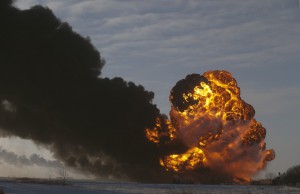
A year ago today, in the small hours of the morning, a parked oil train slipped its brakes, rolled downhill, and derailed in a small town in Quebec. When the tank cars breached, they caught fire and erupted into a towering fireball that leveled several blocks of town and incinerated 47 people almost instantly.

That horrific disaster ushered in a new era of fear about crude oil-by-rail shipments.

Two weeks earlier Sightline had published the first regional inventory anywhere of oil-by-rail projects. We pointed out that Oregon and Washington are home to nearly a dozen active or proposed oil train depots that in aggregate would move about as much crude as the Keystone XL Pipeline—and far more than the region’s oil refining capacity. We released the report widely, and the response we got back sounded a lot like crickets chirping.

But after the explosion in Quebec, our phones started ringing off the hook.

Meeting Logs: Obama White House Quietly Coddling Big Oil on “Bomb Trains” Regulations

By Justin Mikulka and Steve Horn - DeSmog Blog, June 15, 2014

Disclaimer: The views expressed here are not the official position of the IWW (or even the IWW’s EUC) and do not necessarily represent the views of anyone but the author’s.

When Richard Revesz, Dean Emeritus of New York University Law School, introduced Howard Shelanski at his only public appearance so far during his tenure as Administrator of the White House Office of Information and Regulatory Affairs (OIRA), Revesz described Shelanski as, “from our perspective, close to the most important official in the federal government.”

OIRA has recently reared its head in a big way because it is currently reviewing the newly-proposed oil-by-rail safety regulations rolled out by the Department of Transportation (DOT) and Pipeline and Hazardous Materials Safety Administration (PHMSA).   

During his presentation at NYU, Shelanski spoke at length about how OIRA must use “cost-benefit analysis” with regards to regulations, stating, “Cost-benefit analysis is an essential tool for regulatory policy.”

But during his confirmation hearings, Shelanski made sure to state his position on how cost-benefit analysis should be used in practice. Shelanski let corporate interests know he was well aware of their position on the cost of regulations and what they stood to lose from stringent regulations. 

“Regulatory objectives should be achieved at no higher cost than is absolutely necessary,” Shelanski said at the hearing.

With the “cost-benefit analysis” regarding environmental and safety issues for oil-by-rail in OIRA’s hands, it appears both the oil and rail industries will have their voices heard loudly and clearly by the White House. 

Casey Jones in #LacMegantic

Video and Song by J.P. Wright - Railroad Workers United, June 6, 2014

Disclaimer: The views expressed here are not the official position of the IWW (or even the IWW’s EUC) and do not necessarily represent the views of anyone but the author’s. J.P. Wright is a member of the IWW and Railroad Workers United.

Federal Pipeline and Oil-by-Rail Regulator Making 9% Staff Cut, Confounding Experts

Federal Pipeline and Oil-by-Rail Regulator Staff Cut, Confounds Experts - Job cuts come at a time when PHMSA is struggling to regulate the nation’s aging pipeline network and new pipelines tied to the oil and gas boom.

By Elizabeth Douglass - Inside Climate News, April 24, 2014

Disclaimer: The views expressed here are not the official position of the IWW (or even the IWW’s EUC) and do not necessarily represent the views of anyone but the author’s.

If employees accept all of the available buyouts, PHMSA will shrink to a full-time staff of 386, putting it 112 jobs short of its approved payroll for the current fiscal year.

The federal regulator for petroleum pipelines and oil-toting railcars is offering employee buyouts that could shrink the agency’s staff by 9 percent by mid-June—a step that has confounded observers because the agency is widely regarded as being chronically understaffed.

Pipeline and Hazardous Materials Safety Administration (PHMSA) spokesman Damon Hill said the buyout offers are meant to “help the agency manage attrition in areas where a large and growing number of employees are eligible for retirement by offering an inducement for a limited number of employees to voluntarily retire or resign.”

Hill said PHMSA is continuing to hire in key areas at the same time. “I understand how some folks may be looking at [the buyout effort], but it’s part of an overall plan to retain expertise and plan for retention and things like that,” he said. “There is some good that comes out of this.”

Still, the job cuts come at a time when PHMSA is already under considerable duress. Politicians and the public have been pushing the agency to more rigorously regulate the nation’s aging pipeline network as well as the many new pipelines tied to surging domestic oil and natural gas production. A spate of damaging pipeline spills and oil-by-rail accidents is adding to the workload, exposing PHMSA’s shortcomings and intensifying scrutiny of the agency.

Runaway Train: The Reckless Expansion of Crude-by-Rail in North America

By Lorne Stockman, et. al. - Oil Change International, May 2014

This report tracks the rise of crude-by-rail in North America, detailing where crude trains are being loaded and unloaded, how many trains carrying crude oil are crossing the North American continent, and who is involved in this burgeoning trade.

This reportis the first in a series covering North America’s booming crude-by-rail industry and is being published in conjunction with a unique interactive on line map of crude-by-rail terminals and potential routes.

Future reports in this series will look at the economics of crude-by-rail, safety, and climate change issues. Please see this site for the map and links to reports and data.

Read the report (English PDF).

Capital Blight - Oil Town Rebellion

By x344543 - March 22, 2014

Disclaimer: The views expressed here are not the official position of the IWW (or even the IWW’s EUC) and do not necessarily represent the views of anyone but the author’s.

For years, the communities of Western and Northwestern Contra Coast County and southwestern Solano County, located on the San Pablo and Suisun Bays, northwest of the San Francisco Bay have been dominated by the fossil fuel industry (and to some extent--until 1993--by the US Military Industrial Complex), and the capitalists running that industry have run each of these communities essentially like company towns.

Under these conditions, all official institutions, including elected city, county, and regional governments, most other businesses, and even the unions that supposedly "represent" the workers in these facilities are beholden to the dominant capitalist interests. Dissident residents or workers--if there are any--often find themselves isolated and alone if they can even find the courage to speak out at all. Complaints about working conditions, corrupt union officials, bought politicians, environmental racism, toxic pollution, and capital blight often fall on deaf ears and are usually dismissed as the product of "outside agitators", even "unwashed-out-of-town-jobless-hippies-on-drugs" or some such thing.

In this northwestern Bay Area region, there are four corporate refineries that dominate the towns of Avon and Pacheco (Tesoro), Benicia (Valero), Martinez (Shell), Richmond (Chevron), and Rodeo and Crockett (Conoco-Phillips), and--as one would expect--dissenters have indeed had a difficult, almost impossible time being heard.

Chevron in particular has run Richmond as a virtual company town as long as it has existed (indeed, the refinery predates the town's founding).  For years, the people of the nearby residential neighborhoods have complained of toxic pollution and political double standards that favor the corporation--allegations that are supported by mountains if evidence. Until recently, the local politicians were entirely loyal to the company.

The environmental struggles of these communities--mostly composed of African-Americans, Asian, Latino, and working class White people--have often been ignored by mainstream environmental NGOs. Locally based environmental groups, including the West County Toxics Coalition and Communities for a Better Environment (CBE), have had to do the vast majority of the work of bringing attention to the plight of their residents. On occasion, Greenpeace and Earth First! have given attention to them, but for the most part, it's been locals--most of whom are not typically activist oriented--who've borne the brunt of the struggles.

Many of these refineries are unionized--mostly by the United Steelworkers Union, with a minority of the workers instead belonging to IBEW Local 180. Naturally, the leadership of these unions has oriented themselves towards capitalist interests, who have on numerous occasions tripped over themselves to voluntarily speak on behalf of their capitalist masters.

For example, in 1999, after four refinery workers were killed in a fire, at the Tosco (now Tesoro) facility in nearby Avon, CBE spoke up on behalf of the deceased and called for stricter regulations of refineries (to protect both workers and the environment). Tosco, of course, opposed the proposed regulatory changes, instead calling for more watered down oversight which--CBE argued--left the foxes guarding the hen-house. Rather than support CBE, Jim Payne of the PACE union local that "represented" the workers at the time excoriated the environmentalists, declaring,

"It absolutely infuriates me that those damned tree-huggers would place this regulation in jeopardy,"

Certain residents of the nearby communities of Avon and Clyde were not especially welcoming of CBE either because--naturally--Tesoro used their substantial economic and political leverage to convince these people that CBE were "outside agitators", perhaps even "unwashed-out-of-town-jobless-hippies-on-drugs" (imagine that!).

This incident was very similar to the PCB spill in Georgia Pacific's lumber mill in Fort Bragg, California, that took place a decade earlier, in which the union leadership of IWA Local 3-469 (one Don Nelson) essentially took the company's side, leaving the rank and file workers to seek outside help from Earth First! and the IWW. Those efforts were led by Anna Marie Stenberg and (you guessed it), Judi Bari.

In spite of years of frustration and the corporations' seemingly iron rule, aided in large parts by their attempts to divide and conquer workers and environmentalists, the political winds in these northwestern Bay Area refinery towns appears to be shifting. Dissidents are gaining traction within their communities, no longer finding themselves isolated from their fellow residents. Workers employed by these industries are speaking out and even making alliances with environmentalists, the communities are finding that they can elect politicians willing to chart a course independent of the dominate corporate forces, and regulatory agencies—who usually provide official cover for the capitalists they’re ostensibly charged with regulating—are actually showing signs of actually demanding accountability from the powers that be.

Crying for Lec Megantic… and Learning the Lessons

By John Reimann - Oakland Socialist, February 26, 2014

Disclaimer: The views expressed here are not the official position of the IWW (or even the IWW’s EUC) and do not necessarily represent the views of anyone but the author’s.

On February 24, Marilaine Savard, from Lac Megantic Canada gave a presentation in Pittsburg, CA, on the train tanker car explosion that rocked that little town last July, killing 47 people (it would have been far more if it had been later in the morning) and destroying most of downtown. The explosion was of Bakken crude oil, the most explosive oil being pumped nowadays. The Obama administration has ordered “emergency safety rules” for transporting Bakken crude. Those rules are merely that the oil has to be pre-tested for explosiveness. That means absolutely nothing, and even if they did impose more rules, they will not be enforced, if simply by underfunding so there aren’t enough inspectors (a very common trick). From the well head to the refinery and all along the way, fracking is deadly. And that doesn’t even include how it adds to global climate disaster – global warming.

Here is a video of  Marlaine’s presentation:

This Bay Area Town is Taking on Big Oil’s Expansion Plans - And Winning

By Ethan Bucker, US Organizer - Forest Ethics, January 24, 2014

Disclaimer: The views expressed here are not the official position of the IWW (or even the IWW’s EUC) and do not necessarily represent the views of anyone but the author’s

Just over the golden hills of Martinez, the descent into Pittsburg on California's Highway 4 opens a view of the Carquinez Strait. The strait is a narrow segment of the tidal estuary that accepts the rushing waters of the Sacramento and San Joaquin rivers as they empty into the San Francisco Bay. The vista paints a portrait of the transition to a clean energy economy: on the northern side of the strait, enormous turbines of the Shiloh Wind Power Plant revolve gracefully. Along the southern waterfront, an aging former PG&E power plant casts a shadow over massive, decaying fuel tanks next to Pittsburg’s newly revitalized downtown.

This is the stage of the Bay Area’s latest and biggest energy battle, between residents of Pittsburg and energy infrastructure company WesPac.

WesPac Energy wants to transform the PG&E site into a mega crude-by-rail facility, marine oil terminal, and refurbished tank farm. With plans to handle 242,000 barrels per day, the terminal would process one-fifth of all crude coming through California. The facility would deliver Bakken crude and tar sands to all five of the Bay Area’s refineries via new and expanded pipelines. In simple terms, WesPac is looking to turn Pittsburg into the crude hub of Northern California.

WesPac had been developing its proposal with the Pittsburg planning department for two years, but it wasn’t until a sunny Sunday in August 2013 that anyone really knew about it.

On this particular Sunday, longtime Pittsburg resident Lyana Monterrey happened upon a tiny notice in the Contra Costa Times for a public hearing on an environmental impact report. Alarmed at the tremendous risks and dangers posed by the project, Lyana knocked on her neighbor Kalli Graham’s door to tell her about the story she had read. Kalli and Lyana immediately started going door-to-door to alert their neighbors of WesPac’s plans. Neither of them had participated in community organizing before. They attended the city hearing the following day, met a few other concerned residents, and decided to take action.

“I just could not sit still. I could not do nothing about this,” Lyana recalled.

What started as a few neighbors raising their voices quickly grew into a tidal wave of community-led activism that’s swept the town of Pittsburg into the regional and national spotlight. 2013 has been tainted by a half dozen oil train derailments and explosions, including a deadly disaster in Lac Megantic, Quebec that leveled a small town and killed 47 people. So, the prospect of “bombs-on-wheels” (as one community resident put it) rolling through Pittsburg on the daily has set the community ablaze with fierce opposition to WesPac.

Two diverse community led groups--the Pittsburg Defense Council and the Pittsburg Ethics Council--have emerged within the last six months to lead the campaign against the WesPac project, alongside ForestEthics and other NGO allies. Together, we’ve gathered over 4,000 petition signatures, organized a riveting Toxic Tour of the city’s heavy industrial sites, and conducted a bucket brigade air monitoring project that reveals striking levels of pollution in the community. We’ve flooded downtown Pittsburg with lawn signs, mobilized a January 11 march and rally that brought out over 300 residents, and organized a rally that packed Tuesday’s City Council meeting. Community leaders are meeting with city officials, training and empowering volunteers, and generating dozens of media hits. We’re gearing up to come out in full force as the Pittsburg Planning Commission and City Council vote on the project in coming months.

Pages

The Fine Print I:

Disclaimer: The views expressed on this site are not the official position of the IWW (or even the IWW’s EUC) unless otherwise indicated and do not necessarily represent the views of anyone but the author’s, nor should it be assumed that any of these authors automatically support the IWW or endorse any of its positions.

Further: the inclusion of a link on our site (other than the link to the main IWW site) does not imply endorsement by or an alliance with the IWW. These sites have been chosen by our members due to their perceived relevance to the IWW EUC and are included here for informational purposes only. If you have any suggestions or comments on any of the links included (or not included) above, please contact us.

The Fine Print II:

Fair Use Notice: The material on this site is provided for educational and informational purposes. It may contain copyrighted material the use of which has not always been specifically authorized by the copyright owner. It is being made available in an effort to advance the understanding of scientific, environmental, economic, social justice and human rights issues etc.

It is believed that this constitutes a 'fair use' of any such copyrighted material as provided for in section 107 of the US Copyright Law. In accordance with Title 17 U.S.C. Section 107, the material on this site is distributed without profit to those who have an interest in using the included information for research and educational purposes. If you wish to use copyrighted material from this site for purposes of your own that go beyond 'fair use', you must obtain permission from the copyright owner. The information on this site does not constitute legal or technical advice.